
It’s 9 PM on a Friday. Your restaurant is packed. Suddenly, an official-looking envelope arrives. You open it. It’s a notice from the Food Safety department: your FSSAI license expired two weeks ago, and you’re now operating illegally, racking up a ₹100 penalty for every single day.
Panic sets in. Could your business be shut down? What about the fines? This isn’t just a hypothetical nightmare; I’ve seen this exact scenario play out for countless unprepared food business owners (FBOs).
But it doesn’t have to be you. Your FSSAI license is the bedrock of your business’s credibility, and renewing it on time is non-negotiable. This isn’t just another bureaucratic chore. It’s your public promise of safety and quality.
In this in-depth guide, we’ll cut through the government jargon and give you a battle-tested playbook for a seamless food licence renewal in 2026. You’ll learn the exact steps, the common traps to avoid, and the insider strategies to keep your business safe, legal, and thriving.
Why Renewal is a Critical Business Function, Not Just Paperwork
Think of your FSSAI license not as a framed certificate on the wall, but as the very pulse of your food business. It’s the official seal that tells every customer, “We take your health seriously.” When that pulse stops, your business is on life support.
The renewal process, mandated by the Food Safety and Standards Act, 2006, is designed to ensure FBOs consistently uphold the standards they promised at registration. It’s a periodic check-in to prove you’re still committed to excellence. Neglecting it isn’t just lazy; it’s a massive financial and reputational risk.
Let’s be blunt about the consequences. The daily penalty is just the beginning.
| Consequence of Negligence | The Harsh Reality |
|---|---|
| Daily Late Fees | A penalty of ₹100 is charged for every day of delay past the expiry date. A 30-day delay costs you ₹3,000. |
| License Deactivation | If you don’t renew within 180 days post-expiry, your license is permanently deactivated. No more business. |
| Forced Re-application | After deactivation, you can’t just renew. You must apply for a brand-new license, a far more complex and time-consuming process. |
| Legal Action | Operating with an expired license is illegal. It can lead to severe legal penalties, including potential imprisonment in extreme cases. |
| Brand Damage | A compliance failure erodes customer trust instantly. In the age of social media, news of a shutdown spreads like wildfire. |
⚠️ Watch Out
The ₹100/day penalty sounds small, but it’s a ticking time bomb. We’ve seen businesses face penalties running into thousands of rupees simply because they forgot. This is an easily avoidable cost that eats directly into your profits.
Identify Your Weapon: Which FSSAI License Are You Renewing?
Before you log into any portal, you need to know exactly what you’re dealing with. The FSSAI framework is tiered, and your renewal process depends on the scale of your operation. Your license type dictates the fees, the complexity, and the specific documents you’ll need.
Here’s a quick breakdown:
- FSSAI Basic Registration (Form A): This is for the little guys. Think small-scale retailers, street food vendors, or any food business with an annual turnover of up to ₹12 lakh.
- FSSAI State Licence (Form B): This is for the mid-sized players. We’re talking restaurants, mid-sized manufacturers, and processors with an annual turnover between ₹12 lakh and ₹20 crore.
- FSSAI Central Licence (Form B): This is for the big leagues. Large manufacturers, importers, 100% export-oriented units, and operators in multiple states with a turnover exceeding ₹20 crore fall here. Most e-commerce food operators also need a Central Licence.
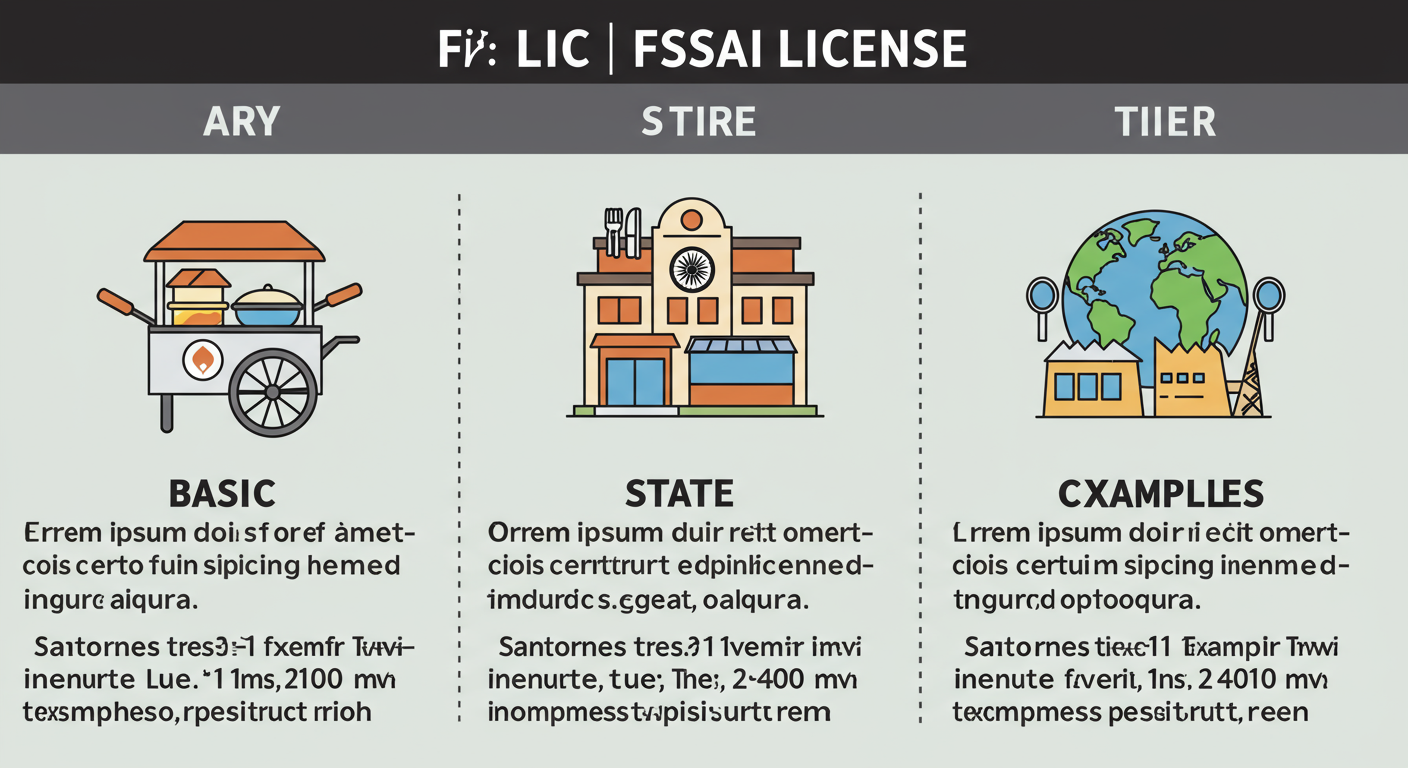
Knowing your category is step zero. It ensures you prepare the right documents and pay the correct fee from the get-go.
| License Type | Who It’s For | Annual Turnover | Typical Annual Fee (Approx.) |
|---|---|---|---|
| Basic Registration | Petty FBOs, Hawkers, Small Retailers | Up to ₹12 Lakh | ₹100 |
| State License | Mid-sized Restaurants, Manufacturers, Hotels | ₹12 Lakh to ₹20 Crore | ₹2,000 – ₹5,000 |
| Central License | Large Manufacturers, Importers, E-commerce | Above ₹20 Crore | ₹7,500 |
The 7-Step Renewal Playbook: Your Path to Flawless Compliance
The entire renewal process happens online through the FSSAI’s official FoSCoS (Food Safety Compliance System) portal. It’s a decent system, but you need to follow the steps precisely. Let’s walk through it.
Step 1: Start Early (No, Earlier Than That)
Procrastination is your worst enemy here. The FoSCoS portal opens the renewal window 180 days before your license expires. Do not wait.
You must submit your application at least 30 days before expiry to be safe. Based on our experience handling hundreds of renewals, the sweet spot is applying 60-90 days out. This gives you ample time to handle any unexpected queries from the food safety officer without the stress of a looming deadline.
💡 Pro Tip
Don’t rely on memory. The moment you get your license, set a recurring calendar reminder for 180 days, 90 days, and 45 days before the expiry date. Better yet, use a compliance management tool or a simple spreadsheet to track all your business licenses in one place.
Step 2: Assemble Your Document Arsenal
Having your documents ready before you even log in is half the battle. Scrambling for a rent agreement at the last minute is a recipe for disaster. While requirements can vary, here’s your core checklist:
- Photo of the FBO/Authorized Signatory (passport-size)
- Government-issued Photo ID (Aadhaar Card, Voter ID, etc.)
- Proof of business address (latest utility bill, rent agreement)
- A copy of the original FSSAI license certificate
- For State/Central Licenses: You may need more, like a blueprint of your processing unit, a list of food categories, water testing reports from a NABL-accredited lab, and a list of directors/partners.
Step 3: Log in to the FoSCoS Portal
Head directly to the official FSSAI portal: foscos.fssai.gov.in. Your username is your 14-digit license number. If you’ve forgotten your password, the ‘Forgot Password’ link is your friend. Use it.
⚠️ Watch Out
Beware of unofficial third-party websites that look like the FoSCoS portal. They often overcharge for services and, in worst-case scenarios, can misuse your sensitive business data. Always double-check that the URL is foscos.fssai.gov.in.
Step 4: Navigate to “Renewal” and Proceed
Once you’re logged in, your dashboard is your command center. You’ll see your active license details. Look for a prominent “Renewal” button or link. The system is smart; it will only allow you to proceed if you’re within the valid renewal window (from 180 days before expiry until the expiry date).
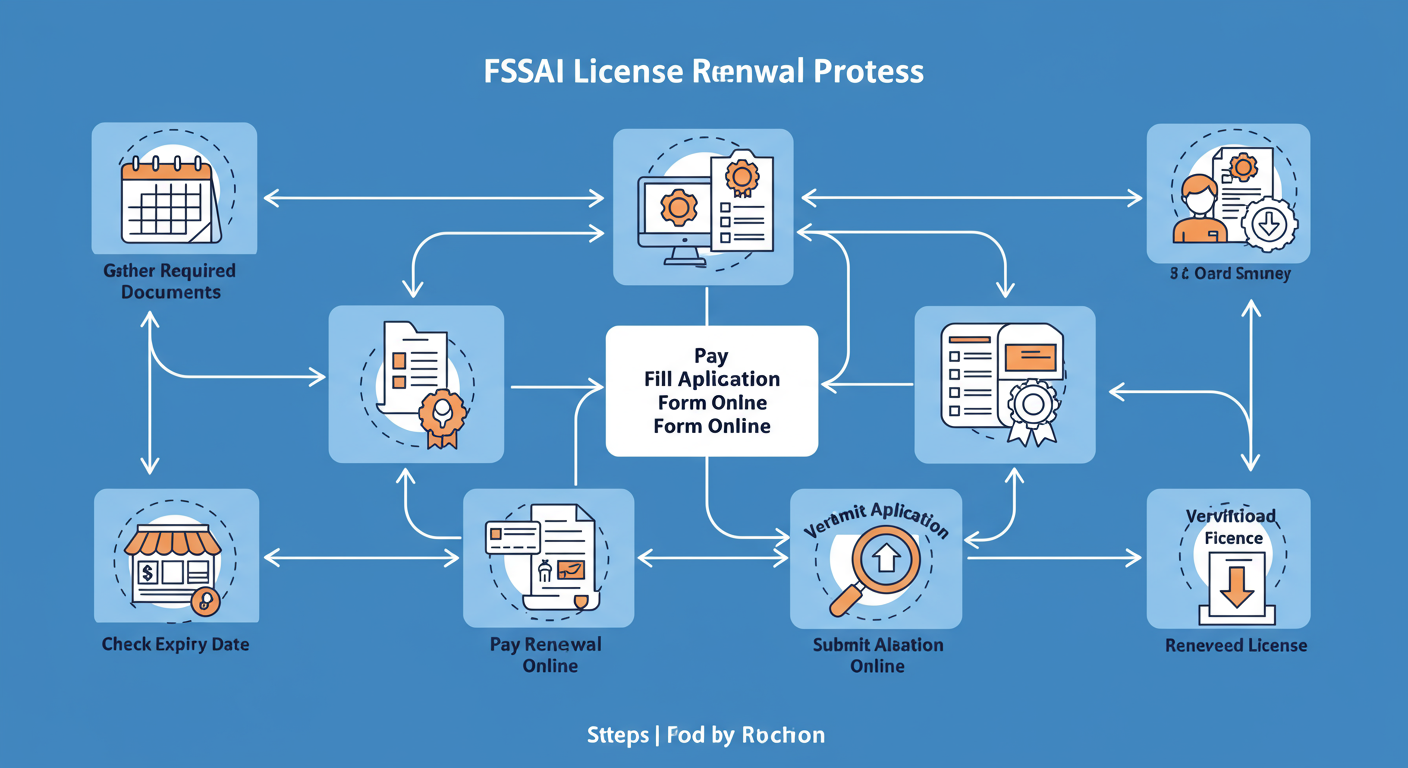
Step 5: Verify, Update, and Upload
You’ll be taken to Form A or Form B, which will be pre-filled with your existing data. Do not just click “Next.” This is a critical E-E-A-T checkpoint. Carefully review every single field. Mastering the GST Late Fee Calculation: Rules, Caps, and Compliance Strategies
- Has your address changed?
- Have you added or removed any food products?
- Is your contact information correct?
If anything has changed, you must update it. This ensures your renewed license accurately reflects your current operations. After verification, upload your scanned documents. Make sure they are clear and legible. Investment Options for NRI in India: Smart Choices
Step 6: Pay the Renewal Fee
The portal will automatically calculate the fee based on your license type and the validity period you select (you can choose from 1 to 5 years). Paying for a longer duration (e.g., 5 years) can save you the hassle of frequent renewals. The payment gateway accepts all standard options: credit/debit cards, net banking, and UPI. Upon successful payment, a receipt with a new 17-digit application reference number is generated. Save this number!
Step 7: Track and Respond
Submitting the application isn’t the final step. A designated Food Safety Officer will now scrutinize it. You can track the status on your FoSCoS dashboard using the reference number.
If the officer needs more information or finds an issue with a document, they will “revert” the application with a query. You’ll get a notification and have a limited time (usually 30 days) to respond. Ignoring this is a guaranteed rejection. Respond promptly and clearly.
Once everything is approved, your renewed license will be available for download in your dashboard. Print it, frame it, and celebrate your commitment to compliance.
💡 Pro Tip
When uploading documents, follow a clear naming convention (e.g., ‘Aadhaar_Card_2026.pdf’, ‘Rent_Agreement_2026.pdf’). Ensure files are in the specified format (usually PDF or JPG) and under the size limit (typically 2-3 MB). A clear, well-organized submission makes the officer’s job easier and speeds up your approval.
🎯 Key Takeaway
Food licence renewal isn’t a one-day task; it’s a process. Start at least 90 days before expiry, have all your documents digitized and ready, and actively track your application on the FoSCoS portal after submission. Proactive compliance is always cheaper and less stressful than reactive panic.
What If I Missed the Deadline? The Grace Period and the Point of No Return
So, you missed the expiry date. Don’t panic just yet, but you need to act fast. The FSSAI provides a grace period.
- The Grace Period (Day 1 to Day 180 Post-Expiry): You can still renew your license by logging into FoSCoS. However, you will be charged the late fee of ₹100 for every single day that has passed since the expiry date.
- The Point of No Return (Day 181 and beyond): If you fail to renew within 180 days after expiry, your license is marked as “Expired and Deactivated.” It’s gone. You cannot operate your business legally and must apply for a completely new FSSAI license from scratch.
Trust me on this one: paying the late fee is infinitely better than going through the entire new license application process again.
❓ Frequently Asked Questions
What is the validity of an FSSAI food licence?
You can choose a validity period from 1 to 5 years when you apply for or renew your license. The fee is calculated on a per-year basis, so a 5-year license will cost five times the annual fee, but it saves you the administrative work for half a decade.
How much does food licence renewal cost in 2026?
The cost depends entirely on your license type. A Basic Registration renewal is just ₹100 per year. A State License can range from ₹2,000 to ₹5,000 per year, and a Central License is a flat ₹7,500 per year. Remember to add the late fee of ₹100/day if you’re renewing after expiry.
Can I modify my license details during renewal?
Yes, and you absolutely should! The renewal process is the perfect time to update any changes to your business, such as a new address, added food categories, or changes in management. The FoSCoS portal has a specific “Modification” workflow that can often be combined with renewal.
What is FoSCoS?
FoSCoS, or the Food Safety Compliance System, is the single, unified online platform for all FSSAI licensing and registration in India. It replaced the older FLRS system and is the only official portal you should use for your food licence renewal.
Do I need a new license if I move my business?
It depends. If you move to a new address within the same city/jurisdiction, you typically only need to file for a “Modification of License” to update the address. However, if the move shifts you into a new license category (e.g., your new facility’s capacity requires a Central license instead of a State one), you will need to surrender the old license and apply for a new one. For more on food safety, the Wikipedia page on Food Safety provides excellent global context.
Your License to Thrive: A Final Word
Look, running a food business is tough. You’re juggling staff, inventory, marketing, and a dozen other things every day. It’s easy to let something like a license renewal slip through the cracks.
But as we’ve seen, this isn’t just paperwork. It’s a fundamental pillar of your business’s health and reputation. A timely food licence renewal is a powerful statement to your customers, your employees, and the regulators that you are a serious, responsible, and trustworthy operator.
Don’t wait for that dreaded notice to arrive. Use this guide, be proactive, and treat your FSSAI license with the respect it deserves. It’s not just a license to operate; it’s your license to thrive.
Your next step? Open your calendar right now and find your FSSAI license expiry date. Set a reminder for 90 days before that date. That single action will put you ahead of 90% of the businesses that get caught off guard.