Imagine building a skyscraper on a foundation you hope is solid, but you’ve never actually checked the concrete mix. That’s exactly what running a business without a competent auditor feels like. In the high-stakes financial environment of 2026, where digital transactions happen in milliseconds and regulatory scrutiny is tighter than ever, the duties of an auditor have evolved from simple bookkeeping checks to becoming the ultimate guardians of economic truth.
Here’s the reality: Stakeholders, investors, and tax authorities don’t just want numbers. They want trust. They need to know that the financial health portrayed on a spreadsheet matches the reality in the bank account.
Whether you are a business owner trying to survive a compliance review, a student aiming for the Big Four, or a CFO navigating the complex regulatory web of 2026, understanding these responsibilities is non-negotiable. In this deep dive, we’re going to strip away the jargon and look at what auditors actually do, how they protect the economy from fraud, and why their role is more critical today than it was a decade ago.
🎯 Key Takeaway
The modern duties of an auditor go beyond verifying math. In 2026, an auditor acts as a strategic watchdog, combining statutory compliance with ethical judgment to ensure financial statements present a “true and fair view,” protecting stakeholders from fraud, error, and mismanagement.
The Core Mandate: Verification, Validation, and Value
At its most basic level, auditing is about independent verification. But let’s be clear: an auditor isn’t just a glorified calculator. Their primary objective is to form an independent opinion on whether a company’s financial statements are accurate. This concept is known in the industry as the “True and Fair View.”
In our experience working with complex entities, we’ve seen that the duties of an auditor usually fall into three distinct buckets: checking the systems, verifying the assets, and reporting the truth.
1. Evaluating Internal Controls
Before an auditor looks at a single dollar amount, they look at the process. This is the “system check.” If a company’s internal software allows a junior employee to transfer $1 million without approval, it doesn’t matter if the books balance today—disaster is inevitable. Auditors must stress-test these internal controls. If the controls are weak, the auditor has to dig much deeper during the substantive testing phase.
2. Verification of Assets and Liabilities
It’s not enough to see “Inventory: $5 Million” on a balance sheet. The auditor has a duty to verify that this inventory actually exists. Is it sitting in a warehouse? Is it obsolete technology from 2020 that’s actually worthless? This involves physical verification and third-party confirmations (like asking the bank directly how much cash is in the account, rather than trusting the client’s printout).
Statutory vs. Ethical Duties: A Critical Comparison
The duties of an auditor aren’t just good business practice; they are often matters of law. However, a great auditor balances legal requirements (Statutory) with a moral compass (Ethical). In 2026, the line between these two is becoming increasingly intertwined.
Here is how these two categories stack up against each other:
| Feature | Statutory Duties (Legal) | Ethical Duties (Professional) |
|---|---|---|
| Source of Authority | Company Law (e.g., Companies Act, SOX) | Professional Bodies (e.g., AICPA, IFAC) |
| Flexibility | None. Mandatory by law. Cannot be waived by shareholders. | High. Requires professional judgment and “spirit of the law.” |
| Primary Focus | Accuracy, compliance, and reporting to the government/shareholders. | Integrity, objectivity, confidentiality, and independence. |
| Consequence of Breach | Legal penalties, fines, or imprisonment. | Loss of license, reputational damage, and disbarment. |
💡 Pro Tip
Don’t ignore the “Spirit” of the law. A transaction might be legally technically correct but ethically misleading (often called “window dressing”). Experienced auditors know that hiding behind technicalities is the fastest way to lose credibility and invite a regulatory investigation.
The Watchdog Role: Duties Regarding Fraud
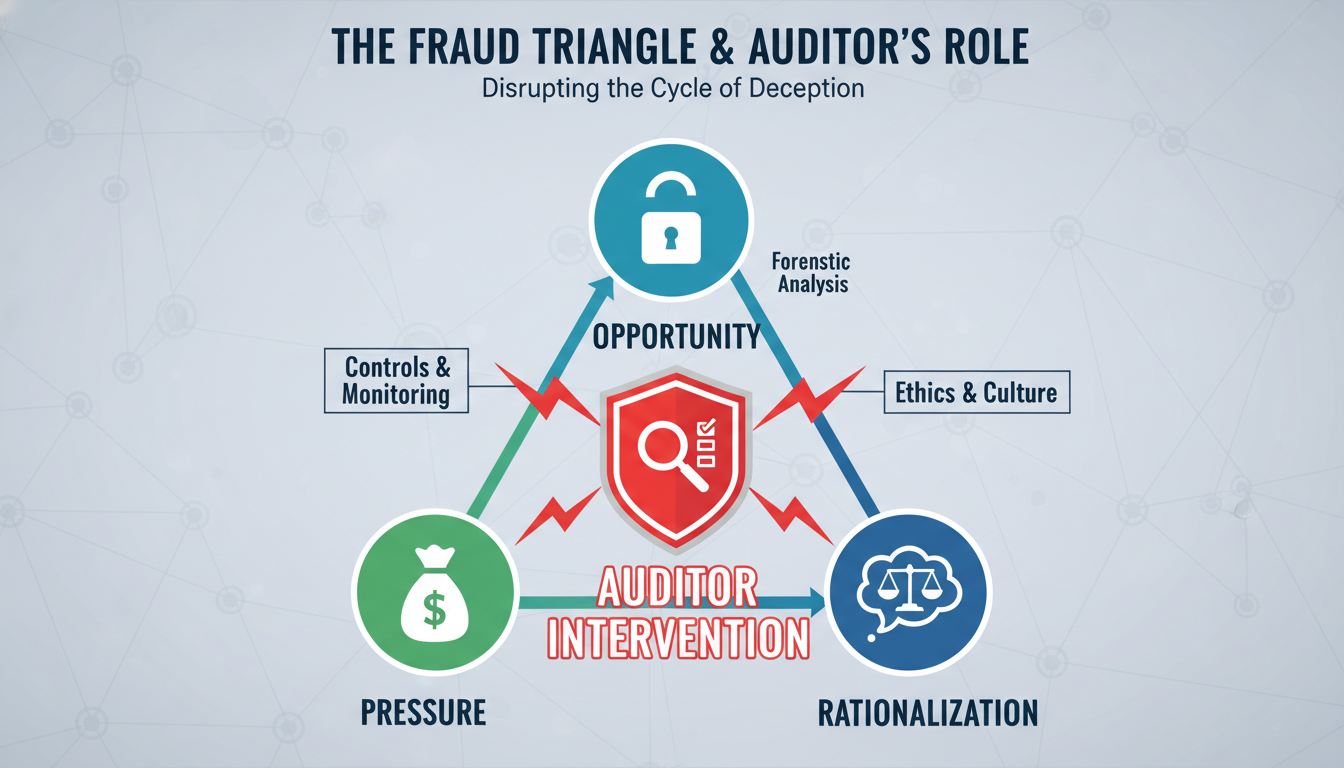
This is the controversial part. For decades, there was an “expectation gap.” The public believed auditors were fraud hunters, while auditors claimed they were just verifying statements. In 2026, that gap has closed significantly. While management is responsible for preventing fraud, the duties of an auditor now heavily emphasize detecting material misstatements caused by fraud.
Auditors must maintain Professional Skepticism. This means assuming that management could be lying, not that they are lying. It’s a “trust but verify” mindset on steroids.
The Red Flags Auditors Look For:
- Management Override: Executives forcing accounting entries outside the normal process.
- Revenue Recognition Issues: Booking sales before they actually happen to boost quarterly numbers.
- Complex Structures: Using shell companies to hide debt (think Enron or Wirecard scenarios).
If an auditor finds fraud, they have a legal duty to report it—sometimes directly to the central government or regulatory authorities, bypassing the company’s management entirely if the management is involved.
⚠️ Watch Out
The “Materiality” Trap. Auditors are not looking for a missing $50 petty cash receipt. They are looking for “material” errors—mistakes big enough to change a decision made by an investor. Business owners often waste time panicking over pennies while missing the massive compliance risks in their revenue recognition policies.
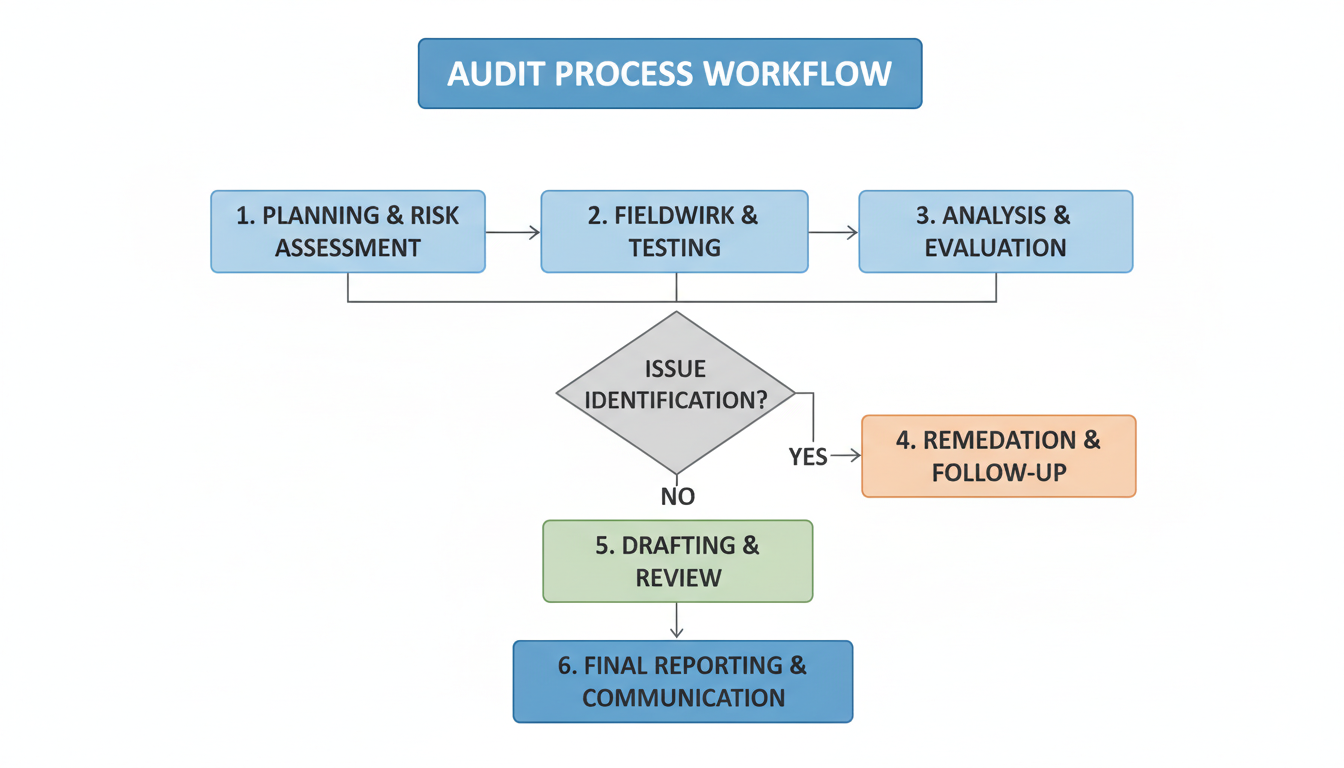
Step-by-Step: How an Audit Actually Happens
Understanding the workflow helps demystify the process. Whether you are the one auditing or the one being audited, this is the standard lifecycle of a financial audit in 2026.
- Appointment & Planning: The auditor is appointed, and they assess the scope. They look at the industry risks (e.g., a crypto firm has different risks than a bakery).
- Risk Assessment: The auditor identifies where things are most likely to go wrong. Is the IT system secure? Is the CFO under pressure to hit bonus targets?
- Internal Control Testing: The auditor tests the company’s own checks. If these work, the auditor does less “grunt work.” If they fail, the auditor must test almost everything manually.
- Substantive Testing: This is the heavy lifting. verifying bank balances, counting inventory, confirming debts with lawyers, and analyzing data trends using AI tools.
- Reporting: The final verdict. The auditor issues an opinion on the financial statements.
The Final Verdict: Reporting Duties
The culmination of weeks or months of work is the Audit Report. This is the only thing most investors ever read. The duties of an auditor require them to be crystal clear here. They cannot be vague.
There are four main types of opinions an auditor can issue. Understanding these is crucial for interpreting a company’s health. Police Verification in GST: Gujarat’s New Mechanism to Curb Fraud
| Opinion Type | What It Means | Investor Reaction |
|---|---|---|
| Unqualified (Clean) | The gold standard. The accounts are true and fair. | ✅ Trust and confidence. |
| Qualified | “Everything is fine, EXCEPT for this one specific issue.” | ⚠️ Caution. Questions will be asked. |
| Adverse | The statements are misleading and do not reflect reality. | 🚨 Panic. Stock usually crashes. |
| Disclaimer of Opinion | The auditor gave up. They couldn’t get enough evidence to form an opinion. | 🚩 Major Red Flag. Avoid investing. |
According to the U.S. Securities and Exchange Commission (SEC) and other global bodies, the clarity of this report is paramount for market stability.
The Modern Auditor: Technology and E-E-A-T
Let’s talk about the elephant in the room: Technology. In 2026, the duties of an auditor involve a heavy dose of data analytics. Auditors no longer sample 50 transactions out of 5,000. They use AI tools to scan 100% of the transactions to find anomalies.
However, technology doesn’t replace judgment. The “E-E-A-T” (Experience, Expertise, Authoritativeness, Trustworthiness) of the auditor is what interprets that data. A machine can spot a variance, but only a human expert can determine if it’s a simple error or a sophisticated fraud scheme.
💡 Pro Tip
Leverage Digital Trails. Modern auditors love digital paper trails. If you are a business owner, ensure your CRM, ERP, and accounting software are integrated. Disconnected systems are a nightmare for auditors and often lead to “Qualified” reports simply because data couldn’t be reconciled.

Specialized Duties: The Tax Audit
Beyond the general financial audit, there is the Tax Audit. This is a different beast entirely. Here, the auditor isn’t just looking for “fairness”; they are looking for strict compliance with tax codes.
The auditor must certify that:
- Taxable income is computed exactly according to the law.
- Deductions claimed (like depreciation or business expenses) are valid.
- The government is getting its due share.
Errors here don’t just mean bad PR; they mean financial penalties. For a deeper understanding of global standards on this, the International Federation of Accountants (IFAC) provides extensive guidelines on the intersection of audit and tax compliance.
⚠️ Watch Out
Personal vs. Business Expenses. One of the most common findings in tax audits is personal expenses disguised as business costs (e.g., family vacations booked as “business trips”). Auditors have a statutory duty to flag these. Don’t do it. It’s the easiest way to trigger a deeper investigation.
Conclusion
The duties of an auditor are the invisible scaffolding that holds up the global economy. From the rigorous testing of internal controls to the ethical obligation of reporting fraud, auditors provide the assurance that allows strangers to do business with each other.
As we move further into 2026, the role is becoming more dynamic. It’s less about ticking boxes and more about analyzing data ecosystems. For business owners, viewing the auditor as a partner in compliance rather than a necessary evil is the key to sustainable growth. For aspiring auditors, the path is challenging, but the responsibility is immense.
Ensure your financial house is in order. If you are looking for specific regulations regarding corporate governance, resources like Investopedia’s breakdown of auditing roles or your local government’s corporate affairs ministry are excellent places to start your research.
❓ Frequently Asked Questions
What are the primary duties of an auditor in 2026?
The primary duties are to examine financial statements for accuracy, evaluate internal controls, verify the existence of assets, and issue an independent report stating whether the accounts present a “true and fair view” of the company’s financial health.
Is an auditor responsible for finding 100% of fraud?
No. An auditor is not an insurer against fraud. Their duty is to provide “reasonable assurance” that the statements are free from material misstatement. However, if they find evidence of fraud, they are legally obligated to report it.
Can a company restrict the duties of an auditor?
Absolutely not. Statutory duties are defined by law (such as the Companies Act or Sarbanes-Oxley). Neither the Board of Directors nor the shareholders can restrict the auditor’s scope or access to information required to perform these legal duties.
What happens if an auditor neglects their duties?
Auditors face severe consequences for negligence, including legal liability for financial losses, fines, criminal charges, and the revocation of their license to practice by professional bodies.
What is the difference between an internal and external auditor?
Internal auditors are employees who focus on improving operations and risk management for the management team. External auditors are independent third parties who focus on the accuracy of financial statements for shareholders and the public.