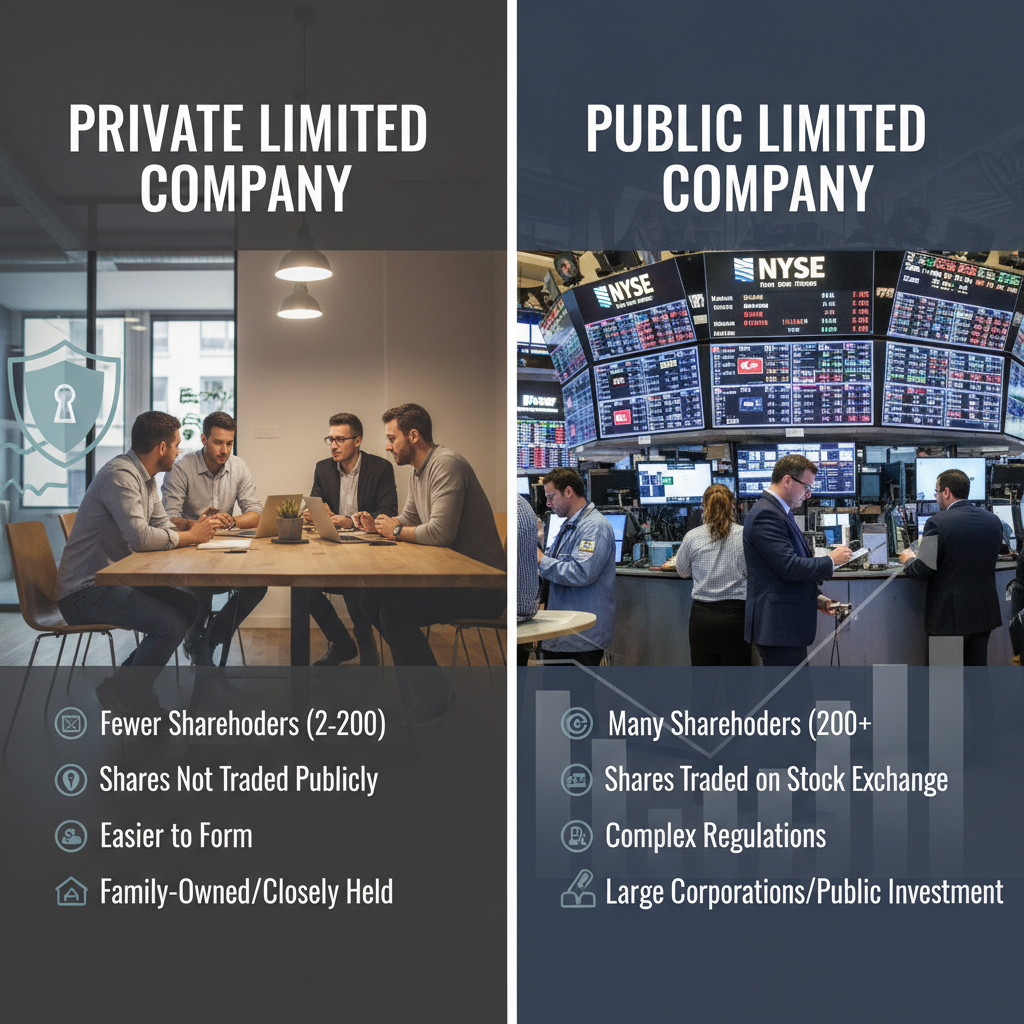
Imagine two founders, both with brilliant ideas. Founder A wants to build a legacy business, keeping control within the family for generations. Founder B dreams of ringing the bell at the stock exchange, scaling globally with massive public investment. Both can succeed, but they need fundamentally different vehicles to get there.
That vehicle is their company structure. And for most ambitious entrepreneurs, the road forks at one critical junction: Private Limited or Public Limited?
Choosing the wrong path isn’t just a paperwork headache; it can cripple your ability to raise funds, suffocate you with compliance, or force you to give up control prematurely. It’s one of the most pivotal decisions you’ll ever make. This isn’t just another dry legal comparison. By the end of this article, you’ll have the strategic clarity to confidently choose the right corporate structure for your specific vision, armed with insider knowledge that goes far beyond a textbook definition.
Pvt Ltd vs. Public Ltd: The 30,000-Foot View
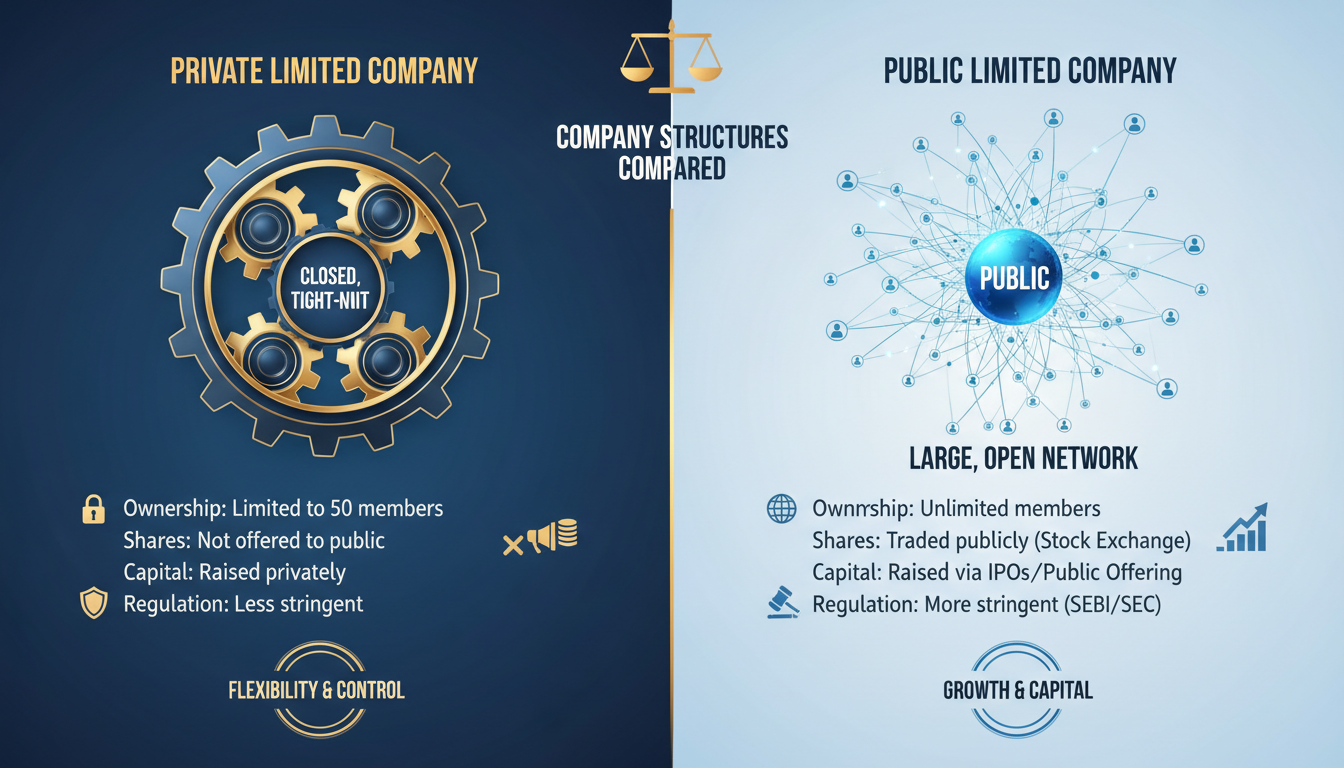
Before we dive deep, let’s get straight to the point. The core difference between a private limited company and a public limited company boils down to a single trade-off: Control vs. Capital.
- A Private Limited Company (Pvt. Ltd.) is designed for control. It’s a closely-held entity where a small group of people (the “members”) own the shares. Think of it as a private club. You can’t just buy your way in; you have to be invited.
- A Public Limited Company (Ltd.) is built for capital. It can offer its shares to the general public, raising vast sums of money from anyone with a brokerage account. It’s an open stadium where shares are traded freely.
This single distinction creates a domino effect, impacting everything from your company name to your daily operations. Here’s a quick snapshot of the most critical differences.
| Parameter | Private Limited Company (Pvt. Ltd.) | Public Limited Company (Ltd.) |
|---|---|---|
| Primary Goal | Maintain control, privacy, and operational simplicity. | Access large-scale public capital for massive growth. |
| Who Can Own Shares? | A select group of private individuals (founders, family, VCs). | Anyone from the general public. |
| Number of Owners | Minimum 2, Maximum 200. | Minimum 7, No maximum limit. |
| Raising Money | Privately from founders, angel investors, venture capitalists. | Publicly through an Initial Public Offering (IPO) and stock markets. |
| Compliance Burden | Moderate. Fewer mandatory meetings and disclosures. | Extremely High. Strict regulations from SEBI and MCA. |
| Name Suffix | Must end with “Private Limited”. | Must end with “Limited”. |
The Anatomy of a Private Limited Company (Pvt. Ltd.)
A Private Limited Company is the default choice for over 90% of startups and small-to-medium enterprises (SMEs) in India, and for good reason. It offers the holy trinity for new ventures: limited liability, a separate legal identity, and manageable compliance.
Think of it as a protective shield. If the business incurs debt or faces legal trouble, your personal assets—your house, your car, your savings—are safe. Your liability is “limited” to the value of the shares you hold. This protection is a massive step up from a sole proprietorship or partnership.
The defining feature, however, is the restriction on share transfers. You can’t just sell your shares on a whim. The company’s Articles of Association (AoA) typically give existing shareholders the “right of first refusal,” meaning you have to offer your shares to them before seeking an outside buyer. This keeps ownership tight and prevents hostile takeovers. It’s all about control.
💡 Pro Tip
When structuring your Pvt. Ltd., think ahead. Even if you’re just two co-founders, build your Shareholders’ Agreement to clearly define share vesting schedules and the process for a founder leaving. From real-world campaigns, we’ve seen this single document prevent countless legal battles down the road.
Entering the Big Leagues: The Public Limited Company (Ltd.)
A Public Limited Company is a different beast entirely. This is the structure for businesses that have achieved significant scale and need massive injections of capital to fuel the next stage of hyper-growth, global expansion, or major acquisitions.
When a company “goes public” through an IPO, it’s essentially selling a piece of itself to the world. This unlocks access to a nearly limitless pool of capital. But this access comes at a steep price: transparency and scrutiny.
Suddenly, your company’s financials are public knowledge, published every quarter for all to see—including your competitors. You’re answerable not just to your co-founders, but to thousands of anonymous shareholders. You must comply with rigorous corporate governance norms, appoint independent directors to your board, and navigate the complex web of regulations from bodies like the Securities and Exchange Board of India (SEBI).
Going public is not a destination; it’s a transition. It’s a fundamental shift from running your company to stewarding a public institution.
Compliance & Governance: Where the Paths Truly Diverge
If you ask any CFO, the most significant day-to-day difference between a private limited company and a public limited company is the compliance burden. It’s not just more paperwork; it’s a different operating philosophy.
A private company can be nimble. Decisions can be made quickly by a small group. A public company, by design, is more deliberate. Its governance structures are built to protect public investors, which inherently adds layers of process and oversight.
Let’s break down the practical differences in compliance.
| Compliance Requirement | Private Limited Company | Public Limited Company |
|---|---|---|
| Board of Directors | Minimum 2 directors. | Minimum 3 directors (often requires independent directors). |
| Statutory Meeting | Not required. | Mandatory after incorporation. |
| Quorum for Meetings | Simple: 2 members present. | Complex: Based on total number of members (e.g., 5 for up to 1000). |
| Financial Reporting | Annual filings with the Registrar of Companies (ROC). | Quarterly and annual audited reports filed with ROC and Stock Exchanges. |
| Public Disclosures | Minimal. Financials are not public. | Extensive. All material information must be disclosed to the public. |
| Regulatory Body | Primarily Ministry of Corporate Affairs (MCA). | MCA + SEBI + Stock Exchanges. A much tougher crowd. |
⚠️ Watch Out
The cost of compliance for a listed public company can be astronomical. We’re talking legal fees, auditing fees, investor relations teams, and listing fees that can easily run into millions annually. This is a financial commitment that can crush a business not ready for it. Key Feature of Budget F.Y. 2023-2024
🎯 Key Takeaway
The choice is a strategic trade-off. A Private Limited Company offers you agility and control at the cost of limited capital access. A Public Limited Company gives you unparalleled access to capital but demands absolute transparency and a heavy compliance burden. Form 26QB Guide: TDS on Sale of Property (Section 194IA)
How to Choose: A Strategic Framework for 2026
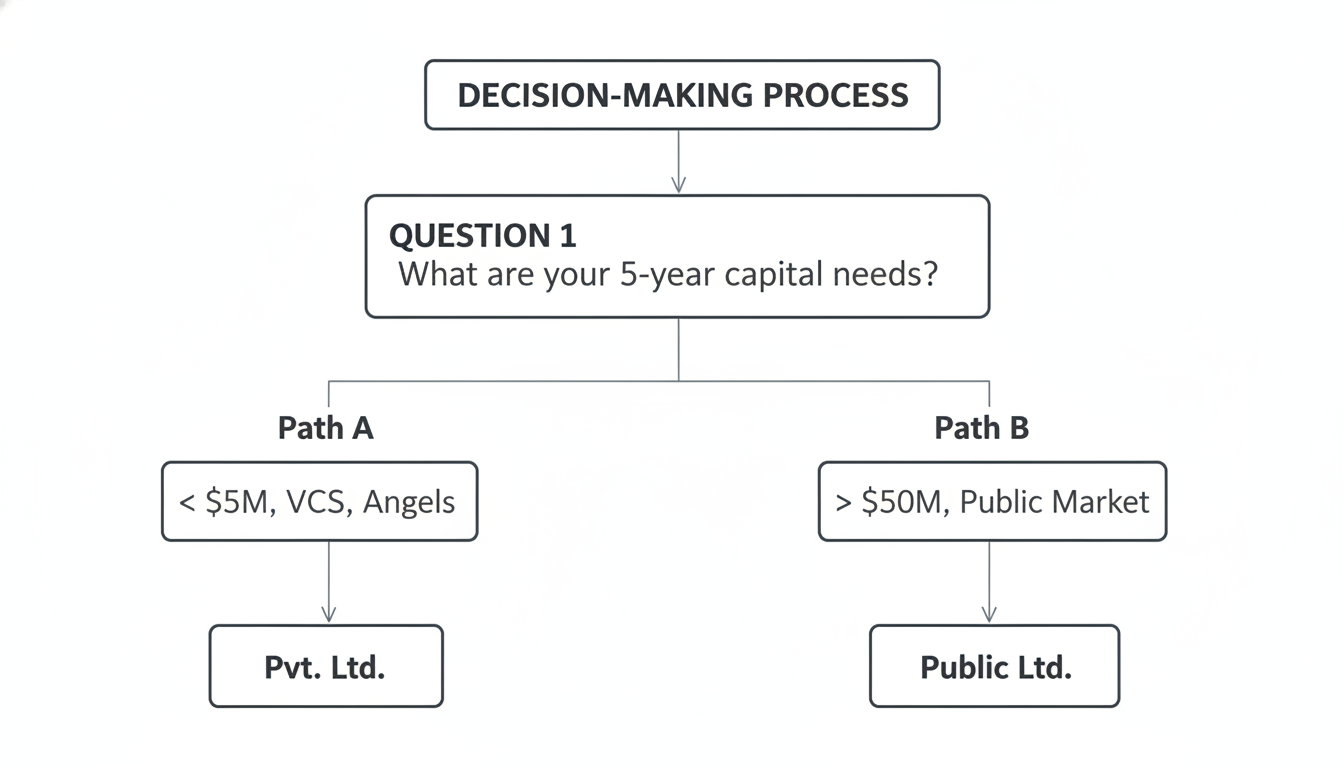
So, how do you make the right call? Forget the legal jargon for a moment and answer these four strategic questions. Your answers will point you to the right structure.
-
What is your long-term funding strategy?
Be honest. Do you need a few million dollars from VCs to get to the next level, or do you need hundreds of millions for global domination? If your path involves venture capital, a Pvt. Ltd. is perfect. If your vision requires the kind of capital only the public markets can provide, you’ll eventually need to become a Public Ltd. company.
-
How much control are you willing to give up?
As a private company, you and your co-founders call the shots. As a public company, you have a board with independent directors and are accountable to thousands of shareholders who can vote on major decisions. If maintaining ultimate control is non-negotiable, stay private.
-
Can you handle radical transparency?
Are you comfortable with your revenue, profit margins, and executive salaries being public information? Public companies live in a glass house. If privacy and confidentiality are critical to your competitive advantage, a public structure could be a strategic liability.
-
What’s your exit strategy?
An IPO is a popular exit strategy, providing liquidity for early investors and employees. But it’s not the only one. You can also be acquired by a larger company or execute a management buyout, both of which are perfectly achievable as a Pvt. Ltd. company. Your desired exit will heavily influence this decision.
⚠️ Watch Out
A common mistake we see is premature conversion. Founders get excited by the idea of an IPO and convert to a Public Ltd. company too early. They end up burdened by the high compliance costs without the immediate benefit of public capital, starving the business of resources when it needs them most.
Conclusion: It’s Your Vision, Your Structure
Look, there’s no universally “better” option. The difference between a private limited company and a public limited company isn’t about good vs. bad; it’s about fit. The right structure is the one that aligns with your unique vision for funding, growth, control, and legacy.
For the vast majority of entrepreneurs starting out in 2026, the Private Limited Company is the undisputed champion. It provides the ideal launchpad: protection, credibility, and the flexibility to raise capital without drowning in red tape. You can always convert to a public company later when you’ve achieved the scale to justify the cost and complexity.
Your next step? Don’t just rush to file paperwork. Sit down with your team and use the four-question framework above. Map out your five-year plan. A thoughtful hour spent on strategy today will save you years of headaches and position your company for true, sustainable success.
❓ Frequently Asked Questions
Can a private limited company convert into a public limited company?
Absolutely. It’s a common path for successful, growing companies. The process involves altering your company’s core documents (the MoA and AoA), passing a special resolution, ensuring you meet the minimums for a public company (7 members, 3 directors), and getting the green light from the Registrar of Companies (ROC).
What does ‘limited liability’ really mean for me as a founder?
It’s your financial safety net. It means that if the business fails or racks up debt, creditors can only go after the company’s assets, not your personal property. Your personal financial risk is limited to the capital you’ve invested in your shares. According to the Companies Act, 2013, this is a core benefit of incorporation.
Which structure is better for a startup seeking venture capital?
Hands down, a Private Limited Company. VCs are structured to invest in private entities. It provides the clean, formal structure they require without the massive overhead of a public company. In our experience, virtually no early-stage startup is a public company.
Is it easier for one type of company to get a bank loan?
Not necessarily. Banks look at the health of the business—cash flow, profitability, and assets—not just the corporate structure. A profitable Pvt. Ltd. with a solid track record will find it much easier to get a loan than a struggling Public Ltd. company. Credibility comes from performance, not just the suffix on your company name.
Are there any tax differences between the two?
In India, the corporate income tax rates are generally the same for both domestic private and public limited companies. However, tax implications can get more complex for public companies around things like dividend distribution and securities transaction tax (STT) once listed. For more detailed information, consulting a tax professional or reviewing resources from an institution like the Institute of Chartered Accountants of India (ICAI) is always recommended.