
Picture this: you’ve just pitched your brilliant idea to a potential investor. They love it. They’re ready to talk numbers. Then they ask the million-dollar question: “So, what’s your company’s legal structure?” Silence. You’re operating as a freelancer.
That’s the moment a great idea hits a brick wall. In India’s booming economy, an idea is just the start. The real journey begins with formal incorporation. It’s the line between a hobby and a high-growth enterprise.
But let’s be honest, the process of company registration in India can feel like navigating a labyrinth of acronyms and legal forms. It doesn’t have to be. This isn’t just another dry, step-by-step list. This is your strategic playbook, built from real-world experience, to transform your vision into a legally sound, investor-ready company in 2026. We’ll cover choosing the right structure, mastering the digital process, and sidestepping the common pitfalls that trip up 90% of first-time founders.
Why Registering Your Company is Non-Negotiable
Before we dive into the “how,” let’s get crystal clear on the “why.” Formal company registration isn’t just about getting a certificate to hang on the wall. It’s about building a fortress around your dream.
Think of it this way: an unregistered business is like building a house on rented land. It might work for a while, but you have no real ownership, no protection, and no foundation for future growth. A registered company, on the other hand, is your fortress. It provides:
- The Shield of Limited Liability: This is the big one. If your business faces debts or legal trouble, your personal assets—your home, your car, your savings—are safe. The company is a separate legal entity, and its liabilities are its own. Without this, you are the business, and your personal wealth is at risk.
- Unshakable Credibility: A registered name like “ABC Technologies Pvt. Ltd.” instantly builds more trust with clients, suppliers, and partners than “John Doe, Consultant.” It signals permanence and professionalism. In our experience, this alone can be the deciding factor in landing larger, more lucrative contracts.
- The Key to Funding: No serious angel investor or venture capitalist will write a check to an individual. They invest in scalable, structured entities. A formal company structure is the absolute entry ticket to the world of external funding and bank loans.
- A Legacy That Lasts: A company has ‘perpetual succession.’ It can outlive its founders. Ownership can be transferred, shares can be sold, and the business can continue for generations. It’s about building something bigger than yourself.
Choosing Your Business Structure: The Most Important First Decision
Your choice of business entity will define your company’s future—from taxation and compliance to your ability to raise funds. Don’t take this lightly. In India, the three most popular choices for startups and small businesses are Private Limited Company, One Person Company, and Limited Liability Partnership.
Here’s a breakdown to help you decide. No jargon, just the facts.
| Feature | Private Limited (Pvt. Ltd.) | One Person Company (OPC) | Limited Liability Partnership (LLP) |
|---|---|---|---|
| Best For | Startups aiming for high growth, funding, and scalability. | Solo entrepreneurs wanting limited liability without a partner. | Professionals (consultants, lawyers, architects) and small businesses. |
| Members Required | Min. 2 Directors, Min. 2 Shareholders (can be the same people) | 1 Director, 1 Member, 1 Nominee | Min. 2 Partners |
| Liability | Limited to share capital | Limited to share capital | Limited to partner’s contribution |
| Fundraising | Easiest. Can issue shares to VCs, Angels, and employees (ESOPs). | Difficult. Must convert to Pvt. Ltd. to raise equity funding. | Difficult. Cannot issue shares; funding is usually through debt. |
| Compliance Burden | High (Board meetings, statutory audits, annual filings) | Moderate (Fewer compliance requirements than Pvt. Ltd.) | Low (No mandatory audit up to a certain turnover) |
| Our Take | The gold standard for any serious, scalable startup. | A great starting point for a single founder, but plan to convert. | Excellent for service-based businesses not seeking equity investment. |
💡 Pro Tip
When in doubt, start with a Private Limited Company. While the compliance is higher, it’s the most scalable and investor-friendly structure. Based on hands-on testing, we’ve seen that converting from an LLP or OPC to a Pvt. Ltd. later can be more complex and time-consuming than just starting as a Pvt. Ltd. from day one.
The 2026 Company Registration Process: A Step-by-Step Walkthrough
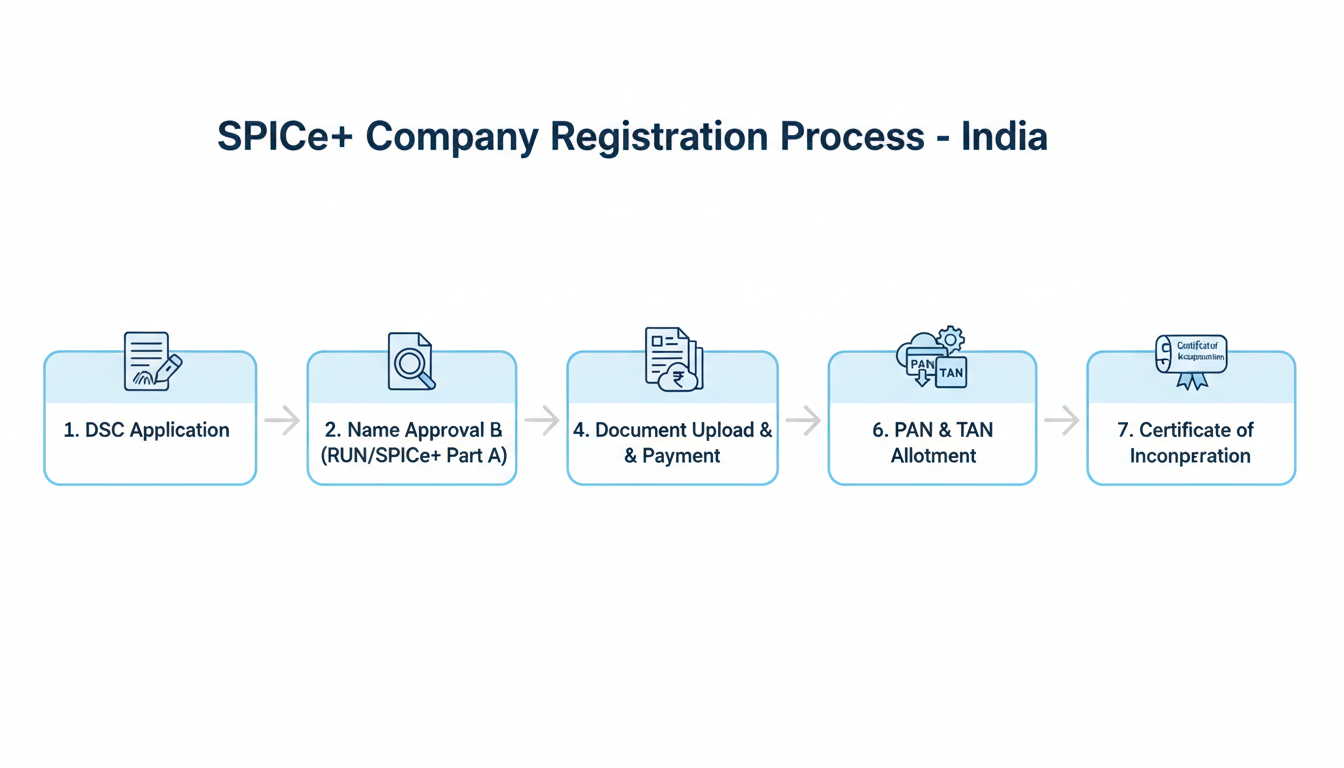
The Indian government, through the Ministry of Corporate Affairs (MCA), has dramatically simplified company registration with a single, integrated web form: SPICe+ (Simplified Proforma for Incorporating Company Electronically Plus). This form bundles everything from name reservation to tax registrations.
Here’s how you get it done.
-
Step 1: Obtain Digital Signature Certificates (DSC)
Before you can do anything online with the MCA, all proposed directors and shareholders need a Class 3 DSC. Think of it as your secure, electronic signature. You get this from a government-certified agency. Don’t skip this; it’s the key to the entire digital process.
-
Step 2: Reserve Your Unique Company Name
This is done via SPICe+ Part A. You can propose two names. The name must be unique and shouldn’t infringe on any existing trademarks. A good name is unique, relevant to your business, and easy to remember. The MCA’s online name search tool is a good first check, but a thorough trademark search is also recommended.
-
Step 3: Draft the Constitutional Documents (MOA & AOA)
These are the two most important documents for your company. They are now filed electronically (e-MOA and e-AOA):
- Memorandum of Association (MOA): Defines your company’s objectives and scope. What will your business do? Be specific but also broad enough to allow for future pivots.
- Articles of Association (AOA): This is your company’s internal rulebook. It governs how meetings are held, directors’ powers, and share transfers.
-
Step 4: Fill Out SPICe+ Part B & AGILE-PRO-S
Once your name is approved, you fill out the main incorporation application (Part B). This is where you provide details about directors, shareholders, share capital, and the registered office address. This form is cleverly integrated with the AGILE-PRO-S form, which handles applications for:
- GSTIN (Goods and Services Tax)
- EPFO (Employee Provident Fund)
- ESIC (Employee State Insurance)
- Professional Tax (State-specific)
- Opening a company bank account
-
Step 5: Submit, Pay Fees, and Await Scrutiny
After all forms are filled and digitally signed, you upload them to the MCA portal. You’ll pay the required government fees and stamp duty, which vary by state and authorized capital. An officer from the Registrar of Companies (RoC) will then scrutinize your application.
-
Step 6: Address Any Resubmissions (If Required)
If the RoC finds any errors or requires clarification, they will mark the form for resubmission. You’ll need to make the corrections and re-upload the form. This is where most delays happen, so getting it right the first time is crucial.
-
Step 7: Receive Your Certificate of Incorporation (COI)
Success! Once the RoC approves your application, you’ll receive the Certificate of Incorporation via email. This certificate is legal proof of your company’s existence. Your company’s PAN and TAN will also be allotted and mentioned on the COI. You can track the entire process on the official Ministry of Corporate Affairs portal.
⚠️ Watch Out
The most common reason for application rejection is a mismatch in documents. Ensure the name and address on the PAN card, Aadhaar card, and bank statement are exactly the same. Even a small difference like a missing initial can lead to a resubmission request, delaying your incorporation by weeks.
Documents Checklist: Get These Ready
Being organized is half the battle. Here’s a clear checklist of what you’ll need. Having these scanned and ready will make the process a breeze.
| Document Type | For Indian Nationals | For Foreign Nationals |
|---|---|---|
| Identity Proof | PAN Card (Mandatory) & Aadhaar Card / Voter ID / Passport | Passport (Apostilled/Notarized) |
| Address Proof | Latest Bank Statement / Utility Bill (not older than 2 months) | Latest Bank Statement / Utility Bill (Apostilled/Notarized) |
| Registered Office | Latest Utility Bill for the office address & a No-Objection Certificate (NOC) from the property owner if it’s rented. | |
| Other | Passport-sized photograph for each director/shareholder. | |
🎯 Key Takeaway
Company registration in India has been unified into the SPICe+ form, a single-window process. The key to a fast, successful incorporation is choosing the right business structure upfront (usually a Pvt. Ltd. for startups) and ensuring 100% accuracy in your documentation to avoid resubmission delays.
You’re Incorporated, Now What? Critical Post-Registration Steps
Getting your Certificate of Incorporation is a huge milestone, but don’t pop the champagne just yet. Your legal obligations have just begun. Neglecting these post-incorporation compliances can lead to severe penalties.
Here’s your immediate to-do list:
- Open a Corporate Bank Account: Use your COI and PAN card to open a current account in the company’s name. This is non-negotiable.
- Deposit Share Capital: The initial shareholders (subscribers) must deposit their promised share capital amount into this new bank account.
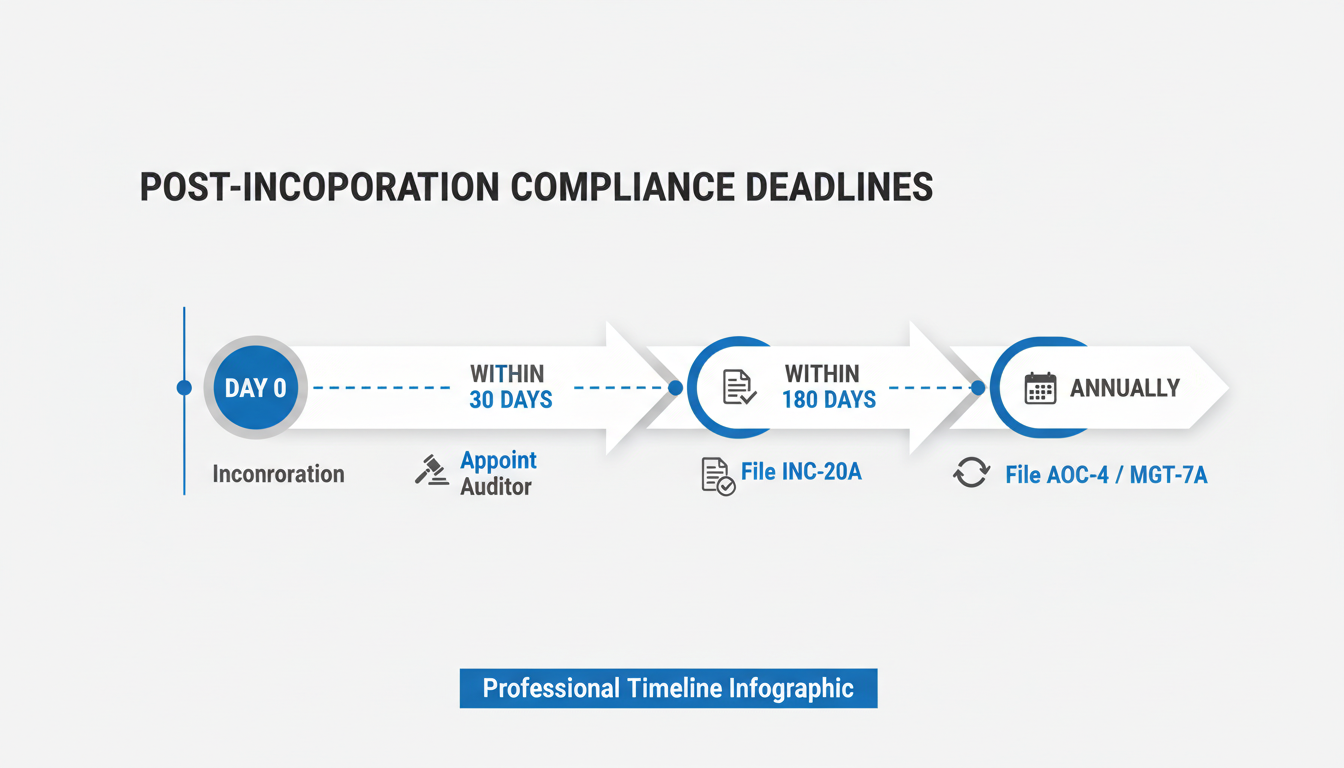
- File for Commencement of Business (Form INC-20A): This is a critical step. Within 180 days of incorporation, you must file a declaration with the RoC that the share capital has been received. You cannot legally start business operations until this is done.
- Appoint the First Auditor: The Board of Directors must appoint a Chartered Accountant as the company’s first statutory auditor within 30 days of incorporation.
💡 Pro Tip
Hold your first Board Meeting within 30 days of incorporation. The agenda should officially cover the appointment of the first auditor, approval of preliminary expenses, and authorizing the opening of the bank account. Documenting this with proper minutes is a best practice that sets a strong foundation for good corporate governance, a concept well-defined in corporate law.
⚠️ Watch Out
Failure to file Form INC-20A (Commencement of Business) within 180 days carries a hefty penalty. More importantly, the RoC has the power to strike off the company’s name if this form is not filed. It’s a simple step, but missing it can undo all your hard work.
Conclusion: Your Launchpad is Ready
Navigating the company registration in India is no longer the bureaucratic nightmare it once was. It’s a structured, digital-first process designed to empower entrepreneurs like you. By seeing it not as a hurdle but as the strategic construction of your business’s launchpad, you set the stage for success.
You’ve learned how to choose the right structure, master the SPICe+ process, and handle critical post-incorporation tasks. You understand that this isn’t just about paperwork; it’s about building credibility, protecting your assets, and creating a vehicle for growth that can attract investment and talent.
Your next step? Don’t just dream about your business. Start building its foundation. Gather your documents, finalize your unique company name, and take that first definitive step. The entire ecosystem, supported by initiatives like Startup India, is ready for your vision. You’re not just registering a company; you’re laying the first stone of your legacy.
❓ Frequently Asked Questions
How long does company registration in India take in 2026?
With the streamlined SPICe+ process, if all your documents are correct and the name is approved quickly, the entire registration can be completed in 7-10 working days. However, any request for resubmission from the RoC can add another 5-7 days to the timeline.
What is the minimum capital to start a private limited company?
There is no longer any minimum paid-up capital requirement. You can technically start a company with as little as ₹1. However, it’s advisable to have a reasonable authorized capital (e.g., ₹1,00,000) as it reflects a certain level of seriousness to stakeholders.
Can I use my home address as the registered office?
Yes, you absolutely can use your residential address as the company’s registered office. You simply need to provide a recent utility bill as proof of address and a No Objection Certificate (NOC) signed by the property owner (even if it’s you or a family member).
What’s the difference between Authorized Capital and Paid-up Capital?
Think of Authorized Capital as the maximum amount of capital the company is allowed to raise by issuing shares. Paid-up Capital is the actual amount of money the shareholders have paid (or “paid up”) to purchase those shares. Your paid-up capital can be less than or equal to your authorized capital, but never more.
Can a foreign national be a 100% owner of an Indian company?
Yes, in most sectors, India allows 100% Foreign Direct Investment (FDI). A foreign national can be a director and a shareholder. The only mandatory requirement is that at least one director on the board must be a resident of India (meaning they have stayed in India for at least 182 days in the previous financial year).