Investing is a journey, and profit is the destination. However, the bridge between your investment and your realized profit is often guarded by taxation. If you have sold a property, stocks, or mutual funds recently, understanding capital gains tax India is not just optional—it is mandatory to avoid penalties and optimize your returns. With the significant changes introduced in the Union Budget 2024, the landscape of taxation has shifted, making it crucial for investors to stay updated.
Whether you are a seasoned investor or selling a family heirloom property, the rules governing capital gains tax India determine how much of that profit actually stays in your pocket. This guide will walk you through the nuances of Short-Term Capital Gains (STCG), Long-Term Capital Gains (LTCG), calculation methods, and legal ways to save on taxes.
What Constitutes Capital Gains Tax India?
At its core, any profit or gain that arises from the sale of a ‘capital asset’ is income. This income is taxable under the head ‘Capital Gains.’ The tax is levied in the year in which the transfer of the asset takes place. To understand capital gains tax India, you first need to understand what qualifies as a capital asset.
Capital assets generally include:
- Land, building, house property.
- Trademarks, patents, and leasehold rights.
- Jewelry, archaeological collections, drawings, paintings, sculptures, or any work of art.
- Equity shares, bonds, and mutual funds.
It is important to note that not all assets attract this tax. For instance, stock-in-trade (goods held for business trading), personal effects (like furniture or clothes held for personal use), and agricultural land in rural India are typically excluded from the definition of a capital asset for tax purposes.
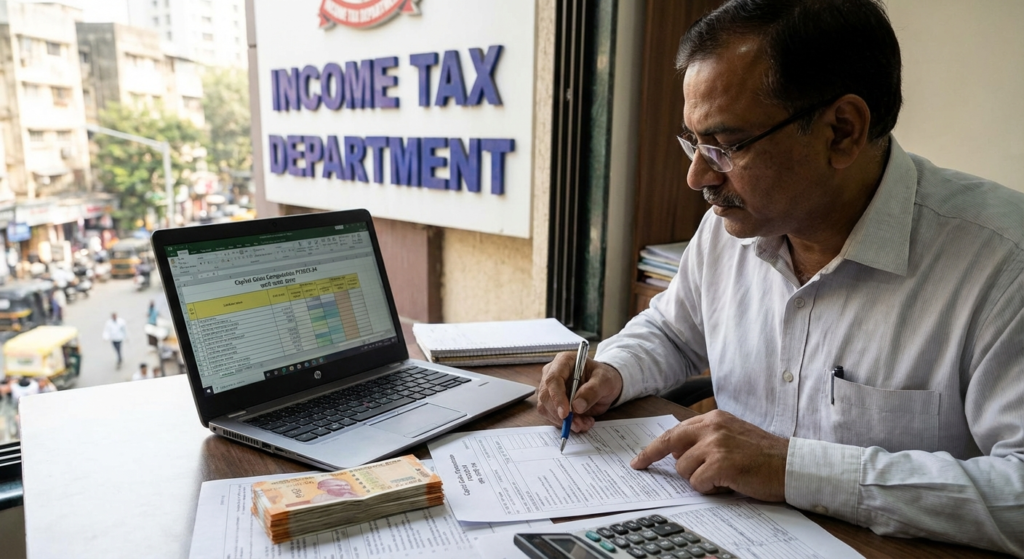
Proper calculation is key to tax compliance.
Classifying Assets: Short-Term vs. Long-Term
The rate at which you pay capital gains tax India depends entirely on how long you held the asset before selling it. This period of holding classifies the gain as either Short-Term Capital Gain (STCG) or Long-Term Capital Gain (LTCG). The Budget 2024 has simplified these holding periods significantly.
Listed Financial Assets
Holding Period: 12 Months
If you sell listed equity shares or equity-oriented mutual funds after holding them for more than 12 months, the gain is Long-Term. Less than 12 months is Short-Term.
Other Assets (Property, Gold, Unlisted)
Holding Period: 24 Months
For immovable property (land/building), gold, and unlisted shares, the holding period is now generally 24 months to qualify as Long-Term. Anything less is Short-Term.
The New Rate Structure for Capital Gains Tax India (FY 2024-25)
The 2024 Union Budget brought about a paradigm shift in the rates for capital gains tax India. The government aimed to simplify the tax regime, but this also meant an increase in rates for certain asset classes. It is vital to differentiate between the tax treatment for equity markets and real estate.
1. Equity and Related Assets
The taxation on the stock market has seen an uptick. If you are trading in the Indian stock market, here is what you need to know:
- STCG (Short-Term): Taxed at 20% (increased from 15%). This applies if you sell listed shares within 12 months.
- LTCG (Long-Term): Taxed at 12.5% (increased from 10%) on gains exceeding ₹1.25 Lakh in a financial year.
2. Real Estate and Other Assets
Perhaps the most debated change in capital gains tax India is regarding real estate. The indexation benefit—which allowed taxpayers to adjust the purchase price for inflation—has been largely removed for property sold after July 23, 2024.
- New Rule: LTCG is taxed at 12.5% without indexation.
- Grandfathering Clause: For properties bought before July 23, 2024, taxpayers may have the option to choose between the old regime (20% with indexation) and the new regime (12.5% without indexation) to ensure they are not disadvantaged.
When dealing with high-value property transactions, compliance is key. Often, the buyer must deduct tax at source. To understand the procedural aspects of this, you might find our guide on mastering TDS return filing online very useful, as TDS is inextricably linked to property sales.
Calculating Your Capital Gains Liability
Calculating your liability for capital gains tax India involves a specific formula. While online calculators are available, knowing the logic helps in planning.
The Formula for Short-Term Capital Gains:
Full Value of Consideration (Sale Price) – (Cost of Acquisition + Cost of Improvement + Transfer Expenses) = STCG
The Formula for Long-Term Capital Gains (New Regime):
Full Value of Consideration – (Cost of Acquisition + Cost of Improvement + Transfer Expenses) = LTCG
Under the old regime (or for specific grandfathered assets), the “Cost of Acquisition” would be replaced by the “Indexed Cost of Acquisition,” calculated using the Cost Inflation Index (CII) notified by the Income Tax Department of India.
Real estate taxation has undergone major changes in 2024.
Key Exemptions to Save on Capital Gains Tax India
The Income Tax Act provides several avenues to reduce your tax burden. The government encourages reinvestment of profits into specific sectors like housing or infrastructure bonds. Here are the most effective sections to save on capital gains tax India:
Section 54: Selling a House to Buy a House
This is available to individuals and Hindu Undivided Families (HUFs). If you sell a residential property and use the capital gains to purchase or construct another residential property, you can claim an exemption. The new house must be purchased either one year before or two years after the sale, or constructed within three years.
Section 54EC: Investing in Capital Gains Bonds
If you are not interested in buying another property, you can invest your Long-Term Capital Gains (from land or building) into specified bonds issued by NHAI or REC. The maximum limit for investment is ₹50 Lakhs, and these bonds have a lock-in period of 5 years.
Section 54F: Selling Other Assets to Buy a House
If you sell a Long-Term asset other than a house (like gold or shares) and use the entire net consideration (not just the profit) to buy a residential house, the tax is exempt. If only a part of the consideration is invested, the exemption is pro-rated.
Corporate vs. Individual Capital Gains
It is worth noting that the rules discussed above primarily apply to individuals. However, businesses also face capital gains tax. The structure of your business entity can dictate how these taxes are handled. For example, a private limited company treats asset disposal differently compared to a public company in terms of compliance and reporting. If you are unsure about your entity structure, you can read about the difference between private and public companies to better understand your corporate tax liabilities.
Filing Requirements and Compliance
Reporting your gains correctly is the final step in the process. Capital gains tax India must be reported in your Income Tax Return (ITR). For individuals with capital gains, ITR-2 or ITR-3 is usually the required form, as ITR-1 (Sahaj) does not allow for capital gains reporting.
Furthermore, if your tax liability on capital gains is significant, you may be liable to pay Advance Tax. Failure to pay Advance Tax installments can attract interest under sections 234B and 234C. Always consult authoritative resources or the Securities and Exchange Board of India (SEBI) guidelines if your gains are related to complex market securities.
Strategic planning can significantly reduce your tax outflow.
Conclusion
Navigating capital gains tax India requires a blend of vigilance and strategic planning. With the FY 2024-25 updates, the removal of indexation for real estate and the hike in equity tax rates have changed the math for many investors. However, by leveraging exemptions like Section 54 and understanding the distinction between Short-Term and Long-Term assets, you can still manage your liabilities effectively.
Remember, tax saved is income earned. Whether you are dealing with property, gold, or stocks, ensure you calculate your tenure and costs accurately. Always stay compliant, file your ITR on time, and consult with a tax professional for complex transactions.
FAQs About Capital Gains Tax India
For FY 2024-25, Short-Term Capital Gains (STCG) on listed equity shares are taxed at 20%. Long-Term Capital Gains (LTCG) are taxed at 12.5% on gains exceeding ₹1.25 Lakh per financial year.
Generally, no. The Budget 2024 removed indexation benefits for properties sold after July 23, 2024, taxing LTCG at a flat 12.5%. However, for properties acquired before this date, taxpayers may choose between the old regime (20% with indexation) and the new regime (12.5% without indexation).
To qualify as a Long-Term Capital Asset, immovable property (land or building) must be held for a period of 24 months (2 years) or more. If sold before 24 months, it is treated as Short-Term.
Yes, under Section 54 of the Income Tax Act, if you use the capital gains from the sale of a residential house to purchase or construct another residential house within the specified time limits, you can claim an exemption.
No, there is no capital gains tax at the time of inheritance. However, if you decide to sell the inherited property later, capital gains tax will apply. The cost of acquisition will be based on the cost to the original owner.