
Think the appointment of an auditor is just another piece of corporate paperwork? Think again. I’ve seen promising startups get their funding pulled at the last minute because of a sloppy audit trail. I’ve also seen established firms face crippling penalties from the Registrar of Companies (ROC) for a simple missed deadline.
This isn’t just about ticking a compliance box. It’s about building a fortress of financial credibility around your business.
Getting this right signals to investors, banks, and even your top customers that your house is in order. It’s a non-negotiable pillar of trust. In this guide, we’re cutting through the legal jargon. You’ll get a battle-tested, step-by-step roadmap for appointing your company’s auditor in India, based on the latest 2026 regulations. No fluff, just actionable strategy.
Why Auditor Appointment is Your Business’s Financial Bedrock
Let’s be clear: an independent auditor is the financial conscience of your company. They are an external, unbiased expert whose job is to scrutinize your financial statements and provide an opinion on whether they present a “true and fair” view of your company’s financial health. It’s a mandatory health checkup for your books.
But the real value goes far beyond compliance. Based on our experience guiding hundreds of companies, a clean audit report is a powerful business asset. Here’s why it matters so much:
- Unlocks Funding & Credit: No serious investor will put money into a company without audited financials. Banks see it the same way. A history of clean audits is your golden ticket to securing loans and attracting venture capital.
- Builds Stakeholder Trust: From minority shareholders to major clients, everyone wants assurance. An audit provides that third-party validation, proving your numbers are reliable and your governance is sound.
- Deters and Detects Fraud: The mere presence of an auditor is a powerful deterrent to internal financial misconduct. They are trained to spot irregularities and weaknesses in your internal controls that you might miss.
- Improves Internal Processes: Auditors often provide a Management Letter alongside their report, highlighting areas where your financial processes or controls could be stronger. This is free, high-level consulting that can make your business run more efficiently.
Neglecting this isn’t just a legal risk; it’s a strategic blunder that undermines the very foundation of trust your business needs to grow.
💡 Pro Tip
Don’t just hire the cheapest auditor you can find. Vet them like you would a key executive. Ask for references from companies in your industry. A good auditor understands your business context and can provide insights, not just a signature on a report.
First vs. Subsequent Auditors: Understanding the Key Differences
The Companies Act, 2013, makes a critical distinction between appointing your company’s first auditor and all subsequent auditors. The initial appointment is a foundational step for a new company, while subsequent appointments are part of a recurring governance cycle. Understanding the different timelines and responsibilities is crucial for staying compliant.
Here’s a high-level breakdown of the core differences:
| Aspect | First Auditor Appointment | Subsequent Auditor Appointment |
|---|---|---|
| Who Appoints? | Primarily the Board of Directors. If they fail, the members (shareholders) in an EGM. | The members (shareholders) at the Annual General Meeting (AGM). |
| Timeline | Within 30 days of incorporation (by the Board). | At every AGM, starting from the first one. |
| Tenure | Holds office only until the conclusion of the first AGM. | Holds office from the conclusion of one AGM to the conclusion of the sixth AGM (a 5-year term). |
| Governing Section | Section 139(6) of the Companies Act, 2013 | Section 139(1) of the Companies Act, 2013 |
The Step-by-Step Guide to Appointing Your First Auditor
For a newly incorporated company, appointing the first auditor is one of your first major compliance tasks. The clock starts ticking from the date on your Certificate of Incorporation. The process varies slightly for government and non-government companies.
Let’s walk through the process for a typical private or public limited company (non-government).
Step 1: Identify and Obtain Consent from a Qualified Auditor
Before you can even think about appointing someone, you need their permission. Your first step is to identify a qualified Chartered Accountant or a CA firm. You must then obtain two critical documents from them:
- Written Consent: A formal letter from the auditor stating they agree to be appointed.
- Eligibility Certificate: A certificate under Section 141 of the Companies Act, 2013, confirming they are not disqualified from being your auditor. This certificate affirms their independence and eligibility.
Trust me on this one: do not proceed to a board meeting without these documents in hand. It’s a common rookie mistake.
Step 2: Convene a Board Meeting
The Board of Directors has the primary responsibility. You must hold a Board Meeting within 30 days of the company’s incorporation date. The main agenda item will be the appointment of the first auditor.
Step 3: Pass a Board Resolution
During the meeting, the directors will pass a resolution to appoint the auditor. This resolution should be formally recorded in the minutes of the meeting. The resolution officially marks the appointment.
Step 4: File Form ADT-1 with the ROC
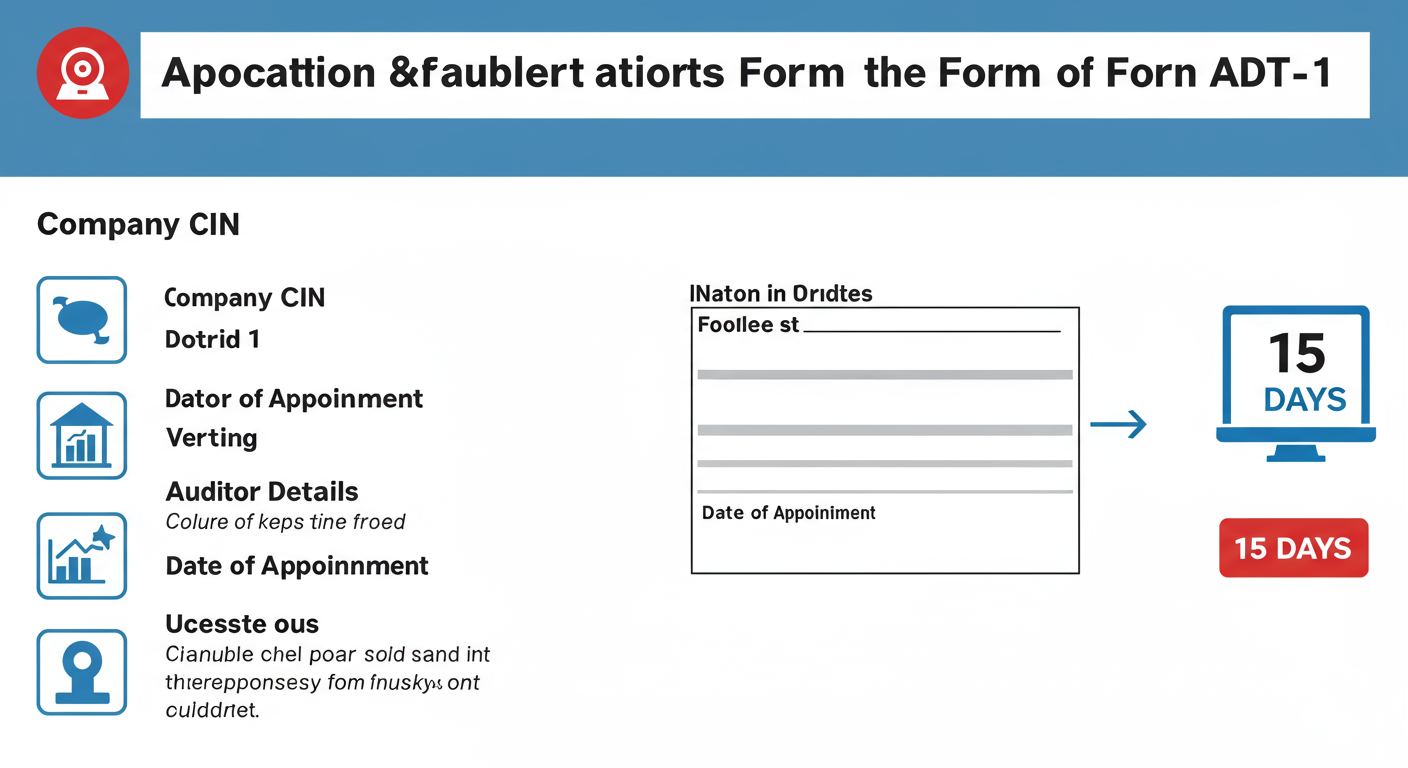
This is the final, non-negotiable step. The company must inform the Registrar of Companies (ROC) of the appointment. You do this by filing e-Form ADT-1 on the Ministry of Corporate Affairs (MCA) portal. This must be filed within 15 days of the Board Meeting where the resolution was passed.
⚠️ Watch Out
The 15-day deadline for filing Form ADT-1 is strict. Missing it results in automatic penalties that increase daily. There’s very little leniency here. Set a calendar reminder the moment the board resolution is passed. Don’t let this simple task become an expensive problem.
What If the Board Fails to Appoint?
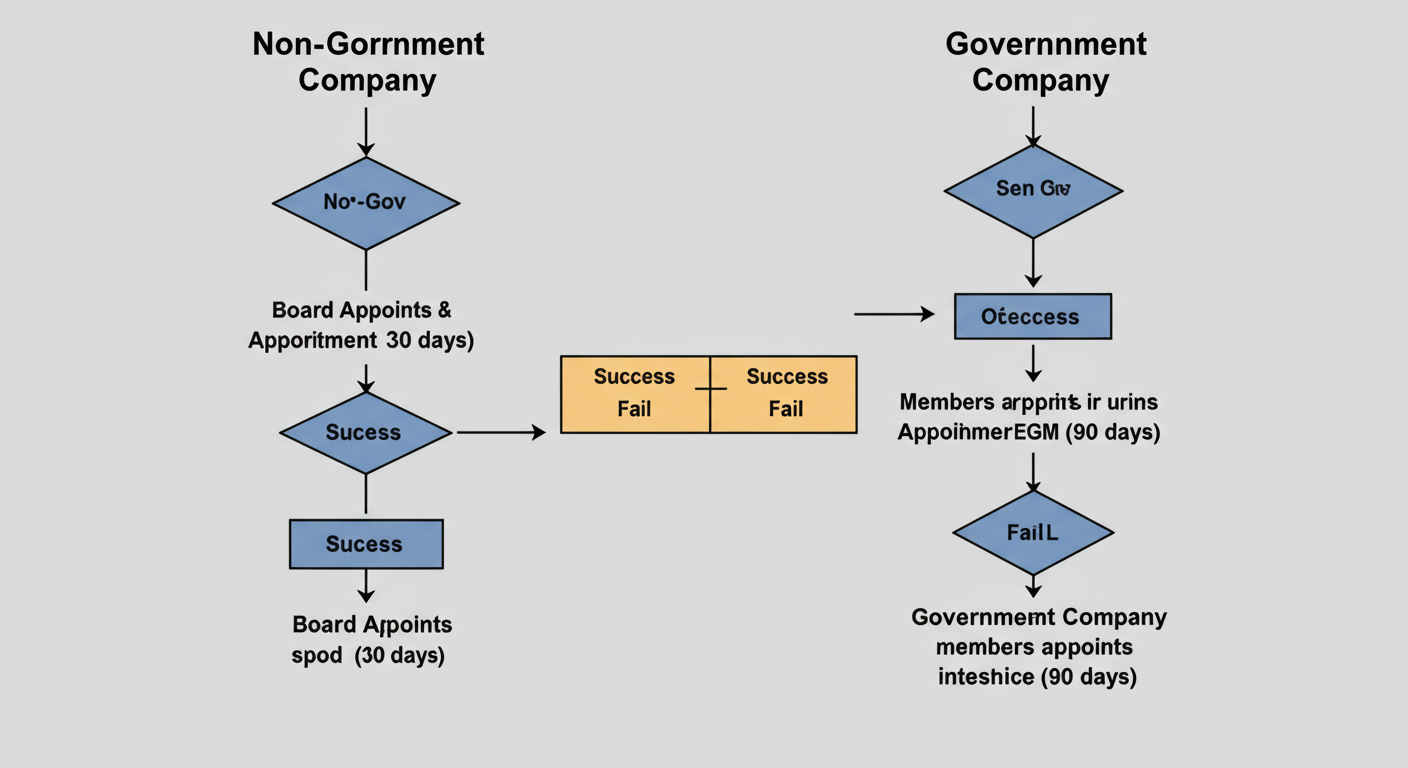
If the Board of Directors fails to appoint an auditor within the initial 30-day window, the ball is passed to the members (shareholders). The Board must inform the members, who then must convene an Extraordinary General Meeting (EGM) within 90 days to appoint the auditor. The auditor appointed at the EGM will also hold office until the first AGM.
Special Rules for Government Companies
For government companies or companies owned/controlled by the government, the process is slightly different, reflecting public accountability. The Comptroller and Auditor General of India (CAG) gets the first say.
| Entity | Responsible Body | Timeline |
|---|---|---|
| Non-Government Company | Board of Directors | Within 30 days of incorporation |
| Members (if Board fails) | Within 90 days at an EGM | |
| Government Company | CAG of India | Within 60 days of incorporation |
| Board of Directors (if CAG fails) | Within the next 30 days | |
| Members (if Board fails) | Within the next 60 days at an EGM |
Navigating Subsequent Appointments and Mandatory Rotation
The first auditor’s job is short-lived. Their term automatically ends at the conclusion of the company’s first Annual General Meeting (AGM). At this meeting, the shareholders take over the responsibility for the appointment of the auditor for the long term. ROC Annual Filing 2026: AOC-4 and MGT-7 Due Dates and Penalties
The auditor appointed at the first AGM will hold office for a five-year term—from the end of the first AGM to the end of the sixth AGM. However, their appointment must be ratified by the shareholders at every AGM during this tenure. 80G Registration under Income Tax Act
The process is similar to the first appointment but is driven by shareholders:
- Audit Committee/Board Recommendation: The Audit Committee (if your company is required to have one) or the Board recommends an auditor for appointment.
- Obtain Consent & Certificate: The company must again obtain the written consent and eligibility certificate from the proposed auditor.
- Shareholder Approval at AGM: The matter is placed before the shareholders at the AGM, who vote to appoint the auditor by passing an ordinary resolution.
- File Form ADT-1: Once appointed, the company must again file Form ADT-1 with the ROC within 15 days of the AGM.
The Deal with Auditor Rotation
To ensure independence and prevent complacency, the Companies Act, 2013, mandates auditor rotation for certain classes of companies. This prevents an audit firm from becoming too familiar with a company over time. After completing a term (or two consecutive terms for a firm), they must be replaced.
This rotation is mandatory for:
- All listed companies.
- Unlisted public companies with paid-up share capital of ₹10 crore or more.
- Private limited companies with paid-up share capital of ₹50 crore or more.
- All companies with public borrowings from financial institutions, banks, or public deposits of ₹50 crore or more.
💡 Pro Tip
If your company is approaching the thresholds for mandatory rotation, start the search for a new auditor at least 6-9 months in advance. A proper transition and knowledge transfer between the outgoing and incoming auditors is critical for a smooth audit cycle.
Auditor Eligibility and Disqualifications (Section 141)
You can’t just appoint your cousin who’s good with numbers. The law is extremely strict about who can be an auditor to ensure competence and, more importantly, independence. The rules are laid out in Section 141 of the Companies Act.
“The purpose of an audit is to provide an independent and objective opinion. The eligibility rules are there to eliminate any potential conflicts of interest that could compromise that objectivity.” – A core principle of corporate governance, as emphasized by bodies like the OECD.
Who is Eligible?
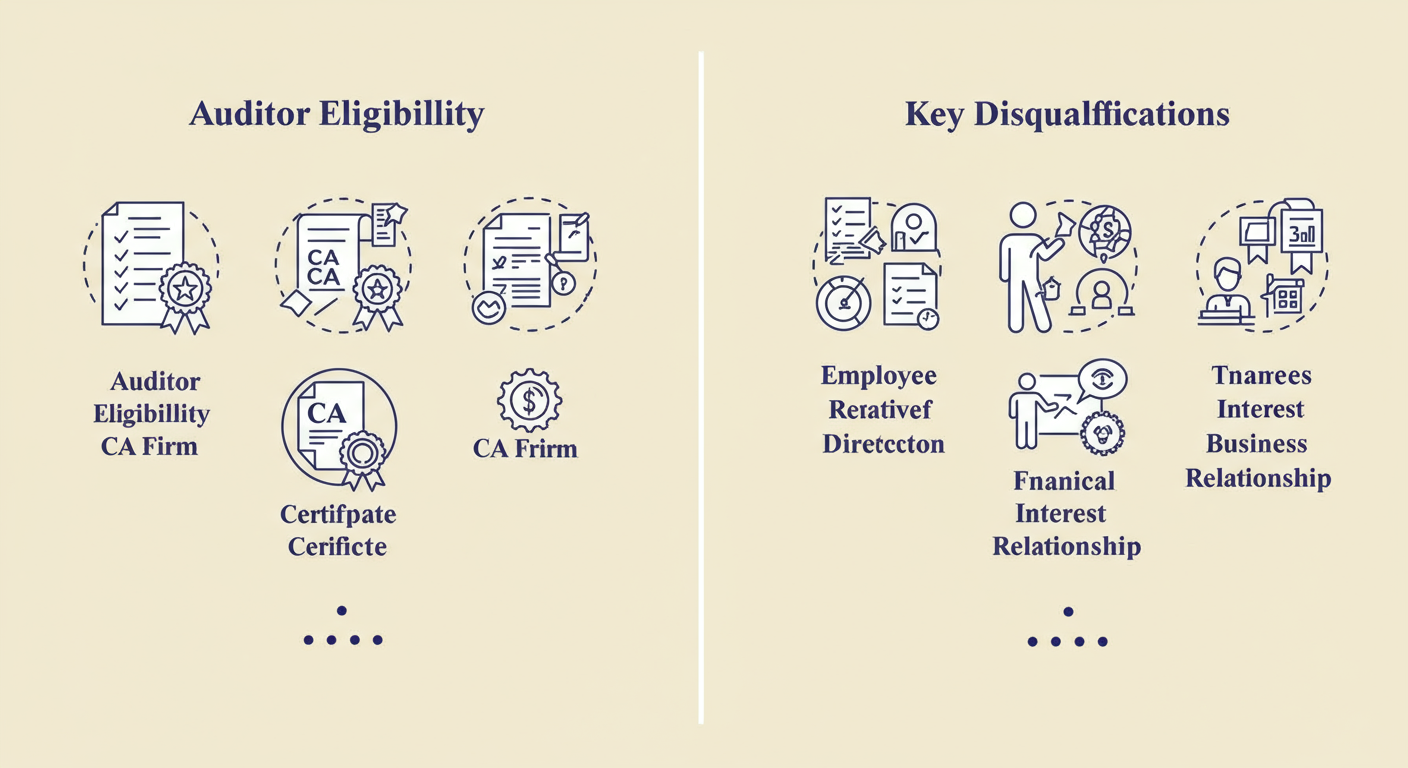
- An individual who is a Chartered Accountant and holds a valid Certificate of Practice from the Institute of Chartered Accountants of India (ICAI).
- A firm, including a Limited Liability Partnership (LLP), where the majority of partners practicing in India are qualified Chartered Accountants.
Who is Disqualified?
The list of disqualifications is long, but it boils down to one thing: independence. A person or firm cannot be an auditor if they have a pre-existing relationship with the company that could create a conflict of interest. This includes:
- An officer or employee of the company.
- A partner or employee of an officer/employee of the company.
- Anyone whose relative is a director or is in the key managerial personnel (KMP) of the company.
- Anyone who, or whose relative or partner, holds any security or interest in the company, or is indebted to the company beyond a certain limit.
- Anyone who has a direct or indirect business relationship with the company.
⚠️ Watch Out
The “business relationship” disqualification is a common trap. This is broadly interpreted and can include consulting services beyond the audit scope. Before engaging your auditor for any advisory work, confirm that it doesn’t violate the independence criteria under the Act. When in doubt, consult a legal expert.
🎯 Key Takeaway
The appointment of an auditor is a time-sensitive, legally mandated process governed by the Companies Act, 2013. The Board handles the first appointment within 30 days of incorporation, while shareholders handle all subsequent appointments at the AGM. Filing Form ADT-1 within 15 days of any appointment is absolutely critical to avoid penalties.
❓ Frequently Asked Questions
What happens if a company fails to appoint an auditor at its AGM?
If the shareholders fail to appoint an auditor at the AGM, it’s known as a “casual vacancy.” The company must inform the Central Government, which will then step in and appoint an auditor. This is a serious compliance lapse that can lead to significant penalties for the company and its officers.
Can we remove an auditor before their 5-year term is over?
Yes, but it’s a difficult and deliberate process designed to protect the auditor’s independence. You must pass a special resolution (requiring 75% shareholder approval) and get prior approval from the Central Government by filing Form ADT-2. You can’t just fire an auditor because you disagree with their findings.
Is an auditor required for a small private limited company?
Yes. Under the Companies Act, 2013, every company registered in India, regardless of its size, turnover, or nature of business (public or private), must appoint a statutory auditor. There are no exceptions based on size for this requirement.
What is the difference between a statutory auditor and an internal auditor?
A statutory auditor is an independent external party appointed by shareholders as required by law (the Companies Act) to report on the financial statements. An internal auditor, on the other hand, is often an employee or a firm hired by management to review internal controls and business processes. The appointment of an internal auditor is mandatory only for certain classes of companies.
How long does the first auditor hold office?
The first auditor, whether appointed by the Board of Directors or by the members, holds office only until the conclusion of the company’s very first Annual General Meeting (AGM). A new appointment must be made at that AGM for the subsequent five-year term.
Conclusion: From Compliance Task to Strategic Advantage
We’ve covered a lot of ground, from the initial 30-day scramble to appoint your first auditor to the five-year cycles of subsequent appointments and the complexities of mandatory rotation. It’s clear that the appointment of an auditor is far more than a bureaucratic hurdle.
It’s a foundational element of good corporate governance. It’s a signal of transparency. And it’s a strategic tool for building unshakable trust with the people who matter most to your business’s future—your investors, lenders, and customers.
Your next step? If you’re a new company, check your incorporation date and get that first board meeting on the calendar. If you’re an established business, review your records for the last AGM and ensure your ADT-1 was filed correctly. Treat this process with the seriousness it deserves, and you’ll transform a simple compliance requirement into a powerful asset for sustainable growth.