
What if a single missed deadline could cost your company ₹10,000 instantly, plus another ₹100 for every single day you’re late? It’s not a hypothetical. It’s the harsh reality of missing the AOC 4 due date in India.
Every year, thousands of companies scramble, stress, and ultimately pay hefty fines for failing to file this one critical document on time. But it doesn’t have to be this way. This isn’t just another compliance task; it’s a fundamental measure of your company’s health and governance.
Forget the dense legal jargon and confusing advice. In this guide, we’ll give you the straight-up, battle-tested strategy to master your AOC-4 filing for the Financial Year 2025-26. You’ll learn the exact timelines, how to pick the right form, and a foolproof process to file with confidence, keeping your company safe and your directors out of trouble. Let’s get it done right.
What is Form AOC-4, Really? (Beyond the Bureaucratic Jargon)
Think of Form AOC-4 as your company’s annual report card to the Ministry of Corporate Affairs (MCA). It’s not just a form; it’s a formal declaration of your financial health. According to Section 137 of the Companies Act, 2013, every single company registered in India must file its audited financial statements with the Registrar of Companies (ROC) after they’ve been approved at the Annual General Meeting (AGM). Form AOC-4 is the official e-form for that submission.
In our experience, many new directors see it as just another piece of paper. That’s a huge mistake. This document package is what provides transparency to stakeholders, lenders, and the government. It includes:
- The Balance Sheet: A snapshot of what you own and what you owe.
- The Profit & Loss (P&L) Account: The story of your revenue and expenses over the year.
- Cash Flow Statement: Where your money actually came from and where it went.
- The Board’s Report: Management’s own narrative on the company’s performance and future.
- The Auditor’s Report: The crucial, independent verdict on the accuracy of your numbers.
Submitting this isn’t just about compliance. It’s about building trust. A clean, timely filing record is a massive signal of good governance, which is invaluable when you’re trying to secure a loan, attract investors, or even land a major client.
💡 Pro Tip
Don’t just file and forget. Use the preparation of your AOC-4 attachments as an annual strategic review. The insights from your P&L, Balance Sheet, and Board’s Report are a goldmine for identifying business trends and planning for the next financial year.
The Critical Timeline: Calculating the AOC 4 Due Date 2026
Here’s where so many people get tripped up. The AOC 4 due date isn’t a fixed calendar date for everyone. It’s a floating deadline tied directly to your company’s Annual General Meeting (AGM). Understanding this two-step process is non-negotiable.
Step 1: The AGM Deadline
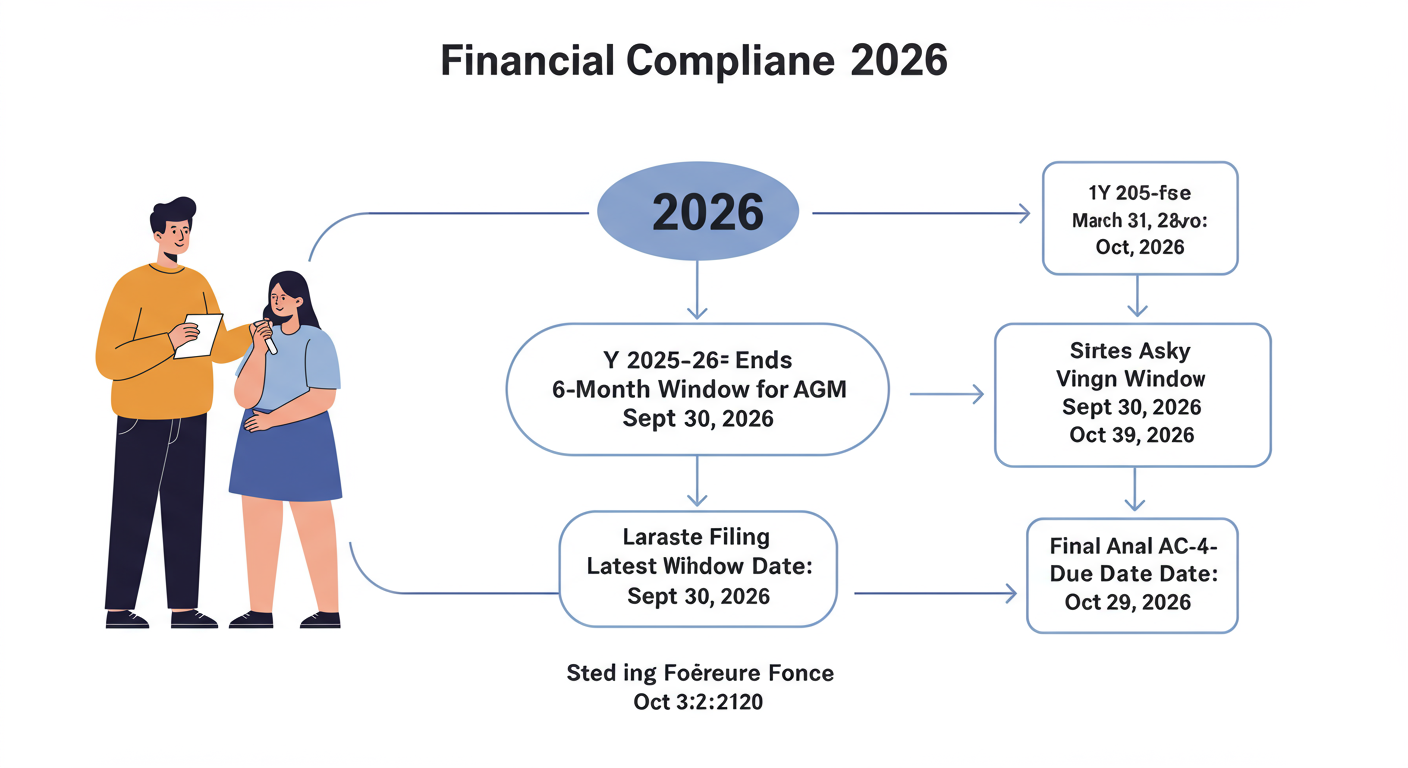
The Companies Act mandates that you must hold your AGM within six months of the financial year’s end. Since the financial year (FY 2025-26) ends on March 31, 2026, the absolute last day to hold your AGM is September 30, 2026.
Step 2: The AOC-4 Filing Clock
Once your financial statements are adopted at the AGM, a 30-day countdown begins. You must file Form AOC-4 within these 30 days.
So, if you hold your AGM on the very last day (September 30, 2026), your AOC-4 due date becomes October 29, 2026. Simple, right? But what if you hold the AGM earlier? If your AGM is on September 10th, your due date is October 9th. The clock starts ticking from the date of your AGM, not from a fixed government date.
The rules are slightly different for a One Person Company (OPC), which doesn’t need to hold an AGM. For them, the timeline is more direct.
| Company Type | Key Event & Timeline | Resulting AOC-4 Due Date for FY 2025-26 |
|---|---|---|
| Private / Public Ltd. Co. | Within 30 days of the Annual General Meeting (AGM). The AGM must be held by Sept 30, 2026. | October 29, 2026 (if AGM is held on the last day) |
| One Person Company (OPC) | Within 180 days from the end of the financial year (March 31, 2026), as no AGM is required. | September 27, 2026 |
⚠️ Watch Out
Never assume the government will extend the deadline. While it has happened in the past due to portal glitches or major events, it’s the exception, not the rule. Banking on an extension is a recipe for disaster. Always plan for the statutory deadline.
Choosing Your Form: AOC-4 vs. CFS vs. XBRL
Filing the wrong type of AOC-4 is as bad as filing late. The MCA portal will reject it, and by the time you correct it, you could already be in the penalty zone. It’s crucial to know which form applies to your company.
Here’s a breakdown of the main versions:
- Form AOC-4: This is the vanilla, standard-issue form. If you’re a standalone company without subsidiaries or complex structures, this is likely your form.
- Form AOC-4 CFS: The “CFS” stands for Consolidated Financial Statements. If your company has subsidiaries, associates, or joint ventures, you must file consolidated accounts for the entire group using this form.
- Form AOC-4 XBRL: This is the big one. XBRL (eXtensible Business Reporting Language) is a format that makes financial data machine-readable. It’s mandatory for larger and listed companies. Filing in XBRL is a more technical process, often requiring specialized software or service providers.
So, how do you know if you’re on the hook for XBRL filing? The rules are quite specific.
| Form Type | Who Should Use It? | Key Considerations |
|---|---|---|
| AOC-4 (Standard) | Most standalone private and public companies that don’t meet XBRL criteria. | The most common and straightforward form. |
| AOC-4 CFS | Companies with one or more subsidiaries, associates, or joint ventures. | Requires preparation of Consolidated Financial Statements (CFS). |
| AOC-4 XBRL |
|
Technically complex. Data must be “tagged” to specific accounting concepts. Requires careful validation before filing. |
⚠️ Watch Out
The XBRL applicability criteria are checked for the financial year in question. If your company crossed the ₹100 crore turnover threshold in FY 2025-26 for the first time, you must file Form AOC-4 XBRL in 2026. Don’t assume you can use the standard form one last time.
The Real Cost of Delay: Unpacking the Brutal Penalties
Let’s talk numbers. The penalties for missing the AOC 4 due date are not a slap on the wrist; they are designed to hurt. The MCA’s stance is clear: compliance is not optional. Mastering TDS Return Filing Online: A Comprehensive Guide for Deductors
The penalty structure is two-pronged, hitting both the company and its leadership. It’s a daily-ticking time bomb. 7 Crucial Rules of GST Audit Applicability Every Business Owner Must Know (2025 Update)
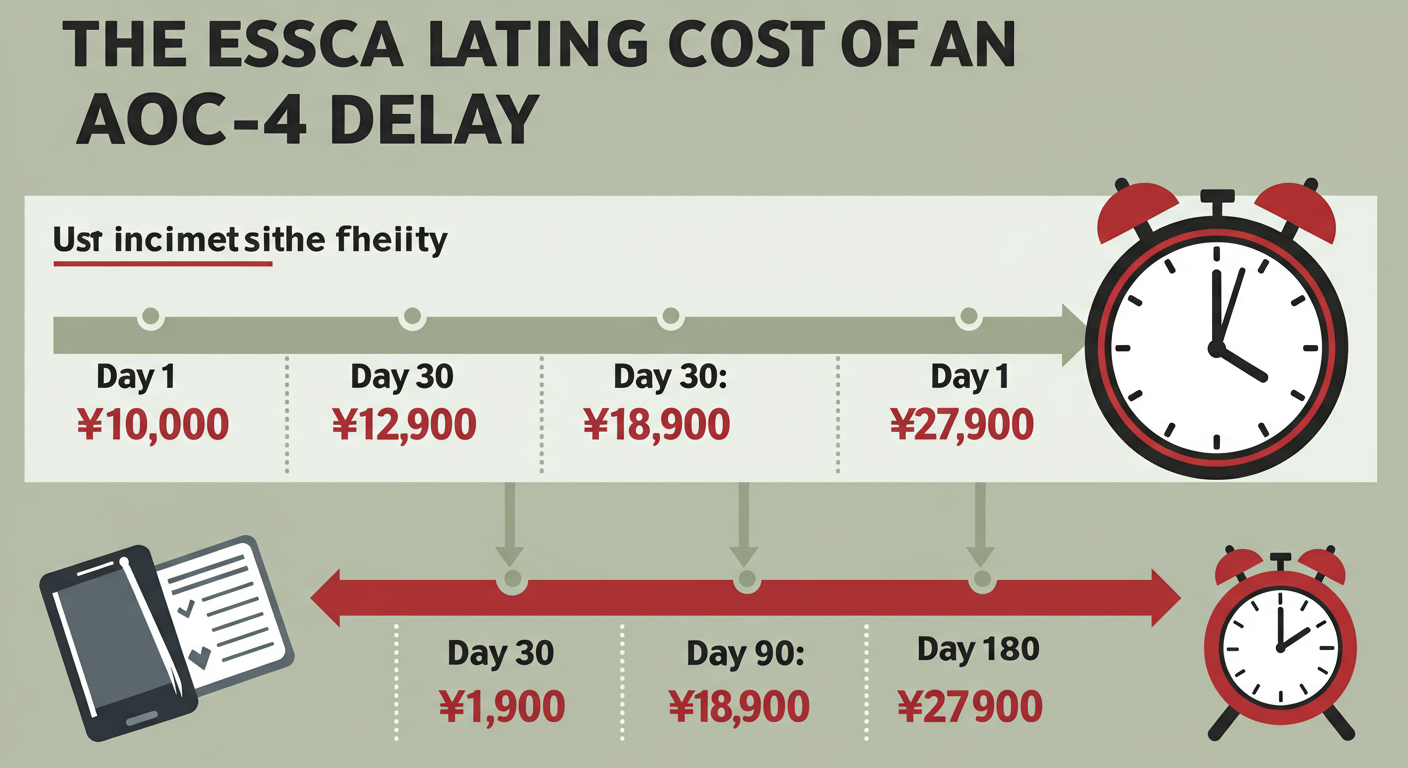
Upon default, a penalty of ₹10,000 is levied immediately. From the next day, an additional penalty of ₹100 per day of default is added until the form is filed.
This might not sound like much, but it adds up frighteningly fast. A 90-day delay means a penalty of ₹10,000 + (90 x ₹100) = ₹19,000 for the company. And that’s just the beginning.
The officers in default—typically the Managing Director, CFO, or any director tasked by the board—are personally liable. They face a separate penalty with the same structure, capped at a lower amount.
But the true cost goes beyond the fines. Prolonged non-compliance can lead to:
- Director Disqualification: Directors of a company that fails to file financial statements for three consecutive years can be disqualified.
- Damaged Reputation: The company is flagged as “NON-COMPLIANT” in the public MCA database, a huge red flag for banks, investors, and potential partners.
- Operational Hurdles: You’ll find it nearly impossible to get loans, raise capital, or participate in government tenders.
🎯 Key Takeaway
Missing the AOC-4 due date isn’t a simple administrative error; it’s a costly strategic failure. The penalties are severe, automatic, and impact both the company’s finances and the personal liability of its directors. Timely filing is one of the most effective risk management actions you can take all year.
Your Foolproof 7-Step AOC-4 Filing Blueprint
Feeling overwhelmed? Don’t be. With a systematic approach, you can make the filing process smooth and stress-free. After managing hundreds of these filings, we’ve refined it to a simple, 7-step process.
- Finalize & Audit Your Books (By July): Don’t wait until September. Have your financial statements (Balance Sheet, P&L, etc.) finalized and handed over to your statutory auditor well in advance. This is the most time-consuming part.
- Convene a Board Meeting (By August): Once the audit is complete, hold a Board Meeting to formally approve the audited financials, the Auditor’s Report, and the Board’s Report. Document this with proper minutes.
- Hold the AGM (By September 30): Conduct your Annual General Meeting to present and adopt the financial statements. The date of this meeting is the trigger for your 30-day filing deadline.
- Download the Correct e-Form: Go to the MCA portal and download the latest version of the applicable form (AOC-4, CFS, or XBRL). They sometimes update forms, so never use an old, saved copy.
- Fill, Attach, and Verify: Meticulously fill in every detail in the e-form. Attach all required documents (audited financials, reports, etc.). This is where attention to detail saves you from rejection.
- Affix Digital Signatures (DSC): The form must be digitally signed by a Director and a practicing professional (CA, CS, or CWA). As the Institute of Company Secretaries of India (ICSI) stresses, this professional certification is a key part of the verification process.
- Upload, Pay, and Confirm: Upload the signed form to the MCA portal, pay the statutory fees, and save the Service Request Number (SRN) and challan. Your filing is only complete after the payment is confirmed.
💡 Pro Tip
Check the validity of all required Digital Signature Certificates (DSCs) at least a month before the deadline. An expired DSC at the last minute is a common and completely avoidable reason for late filing. Renewing a DSC can take a few days.
❓ Frequently Asked Questions
What happens if the AGM is not held by the due date?
If an AGM isn’t held, you must still file the financial statements. They should be filed within 30 days from the last date the AGM should have been held (i.e., by October 29, 2026). You’ll also need to attach a statement explaining why the AGM was not held. The penalties for late filing will apply from this date.
Can I revise a Form AOC-4 after filing?
Yes, the MCA portal allows for the filing of a revised form. However, you can only revise the form to correct defects or incomplete information, not to change the approved financial statements themselves. It’s always better to get it right the first time.
What is the government fee for filing Form AOC-4?
The statutory filing fee is not a flat rate. It depends on the authorized share capital of your company. The fee is nominal if filed on time (ranging from a few hundred to a few thousand rupees) but is separate from the much larger penalties levied for late filing.
What’s the difference between the Board’s Report and the Auditor’s Report?
The Board’s Report is the management’s perspective. It’s written by the directors and discusses the company’s performance, operations, and future outlook. The Auditor’s Report is an independent, external assessment by a Chartered Accountant, giving an opinion on whether the financial statements are true and fair.
My company was dormant and had no transactions. Do I still need to file?
Yes, absolutely. Every registered company, regardless of its transaction volume, must file Form AOC-4. Even for a dormant company, you need to file statements showing ‘nil’ transactions. The only exception is if your company has been officially declared ‘Dormant’ under Section 455 of the Companies Act and files Form MSC-3 instead.
Don’t Just Comply, Excel
Look, meeting the AOC 4 due date is more than just ticking a box. It’s a reflection of your company’s discipline and a cornerstone of its long-term health. The penalties are too steep, and the reputational damage is too great to leave it to chance.
By now, you have the complete playbook for FY 2025-26. You know how to calculate your deadline, which form to use, and the exact steps to file it without breaking a sweat. The process is clear, and the stakes are high.
Your next step is simple. Don’t close this tab and forget about it. Open your calendar right now and work backward from September 30, 2026. Set deadlines for your audit, your board meeting, and your final filing. Take control of the timeline today, and you’ll thank yourself when October rolls around.