Picture this: two co-founders, brilliant and driven, launch a tech startup. Six months in, they’re on fire. But a disagreement over issuing new shares to a key employee brings everything to a screeching halt. One founder thought they had equal say; the other points to a vaguely worded clause in a document they both signed but never truly read. The result? A legal standoff, a demoralized team, and a dream on the verge of collapse.
This isn’t just a hypothetical horror story. I’ve seen variations of this play out countless times. The culprit is almost always a neglected, misunderstood, or poorly drafted document: the Articles of Association.
So, what is the AOA full form? It stands for Articles of Association. But that’s the textbook answer. What it really is, is the operational DNA of your company—the detailed rulebook that governs every internal action, from boardroom decisions to shareholder rights. It’s the document that prevents the chaos I just described.
Forget the dry, legalistic jargon. In this guide, we’re going to break down exactly what the AOA is, why it’s one of the most critical documents you’ll ever sign, and how to make it a strategic asset instead of a ticking time bomb. You’ll learn the difference between an AOA and an MOA, the non-negotiable clauses you need, and how to change it as your business grows.
AOA vs. MOA: The Ultimate Showdown
Before we go any deeper, let’s clear up the biggest point of confusion in corporate governance: the AOA vs. the MOA (Memorandum of Association). People often use them interchangeably, but they are fundamentally different. Getting this wrong is like confusing a building’s foundation with its interior floor plan.
The Memorandum of Association (MOA) is your company’s constitution. It’s an outward-facing document that tells the world:
- Who you are (company name).
- Where you are (registered office state).
- What you can do (your objectives and business activities).
- How much liability your members have.
- Your authorized share capital.
The Articles of Association (AOA), on the other hand, is your company’s internal by-laws. It’s an inward-facing document that dictates how you will achieve the objectives laid out in the MOA. It’s the operating system that runs on the hardware defined by the MOA.
Here’s the thing: the AOA is always subordinate to the MOA. You can’t have a rule in your AOA that permits an activity your MOA forbids. That would be an act of ultra vires (beyond the powers) and legally void. Think of it this way: the MOA sets the boundaries of the playground; the AOA sets the rules for the games played within it.
| Aspect | Memorandum of Association (MOA) | Articles of Association (AOA) |
|---|---|---|
| Purpose | Defines the company’s charter, objectives, and scope. Relationship with the outside world. | Regulates the company’s internal management, rules, and procedures. Relationship with members. |
| Analogy | The Constitution of a country. | The specific laws and regulations of that country. |
| Hierarchy | Supreme document. Overrides the AOA. | Subordinate to the MOA and the Companies Act. |
| Scope | Defines the limits the company cannot cross. | Defines the rules for operating within those limits. |
| Alteration | Difficult. Requires a special resolution and often, regulatory approval (like from the Central Government). | Relatively simple. Requires a special resolution by shareholders. |
| Legal Effect of Breach | Any act beyond the MOA is ultra vires and legally void. It cannot be ratified. | An act beyond the AOA (but within the MOA) can be ratified by shareholders. |
💡 Pro Tip
When incorporating, don’t draft your MOA and AOA in silos. Based on our experience, the most resilient companies are those whose MOA and AOA are strategically aligned. For instance, if your MOA allows for raising funds through various instruments, ensure your AOA has clear, flexible procedures for issuing different classes of shares or debentures. This foresight saves immense time and legal fees later.
The 7 Pillars of a Bulletproof AOA You Can’t Ignore
A generic, template-based AOA is a recipe for disaster. Your company’s rulebook needs to be tailored to your specific vision, structure, and future plans. While the full document is extensive, it’s built on seven critical pillars. Getting these right is non-negotiable.
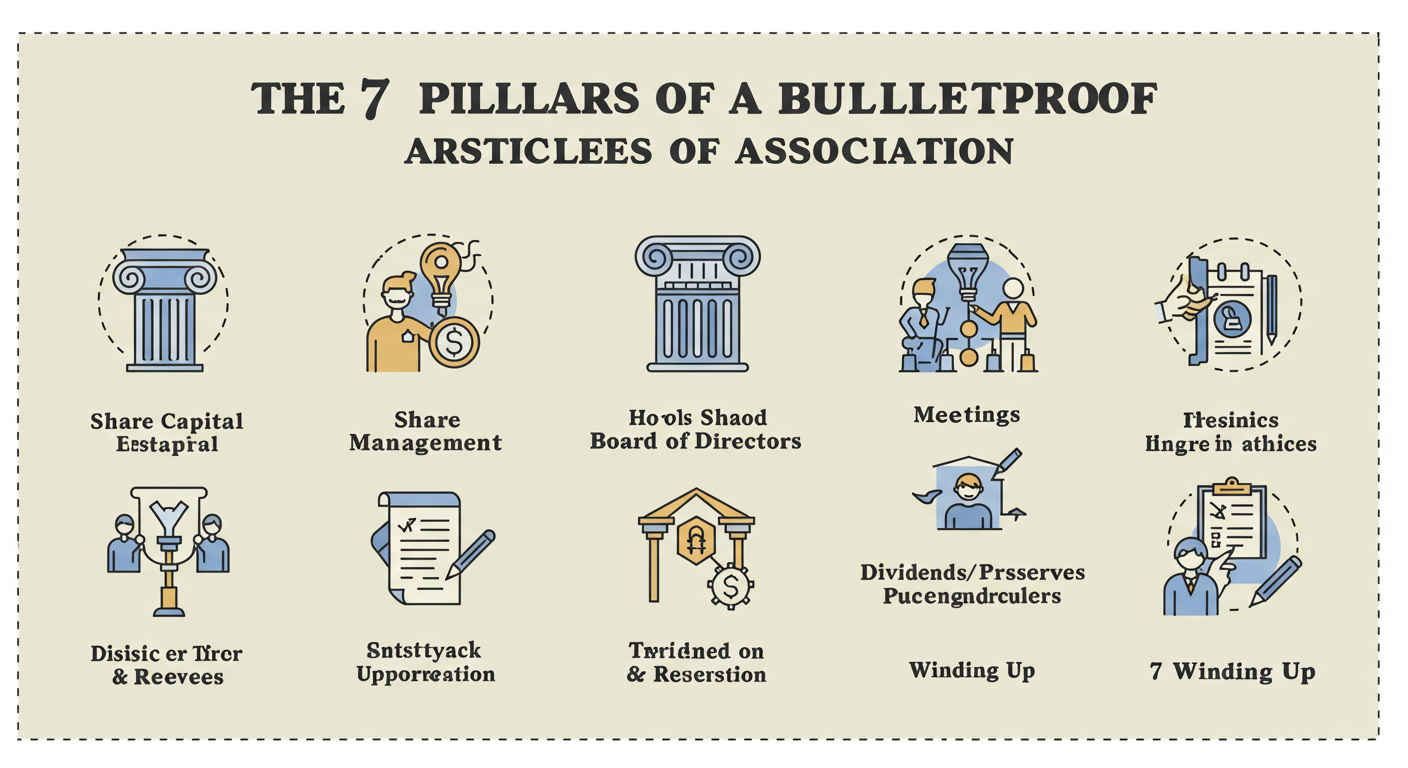
1. Share Capital & Class Rights
This isn’t just about the total number of shares. It’s about defining different classes of shares (like Equity Shares, Preference Shares) and the specific rights attached to each. Who gets to vote? Who gets paid first if the company dissolves? Do some shares have 10x the voting power of others (a common scenario in tech startups)? Defining this with surgical precision prevents future power struggles.
2. Issuance and Allotment of Shares
This clause dictates the exact procedure the board must follow to issue new shares. It’s the “how-to” for raising capital or offering employee stock options (ESOPs). Without clear rules, a rogue director could theoretically dilute your ownership stake overnight. This section is your primary defense.
3. Transfer and Transmission of Shares
This is huge. This pillar governs how shareholders can sell or transfer their shares. Can a co-founder sell their stake to a competitor? The AOA can grant the board the “Right of First Refusal” (ROFR), forcing a selling shareholder to offer the shares to existing members first. It also covers transmission—what happens when a shareholder passes away. Trust me, you want this figured out before you need it.
4. The Board of Directors
Who runs the show? This section defines the powers, duties, and responsibilities of your directors. It covers everything:
- How directors are appointed, removed, and paid.
- What constitutes a quorum for a board meeting (the minimum number of directors needed to make a valid decision).
- The specific powers reserved for the board versus the shareholders.
5. General Meetings (AGM & EGM)
This is about shareholder democracy. The AOA lays down the law for conducting Annual General Meetings (AGMs) and Extraordinary General Meetings (EGMs). It specifies notice periods, quorum requirements for shareholders, and the rules for voting and appointing proxies. This ensures that major company decisions are made fairly and transparently.
6. Dividends and Reserves
When the company is profitable, how is that profit shared? This clause outlines the mechanism for declaring and distributing dividends. Crucially, it also allows the company to transfer a portion of profits to a reserve fund before paying dividends. This is a vital tool for reinvesting in growth and ensuring long-term financial stability.
7. Winding Up
The final pillar deals with the end of the company’s life. Should the company need to be dissolved, the AOA specifies the procedure for winding up and, most importantly, the order and manner in which the company’s assets will be distributed among the shareholders after all debts are paid.
⚠️ Watch Out
The biggest mistake we see founders make is blindly adopting a “model” AOA from the Companies Act without customization. These templates are generic for a reason. They often lack crucial clauses like ROFR, drag-along/tag-along rights, or specific director powers that are essential for startups and closely-held companies. A template is a starting point, not the final product.
🎯 Key Takeaway
Your Articles of Association is not a static legal document; it’s a dynamic strategic tool. A well-crafted AOA protects founders, clarifies rights for investors, and creates a stable governance framework that prevents internal disputes and enables decisive action.
The Legal Framework: AOA under the Companies Act, 2013
Your AOA doesn’t exist in a vacuum. In India, its creation and content are governed by the Companies Act, 2013. Section 5 of the Act mandates that a company’s articles must contain the regulations for its management.
To simplify this, the Act provides model articles in Schedule I, presented in different tables for different types of companies. You can adopt the relevant table as-is or use it as a base for your custom AOA. Knowing which table applies to you is the first step.
| Table | Applicable Company Type | Key Characteristic |
|---|---|---|
| Table F | Company limited by shares (e.g., Private Limited, Public Limited) | This is the most common model, forming the basis for most standard corporations. |
| Table G | Company limited by guarantee with a share capital | A hybrid structure, often used for non-profits that also have investment capital. |
| Table H | Company limited by guarantee without a share capital | Typical for non-profits, clubs, and charitable organizations. |
| Table I | Unlimited company with a share capital | Rare; members have unlimited liability, but the company has share capital. |
| Table J | Unlimited company without a share capital | Also very rare; members’ liability is unlimited. |
How to Draft and Alter Your AOA: A Step-by-Step Guide
As your business evolves, your AOA may need to change. You might need to create a new class of shares for a funding round or change the rules for board meetings. Altering your AOA is a formal process that must be followed precisely to be legally valid.
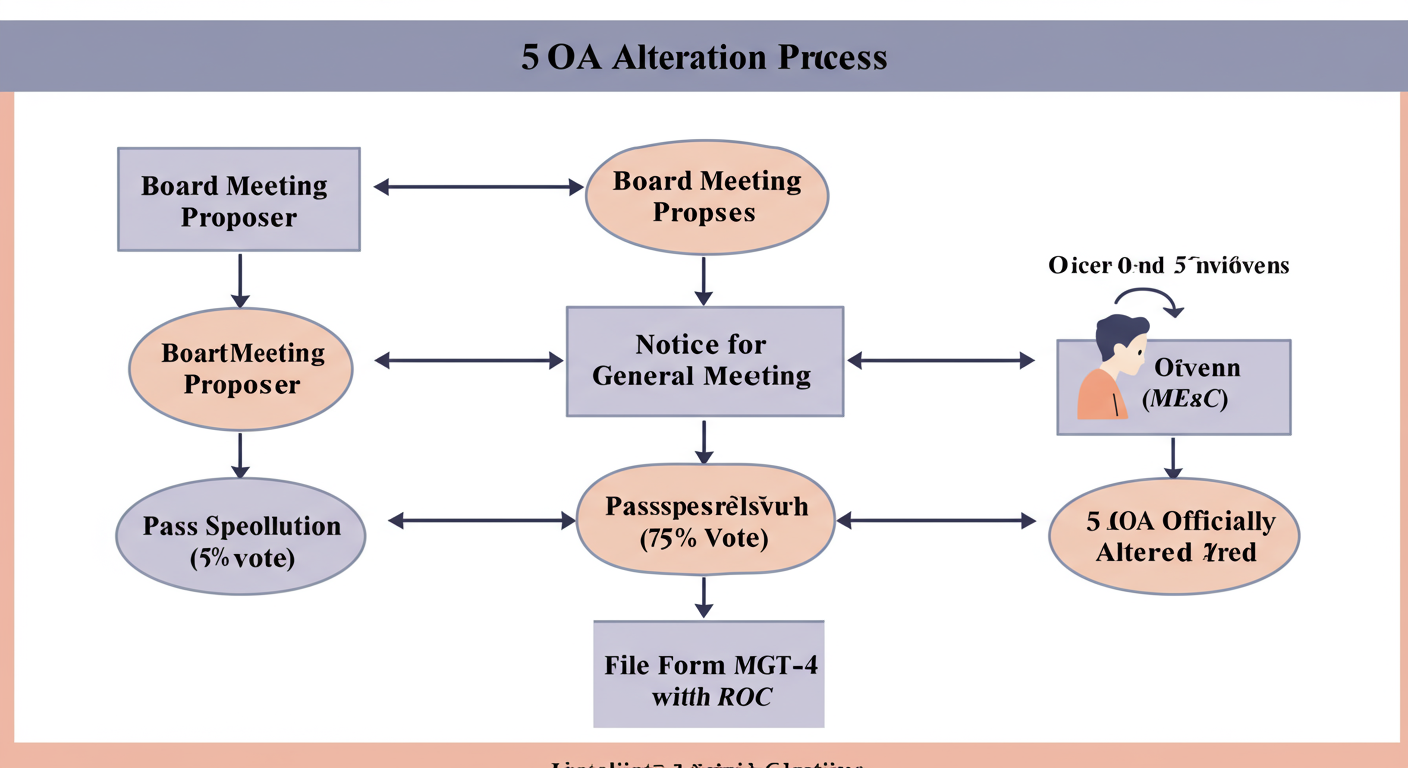
A 5-Step Guide to Altering Your Articles of Association
- Convene a Board Meeting: The process begins with the Board of Directors. They must meet and pass a board resolution to propose the specific alteration(s) and to call a General Meeting of the shareholders to vote on the proposal.
- Issue a Notice for a General Meeting: You must send a formal notice to all shareholders, directors, and the company’s auditor at least 21 clear days before the meeting. This notice must include the exact text of the proposed resolution and an “explanatory statement” detailing the reasons for and implications of the change.
- Pass a Special Resolution: At the General Meeting, the alteration must be approved by a Special Resolution. This isn’t a simple majority. It requires the votes in favor to be at least three times (75%) the votes against the resolution.
- File with the Registrar of Companies (ROC): Within 30 days of passing the special resolution, you must file Form MGT-14 with the ROC. This form includes a copy of the special resolution and the newly altered AOA.
- Incorporate the Changes: Once filed and approved by the ROC, the alteration becomes a legal part of your AOA. You must then ensure that every copy of the AOA issued thereafter includes the amendment.
💡 Pro Tip
While it’s technically possible to do this yourself, we strongly recommend engaging a Company Secretary (CS) or a corporate lawyer for any AOA alteration. They ensure the proposed changes don’t conflict with the MOA or the Companies Act and that all procedural and filing requirements are met perfectly. A small professional fee here can save you from catastrophic legal errors down the line.
The Doctrine of Indoor Management: A Shield for Outsiders
So, if the AOA is an internal rulebook, does every single person dealing with your company need to read it and verify you’re following every rule? Thankfully, no. That would bring business to a standstill.
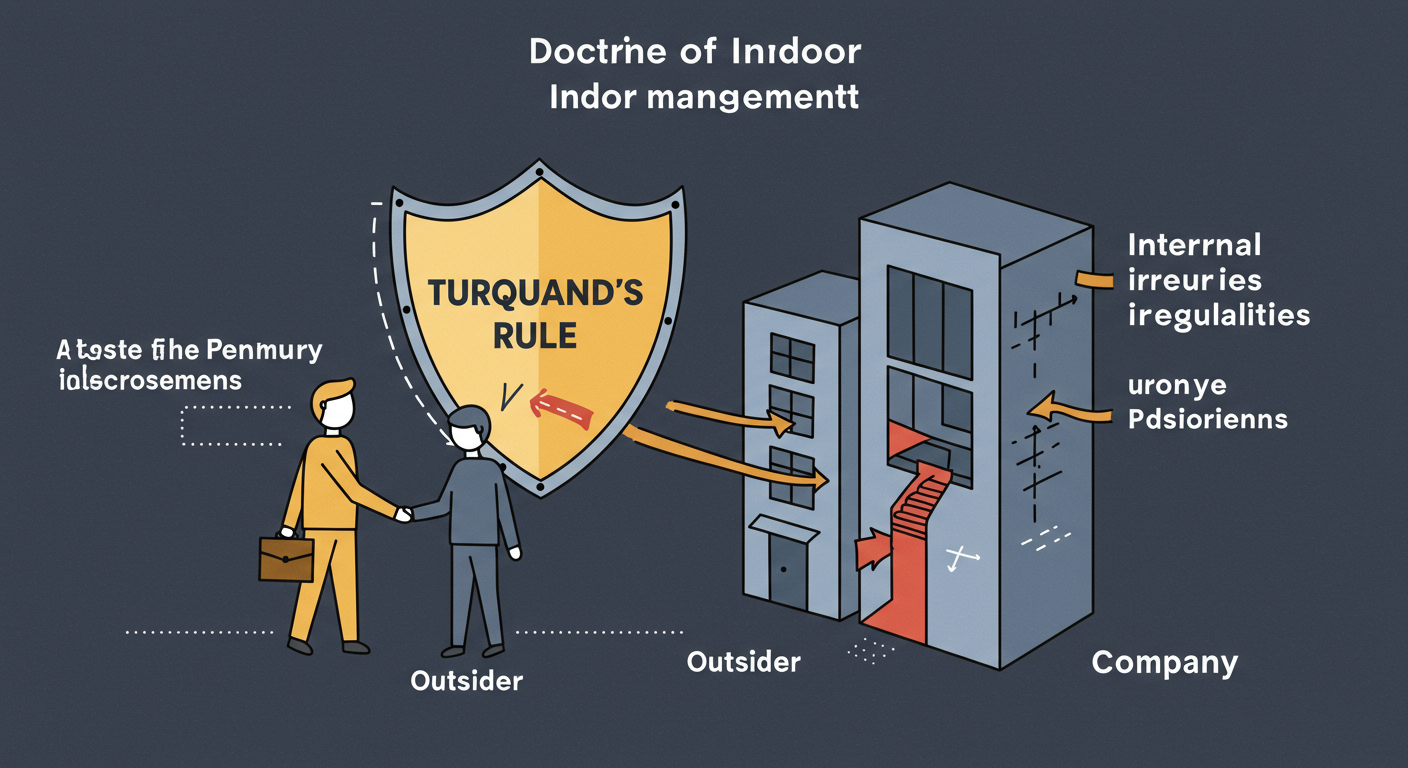
This is where a legal principle called the Doctrine of Indoor Management comes in. Also known as Turquand’s Rule, it essentially protects outsiders who deal with a company in good faith. It states that outsiders are entitled to assume that the company’s internal procedures have been followed correctly.
For example, if your AOA says that any contract over ₹1,00,000 requires a board resolution, and a director signs a ₹2,00,000 contract with a supplier, that supplier can assume the board resolution was passed. The company cannot later cancel the contract by claiming its own internal rules weren’t followed. The contract is binding.
This doctrine builds trust in corporate dealings. However, it’s not a “get out of jail free” card. It doesn’t protect someone who had actual knowledge of the internal irregularity or if the circumstances were so suspicious that they should have inquired further.
⚠️ Watch Out
Don’t misinterpret the Doctrine of Indoor Management as an excuse for sloppy internal governance. While it may protect an outsider, the directors who acted without proper authority can still be held personally liable by the company and its shareholders for breaching their duties as defined in the AOA.
Conclusion: Your AOA Is Your Blueprint for Success
We’ve covered a lot of ground, but the core message is simple. The AOA full form—Articles of Association—is far more than a legal formality you file and forget. It’s the living, breathing operational blueprint for your company.
A strong, well-considered AOA prevents founder disputes, clarifies investor rights, and provides a stable framework for growth. A weak or generic one is a ticking time bomb, waiting to explode at the first sign of internal conflict or corporate complexity.
So, here’s your next step. Don’t just file this article away. If you’re a founder, director, or key stakeholder, find your company’s AOA. Read it. Does it accurately reflect how your company operates today? Does it protect you and your partners? Does it empower you to achieve your future goals? If the answer to any of these is “no” or “I don’t know,” it’s time to schedule a review. Your company’s future may depend on it.
❓ Frequently Asked Questions
What is the full form of AOA and MOA?
The AOA full form is Articles of Association, which serves as the company’s internal rulebook for day-to-day management. The MOA full form is Memorandum of Association, which is the company’s charter document defining its objectives and powers.
Is an AOA mandatory for all companies in India?
Yes, for most companies, it is. Under the Companies Act, 2013, it’s mandatory for private limited companies, unlimited companies, and companies limited by guarantee to have their own registered AOA. A public company limited by shares can choose to adopt the model articles in Table F of the Act by default if it doesn’t register its own.
Can the Articles of Association be changed easily?
“Easily” is relative. It’s a simpler process than changing the MOA’s core objectives, but it’s still a formal legal procedure. You must pass a Special Resolution (requiring a 75% majority of shareholders) and file the changes with the Registrar of Companies (ROC). You can’t just decide to change a rule in a board meeting.
What happens if a director acts against the AOA?
If a director performs an act that is beyond the powers granted to them in the AOA (but still within the company’s powers per the MOA), the act is not automatically void. The shareholders can choose to ratify (approve) it later. However, the director may be held liable for breaching their duties to the company.
Who signs the AOA during company formation?
The AOA must be signed by all the initial subscribers to the Memorandum of Association. These are the first shareholders of the company. Their signatures must be witnessed, and the witness must also sign and provide their details.
Should I use a template AOA or hire a professional?
While templates (like Table F) are a good starting point, they are very generic. For any serious business, especially one with multiple founders or plans for investment, it’s highly advisable to hire a Company Secretary (CS) or corporate lawyer to draft a custom AOA. The investment upfront can save you from millions in legal fees and business disputes later.