Introduction to Corporate Governance
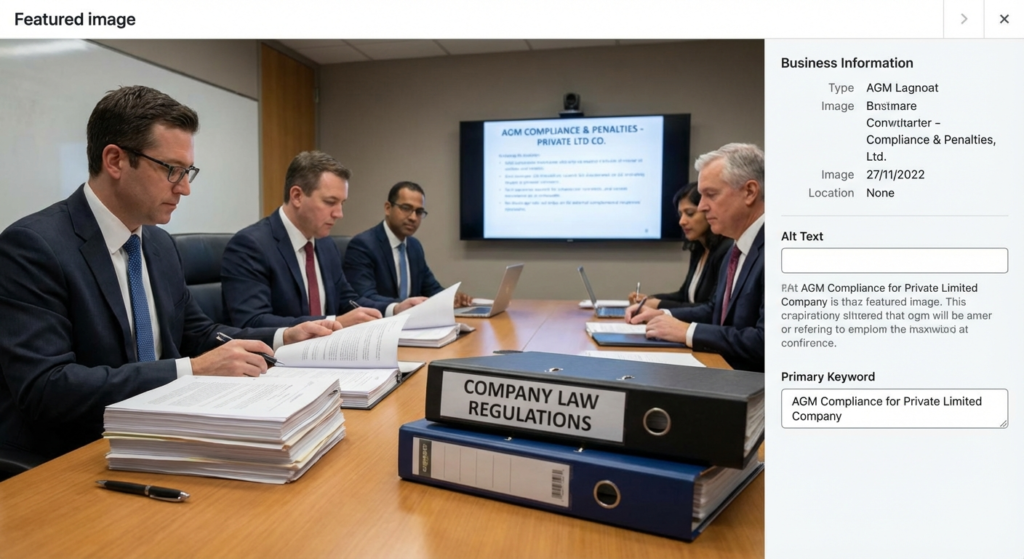
In the dynamic landscape of Indian business, maintaining regulatory standards is paramount for the longevity and reputation of any business entity. For entrepreneurs and stakeholders, ensuring AGM compliance for private limited company operations is a critical annual responsibility. An Annual General Meeting (AGM) is more than just a formal gathering; it is the primary platform where shareholders interact with the management, review financial performance, and make pivotal decisions for the upcoming fiscal year.
Under the Companies Act, 2013, the framework for holding these meetings is strictly defined to protect the interests of shareholders and ensure transparency. Navigating the complexities of AGM Compliance requires a thorough understanding of timelines, documentation, and the legal repercussions of negligence. This comprehensive guide delves into the essential rules, mandatory resolutions, and the heavy penalties associated with non-compliance.
Understanding AGM Compliance for Private Limited Company
AGM compliance for private limited company refers to the set of statutory requirements that a company must fulfill regarding its annual general meeting. According to Section 96 of the Companies Act, 2013, every company, other than a One Person Company (OPC), is legally obligated to hold an AGM every year. This meeting serves as a formal venue to present the audited financial statements to the shareholders and seek their approval on key administrative matters.
The essence of an AGM lies in accountability. It allows shareholders to exercise their voting rights and voice their opinions on how the company is being managed. For a private limited company, which often consists of family members or close associates, the AGM provides a structured environment to document decisions that affect the company’s legal standing and future growth trajectories.
Transparency
Provides a clear view of the company’s financial health to all stakeholders and investors.
Legal Security
Ensures the company remains in the good books of the Registrar of Companies (RoC).
Decision Making
Facilitates formal approval for dividends, director appointments, and auditor selections.
The Deadline for AGM Compliance for Private Limited Company
Timing is everything when it comes to statutory filings. The Companies Act specifies clear timelines for holding an AGM. For a newly incorporated company, the first AGM must be held within nine months from the closing of the first financial year. For all subsequent years, the meeting must be held within six months from the date of closing of the financial year.
Since the financial year in India typically ends on March 31st, the deadline for AGM compliance for private limited company usually falls on or before September 30th of each year. Furthermore, the interval between two consecutive AGMs must not exceed 15 months. It is crucial to note that the Registrar of Companies (RoC) has the power to grant an extension of up to three months for special reasons, but this extension is not applicable to the very first AGM of a company.
Mandatory Resolutions for AGM Compliance for Private Limited Company
During an AGM, specific types of business are transacted, categorized into ‘Ordinary Business’ and ‘Special Business’. Ordinary business includes matters that are mandatory for every AGM, while special business refers to any other matter that requires shareholder approval. Ensuring these resolutions are passed and recorded is a cornerstone of effective corporate governance.
The four primary items of ordinary business are:
- Adoption of Financial Statements: Reviewing and approving the audited balance sheet, profit and loss account, and the reports of the Board of Directors and Auditors.
- Declaration of Dividend: Approving the amount of dividend recommended by the Board to be distributed to shareholders.
- Appointment of Directors: Re-appointing directors who are retiring by rotation or filling vacancies in the board.
- Appointment of Auditors: Appointing or ratifying the appointment of statutory auditors and fixing their remuneration.
Notice Requirements and Procedure
To ensure a valid meeting, a company must follow the prescribed procedure for calling an AGM. A written notice must be sent to every member, director, and auditor of the company at least 21 ‘clear’ days before the meeting. ‘Clear days’ means the day of sending the notice and the day of the meeting are excluded from the count.
The notice must specify the place, date, day, and hour of the meeting and must contain a statement of the business to be transacted. Interestingly, a shorter notice period is permissible if consent is obtained from at least 95% of the members entitled to vote at the meeting. This flexibility is often useful for small private limited companies where all shareholders are readily available.
Notice Period
21 clear days written notice via physical or electronic mode is mandatory.
Quorum
For private companies, 2 members personally present constitute a valid quorum.
Location
Meeting must be held at the registered office or another place within the same city/town.
Filing and Documentation Post-AGM
Holding the meeting is only half the battle. The true measure of AGM compliance for private limited company lies in the subsequent filings with the Ministry of Corporate Affairs (MCA). Once the AGM is concluded, companies must file their annual returns and financial statements using specific e-forms.
The most important forms are AOC-4 (for filing financial statements) and MGT-7 (for the annual return). AOC-4 must be filed within 30 days of the AGM, while MGT-7 must be filed within 60 days. For listed companies, an additional report on the AGM in Form MGT-15 is required; however, for private limited companies, maintaining the minutes of the meeting in a minute book is the primary requirement. These documents serve as a legal record of the proceedings and are subject to inspection by regulatory authorities.
For more information on other statutory requirements, you might find our guide on MSME registration fees helpful if your company falls under that category.
Why AGM Compliance for Private Limited Company is Vital
Compliance is not merely about avoiding fines; it is about building a foundation of trust. When a company consistently meets its AGM obligations, it signals to banks, investors, and vendors that the entity is well-managed and legally sound. In contrast, a history of non-compliance can make it difficult to secure loans, attract equity investment, or even participate in government tenders.
As noted by the Ministry of Corporate Affairs, the strict enforcement of these rules is intended to curb the rise of shell companies and ensure that every registered entity is active and operational. Staying compliant ensures that the ‘Active’ status of the company is maintained on the MCA portal, preventing the directors from being disqualified.
Penalties for Non-Compliance
The consequences of failing to hold an AGM or delay in filing the necessary forms are severe. The Companies Act, 2013, provides for both monetary fines and legal prosecution. If a company defaults in holding the AGM, the company and every officer in default may be punishable with a fine of up to ₹1 lakh. If the default continues, a further fine of ₹5,000 per day may be imposed.
Furthermore, if a company fails to file its annual returns (MGT-7) or financial statements (AOC-4) for three consecutive financial years, the directors of that company risk disqualification under Section 164 of the Act. Disqualified directors cannot be appointed or re-appointed in any other company for a period of five years. This can have a devastating impact on a professional’s career and the operational capacity of other businesses they might be involved in.
Company Fine
Up to ₹1,00,000 for the initial default in holding the meeting.
Continuing Default
₹5,000 per day for every day the default continues after the initial penalty.
Director Impact
Potential disqualification and deactivation of Director Identification Number (DIN).
Role of the Tribunal and Extensions
If for some reason a company is unable to hold its AGM within the prescribed time, it can approach the National Company Law Tribunal (NCLT). The NCLT has the power to call or direct the calling of an AGM. However, this is usually a last-resort measure and involves significant legal costs. It is always advisable to plan ahead and adhere to the 6-month deadline to avoid the complexities of tribunal intervention.
According to the Institute of Company Secretaries of India (ICSI), proper secretarial standards (SS-2) should be followed to ensure the minutes and proceedings are beyond reproach. These standards provide a granular guide on how to conduct general meetings, from the seating arrangements to the recording of votes by a show of hands or poll.
Conclusion
In conclusion, AGM compliance for private limited company is a non-negotiable aspect of corporate existence in India. From the strict 6-month deadline to the meticulous filing of AOC-4 and MGT-7 forms, every step requires precision and legal foresight. By prioritizing these meetings, companies not only stay on the right side of the law but also foster a culture of transparency and accountability that benefits all stakeholders. Whether you are a small startup or an established private firm, adhering to these rules is the best way to safeguard your corporate future and avoid the heavy hand of penalties and disqualification.
FAQs
For an existing company, the AGM must be held within 6 months from the end of the financial year, which is usually September 30th. For a newly incorporated company, the first AGM must be held within 9 months of the end of the first financial year.
No, an AGM cannot be held on a National Holiday (e.g., Republic Day, Independence Day, or Gandhi Jayanti). However, it can be held on other public holidays that are not declared national holidays, provided it is held during business hours (9 AM to 6 PM).
Yes, the statutory auditor is required to attend the AGM unless they are granted an exemption by the company. If they cannot attend, they must send a qualified representative who is also a chartered accountant.
If the required quorum (usually 2 members for a private company) is not present within half an hour of the scheduled time, the meeting stands adjourned to the same day in the next week at the same time and place, or to such other date and time as the Board may determine.
While the Companies Act originally envisioned physical meetings, the MCA has issued several circulars allowing companies to hold AGMs through Video Conferencing (VC) or Other Audio-Visual Means (OAVM), subject to specific compliance requirements regarding recording and voting.