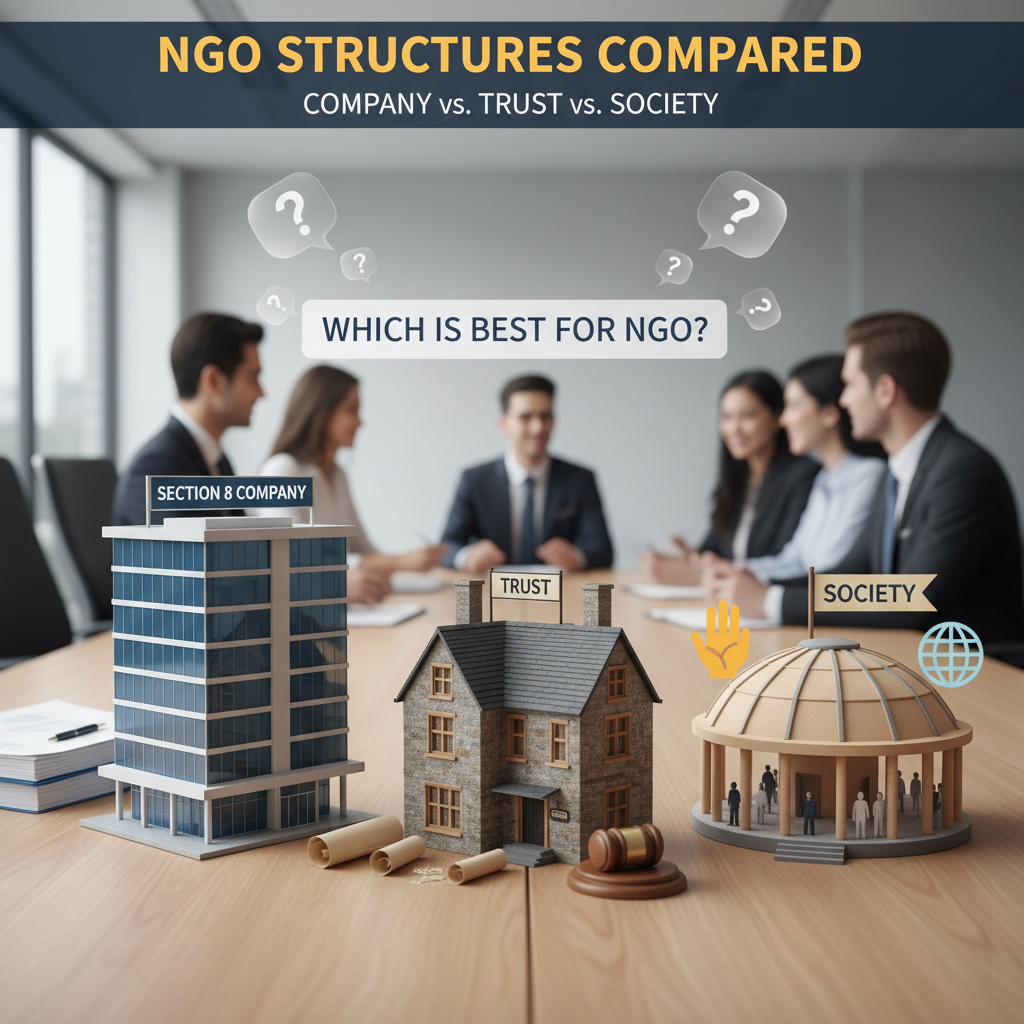
The Crucial Decision: Understanding Section 8 Company vs Trust vs Society
When visionary individuals decide to dedicate their efforts toward social good in India, the journey begins not just with a mission, but with a critical legal decision: choosing the right organizational structure. Non-Governmental Organizations (NGOs) in India typically operate under three primary legal frameworks: the Section 8 Company, the Public Charitable Trust, or the Registered Society. Understanding the differences is paramount, as the choice dictates the level of compliance, governance, funding capabilities, and overall credibility.
This comprehensive guide delves into the specifics of the section 8 company vs trust vs society debate, providing you with the insights needed to select the structure that best aligns with your long-term charitable goals. Ignoring this initial step can lead to significant regulatory hurdles down the line.
Why Structural Choice Matters for NGOs
The legal framework you choose governs the laws under which your organization operates. For instance, a Section 8 Company is governed by corporate law, while Trusts and Societies fall under state-specific regulations or foundational acts. This difference affects everything from board composition to mandatory annual filings.
Key considerations include:
- Credibility: Which structure instills the highest confidence in domestic and international donors?
- Compliance Burden: How rigorous are the mandatory annual filings and auditing requirements?
- Operational Flexibility: How easy is it to manage internal changes, such as adding or removing members/directors?
Section 8 Company vs Trust vs Society: Governing Laws and Registration (PK 1)
While all three structures serve non-profit objectives, their origins and regulatory masters are distinct. Knowing who governs your organization is the first step in managing compliance.
Section 8 Company (Companies Act, 2013)
This structure is registered under the Ministry of Corporate Affairs (MCA). It is essentially a company formed for the promotion of commerce, art, science, sports, education, research, social welfare, religion, charity, protection of environment, or any such other object, with the crucial condition that profits are applied solely toward promoting the company’s objects and no dividend is paid to its members. It offers high national credibility.
Public Charitable Trust (Indian Trusts Act, 1882)
Trusts are regulated primarily by the Indian Trusts Act, 1882, though many states (like Maharashtra, Gujarat, Rajasthan) have their own Public Trusts Acts. Registration happens at the local level with the Registrar or Sub-Registrar of Assurances. Trusts are typically quicker to register but are often viewed as less transparent than Section 8 Companies, especially for large-scale operations.
Registered Society (Societies Registration Act, 1860)
Societies are registered under the Societies Registration Act, 1860, or corresponding state acts. They are generally membership-based organizations designed to promote scientific, literary, or charitable purposes. Registration is done with the Registrar of Societies. Societies require a minimum of seven founding members (subscribers to the Memorandum).
The Role of Governance in NGO Structures
Governance structure significantly differentiates these entities. A Section 8 Company operates with a Board of Directors, requiring strict adherence to corporate governance norms, similar to a private limited company. A Trust is managed by Trustees, governed by the Trust Deed. A Society is managed by a Governing Body or Managing Committee, elected by its general members.
It is often cited that, "Good governance is not just about compliance; it’s about building donor trust and operational efficiency," a principle that Section 8 Companies are inherently designed to uphold due to MCA oversight.
Compliance and Regulatory Burden: Comparing Section 8 Company vs Trust vs Society (PK 2)
The level of mandatory adherence to statutory rules is perhaps the most significant practical difference between these three structures. Compliance dictates the time, cost, and administrative effort required annually.
High Compliance (Section 8)
Must comply with all provisions of the Companies Act, 2013 (including annual filings like AOC-4 and MGT-7), hold mandatory Board meetings, and adhere to strict auditing standards. This structured compliance is why they are highly credible.
Medium Compliance (Society)
Requires annual filing of the list of managing committee members and potentially audited accounts with the Registrar of Societies. Compliance requirements vary significantly by state.
Low Compliance (Trust)
Generally has the lowest regulatory burden, often only requiring filing annual accounts with the local Charity Commissioner or Registrar (where applicable). However, lack of centralized regulation can sometimes reduce perceived credibility.
The formal process for incorporating a Section 8 Company is governed by the Ministry of Corporate Affairs (MCA) and involves stricter, time-bound filings compared to Trusts or Societies. If you are ready to proceed, detailed guidance is available on the Section 8 Registration process. Furthermore, compliance requirements, such as those related to the Annual General Meeting (AGM) and mandatory audits, are rigid for Section 8 companies, ensuring higher transparency, similar to rules governing private limited company formation in India.
Taxation, Funding, and Donor Confidence (PK 3)
For any non-profit, the ability to secure tax exemptions (12A) and offer tax benefits to donors (80G) is crucial. While all three structures are eligible for these benefits, the perception and ease of receiving large-scale funding differ.
Achieving 12A and 80G Status
Regardless of whether you choose a Section 8 Company, Trust, or Society, obtaining registration under Section 12A of the Income Tax Act, 1961, is mandatory to claim income tax exemption. Subsequent registration under Section 80G allows donors to claim deductions on their contributions. The process for applying for these exemptions is regulated by the Income Tax Department. The requirements for documentation and subsequent annual filing of IT returns are rigorous for all three structures once 12A and 80G status is achieved. You can find detailed regulations regarding the filing requirements for charitable organizations on the official website of the Income Tax Department, Government of India. Refer to the Income Tax Act guidelines for the latest provisions regarding tax exemptions for charitable institutions.
Section 8: Funding Magnet
Highest donor confidence, especially from corporate CSR funds and international donors (subject to FCRA registration). Its corporate structure suggests greater accountability and professional management.
Trust: Asset Focus
Often preferred for managing specific assets (like schools or hospitals) or for family endowments. Credibility is moderate; funding often relies on the reputation of the trustees.
Society: Membership Focus
Ideal for localized operations, clubs, or academic institutions. Funding is often localized or membership-driven. Securing large institutional grants might require extra effort to prove governance standards.
The Section 8 Company vs Trust vs Society Decision Matrix (PK 4)
Choosing the "best" structure depends entirely on the scale, scope, and nature of your intended activities.
If your mission involves nationwide operations, professional management, and reliance on substantial corporate social responsibility (CSR) funds, the Section 8 Company is usually the superior choice. If your focus is purely localized, asset-based, or requires minimal initial compliance hassle, a Trust or Society may suffice.
Choose Section 8 Company If…
- You plan to operate across multiple states or nationally.
- You seek major corporate/institutional funding (CSR).
- You prioritize high public credibility and transparency.
- You are comfortable with strict annual compliance and auditing.
Choose Charitable Trust If…
- Your operations are localized (e.g., in one city/district).
- Your primary goal is managing specific property or assets (e.g., a school building).
- You need the quickest and simplest registration process.
- You prefer minimal statutory compliance initially.
Choose Registered Society If…
- Your organization is membership-driven (e.g., sports clubs, academic associations).
- You require democratic decision-making via a large general body.
- Your focus is on promoting literary, scientific, or cultural activities.
- You have a minimum of seven people ready to form the Governing Body.
Ultimately, the structure must support the mission. While a Trust is easier to start, the administrative complexity of managing a large, professional non-profit through a Trust Deed can often outweigh the benefits of lower initial compliance. The corporate framework of a Section 8 Company is designed to handle scalability and professional management effectively.
It is worth noting that Section 8 Companies are subject to the rigors of corporate law. For example, their annual audit deadlines and adherence to meeting protocols are similar to those faced by a standard private company audit, ensuring a high degree of financial discipline.
Operational Flexibility and Member Liability
Operational flexibility is another area where these structures diverge. In a Section 8 Company, the liability of members is limited to the amount they agree to contribute (usually nominal), offering protection. Trusts and Societies generally do not offer the same degree of limited liability protection to their management members, depending on the specific deed or state act.
Moreover, Section 8 Companies have a clear process for appointing and removing directors under the Companies Act, providing a stable governance structure. Changes in trustees or society members can sometimes be more cumbersome, particularly if disputes arise and the foundational documents are vaguely drafted. For detailed information on the legal implications of non-profit operations and accountability, the regulatory framework governing NGOs often refers to global best practices. The United Nations provides extensive resources on the role and accountability of civil society organizations worldwide.
Conclusion: Making the Informed Choice
The decision between a Section 8 Company, a Trust, and a Society is a strategic one that should not be rushed. If your goal is to build a scalable, nationally or internationally recognized NGO that attracts significant corporate funding and prioritizes robust governance, the Section 8 Company is the undisputed best choice, despite its higher compliance costs.
Conversely, if speed, localized operations, and minimum initial formality are your priorities, a Trust or Society may be more suitable. By carefully weighing the requirements of compliance against the potential for funding and credibility, you can ensure your non-profit organization is built on a solid legal foundation ready to achieve its mission.
FAQs
Yes. A Section 8 Company is generally considered superior for securing large-scale funding, especially Corporate Social Responsibility (CSR) funds and international grants. Its registration under the Ministry of Corporate Affairs (MCA) mandates stricter governance and transparency, which significantly boosts donor confidence compared to Trusts, which are often locally regulated.
The Public Charitable Trust generally has the lowest compliance burden, particularly in states without stringent Public Trusts Acts. However, this lower burden is often offset by lower perceived credibility and limitations on scalability.
Yes, all three legal structures (Section 8 Company, Trust, and Society) are eligible to apply for and obtain registration under Section 12A (income tax exemption) and Section 80G (tax benefits for donors) of the Income Tax Act, 1961, provided they meet the specific conditions and follow the prescribed application process.
A Registered Society typically requires a minimum of seven members (subscribers to the Memorandum) to be established under the Societies Registration Act, 1860, or corresponding state legislation. This requirement makes it fundamentally membership-driven.
No. A significant advantage of the Section 8 Company is the limited liability of its members. Their liability is usually limited to the nominal amount they guarantee to contribute to the assets of the company in the event of winding up, offering a layer of protection not always available in Trusts or Societies.
Read Also:
- How to Change Business Address in GST Registration Online: The Ultimate 2025 Guide
- The Essential Guide to MOA and AOA Meaning: Difference and Importance for Companies
- How to Start Working in India as a Foreigner – 8 Comprehensive Step
- LLP vs Private Limited Company India Comparison: Choosing the Best Structure for 2026
- 7 Crucial Facts About GST Penalty Interest Every Business Owner Must Know – Visual Story
- Launch Your 2026 Trucking Empire
- Master Your HRA for 2026 Tax Savings
- Partnership to Powerhouse: Your 2026 Upgrade
- Odisha Scholarship 2026: Your Future Funded
- MGT Full Form: The 2026 Director’s Guide to MCA Compliance – Visual Story