Unlocking Global Trade: Why Import Export Code IEC Registration Online is Essential
The global marketplace offers unprecedented opportunities for businesses, but accessing this vast arena requires adherence to regulatory frameworks. For any entity in India looking to engage in cross-border trade—whether importing goods into the country or exporting products internationally—the foundational requirement is obtaining the Import Export Code (IEC). This unique 10-digit number, issued by the Directorate General of Foreign Trade (DGFT), acts as a mandatory license for conducting import and export activities.
Fortunately, the process has been streamlined significantly. Applying for your import export code IEC registration online is now a fast, efficient, and paperless procedure handled entirely through the official DGFT portal. This guide provides a comprehensive walkthrough, ensuring you understand not only the necessity of the IEC but also the precise steps required to secure it quickly and compliantly.
If you are serious about expanding your business horizons beyond India’s borders, understanding and completing your IEC Registration is the critical first step. Let’s dive into the details of navigating this crucial requirement.
Why the Import Export Code (IEC) is Non-Negotiable
The IEC is more than just a registration number; it is the passport for your goods at customs. Without a valid IEC, Indian customs authorities will not permit goods to be shipped out or cleared inbound shipments. It is a mandatory requirement under the Foreign Trade (Development and Regulation) Act, 1992.
The digitization of the process has made obtaining the import export code IEC registration online simpler than ever, typically taking just a few days if all documents are in order. Furthermore, the IEC is a permanent registration, valid for the lifetime of the entity, provided annual updates are performed.
Key Advantages of Obtaining the Import Export Code
Beyond compliance, the IEC offers several operational and strategic benefits:
- Access to Schemes: IEC holders can avail themselves of various export promotion schemes offered by the DGFT, such as the Merchandise Exports from India Scheme (MEIS) or Remission of Duties and Taxes on Exported Products (RoDTEP).
- Streamlined Banking: Banks require the IEC to facilitate international transfers and transactions related to import and export activities.
- Business Expansion: It validates your business’s intention to operate on a global scale, enhancing credibility with international partners and suppliers.
- Simple Compliance: Unlike many other licenses, the IEC requires minimal post-registration compliance, making it highly accessible for SMEs and proprietorships.
As experts often note, “In the realm of international trade, documentation is paramount. The IEC serves as the primary legal gateway for Indian entities to participate.”
Preparing for Your Import Export Code IEC Registration Online Application
The DGFT application portal requires specific documentation and details to verify the identity and bank account of the applicant. Preparation is key to ensuring your application is approved without delays. The entire process hinges on the applicant’s PAN card, which acts as the primary identifier.
PAN Card Details
The PAN of the individual (for proprietorship) or the entity (for company/LLP) is mandatory. The application links directly to the PAN database for verification.
Bank Account Proof
A cancelled cheque or bank certificate showing the applicant’s name, account number, and IFSC code. This account must be used for export/import transactions.
Address Proof
Proof of the registered office address (e.g., utility bill, rent agreement, sale deed). This must be current and in the name of the applicant or associated entity.
Digital Signature/Aadhaar OTP
The application is submitted digitally. You will need either a Digital Signature Certificate (DSC) or the ability to authenticate using Aadhaar OTP (for individuals/proprietorships).
The Significance of Linking with GSTIN
Post-2017, the integration between the IEC and the Goods and Services Tax Identification Number (GSTIN) became mandatory for most registered businesses. If you are registered under GST, your GSTIN will effectively serve as your IEC for most purposes. However, certain categories of entities (such as those dealing only in exempt goods or those not required to register under GST) still need the traditional import export code IEC registration online.
It is crucial that the details provided during the IEC application (especially the legal name and address) exactly match the records held by the Income Tax Department (PAN) and the GST Network (GSTN), if applicable. Discrepancies lead to automatic rejection.
Step-by-Step Guide to Import Export Code IEC Registration Online
The application is processed via the official DGFT website. The entire procedure is designed to be user-friendly, minimizing manual intervention and maximizing speed.
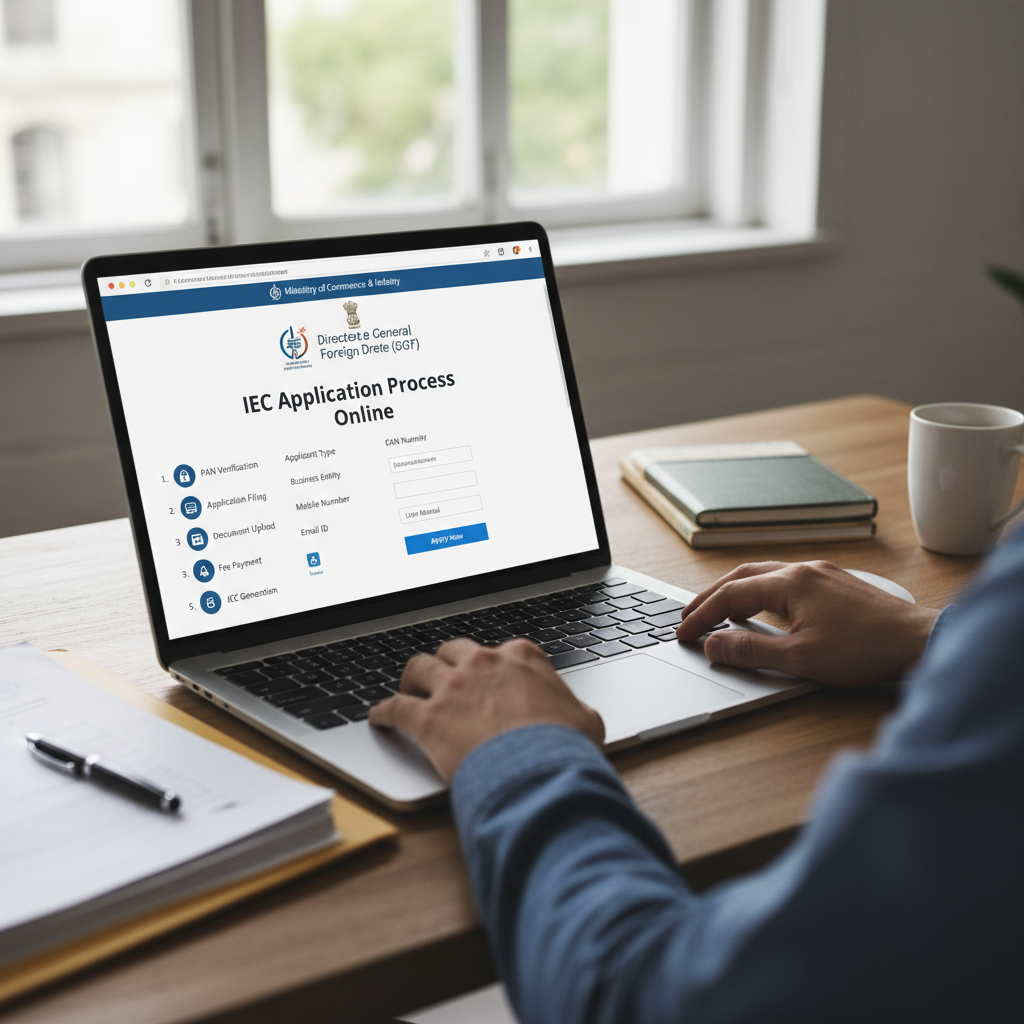
Step 1: Access the DGFT Portal
Navigate to the DGFT website and locate the ‘Services’ section, then select ‘Apply for IEC’. You will be required to register as a new user using your email and mobile number.
Step 2: PAN Verification and Entity Details
Enter the applicant’s PAN. The system validates the PAN automatically. Once validated, fill in basic details like the name of the entity, address, and the nature of the business (e.g., manufacturer, merchant exporter).
Step 3: Bank Details and Certificate Upload
Provide the bank account number and IFSC code. Upload the scanned copy of the cancelled cheque or bank certificate. Ensure the file size and format comply with DGFT specifications.
Step 4: Supporting Documents Upload
Upload the required address proof and any other mandatory documents based on the constitution of your business (e.g., Partnership Deed, Certificate of Incorporation).
Step 5: Fee Payment and Submission
Pay the prescribed application fee online using net banking, credit/debit card, or UPI. Once payment is confirmed, submit the application using either Aadhaar OTP verification or a Digital Signature Certificate (DSC).
Once submitted, the system automatically processes the application. Because the verification is linked primarily to PAN and Aadhaar/GSTIN, approval is often instantaneous or within a few hours. The IEC certificate is then generated and can be downloaded immediately from the portal.
Maintaining and Updating Your Import Export Code (IEC): Annual Compliance
While the IEC is valid for the entity’s lifetime, the DGFT introduced a crucial compliance measure in 2021: the requirement for annual electronic updation (e-KYC) of the IEC profile. This process, known as the Annual Updation Exercise, ensures the DGFT database remains current.
Every IEC holder must electronically confirm or update their details between April and June each year. Failure to complete this annual update results in the deactivation of the IEC. A deactivated IEC cannot be used for any import or export transaction until it is reactivated after the necessary compliance is met.
This mandatory annual exercise highlights DGFT’s commitment to maintaining a robust and accurate record of global traders in India. Even if there are no changes to the business details, the IEC holder must log in and confirm that the existing data is correct.
Benefits of Timely IEC Updation
Continuous Operational Flow
Ensures your IEC remains active, preventing customs delays and interruptions in your supply chain due to deactivation.
Eligibility for Incentives
Only active IEC holders are eligible to apply for export promotion schemes and benefits offered by the government.
Regulatory Compliance
Fulfills the mandatory requirement under the Foreign Trade Policy, avoiding potential penalties or complications during audits.
Common Pitfalls and Pro Tips for IEC Application
While the process for import export code IEC registration online is straightforward, minor errors can cause significant processing delays. Paying attention to these details can ensure rapid approval:
- Matching Names: Ensure the name on the bank certificate/cancelled cheque exactly matches the name of the legal entity on the PAN card.
- Valid Address Proof: Utility bills must not be older than two months. If the address proof is in the director’s name but the application is for a company, a supporting document (like a board resolution or rent agreement) linking the two must be provided.
- Clear Scans: Upload high-resolution scans of all documents. Blurry or incomplete documents are the most common reason for rejection.
For businesses seeking comprehensive regulatory assistance, integrating IEC registration with other necessary registrations, such as GST registration, provides a holistic compliance foundation.
It is also important to note that certain individuals or entities are exempted from obtaining the IEC, primarily government departments and ministries, or individuals importing/exporting goods for personal use not connected with trade, manufacture, or agriculture. However, for commercial purposes, the IEC is universally required. For detailed policies, applicants should always refer to the official DGFT Foreign Trade Policy Handbook.
Furthermore, understanding the classification of goods using the Harmonized System (HS) codes is essential for smooth customs clearance once the IEC is secured. The IEC simply grants permission; the specific trade regulations depend on the nature of the goods being traded, which are governed by specific customs and trade agreements, often monitored by bodies like the Ministry of Commerce and Industry. You can find essential trade details and policies on the Ministry of Commerce website.
Conclusion
The accessibility of the import export code IEC registration online has fundamentally changed how Indian businesses approach global trade. By leveraging the digital infrastructure provided by the DGFT, entrepreneurs can secure their license to trade internationally quickly and efficiently. The key to a seamless application lies in meticulous preparation of documents, accurate data entry matching existing government records (PAN and GSTIN), and timely annual compliance.
Securing the IEC is not merely a bureaucratic hurdle; it is a strategic investment that certifies your business for global operations, opening doors to incentives and facilitating smoother logistical processes. Start your registration today and take the definitive step toward international business success.
FAQs
If all documents are accurately uploaded and verified (especially PAN and bank details), the IEC is often generated instantaneously or within 24 to 48 hours. The DGFT system is highly automated, minimizing processing delays.
No. According to DGFT regulations, if you are only exporting services or software and are not importing or exporting goods, the IEC is generally not mandatory. However, banks may sometimes request it for international remittance purposes, so many service exporters choose to obtain it anyway for operational ease.
The IEC itself does not expire; it is valid for the lifetime of the business. However, it requires mandatory annual electronic updation (e-KYC) between April and June each year, even if there are no changes. Failure to complete this annual update leads to automatic deactivation.
The prescribed application fee for new IEC registration through the DGFT portal is currently Rs. 500. This fee must be paid online during the final submission step of the application process.
If you are registered under GST, your GSTIN is treated as your IEC for customs purposes. However, you still need to register on the DGFT portal to obtain the official IEC certificate which is linked to your PAN/GSTIN. This ensures you are listed in the DGFT database and can access trade benefits.
Read Also:
- Trade License Registration: State-wise Requirements and Process in India
- Is NGO Darpan Registration mandatory for a Bank Account?
- Comprehensive Guide to Trade License Registration Requirements India: State-wise Process and Renewal
- TDS Rate Chart for FY 2025-26 India: A Comprehensive Guide for Small Businesses
- 7 Critical Rules for Advance Tax Payment India: The Ultimate FY 2024-25 Guide
- Why Your Business Needs a CA in 2026
- Maharashtra PT Payment: The Ultimate Online Guide for 2026
- Avoid Tax Penalties: Your 2026 194Q Guide
- Your CIN Certificate in 2024: 7 Key Facts Every Business Owner Must Know – Visual Story
- Professional Tax Payment Online Maharashtra 2026: The Definitive Guide
- 12 Famous Trademark Examples & The Secrets to Their Success (2026)
- MCA Name Availability 2026: Get Your Company Name Approved – Visual Story
- Trademark Renewal in India: The Ultimate 2026 Guide
- Your 2026 Startup’s Secret Legal Weapon
- Partnership Firm Registration: The Ultimate 2026 Guide