Picture this: You and your co-founder have a brilliant idea. You’ve spent countless nights sketching it out, and you’re ready to build an empire together. But then you hit the first real hurdle: legal structure. You’ve heard a partnership is easy, but what does that actually mean? Here’s a shocking fact: most unregistered partnerships in India are operating on a handshake and a prayer, legally exposed and unable to enforce their own contracts.
Don’t let that be you.
This isn’t just another dry legal post. This is your 2026 playbook, written from years of hands-on experience guiding entrepreneurs through this exact process. You’re about to learn not just the ‘how’ of partnership firm registration, but the ‘why’ behind every step. We’ll cover drafting an ironclad partnership deed, navigating the online registration portal, and avoiding the rookie mistakes that can derail your business before it even starts.
Registered vs. Unregistered: Why “Optional” is a Trap
The Indian Partnership Act, 1932, technically makes registration optional. This is, without a doubt, the most misleading “option” in Indian business law. Choosing to remain unregistered is like building a house without a foundation. It might stand for a while, but it’s destined to crumble under pressure.
An unregistered firm is a ghost in the legal system. It can’t sue anyone to enforce its rights, but anyone can sue it. Think about that. A client refuses to pay a massive invoice? You can’t take them to court. A supplier sends you faulty goods? Your legal options are next to none. It’s a one-way street to financial risk.
In our experience, the short-term convenience of skipping registration is never worth the long-term vulnerability. Let’s break down the real-world differences.
| Feature | ✅ Registered Partnership Firm | ❌ Unregistered Partnership Firm |
|---|---|---|
| Legal Action | Can sue third parties (clients, suppliers) to enforce contracts. | Cannot sue third parties for contractual rights. A massive disadvantage. |
| Internal Disputes | Partners can sue each other or the firm to enforce their rights under the deed. | Partners cannot sue each other over firm matters. Disputes become unresolvable. |
| Claiming Set-Off | Can claim a set-off if sued by a third party (i.e., counterclaim to reduce the debt). | Cannot claim a set-off, severely weakening its defense in a lawsuit. |
| Credibility & Funding | Viewed as credible by banks, investors, and government bodies. Easier to get loans. | Lacks credibility. Most banks and financial institutions will refuse to lend. |
| Conversion | Can be more easily converted into other legal structures like an LLP or Company. | Complex and often requires registration first before any conversion. |
⚠️ Watch Out
The biggest myth is that you can just register later when a problem arises. Wrong. You cannot file a lawsuit for a past event that occurred while your firm was unregistered. The right you want to enforce must exist after the registration is complete. It’s not retroactive.
The Partnership Deed: Your Business Constitution
Before you even think about forms or government portals, you need to focus on the single most important document in your partnership’s life: the Partnership Deed.
This isn’t just a formality; it’s the legally binding rulebook for your business. It governs everything from who puts in what money to how you’ll handle a fight. A well-drafted deed is your best insurance policy against future disputes. A vague one is a lawsuit waiting to happen.
Think of it like this: you and your partners are setting off on a long voyage. The Partnership Deed is your map, your emergency plan, and your agreement on who gets to be captain. You wouldn’t set sail without it, would you?
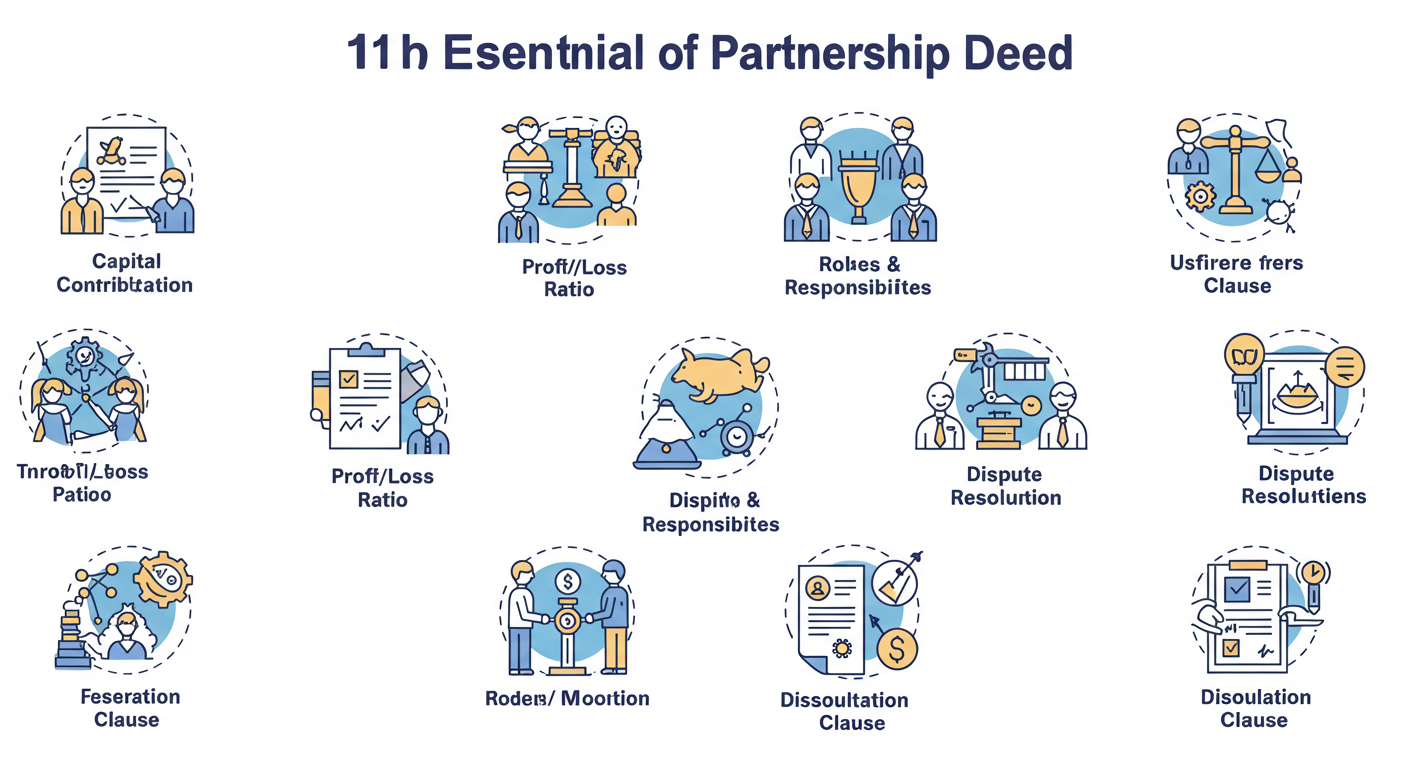
Key Clauses Your Deed MUST Include:
- Name and Address of the Firm & Partners: The basics.
- Nature of Business: What will the firm actually do? Be specific.
- Capital Contribution: How much cash, assets, or expertise is each partner bringing to the table? This must be crystal clear.
- Profit and Loss Sharing Ratio: The default is equal, but you can set any ratio. Define it explicitly.
- Management Roles & Responsibilities: Who does what? Who has the final say on key decisions?
- Salaries and Drawings: Can partners draw a salary? How much can they withdraw from the business?
- Dispute Resolution: How will you resolve disagreements? Agree on a mediation or arbitration process now to avoid court later.
- Dissolution Clause: The “business pre-nup.” How will you wind up the business if things go south or a partner wants to leave?
* Duration of Partnership: Is it for a fixed term, a specific project, or will it be a “partnership-at-will”?
💡 Pro Tip
Don’t use a generic template you found online without customizing it. Spend a little extra time (and maybe money on a legal professional) to draft a deed that reflects your specific business and partner dynamics. Address the “what ifs”: What if a partner passes away? What if someone wants to exit? What if you want to bring in a new partner? Cover these now, thank yourself later.
The 2026 Partnership Firm Registration Process: Step-by-Step
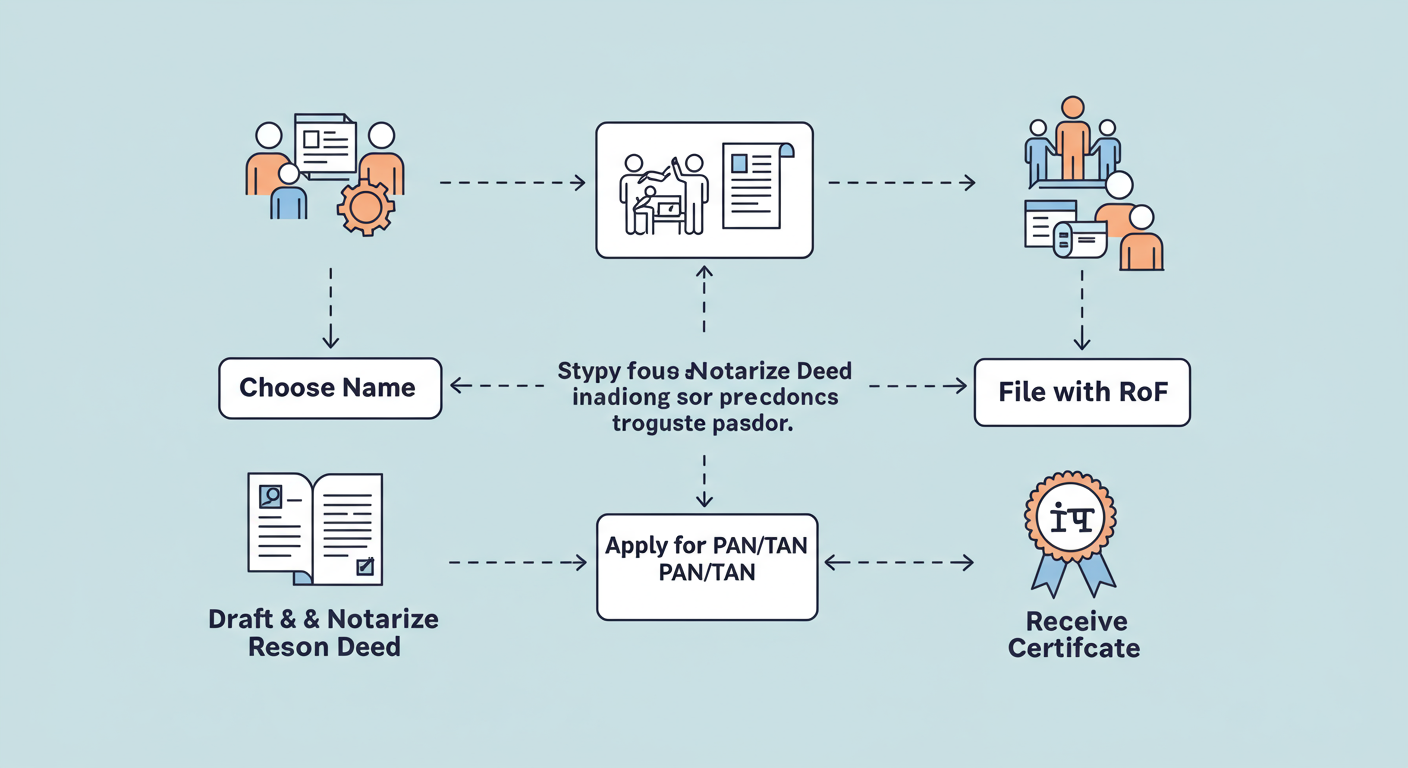
Alright, with your ironclad deed ready, it’s time to make it official. The process is regulated at the state level by the Registrar of Firms (RoF), and most states now have streamlined online portals. Here’s the game plan.
Step 1: Choose a Unique Business Name
Your firm’s name can’t be identical or too similar to an existing firm in the same business. It also can’t contain words like ‘Crown’, ‘Emperor’, ‘Empire’, or any term that suggests government patronage, without explicit permission.
Action: Brainstorm 3-5 names and perform a basic Google search and a check on the MCA portal to see if companies with similar names exist. This reduces the chance of rejection.
Step 2: Finalize and Notarize the Partnership Deed
Get your finalized Partnership Deed printed on non-judicial stamp paper. The value of the stamp paper varies by state and is often linked to the firm’s capital. After printing, all partners must sign the deed in the presence of two witnesses. Then, get it notarized.
Action: Check your state’s Stamp Act to determine the correct stamp duty value. Getting this wrong can invalidate the deed.
Step 3: Apply for Firm PAN and TAN
Before you even file for registration, you need a Permanent Account Number (PAN) for the firm. This is mandatory for all financial transactions and tax purposes. You’ll apply for this from the Income Tax Department. A TAN (Tax Deduction and Collection Account Number) is also needed if you’ll be deducting tax at source (e.g., on salaries).
Action: You can apply for the PAN card online using Form 49A. You’ll need a copy of your notarized Partnership Deed.
Step 4: File the Application with the Registrar of Firms (RoF)
This is the final step. You’ll submit the main application form (typically Form 1) along with all the required documents to the RoF of the state where your business is located.
Action: Collate all your documents, scan them if using an online portal, and submit the application along with the prescribed fee. The RoF will review everything. If all is in order, they will issue the Certificate of Registration. Boom. You’re official. October 2023 Compliance Calendar: Navigating Crucial Deadlines
🎯 Key Takeaway
Partnership firm registration isn’t just a legal task; it’s a foundational business strategy. A registered firm with a strong Partnership Deed transforms your venture from a fragile agreement into a resilient, credible, and legally protected entity ready for growth. GST Invoice Format Requirements: Understanding the GST Invoice Format Mandatory Fields India (2026 Update)
Your Ultimate Document Checklist
Getting your documents in order is half the battle. Delays almost always happen because of a missing paper or an incorrect detail. Use this checklist to get it right the first time. Based on hands-on testing, having a digital folder with scans of everything ready will save you hours.
| Document | Details & Key Checks |
|---|---|
| Application Form (Form 1) | The main application, duly signed by all partners. Ensure all details match the Partnership Deed. |
| Notarized Partnership Deed | The original deed printed on stamp paper of the correct value and notarized. |
| Firm’s PAN Card | A copy of the PAN card issued in the firm’s name. |
| Proof of Business Address | If owned: Property deed or tax receipt. If rented: Rent agreement + a No Objection Certificate (NOC) from the landlord. |
| Partner ID & Address Proof | PAN Card and Aadhaar Card/Voter ID/Passport for every partner. Ensure names match perfectly across all documents. |
| Affidavit/Declaration | A sworn statement, often notarized, confirming the authenticity of all submitted information. |
⚠️ Watch Out
Address proof is a common stumbling block. If you’re using a residential address, ensure you have a clear NOC from the property owner. For rented commercial spaces, make sure the rent agreement explicitly allows for commercial activity. A mismatch here is a frequent cause for application rejection.
Beyond Registration: Your First 90 Days of Compliance
Congratulations, you’re registered! But don’t pop the champagne just yet. The work isn’t over. What you do in the first 90 days sets the tone for your firm’s operational health.
- Open a Current Bank Account: This is your top priority. All business transactions must flow through this account. You cannot use personal accounts. Banks will require the Certificate of Registration and the Partnership Deed to open an account in the firm’s name.
- GST Registration: Is your business expected to have a turnover exceeding the threshold limit (₹20 lakhs for services and ₹40 lakhs for goods in most states)? If yes, GST registration is mandatory. It’s also required for any interstate trade, regardless of turnover.
- Other Local Registrations: Depending on your business type and location, you might need a Trade License from your local municipality or other specific permits. Research what’s required in your city.
💡 Pro Tip
When you go to open the firm’s bank account, take all partners along with their original ID/address proofs. Banks have strict KYC (Know Your Customer) norms, and having everyone present can turn a multi-day process into a single-visit task. Trust me on this one, it saves a ton of back-and-forth.

❓ Frequently Asked Questions
How long does partnership firm registration take in 2026?
It varies by state, but with most portals now online, the timeline has improved. After you submit all the correct documents, you can typically expect the Certificate of Registration within 7-15 working days. The document preparation phase, however, is entirely up to you.
What’s the difference between a Partnership and an LLP?
The biggest difference is liability. In a traditional partnership, partners have unlimited liability (meaning personal assets are at risk). In a Limited Liability Partnership (LLP), partners’ liability is limited to their capital contribution. LLPs are registered with the central Ministry of Corporate Affairs (MCA) and have more compliance requirements, making them a sort of hybrid between a partnership and a private limited company.
Can an NRI be a partner in an Indian partnership firm?
Yes, a Non-Resident Indian (NRI) or a Person of Indian Origin (PIO) can become a partner in a firm. However, the investment must comply with FEMA (Foreign Exchange Management Act) regulations, and profits repatriated require RBI approval. It adds a layer of complexity, so professional advice is highly recommended.
What is the maximum number of partners allowed?
For most businesses, the maximum number of partners is 50. If the number of partners exceeds this limit, the association becomes illegal unless it is registered as a company under the Companies Act.
Do we need to renew the registration?
No, the registration of a partnership firm is a one-time process. It’s valid for the lifetime of the firm. However, you must inform the RoF of any changes, such as a change in partners, business address, or firm name, within a stipulated time to avoid penalties.
Your Next Step: From Idea to Official Entity
Navigating the partnership firm registration process in 2026 is more straightforward than ever, but it demands attention to detail. It’s not about just filling out forms; it’s about laying a secure, legal, and credible foundation for the business you’re so passionate about building.
You’ve learned that “optional” registration is a trap, that the Partnership Deed is your non-negotiable business constitution, and that post-registration compliance is just as critical as the registration itself. You’re no longer in the dark. You have the map.
So, what’s your immediate next step? Don’t just think about it. Start drafting your Partnership Deed today. Open a document, list the key clauses we discussed, and schedule a meeting with your partners. Turn that handshake agreement into an ironclad plan. That is the first real step toward building a business that lasts.