Introduction to TDS Compliance for the New Financial Year
As we step into the new financial year, small business owners and entrepreneurs must align their accounting practices with the latest tax regulations. Tax Deducted at Source (TDS) remains one of the most critical compliance pillars in the Indian taxation system. Navigating the TDS rate chart FY 2025-26 India is essential not just for legal adherence, but also for maintaining healthy financial relationships with vendors, employees, and service providers. TDS is essentially an indirect method of collecting tax which combines the concepts of “pay as you earn” and “collect as it is being earned.” For a small business, being aware of these rates ensures you avoid the heavy interest and penalties associated with non-compliance.
Understanding the nuances of the TDS rate chart FY 2025-26 India helps in better cash flow management. When you deduct tax at the right time and at the correct rate, you ensure that your business remains in the good books of the Income Tax Department. Moreover, with the integration of technology in tax administration, mismatches in TDS are flagged almost instantly. Therefore, accuracy is no longer an option; it is a necessity. In this guide, we will break down the complex sections of the Income Tax Act, from 194A to the newly introduced 194T, providing you with a clear roadmap for the upcoming year.
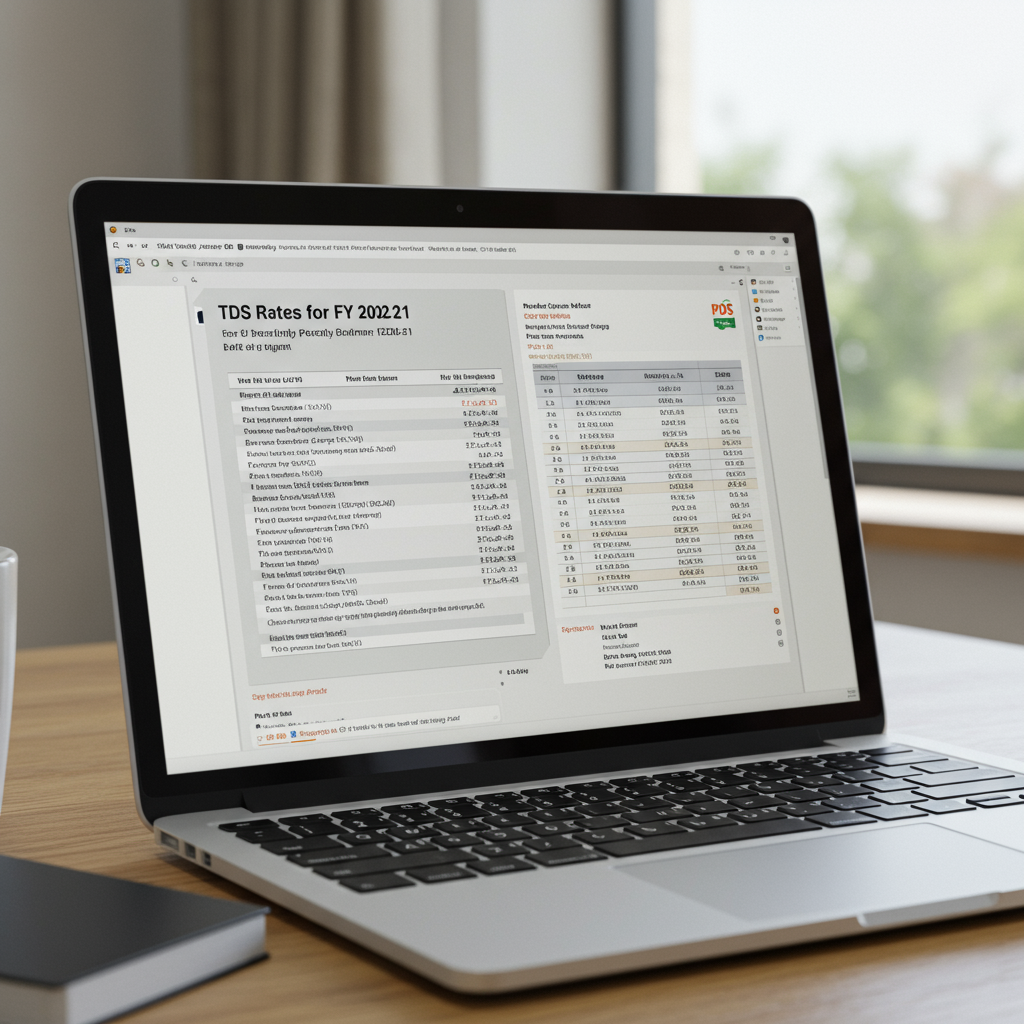
Comprehensive TDS Rate Chart FY 2025-26 India for Businesses
The following table outlines the primary sections that most small and medium enterprises (SMEs) encounter in their daily operations. It is important to note that these rates apply to payments made to residents. For payments to non-residents, the rates are governed by Section 195 and relevant Double Taxation Avoidance Agreements (DTAA).
| Section | Nature of Payment | Threshold Limit | TDS Rate |
|---|---|---|---|
| 194A | Interest other than interest on securities | ₹40,000 (₹50,000 for Seniors) | 10% |
| 194C | Payment to Contractors (Individual/HUF) | ₹30,000 (Single) / ₹1,00,000 (Aggregate) | 1% |
| 194C | Payment to Contractors (Others) | ₹30,000 (Single) / ₹1,00,000 (Aggregate) | 2% |
| 194H | Commission or Brokerage | ₹15,000 | 5% |
| 194I(a) | Rent (Plant & Machinery) | ₹2,40,000 | 2% |
| 194I(b) | Rent (Land, Building, Furniture) | ₹2,40,000 | 10% |
| 194J | Professional Fees / Royalty | ₹30,000 | 10% (2% for Technical/Call Centre) |
| 194Q | Purchase of Goods (Turnover > 10 Cr) | ₹50,00,000 | 0.1% |
| 194R | Benefit or Perquisite in Business | ₹20,000 | 10% |
| 194T | Payments to Partners (Salary/Bonus/Int) | ₹20,000 | 10% |
Managing these various rates can be overwhelming for a growing business. Many entrepreneurs opt for professional TDS Return Filing Services to ensure that every deduction is recorded accurately and filed before the quarterly deadlines. This not only saves time but also prevents the 20% penal rate that applies if the deductee fails to provide a valid PAN.
Understanding Specific Provisions in the TDS rate chart FY 2025-26 India
While the table provides a quick glance, certain sections require a deeper understanding. For instance, Section 194C is one of the most frequently used sections by small businesses. It covers payments made to contractors for any work, including advertising, broadcasting, and catering. If you hire a freelance graphic designer for a one-time project exceeding ₹30,000, you are legally bound to deduct TDS. However, if the designer is an individual, the rate is only 1%, whereas for a company, it jumps to 2%.
Another critical area is Section 194J. There is often confusion between professional services and technical services. Professional services (like legal, medical, or engineering) attract a 10% rate, while technical services (like routine maintenance or call center services) attract a lower rate of 2%. Correct classification is vital to avoid under-deduction, which can lead to the disallowance of the expense in your Income Tax Return. Understanding the benefits of income tax return filing starts with ensuring your expenses are fully deductible through proper TDS compliance.
Why Compliance Matters
Timely deduction and payment of TDS prevent the levy of 1.5% interest per month. It also ensures that your business expenses are not disallowed under Section 40(a)(ia).
The PAN Factor
Always verify the PAN of your vendors. If a vendor does not provide a PAN, the TDS rate automatically jumps to 20%, regardless of the rate mentioned in the chart.
Quarterly Deadlines
TDS returns must be filed quarterly (July 31, Oct 31, Jan 31, and May 31). Missing these dates attracts a late fee of ₹200 per day under Section 234E.
Navigating the TDS Rate Chart FY 2025-26 India for Service Providers
For service-oriented startups, Section 194H (Commission) and Section 194I (Rent) are high-impact areas. If your office rent exceeds ₹2.4 Lakhs per annum, you must deduct 10% TDS. However, if you are renting furniture or equipment, the rate is significantly lower at 2%. This distinction is often missed by new business owners, leading to unnecessary tax outflow. It is advisable to consult the official Income Tax Department website for any mid-year notifications or circulars that might alter these interpretations.
Furthermore, the introduction of Section 194T in recent budgets has brought payments made by firms to their partners under the TDS net. If a partnership firm pays salary, bonus, commission, or interest to its partners exceeding ₹20,000 in a year, it must deduct TDS at 10%. This is a significant change aimed at tracking high-value transactions within closely-held businesses and ensuring they are reflected in the partners’ individual tax returns.
Practical Examples Using the TDS rate chart FY 2025-26 India
Let’s look at a practical scenario. Suppose “Alpha Tech Solutions,” a small software firm, pays ₹5,00,000 as professional fees to a consultant and ₹1,00,000 as rent for its office space. According to the TDS rate chart FY 2025-26 India, Alpha Tech must deduct ₹50,000 (10% of 5L) under Section 194J and ₹10,000 (10% of 1L) under Section 194I. The net amounts paid to the consultant and the landlord would be ₹4,50,000 and ₹90,000 respectively. The deducted ₹60,000 must be deposited with the government by the 7th of the following month.
Another example involves the purchase of goods. If your business turnover exceeded ₹10 Crores in the previous year, and you purchase goods worth ₹60 Lakhs from a single supplier, Section 194Q kicks in. You must deduct 0.1% on the amount exceeding ₹50 Lakhs (i.e., 0.1% of ₹10 Lakhs = ₹1,000). While the percentage seems small, the compliance burden is significant, and non-compliance can lead to a 30% disallowance of the purchase value as an expense.
Strategic Impact of the TDS Rate Chart FY 2025-26 India on Cash Flow
TDS is often viewed as a burden, but it serves as an early tax payment mechanism. For the person receiving the payment, the TDS deducted is reflected in their Form 26AS and AIS (Annual Information Statement). This amount can be claimed as a credit against their final tax liability. For the deductor, it requires a disciplined approach to bookkeeping. You must ensure that the tax is not just deducted on paper but also deposited in the government treasury within the stipulated time. Failure to deposit the deducted tax is a serious offense and can even lead to prosecution.
According to Investopedia, tax deduction at source is a global practice used to minimize tax evasion. In India, the system has become increasingly automated. The TRACES portal allows deductors to download consolidated files and check the status of their filings. For a small business, staying updated with the TDS rate chart FY 2025-26 India means you can provide accurate certificates (Form 16/16A) to your vendors, helping them claim their tax credits without hurdles. This builds trust and professionalism in your business dealings.
Compliance Best Practices for the TDS Rate Chart FY 2025-26 India
To stay ahead of the curve, businesses should implement a few best practices. First, always collect the PAN and Aadhaar details of a vendor at the time of onboarding. Second, reconcile your books of accounts with your TDS returns monthly. Third, use automated accounting software that can calculate TDS based on the latest TDS rate chart FY 2025-26 India. This reduces manual errors and ensures that even if rates change mid-year due to a supplementary budget, your system is updated.
Moreover, keep an eye on the lower deduction certificates. Some vendors might provide a certificate issued by the Assessing Officer under Section 197, allowing you to deduct tax at a lower rate or nil rate. Always verify the validity of such certificates on the TRACES portal before applying the lower rate. Ignoring this step can make you liable for the short-deduction amount plus interest.
Section 194Q vs 206C(1H)
If both TDS on purchase of goods and TCS on sale of goods apply, Section 194Q (TDS) takes precedence. The buyer must deduct tax.
Digital Payments
While TDS applies regardless of the mode of payment, digital records make it easier to track thresholds and ensure compliance for audit purposes.
Lower Deduction
If a vendor provides a certificate under Section 197, you can deduct tax at the specific lower rate mentioned in that certificate.
Conclusion: Staying Ahead with TDS Compliance
Mastering the TDS rate chart FY 2025-26 India is a fundamental skill for every Indian business owner. While the percentages might seem like mere numbers, they represent your commitment to corporate governance and national contribution. By understanding the thresholds for sections like 194C, 194J, and the new 194T, you protect your business from unnecessary financial leakage in the form of penalties. Remember, tax compliance is not a year-end activity; it is a daily commitment to accuracy. As the tax landscape continues to evolve with more digital integrations, being proactive will always be your best strategy for sustainable business growth.
FAQs
Under Section 194J, the TDS rate for professional services is 10%. However, for technical services, royalty for the sale of cinematographic films, or call center operations, the rate is reduced to 2%.
No, TDS is only applicable if the payment to a single party exceeds the specified threshold limit in a financial year. For example, under Section 194C, the limit is ₹30,000 for a single transaction or ₹1,00,000 in aggregate for the year.
If you fail to deduct TDS, you will be liable to pay interest at 1% per month from the date the tax was deductible to the date it is actually deducted. Additionally, 30% of the expense amount may be disallowed for tax purposes.
Section 194T requires partnership firms to deduct TDS at 10% on payments made to partners in the form of salary, bonus, commission, or interest, provided the aggregate payment exceeds ₹20,000 in a financial year.
Yes, if the total TDS deducted is more than your actual tax liability for the year, you can claim a refund by filing your Income Tax Return (ITR).
TDS must be deposited by the 7th of the following month in which the deduction was made. For the month of March, the due date is extended to April 30th.