Understanding Trade License Registration Requirements India for New Businesses
Starting a business in India is an exhilarating journey, but it comes with a suite of regulatory obligations that ensure the safety and harmony of the local community. One of the most fundamental legal steps for any entrepreneur is ensuring they meet the trade license registration requirements India. A trade license is a document or certificate that permits an individual or a company to carry out a specific trade or business for which it is issued in a particular location or area. It is not to be confused with other forms of registration; it is specifically about the suitability of the premises and the nature of the activity within a municipal jurisdiction.
In India, trade licenses are governed by the municipal corporations of the respective state governments. The primary objective is to ensure that the business does not cause any health hazards or nuisance to the residents in the surrounding area. While Business Registration like GST is a federal or state-level tax requirement, the trade license is a localized permit that acts as a bridge between your commercial activity and the local urban body.
Shop License
Issued for small shops, retail outlets, and general commercial establishments operating within municipal limits.
Industrial License
Required for small, medium, and large-scale manufacturing units or factories that may impact environmental safety.
Food Establishment License
Mandatory for restaurants, cafes, hotels, and any business dealing with the sale or processing of food items.
The Necessity of a Municipal Trade License
Why is this license so critical? Beyond the legal mandate, a trade license ensures that your business adheres to the standards set by the National Portal of India and local authorities regarding fire safety, waste management, and public health. Without it, your business could face heavy penalties, or worse, a forced closure by the municipal commissioner. It serves as a validation that your commercial activity is recognized and permitted by the local government.
Furthermore, having a valid trade license is often a prerequisite for obtaining other business-related benefits. For instance, if you are looking for MSME registration documents required, you will find many similarities in the documentation process, and having your trade license in order simplifies these secondary registrations. It also builds trust with banks and financial institutions when applying for business loans or opening a current account.
Detailed Trade License Registration Requirements India: Document Checklist
The documentation process can vary slightly depending on the state, but the core trade license registration requirements India remain relatively consistent. The goal of these documents is to prove the identity of the owner, the legality of the business premises, and the safety of the operations.
- Identity Proof: PAN Card, Aadhaar Card, or Voter ID of the applicant.
- Address Proof: Recent utility bills (electricity or water) of the business location.
- Ownership Proof: Property tax receipts, sale deeds, or a registered lease/rent agreement if the premises are rented.
- No Objection Certificate (NOC): From the landlord (if rented) and sometimes from immediate neighbors for specific types of trades.
- Certified Layout Plan: A map of the business premises showing the area of operation, approved by the municipal corporation.
- Fire NOC: Essential for businesses dealing with hazardous materials or high-occupancy areas like restaurants and factories.
It is worth noting that for certain specialized trades, such as those involving chemicals or heavy machinery, additional environmental clearances may be required from the State Pollution Control Board. Always ensure your documents are updated and clearly legible to avoid rejection during the verification phase.
Essential Trade License Registration Requirements India for Commercial Establishments
For commercial establishments like retail stores or service centers, the focus is often on the “Shop and Establishment Act” of the respective state. While technically distinct in some regions, many municipal bodies integrate these requirements. The primary focus here is on working hours, employee welfare, and the physical safety of the shop. Ensuring your establishment is not encroaching on public land is a key part of the trade license registration requirements India for these businesses.
Navigating Trade License Registration Requirements India Across Different States
India is a diverse country, and this diversity extends to its administrative processes. Each state and its municipal corporations have their own set of rules, portals, and fee structures. Understanding these nuances is vital for a smooth registration process.
Maharashtra (BMC/NMC)
In Mumbai, the Brihanmumbai Municipal Corporation (BMC) manages the process through the ‘Gumasta’ license. It is highly digitized and requires strict adherence to fire safety norms.
Karnataka (BBMP)
The Bruhat Bengaluru Mahanagara Palike (BBMP) has moved most of its trade license services online. They categorize trades into various schedules based on the level of risk and public impact.
Delhi (MCD)
The Municipal Corporation of Delhi offers a unified portal for North, South, and East zones. They emphasize the use of the property’s Unique Property Identification Code (UPIC).
In states like West Bengal, the process is governed by the Kolkata Municipal Corporation (KMC), which issues a “Certificate of Enlistment.” Meanwhile, in Tamil Nadu, the Chennai Corporation has a detailed online system where the fees are calculated based on the square footage and the nature of the trade. Regardless of the state, the underlying principle of trade license registration requirements India remains the protection of public interest.
The Step-by-Step Registration Process
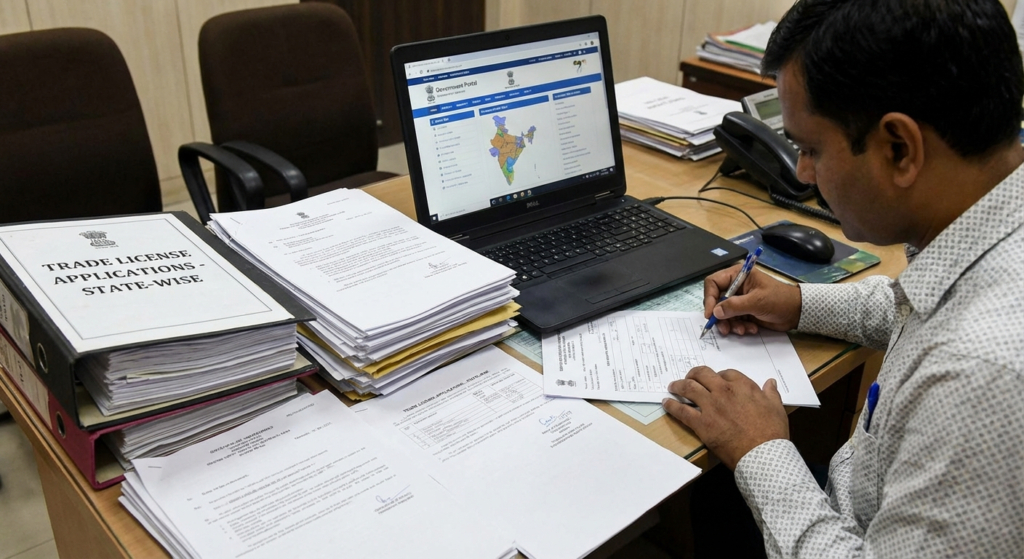
With the push towards Digital India, most municipal corporations have transitioned to online applications. Here is a general outline of the process:
- Online Application: Visit the official portal of your local Municipal Corporation and register as a user.
- Form Submission: Fill out the application form with accurate details about the business, owner, and premises.
- Document Upload: Upload scanned copies of the required documents mentioned in the checklist.
- Fee Payment: Pay the prescribed registration fee through the integrated payment gateway.
- Inspection: In many cases, a municipal inspector will visit the premises to verify the details provided in the application.
- Issuance: Once the inspection report is positive and the documents are verified, the trade license is issued and can be downloaded from the portal.
According to the Ministry of Corporate Affairs guidelines and general administrative practices, the timeline for issuance usually ranges from 15 to 30 days, provided there are no discrepancies in the application.
Compliance and Trade License Registration Requirements India for Smooth Operations
Obtaining the license is only the first step; maintaining it is equally important. Trade licenses in India are typically valid for one financial year (April to March). Renewal applications must be submitted well in advance, usually between January and March, to avoid late fees or penalties. Failure to renew the license can lead to the cancellation of the permit and legal action.
As one industry expert noted, “A trade license is not just a piece of paper; it is a commitment by the business owner to operate within the ethical and safety boundaries of the city.” This sentiment highlights why local authorities are so stringent about the trade license registration requirements India.
Fees and Penalties
The fee for a trade license is not uniform. it is determined by factors such as the size of the premises, the number of employees, and the potential impact of the trade on the environment. For example, a small grocery store will pay significantly less than a large manufacturing plant. Penalties for operating without a license or failing to renew can range from double the license fee to a daily fine until the compliance is met.
Final Thoughts on Business Licensing
Navigating the trade license registration requirements India might seem daunting at first, but it is a manageable process when approached systematically. By ensuring all your documentation is in order and understanding the specific rules of your local municipality, you set a solid foundation for your business. Remember, legal compliance is not a burden but a safeguard that protects your investment and ensures the longevity of your commercial venture. Whether you are in Delhi, Mumbai, or a growing town, staying compliant with municipal laws is the hallmark of a responsible and successful entrepreneur.
FAQs
No, they are different. A trade license is issued by local municipal bodies for the right to operate a business in a specific location, while GST registration is for tax purposes at the state and federal levels.
Most trade licenses in India are valid for one year, typically following the financial year from April 1st to March 31st, requiring annual renewal.
Yes, most major municipal corporations in India, such as those in Delhi, Mumbai, and Bangalore, offer online portals for application, fee payment, and license downloads.
Operating without a valid license can lead to heavy fines, penalties, and the potential closure of your business by the local municipal authorities.
Yes, since a trade license is location-specific, you generally need to obtain a separate license for every individual branch or outlet operating in different municipal jurisdictions.
Read Also:
- Thank You
- Terms and Conditions
- Director KYC Filing: DIR-3 KYC Due Date and Penalty 2026
- How to Start a Construction Company in India – Guide 2024-25
- 5 Essential Types of Business Structure India: 2025 Selection Guide
- Starting a Transport Business in 2024: 10 Steps to Success
- FSSAI Food Licence Renewal 2026: Your Guide to Avoiding Penalties
- How to Register a Trademark Online in 2026 (A Pro’s Guide)