Ever checked your stock purchase contract note and spotted a tiny, mysterious charge labeled “stamp duty”? You’re not alone. Most investors focus on the big-ticket items—brokerage fees, capital gains tax—and gloss over this small deduction. But here’s the thing: that seemingly insignificant fee is one of the most critical parts of your transaction.
It’s the invisible thread that makes your share ownership legally binding.
Ignoring or misunderstanding the stamp duty on transfer of shares isn’t just a financial oversight; it can render your ownership unenforceable and expose you to shocking penalties. The rules have changed dramatically in recent years, moving from a chaotic, state-by-state mess to a streamlined, unified system. And in 2026, knowing how this system works is non-negotiable for any serious investor.
In this deep dive, you’ll get the complete, no-fluff breakdown. We’ll cover exactly what the current rates are, who pays in every scenario (buying, selling, gifting), and the critical mistakes to avoid. By the end, you’ll see this small charge not as a nuisance, but as a cornerstone of your investment’s security.
What Exactly is Stamp Duty on Shares? (And Why You Can’t Ignore It)
At its heart, stamp duty is a government tax on legal documents. Think of it as the official seal of approval that validates a transaction. When you buy or sell shares, a legal “instrument” is created to record that change of ownership. Stamp duty is the fee paid to make that instrument legally legitimate and enforceable in a court of law.
Without it, your proof of ownership is just a piece of paper (or a digital entry) with no legal weight. It’s a tiny fee. But it’s a mighty one.
For decades, the process was a nightmare, especially for physical shares. Each state had its own rates and rules. It was confusing, inefficient, and ripe for errors. Thankfully, amendments to the Indian Stamp Act, 1899, which took full effect in mid-2020, swept all that away. The goal was simple: create one country, one stamp duty rate for securities.
Based on our experience guiding thousands of investors, this change was one of the most positive compliance shifts in the last decade. It replaced ambiguity with absolute clarity.
The Old Way vs. The New Way: A System Transformed
To appreciate how simple things are now, you need to see how complicated they were. The 2020 reforms weren’t just a minor tweak; they were a complete overhaul. Here’s a side-by-side look at the transformation.
| Feature | Pre-2020 System (The “Old Way”) | Post-2020 System (The “2026 Reality”) |
|---|---|---|
| Rate Structure | Fragmented; varied by state. Led to confusion and “rate shopping.” | Uniform nationwide rate. No ambiguity. |
| Collection Agency | State governments, leading to inconsistent collection processes. | Centralized collection by Stock Exchanges, Clearing Corporations, or Depositories. |
| Applicability | Different rates for physical vs. demat shares. Complex calculations. | Same rate for both on-market and off-market transfers of demat securities. |
| Compliance Burden | High. Required physical stamping of documents, especially for off-market transfers. | Extremely low. Automated, digital collection at the source of the transaction. |
💡 Pro Tip
The biggest win of the new system is automation. For 99% of investors buying and selling on the stock exchange, you don’t have to do anything. The duty is calculated and deducted for you. Your job is simply to understand it.
Calculating Stamp Duty in 2026: The Only Two Numbers You Need to Know
Forget complex formulas. The new regime is beautifully simple. There are just two key rates:
- 0.015% for the transfer of securities (when you buy on an exchange or transfer shares off-market).
- 0.005% for the issuance of securities (when a company allots new shares, like in an IPO or FPO).
That’s it. The real question isn’t the rate, but who is responsible for paying it. This depends entirely on the type of transaction.
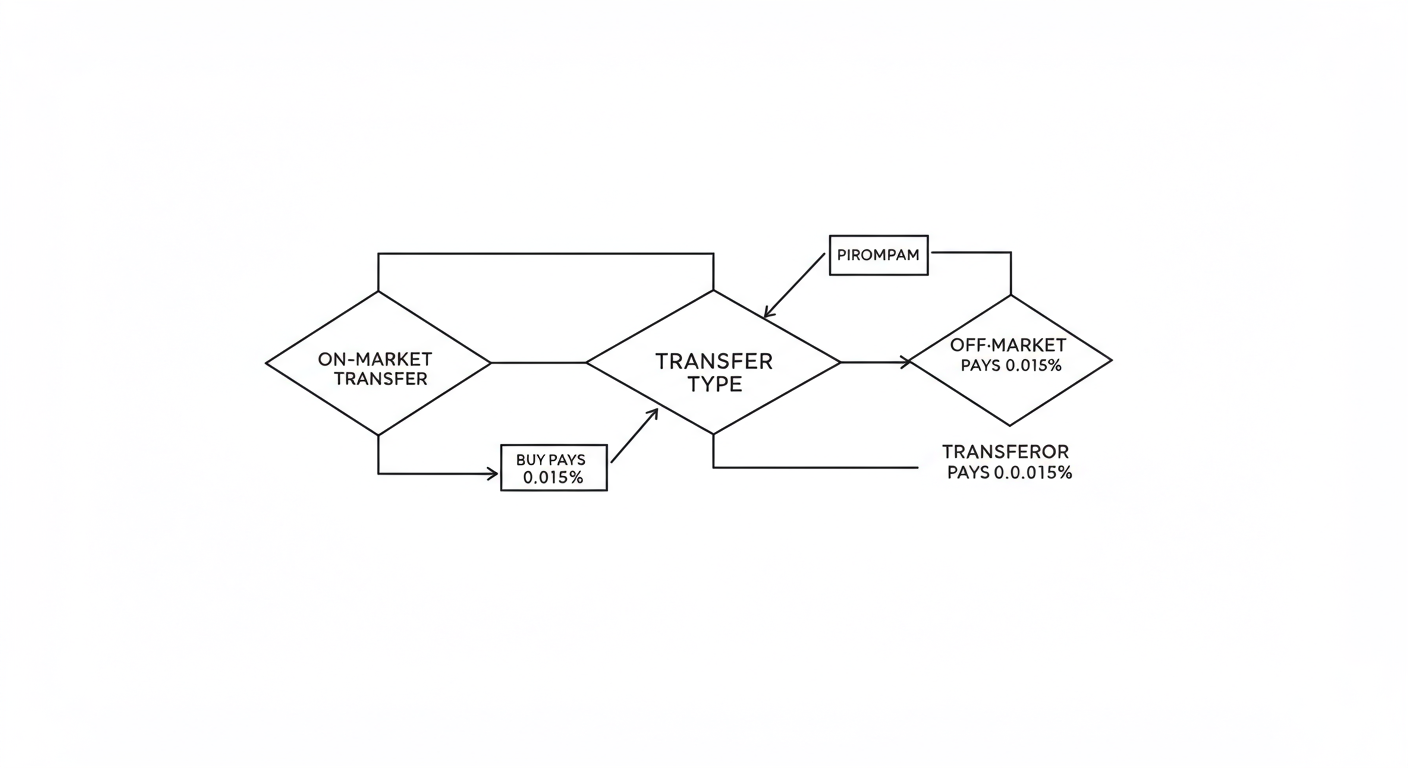
Scenario 1: On-Market Transfers (Buying on NSE/BSE)
This is the most common scenario for retail investors. When you buy shares through a stock exchange, the liability to pay stamp duty falls squarely on you, the buyer.
Let’s run a real-world example. Say you decide to buy 50 shares of a tech company at ₹4,000 per share.
- Total Transaction Value: 50 shares x ₹4,000/share = ₹2,00,000
- Applicable Stamp Duty: ₹2,00,000 x 0.015%
- Total Duty Payable: ₹30
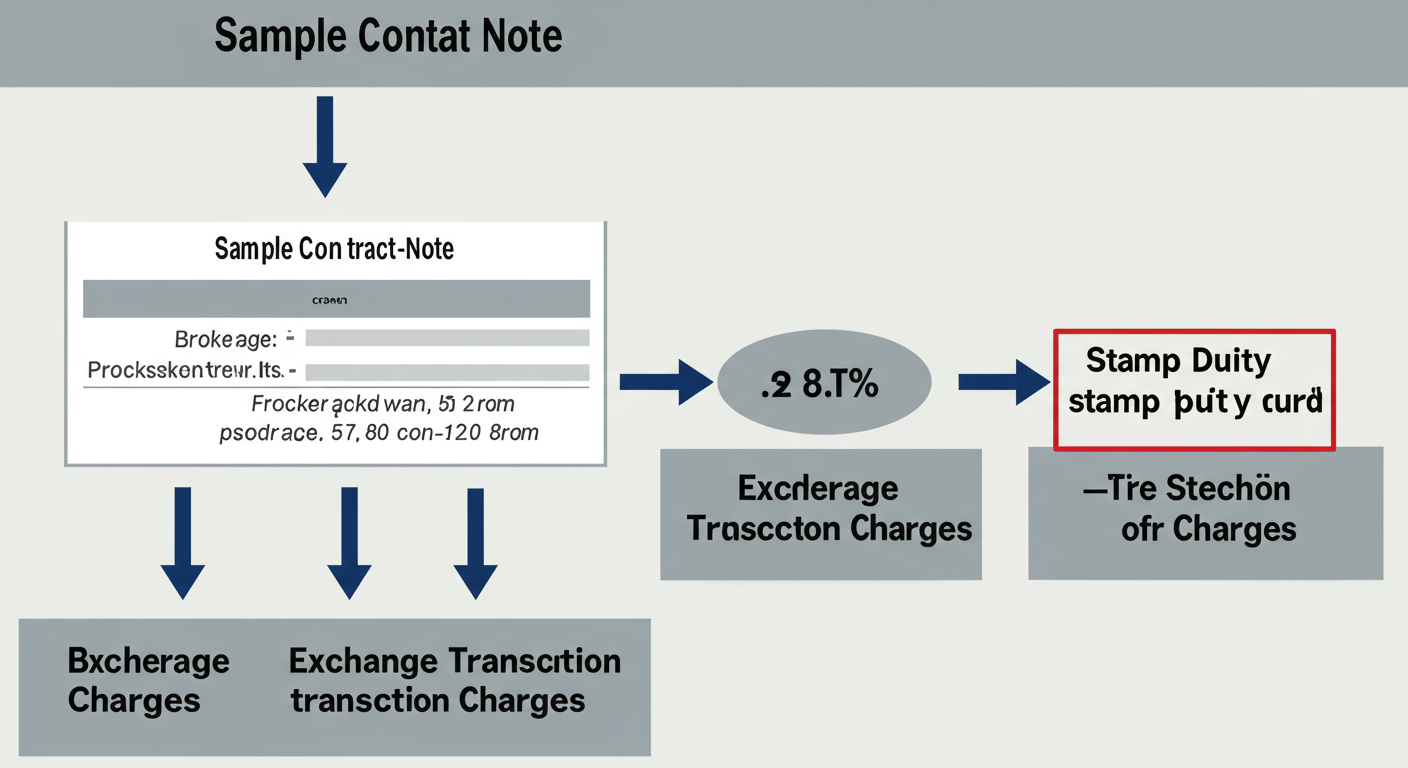
This ₹30 is automatically collected by the stock exchange (like NSE or BSE) from your trading account, along with other charges. It’s then passed on to the relevant state government based on your registered address. You’ll see this itemized on your contract note.
Scenario 2: Off-Market Transfers (Gifts, Private Sales, Inheritance)
This is where investors often get tripped up. An off-market transfer happens outside the stock exchange system. Common examples include:
- Gifting shares to a family member.
- Transferring shares between your own Demat accounts at different brokers.
- A private sale between two individuals.
In an off-market transfer, the liability to pay stamp duty shifts to the transferor (the person selling or gifting the shares).
The duty is still 0.015%, but it’s calculated on the consideration amount. If it’s a gift with no money exchanged, the duty is levied on the market value of the shares as of the previous day’s closing price. The collection is handled by the Depository (like NSDL or CDSL) before processing the transfer instruction.
⚠️ Watch Out
Gifting shares is not exempt from stamp duty. I’ve seen many people assume that because no money changes hands, no tax is due. This is a costly mistake. The transferor (the person giving the gift) is responsible for the 0.015% duty on the shares’ market value.
On-Market vs. Off-Market: A Clear Comparison
To make it crystal clear, here’s a direct comparison of the two main transfer types. 7 Essential Facts About Capital Gains Tax India: The Ultimate 2024-25 Guide
| Aspect | On-Market Transfer (via Exchange) | Off-Market Transfer (Demat to Demat) |
|---|---|---|
| Who Pays? | The Buyer | The Transferor (Seller/Gifter) |
| Rate | 0.015% | 0.015% |
| Calculated On | The total purchase value of the shares. | The consideration amount (or market value if it’s a gift). |
| Collected By | Stock Exchange (e.g., NSE, BSE) | Depository (e.g., NSDL, CDSL) |
| How it’s Paid | Automatically deducted from the buyer’s funds and shown on the contract note. | Debited from the transferor’s linked bank account by the Depository before the transfer. |
🎯 Key Takeaway
The core principle is simple: if a transaction happens on an exchange, the buyer pays. If it happens privately between two Demat accounts, the person sending the shares pays. The rate (0.015%) remains the same for both. Understanding the TDS Late Filing Penalty: Section 234E Fees and Section 271H Consequences
A Practical Guide: Executing an Off-Market Transfer Step-by-Step
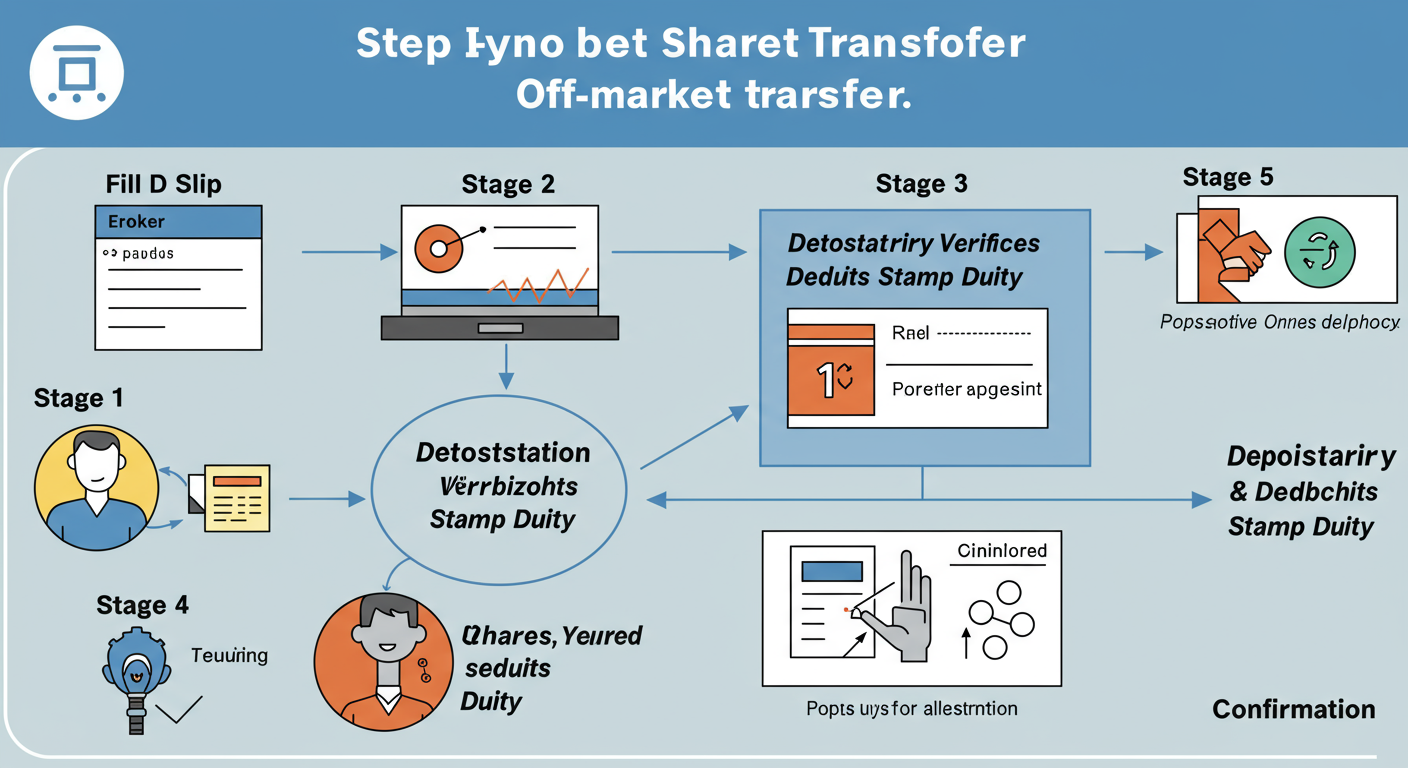
While on-market transfers are fully automated, off-market transfers require a manual (though still digital) process. Here’s how you typically do it.
- Obtain the Delivery Instruction Slip (DIS): This is like a chequebook for your Demat account. You get this from your Depository Participant (your broker).
- Fill Out the DIS Booklet: You’ll need to fill in details accurately:
- The name of the shares (e.g., “Reliance Industries Ltd”).
- The ISIN (International Securities Identification Number) of the stock.
- The quantity of shares to be transferred.
- The Target Demat Account details (the recipient’s DP ID and Client ID).
- The consideration amount (if any). If it’s a gift, you can mention zero.
- Calculate and Ensure Funds for Stamp Duty: The depository will calculate the stamp duty (0.015% of consideration or market value). You must ensure sufficient funds are available in your primary linked bank account for the depository to debit this amount. A lack of funds is a common reason for rejection.
- Submit the DIS to Your Broker: Submit the signed DIS slip to your broker. Many top brokers now offer a digital submission process through their platforms (like CDSL Easiest).
- Verification: The depository verifies the details, debits the stamp duty, and then transfers the shares to the recipient’s account. The whole process usually takes 1-2 business days.
The Exceptions to the Rule: When Stamp Duty is NOT Payable
While the 0.015% rule is broad, there are a few important scenarios where stamp duty is completely exempt. Understanding these can save you from unnecessary worry.
“Not every movement of shares constitutes a ‘transfer’ in the eyes of the Stamp Act. The law specifically exempts actions that don’t change the ultimate beneficial owner.”
- Transmission of Shares: This is a critical distinction. Transmission is the transfer of shares due to the operation of law, most commonly to a legal heir after the shareholder’s death. This is not considered a voluntary transfer and is 100% exempt from stamp duty. However, proper documentation (like a death certificate and will/succession certificate) is required.
- Dematerialization: When you convert your old physical share certificates into electronic (Demat) form, you are technically transferring them to the depository’s name to be held in trust for you. Since you remain the beneficial owner, this process is exempt from stamp duty.
- Pledging of Shares: If you pledge your shares as collateral for a loan, this does not attract stamp duty as it’s not a transfer of ownership.
💡 Pro Tip
For transmission, documentation is everything. Keep meticulous records and work closely with your broker. While no stamp duty is payable, the process to prove you are the rightful heir can be complex. Starting early and having all documents in order is key.
The High Cost of Getting It Wrong: Penalties for Non-Compliance
In the new automated world, it’s hard to evade stamp duty on Demat transactions. The system simply won’t process the transfer without collecting it. The real risk lies with the few remaining physical share transfers or improperly structured off-market deals.
The consequences are severe. According to the Indian Stamp Act, an instrument that isn’t duly stamped is:
- Legally Invalid: It cannot be used as evidence in court. This means if there’s a dispute, you can’t legally prove your ownership based on that transfer document.
- Rejected by the Company: A company is legally bound to refuse to register a transfer of shares if the instrument (like a physical SH-4 form) is not properly stamped.
- Subject to Heavy Penalties: An impounded instrument can attract a penalty of up to ten times the deficient stamp duty amount. As highlighted by financial publications like The Economic Times, these penalties are designed to be a powerful deterrent.
⚠️ Watch Out
Physical share transfers are the highest-risk area. While rare, they still exist. If you’re dealing with inherited physical shares, the responsibility is on you to ensure the transfer deed is correctly stamped before submitting it to the company’s Registrar and Transfer Agent (RTA). Don’t guess—consult an expert.
❓ Frequently Asked Questions
Who is liable to pay stamp duty on transfer of shares in 2026?
It’s simple. For sales on a stock exchange (on-market), the buyer pays. For private transfers between Demat accounts (off-market), the transferor (the person sending the shares) pays. For new shares issued by a company, the allottee pays.
What is the current stamp duty rate for share transfers in India?
As of 2026, the uniform stamp duty rate for the transfer of shares (both on-market and off-market) is 0.015% of the transaction value or consideration. For the fresh issue of securities (like in an IPO), the rate is 0.005%.
Is stamp duty applicable on transferring shares as a gift?
Yes, absolutely. A gift is an off-market transfer. Stamp duty of 0.015% is levied on the market value of the shares on the transfer date. The person gifting the shares (the transferor) is responsible for paying it.
Do I need to pay stamp duty when converting physical shares to Demat?
No. The process of dematerialization—transferring shares from your name to a depository to hold them in electronic form—is exempt from stamp duty. This is because the beneficial ownership of the shares does not change.
How is stamp duty collected for off-market transfers?
The depository (NSDL or CDSL) automatically calculates the stamp duty based on the consideration or market value. It then debits this amount from the transferor’s primary bank account before executing the transfer. If funds are insufficient, the transfer will be rejected.
Is stamp duty the same as Securities Transaction Tax (STT)?
No, they are completely different. Stamp duty is a state-level tax (though collected centrally) on the legal instrument of transfer. STT is a central government tax levied on the value of securities transacted through a recognized stock exchange. You will see both charges on your contract note for on-market trades.
Conclusion: Master This Small Cost for Total Peace of Mind
The world of stamp duty on transfer of shares has moved from chaos to clarity. The unified 0.015% rate and automated collection have removed the guesswork for 99% of transactions. For investors, this is fantastic news. It means less paperwork, more transparency, and greater legal security for your holdings.
Your primary job now is one of awareness, not action. Understand that this small cost is what makes your ownership official. Know the difference between an on-market transfer (where you pay as a buyer) and an off-market one (where the sender pays). And most importantly, never assume a transfer—especially a gift—is exempt without confirming.
So, what’s your next step? It’s simple. The next time you get a contract note, don’t just glance at the final profit or loss. Find that line item for “Stamp Duty.” See the number. Understand what it represents. Recognizing and understanding every cost associated with your investments is the first, and most important, step toward becoming a truly savvy investor.