
Imagine this: you’ve poured your soul into your startup. You’re finally hitting your stride, revenue is climbing, and then… you’re slammed with a mountain of complex compliance paperwork. Suddenly, your time is spent on tedious filings instead of growth. Sound familiar?
This was the reality for thousands of Indian businesses just a few years ago. But things have changed. Drastically.
The government has systematically relaxed the rules, making it easier than ever to qualify for ‘small company’ status—a classification that unlocks a treasure trove of benefits, saving you time, money, and headaches. This isn’t just a minor tweak; it’s a strategic shift designed to fuel entrepreneurship.
In this deep dive, we’ll break down everything you need to know about the small company definition India 2026. You’ll learn the current thresholds, the game-changing benefits you can claim, and a step-by-step process to verify your status today. Let’s get you back to building your business.
What is a ‘Small Company’ in 2026? The Current Thresholds
Let’s cut straight to the chase. As of 2026, to be classified as a ‘small company’ under Section 2(85) of the Companies Act, 2013, your private limited company must satisfy both of the following conditions:
- Paid-up Share Capital: Does not exceed ₹4 crore.
- Turnover: Does not exceed ₹40 crore as per the latest audited Profit & Loss Account.
The key word here is AND. You can’t just meet one criterion; you must be under both limits. If your paid-up capital is ₹3 crore but your turnover hits ₹41 crore, you lose the ‘small company’ status for the following year. It’s a binary switch. You’re either in or you’re out.
💡 Pro Tip
Make it an annual ritual. At the end of every financial year, as you’re finalizing your accounts, make a specific note to check your paid-up capital and turnover against these thresholds. This simple check can save you from accidentally falling into a higher compliance bracket and facing unexpected costs and paperwork.
The Evolution of Relief: A Timeline of Change
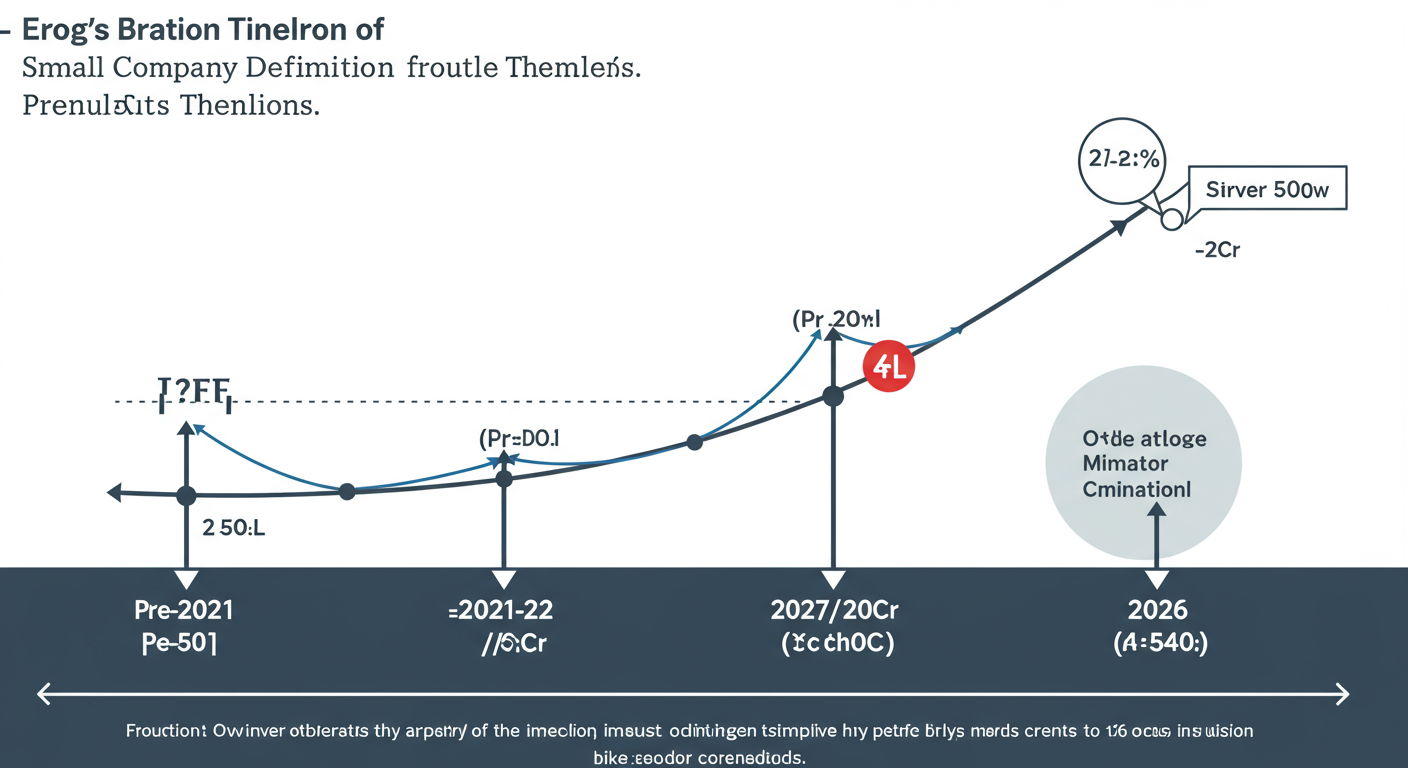
These generous limits of ₹4 crore and ₹40 crore didn’t appear overnight. They are the result of a deliberate, multi-year government strategy to improve the ease of doing business in India. Understanding this evolution shows just how significant the current benefits are.
The most pivotal moment was the Union Budget 2021 announcement, which took effect on April 1, 2021. This single change quadrupled the capital limit and increased the turnover limit tenfold, providing massive relief. The government then doubled down in September 2022, raising the limits again to the current levels.
Here’s a look at how dramatically the landscape has shifted:
| Period | Maximum Paid-up Capital | Maximum Turnover |
|---|---|---|
| Before April 1, 2021 | ₹50 Lakh | ₹2 Crore |
| From April 1, 2021 (FY 2021-22) | ₹2 Crore (4x Increase) | ₹20 Crore (10x Increase) |
| Current (Since Sept 2022) | ₹4 Crore (8x vs. pre-2021) | ₹40 Crore (20x vs. pre-2021) |
This wasn’t just about changing numbers. According to the Press Information Bureau (PIB), these amendments were made to reduce the compliance burden on a larger number of companies, allowing them to focus resources on innovation and growth rather than red tape.
The Real-World Payoff: Why You Want to Be a Small Company
So, you qualify. What’s the big deal? The benefits are tangible, immediate, and they directly impact your bottom line and your sanity.
Based on our experience helping hundreds of companies navigate their compliance, these aren’t just minor perks. They represent a significant strategic advantage. Think of it as a “business class” lane for compliance.
Being a ‘small company’ means less time on paperwork and more time on what truly matters: your customers, your product, and your team.
Here’s a direct comparison of the compliance load:
| Compliance Area | Small Company | Other Private Company |
|---|---|---|
| Board Meetings | Only 2 per year required | Minimum 4 per year required |
| Annual Return | Abridged Form MGT-7A (Simpler) | Detailed Form MGT-7 (Complex) |
| Financial Statements | No Cash Flow Statement required | Cash Flow Statement is mandatory |
| Auditor Rotation | Not mandatory | Mandatory rotation after term |
| Penalties for Non-Compliance | Lower penalties (capped at 50% in many cases) | Higher, standard penalties |
| Director’s Signature | Annual return can be signed by 1 director (if no CS) | Requires signatures from a director and CS |
⚠️ Watch Out
Not every company can be ‘small’. The Companies Act specifically excludes certain entities, regardless of their turnover or capital. You are NOT eligible if your company is a holding or a subsidiary of another company, a Section 8 (non-profit) company, or governed by a Special Act (like banking or insurance companies).
🎯 Key Takeaway
Qualifying as a ‘small company’ in 2026 is a massive strategic advantage. The current thresholds of ₹4 crore (capital) and ₹40 crore (turnover) mean thousands more businesses can enjoy reduced compliance, simplified reporting, and lower penalties, freeing up vital resources for growth.
Small Company vs. MSME: Don’t Make This Costly Mistake
Here’s a classic mix-up I see all the time: entrepreneurs confusing ‘small company’ status with ‘MSME’ registration. They are not the same thing, and thinking they are can cause you to miss out on benefits from both. Form ADT-1 Filing: The Ultimate Guide for Indian Companies (2026)
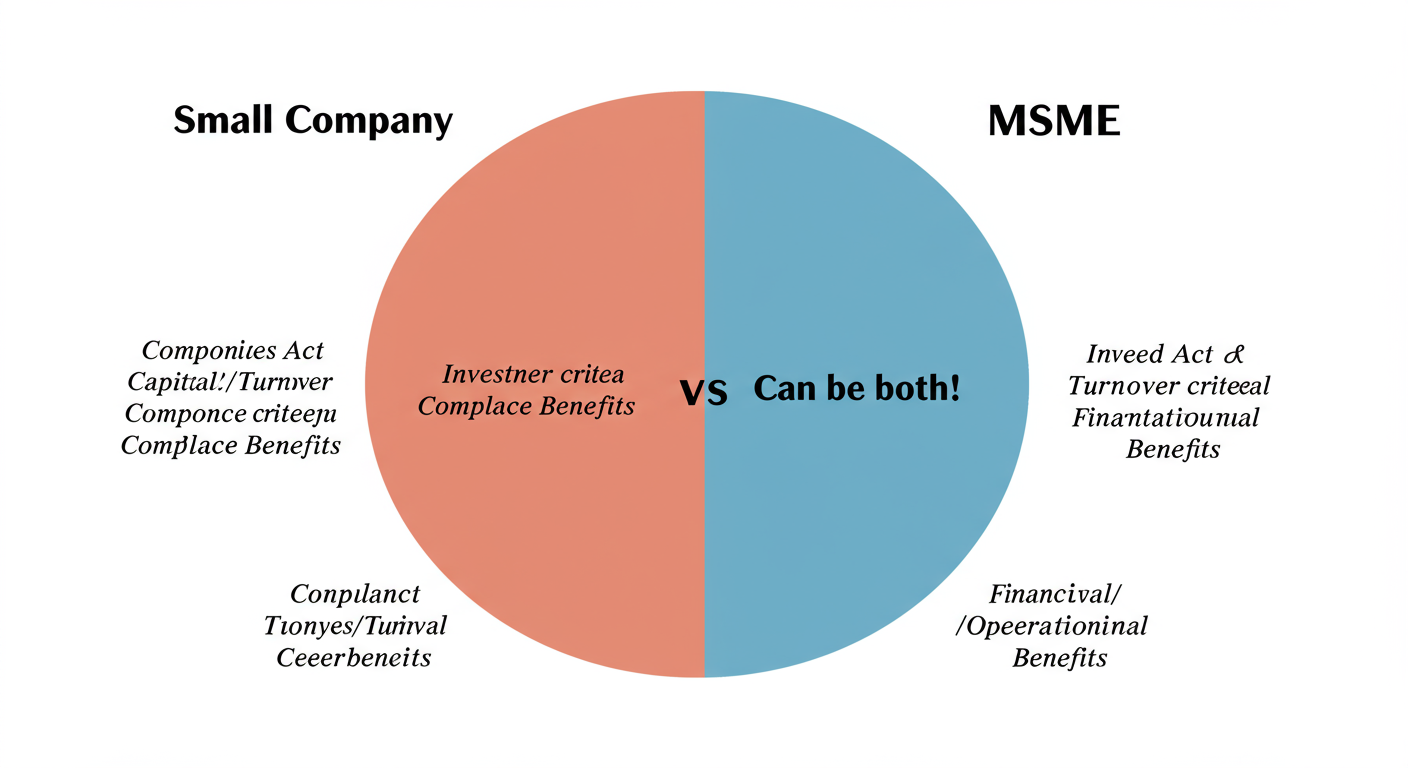
- Small Company is a legal status under the Companies Act, 2013. Its benefits are all about reducing corporate compliance burdens.
- MSME (Micro, Small, and Medium Enterprise) is a classification under the MSMED Act, 2006. Its benefits are operational and financial—think priority lending, government subsidies, and protection against delayed payments.
The criteria are also completely different. A small company is defined by paid-up capital and turnover. An MSME is defined by investment in plant & machinery and turnover. A business can be one, the other, both, or neither. The Essential GSTR-1 Filing Checklist: A Step-by-Step Guide for Accurate GST Compliance
💡 Pro Tip
Aim for both! If you’re a private limited company that meets the ‘small company’ thresholds, check if you also meet the MSME criteria. Getting an Udyam Registration for MSME status unlocks a completely different set of powerful benefits. It’s like having two different sets of superpowers for your business.
How to Determine Your ‘Small Company’ Status: A 5-Step Guide
Ready to find out where you stand? Don’t guess. Follow this simple, methodical process.
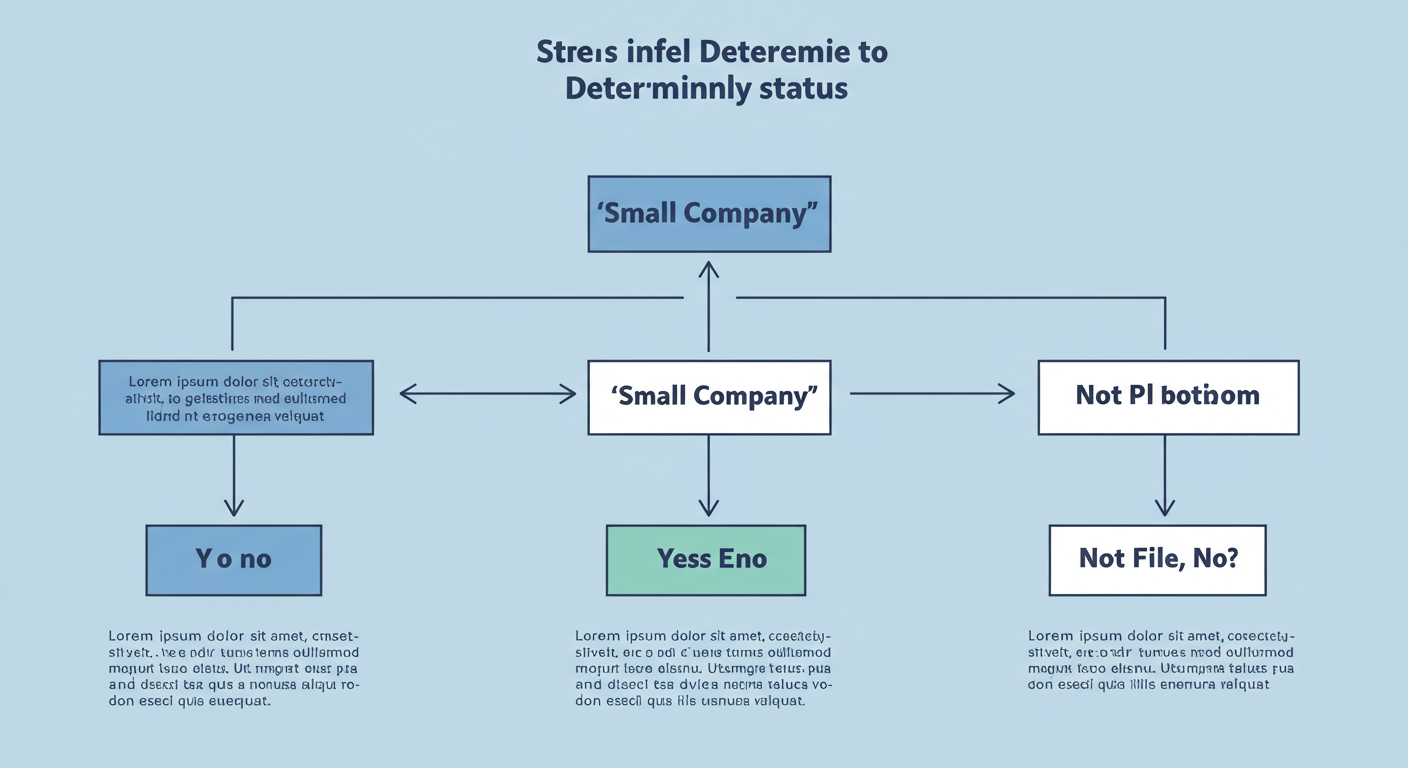
- Step 1: Confirm Your Entity Type. Are you a Private Limited Company? If yes, proceed. If you’re an LLP, Public Company, or Proprietorship, this classification doesn’t apply to you.
- Step 2: Check Your Paid-Up Share Capital. Look at your company’s latest audited Balance Sheet. Find the ‘Paid-up Share Capital’ line item. Is the amount ₹4 crore or less?
- Step 3: Check Your Turnover. Now, look at your latest audited Profit and Loss (P&L) Account. Find the ‘Revenue from Operations’ or ‘Turnover’ figure. Is it ₹40 crore or less?
- Step 4: Verify You’re Not Excluded. Re-read the ‘Watch Out’ section above. Is your company a holding or subsidiary? A Section 8 company? If no, you’re clear.
- Step 5: Confirm Your Status. If you answered ‘yes’ to being a private limited company, ‘yes’ to being under the capital limit, ‘yes’ to being under the turnover limit, and ‘no’ to being in an excluded category—congratulations! You are officially a ‘small company’ for the current compliance year.
⚠️ Watch Out
Timing is everything. Your status for the current financial year (e.g., FY 2026-27) is determined by the figures in your audited financial statements from the previous financial year (FY 2025-26). You don’t lose your status mid-year if you cross a threshold; the change takes effect in the next compliance cycle.
Your Next Step: From Information to Action
The evolution of the small company definition is one of the most pro-business regulatory shifts in India in the last decade. The current thresholds of ₹4 crore in paid-up capital and ₹40 crore in turnover are a clear signal: the government wants you to spend less time on compliance and more time building a successful enterprise.
You now know the current limits, the powerful benefits at stake, and how to avoid common pitfalls like confusing it with MSME status. You have a clear, 5-step process to determine exactly where your company stands.
So, what’s next? Don’t just file this information away. Take action.
Your immediate next step: Pull up your company’s last audited financial statements. Right now. Walk through the 5-step guide and confirm your status. This five-minute check could unlock hundreds of hours and significant cost savings for your business this year.
❓ Frequently Asked Questions
What are the current limits for a small company in 2026?
As of 2026, a private company is a ‘small company’ if its paid-up share capital is no more than ₹4 crore AND its turnover is no more than ₹40 crore, based on the last audited financial statements.
Does this definition apply to LLPs or Public Limited Companies?
No. The ‘small company’ classification under Section 2(85) of the Companies Act, 2013, is exclusively for Private Limited Companies. It does not apply to Limited Liability Partnerships (LLPs), Public Companies, or any other business structure.
What happens if my company crosses the turnover limit mid-year?
Your company’s status is determined by the figures in its last audited financial statements. If you cross the ₹40 crore turnover threshold during FY 2026-27, you will lose your ‘small company’ status starting from the next financial year, FY 2027-28, once those higher figures are officially reported.
Is MSME registration required to be a small company?
No, they are completely separate. ‘Small company’ status is governed by the Companies Act, while MSME registration is under the MSMED Act. You can be a small company without MSME registration, or vice-versa. However, it’s highly beneficial to secure both if you are eligible.
What was the major change to the definition in FY 2021-22?
The change effective April 1, 2021, was a landmark reform. It increased the paid-up capital threshold from ₹50 lakh to ₹2 crore and the turnover threshold from ₹2 crore to ₹20 crore. This was the first major expansion that brought thousands of companies into the simplified compliance regime, a policy that was further expanded in 2022.
Where can I find the official government notification for these changes?
The official notifications are published by the Ministry of Corporate Affairs (MCA). For instance, the 2021 change was detailed in the e-Gazette of India. Checking the MCA website is the best source for the latest official rules and amendments.
Read Also:
- MCA Director Master Data: The Ultimate Guide for 2026
- Form DIR-12 Filing in 2026: The Definitive Guide for Director Changes
- ROC Filing Guide 2026: Master Your Company’s Compliance
- PAS 6 Due Date 2026: The Unlisted Company’s Guide to Flawless Filing
- Form DPT-3 Filing Guide 2026: Avoid Penalties & Master Compliance
- DIN Number Search: The Ultimate 2026 Due Diligence Guide