Imagine this: you’ve just wrapped up a major project. You pay your freelance web developer, your office caterer, and the logistics company that delivered your goods. You breathe a sigh of relief. A month later, a notice from the Income Tax Department lands on your desk. It’s about penalties for non-deduction of tax. What went wrong?
You’ve just stumbled into the world of Section 194C. It’s one of the most common yet misunderstood tax provisions for Indian businesses. It’s not just for massive corporations; if you pay a resident contractor for almost any kind of work, you’re on the hook. And getting it wrong isn’t a slap on the wrist—it’s a direct hit to your bottom line.
Forget the dense legal jargon. This article will give you the straight-up, practical knowledge you need. We’ll break down exactly who needs to deduct, on what payments, at what rates, and how to stay 100% compliant in 2026. You’ll walk away knowing how to turn this compliance headache into a smooth, automated part of your business operations.
🎯 Key Takeaway
Section 194C is a mandatory tax deduction (TDS) on payments to resident contractors for specified ‘work’. Ignoring its rules on thresholds, rates, and deadlines leads to severe financial penalties, interest charges, and a 30% disallowance of your business expenditure, directly inflating your tax bill.
What is Section 194C, Really? (And Why Should You Care?)
At its heart, Section 194C is a tool for the government to collect tax at the source. Instead of waiting for a contractor to declare their income at the end of the year, the government requires you, the payer, to deduct a small portion of their payment and deposit it on their behalf. This concept is known as Tax Deducted at Source (TDS).
Think of it as a prepayment of the contractor’s income tax. It’s not an extra tax. The contractor gets full credit for the amount you deducted when they file their own tax returns. So, why is it so important for you, the business owner?
- It’s Your Responsibility: The law places the burden of deduction and deposit squarely on the person making the payment (the ‘deductor’).
- It Creates a Trail: It helps the government track transactions and ensures that income doesn’t go unreported, curbing tax evasion.
- The Penalties are Brutal: Here’s the thing. If you mess up, the consequences are severe. We’re talking interest, penalties, and even having your legitimate business expenses disallowed.
In our experience, most non-compliance isn’t intentional; it stems from a simple lack of clarity. Let’s fix that right now.
Are You on the Hook? Identifying Who Must Deduct TDS
Not everyone needs to worry about Section 194C. The Income Tax Act specifies a clear list of payers who must comply. If you’re on this list, deducting TDS isn’t optional—it’s mandatory whenever you pay a contractor for specified work.
The rules are slightly different for individuals. An individual or a Hindu Undivided Family (HUF) generally doesn’t have to deduct TDS for personal expenses (like renovating your own home). But there’s a huge catch. If your business turnover exceeded ₹1 crore or your professional gross receipts exceeded ₹50 lakh in the previous financial year, you must deduct TDS on all contractual payments, even personal ones.
Here’s a quick-reference table to see if you’re a designated ‘deductor’.
| Payer Category | Is TDS Deduction Under Sec 194C Required? |
|---|---|
| Central or State Government | Yes |
| Any Company (Private or Public) | Yes |
| Any Firm (Partnership, LLP) | Yes |
| Co-operative Society, Trust, or Registered Society | Yes |
| Individual / HUF (with business turnover > ₹1 Cr or professional receipts > ₹50 Lakh in preceding FY) | Yes, on all payments for work (business or personal) |
| Individual / HUF (not covered above) | No |
⚠️ Watch Out
The Individual/HUF audit threshold is a common tripwire. Many business owners who are required to get their accounts audited forget that this makes them liable to deduct TDS on all contractual payments, not just business ones. Don’t get caught out.
The Million-Rupee Question: What Exactly Counts as ‘Work’?
This is where most of the confusion happens. Section 194C doesn’t apply to buying a finished product off a shelf. It applies to a ‘work contract’. The Act defines ‘work’ to include several specific activities. If your payment falls into one of these buckets, it’s time to think about TDS.
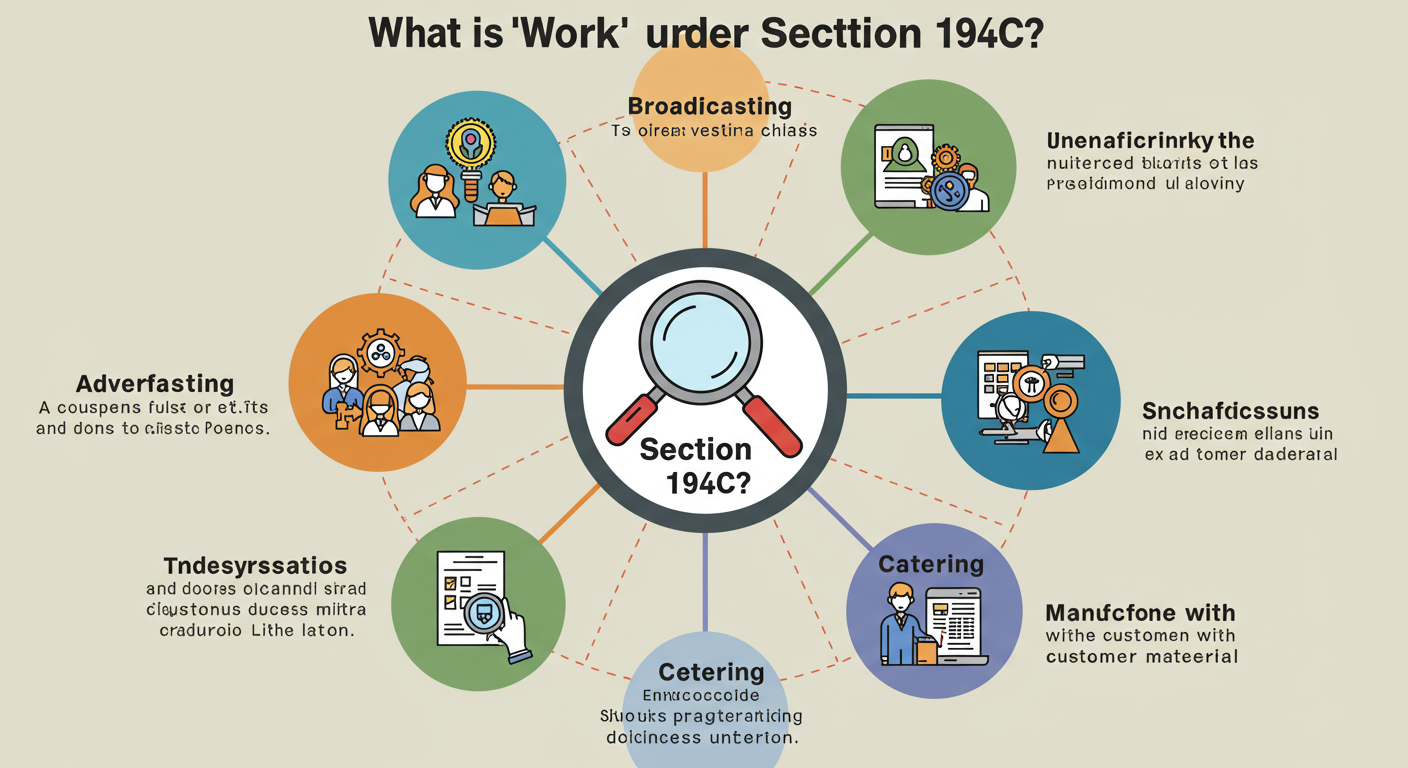
Let’s break down what’s in and what’s out.
| Category of ‘Work’ | What’s Covered (Examples) | What’s NOT Covered (Common Mistakes) |
|---|---|---|
| Advertising | Paying an ad agency to create and run a campaign for you. | Paying a newspaper or TV channel directly for ad space. |
| Broadcasting & Telecasting | Paying a production house to create a program for telecast. | Buying the rights to an already-finished movie or show. |
| Carriage of Goods/Passengers | Hiring a truck company to transport your goods; hiring a bus for staff transport. | Booking a ticket on a train (Railways are excluded). |
| Catering | Paying a caterer for an office event or to run the company canteen. | Giving employees a food allowance to buy their own lunch. |
| Manufacturing/Supplying a Product | Providing raw materials to a job worker to manufacture a component as per your design. | Buying a standard component from a supplier who uses their own materials (this is a sale). |
The key distinction for manufacturing is the material. If the contractor is primarily using material you provided, it’s a work contract. If they’re using their own material to make a product they sell to many customers, it’s a contract for sale, and 194C doesn’t apply.
The Numbers Game: TDS Rates & Thresholds for 2026
Okay, you’ve determined you’re a liable deductor and the payment is for ‘work’. Now, do you need to deduct tax on a tiny ₹5,000 payment? No. The law provides thresholds to spare you the hassle on small transactions. But you have to watch these limits like a hawk.
TDS under Section 194C is triggered if:
- A single payment to a contractor exceeds ₹30,000, OR
- The total aggregate payments to the same contractor in a financial year exceed ₹1,00,000.
Once the ₹1,00,000 annual limit is breached, you must deduct TDS on every subsequent payment to that contractor for the rest of the financial year, no matter how small.
💡 Pro Tip
When calculating the payment amount for TDS, you should deduct it on the base value, exclusive of the GST component, provided the GST is shown separately on the invoice. This is based on CBDT Circular No. 23/2017 and can save you from over-deducting tax.
TDS Rates for FY 2025-26 (AY 2026-27)
The rate of deduction depends on who you’re paying. The Ultimate QRMP Scheme Filing Guide: Simplified GST Compliance for Small Businesses
- 1% for payments to resident Individuals or HUFs.
- 2% for payments to any other resident person (e.g., Companies, Firms, LLPs, Co-operative Societies).
But what if the contractor doesn’t give you their PAN (Permanent Account Number)? Trust me on this one, you don’t want to be in that situation. MSME Registration Benefits: Boost Your Small Business
⚠️ Watch Out
If the contractor fails to provide their PAN, you are legally required to deduct TDS at a flat, punitive rate of 20%, as per Section 206AA. There are no exceptions. This is a massive penalty, so always insist on a valid PAN before processing any contractor payment.
Your 4-Step Compliance Blueprint
Deducting the tax is just the beginning. Following through is what keeps you compliant. Based on our hands-on testing of compliance systems for hundreds of businesses, this simple 4-step process works every time.
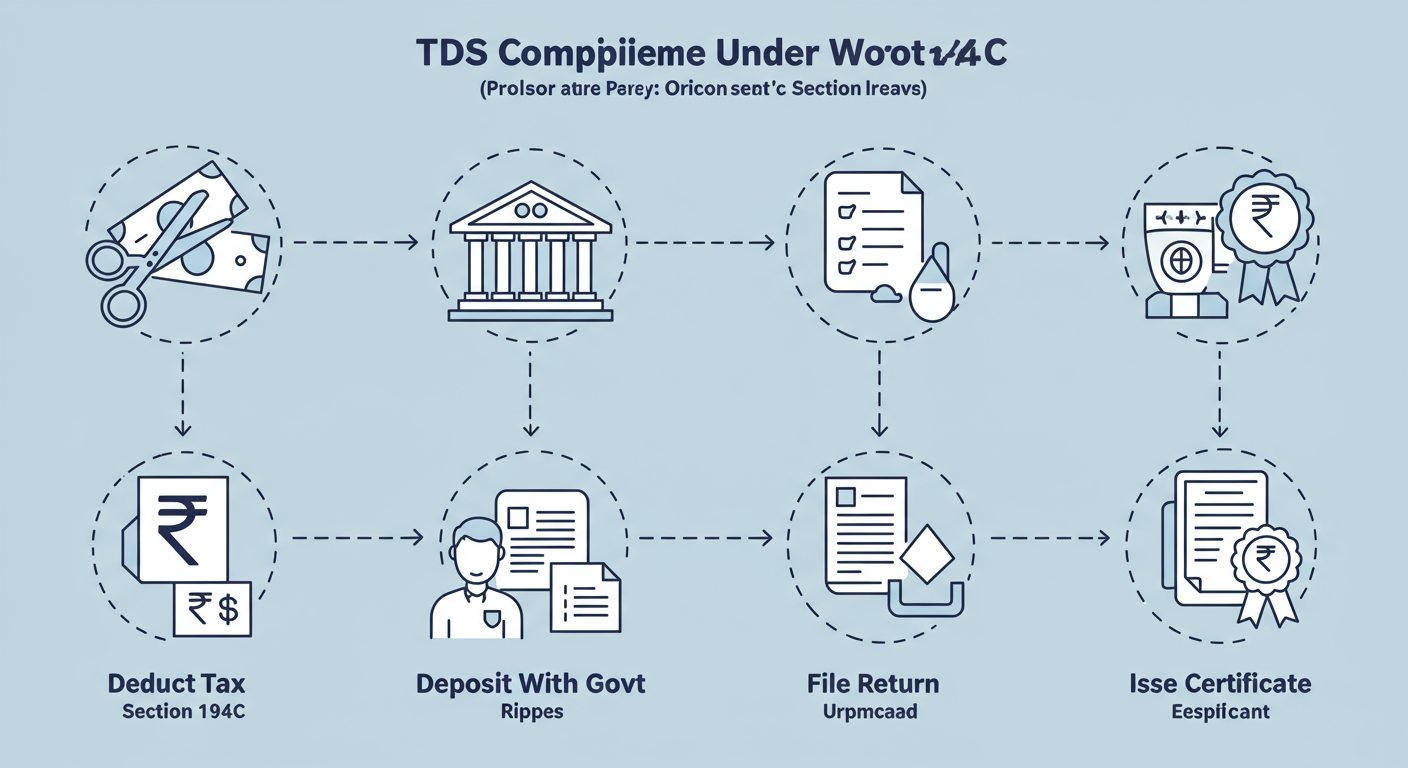
- Deduct Tax at the Right Time: You must deduct TDS at the time you credit the amount to the contractor’s account in your books or at the time of actual payment, whichever is earlier. This “whichever is earlier” clause is crucial.
- Deposit TDS with the Government: The tax you’ve deducted must be deposited using Challan ITNS-281 by the 7th of the following month. For tax deducted in March, you get a little more time—until April 30th.
- File Quarterly TDS Returns: You must electronically file a quarterly statement, Form 26Q, detailing all contractor payments and taxes deducted. This tells the government who you paid and how much tax you deposited.
- Issue TDS Certificate (Form 16A): After filing your return, you must download the TDS certificate (Form 16A) from the government’s TRACES portal and provide it to your contractor. This is their proof that you’ve paid the tax on their behalf.
💡 Pro Tip
For payments to small transporters who own 10 or fewer goods carriages, you can avoid deducting TDS. However, this is not automatic. The transporter must provide you with a written declaration stating this, along with their PAN. You must then report this non-deducted payment in your Form 26Q. Keep these declarations on file; they are your proof during an audit.
The High Cost of Getting It Wrong
Let’s be blunt. The consequences of non-compliance are designed to hurt.
According to Section 40(a)(ia) of the Income Tax Act, failure to deduct TDS or failure to deposit the deducted TDS results in 30% of that business expenditure being disallowed. This means your taxable profit goes up, and you pay significantly more tax.
On top of that, you’ll face:
- Interest: 1% per month for late deduction and 1.5% per month for late deposit. This is not simple interest; it’s calculated for every month or part of a month of delay.
- Late Filing Fees: A fee of ₹200 per day (under Section 234E) for delaying your TDS return, capped at the total TDS amount.
- Penalty: A penalty ranging from ₹10,000 to ₹1,00,000 can be levied by the Assessing Officer for incorrect information or late filing.
As leading financial publications like The Economic Times often highlight, these penalties can cripple a small business’s cash flow.
❓ Frequently Asked Questions
What’s the difference between Section 194C and Section 194J?
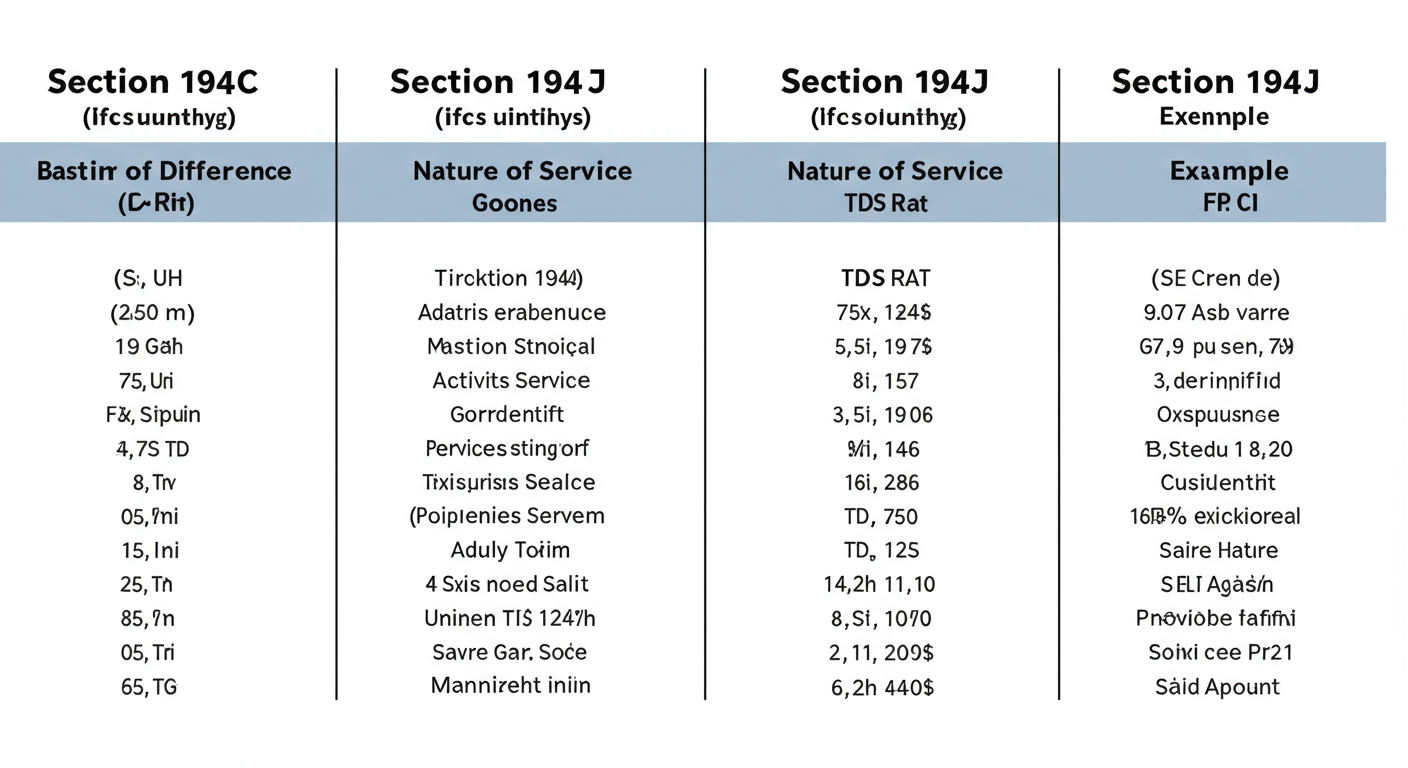
It’s all about the nature of the service. Section 194C is for ‘work’ contracts (like construction, catering, advertising). Section 194J is for ‘professional and technical services’ (like payments to lawyers, engineers, consultants, and digital marketing experts for strategy, not ad placement). The rates and definitions are different, so it’s critical to classify the payment correctly.
Is TDS applicable on a verbal contract?
Absolutely. The Income Tax Act’s definition of ‘contract’ for Section 194C includes both written and oral agreements. As long as a payment is being made for specified work, the liability to deduct TDS exists, regardless of whether you have a signed document.
I made a single payment of ₹28,000. Do I need to deduct TDS?
On that single payment, no, because it’s below the ₹30,000 single-payment threshold. However, you must track the total. If you pay that same contractor another ₹28,000 later in the year, your total becomes ₹56,000. If you pay them another ₹45,000, your total hits ₹1,01,000. At that point, you’ve crossed the ₹1,00,000 aggregate limit, and you must deduct TDS on that ₹45,000 payment and all future payments that year.
Where can I find the official rules and updates?
For the most authoritative and up-to-date information, always refer to the official Income Tax Department’s TDS/TCS page. Tax laws can be amended, so checking the primary source is always a good practice for major decisions.
Can I deduct TDS at a lower rate?
Yes, it’s possible in some cases. If a contractor’s total estimated tax liability for the year is low, they can apply to the Income Tax Officer for a certificate (under Section 197) authorizing you to deduct tax at a lower rate or even at a nil rate. They must provide this certificate to you, and you must follow its instructions.
Your Next Step: From Confusion to Control
Navigating Section 194C doesn’t have to be a source of anxiety. It’s a system, and like any system, it can be mastered. By now, you understand that it’s not just about rules; it’s about protecting your business’s financial health.
Here’s your game plan:
- Review Your Payables: Look at who you’re paying. Are they contractors? Does the payment qualify as ‘work’?
- Set Up a System: Use your accounting software or a simple spreadsheet to track payments to each contractor. Set alerts for the ₹30,000 single and ₹1,00,000 aggregate thresholds.
- Always Get the PAN: Make it a non-negotiable part of your contractor onboarding process. No PAN, no payment processing. It’s that simple.
By treating TDS compliance not as a chore, but as a critical business function, you’ll avoid costly penalties and build a more resilient, professionally managed company. You’ve got this.