
The Billion-Dollar Question: Can You Build a Business That’s Legally Forbidden to Make You Rich?
What if the single most powerful feature of your company was that it could never pay you a dividend? It sounds crazy, right? In a world obsessed with profit margins and shareholder value, we’re taught that money is the ultimate measure of success. But for a growing wave of social entrepreneurs, impact is the new currency. And the legal structure they’re using to scale that impact is the Section 8 Company.
This isn’t just another way to register an NGO. It’s a fundamentally different approach. Think of it as a hybrid vehicle for social change: it has the robust, reliable engine of a private limited company but runs on the clean fuel of a non-profit mission.
If you’re serious about building a credible, scalable, and sustainable organization to tackle a social or environmental problem, you’re in the right place. Forget the dry legal jargon. In this deep dive, we’ll unpack what a Section 8 Company really is, why it’s often the superior choice over a traditional Trust or Society, and provide a battle-tested blueprint for getting registered in 2026. Let’s get started.
What Exactly Is a Section 8 Company? (Beyond the Textbook Definition)
At its core, a company registered under Section 8 of the Companies Act, 2013 is a legal entity created to promote commerce, art, science, sports, education, research, social welfare, religion, charity, or environmental protection. So far, so good. But here’s the twist that changes everything.
The Golden Rule: Any profit or income generated by the company must be reinvested to promote its objectives. It cannot, under any circumstances, be distributed as dividends to its members. This isn’t a suggestion; it’s a legally binding mandate.
This single rule is what gives a Section 8 Company its unique power. It creates a circle of trust. Donors, government agencies, and corporate partners see this structure and know that every single rupee is dedicated to the mission. There’s no ambiguity. There are no back-door profits. It’s all about the cause.
This structure is perfect for founders who want to operate with the professionalism and governance of a corporation but whose primary goal is social impact, not personal wealth. It’s the gold standard for non-profits in India for a reason.
🎯 Key Takeaway
A Section 8 Company combines the credibility and operational structure of a corporate entity with the mission-driven focus of a non-profit. Its defining feature—the mandatory reinvestment of all profits—builds immense trust and is crucial for attracting significant funding and grants.
Section 8 vs. Trust vs. Society: Choosing Your NPO Structure in 2026
Before you jump into the registration process, you need to be 100% sure a Section 8 Company is the right fit. Many founders get stuck choosing between the three main NPO structures in India. While all are valid, they are built for different scales and purposes. Based on our experience helping hundreds of NPOs launch, the choice often comes down to your long-term vision.
Here’s a head-to-head comparison:
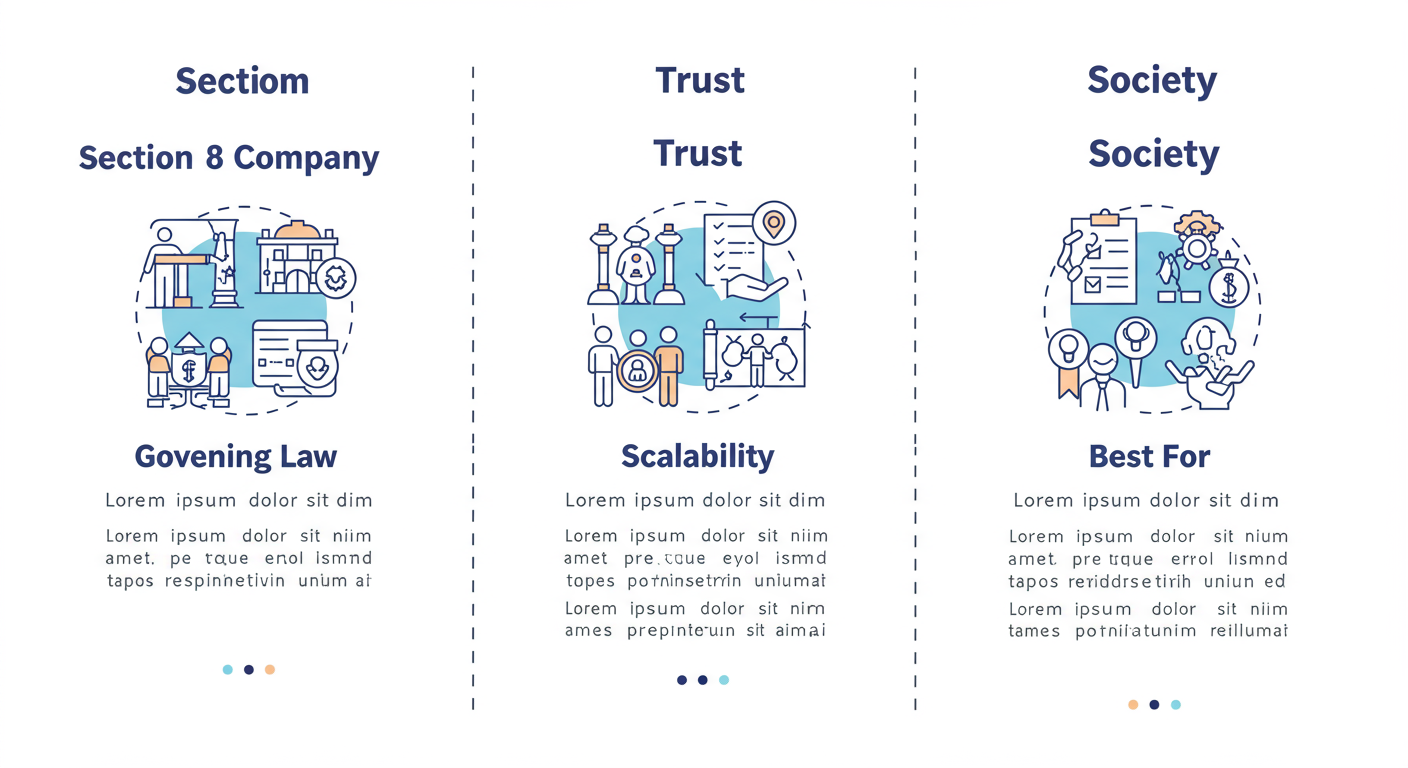
| Feature | Section 8 Company | Trust | Society |
|---|---|---|---|
| Governing Law | Companies Act, 2013 (Central Law) | Indian Trusts Act, 1882 (State variations) | Societies Registration Act, 1860 (State variations) |
| Registration Authority | Ministry of Corporate Affairs (MCA) – Centralized | Sub-Registrar of Trusts (Local) | Registrar of Societies (Local) |
| Credibility & Recognition | Very High (National & International) | Moderate | Moderate |
| Governance Structure | Formal Board of Directors, strict compliance | Managed by Trustees, less formal | Managed by a Governing Body, can be complex |
| Scalability | Excellent for large-scale, national operations | Good for asset management & smaller projects | Good for membership-based community initiatives |
| Best For | Ambitious, large-scale social ventures seeking major grants and foreign funding. | Family foundations, educational institutions, managing specific assets for a cause. | Local community groups, clubs, and member-driven welfare organizations. |
As you can see, if your ambition is to build a large, professionally managed organization with national reach and the ability to attract significant funding (especially from foreign sources or CSR budgets), the Section 8 Company is almost always the superior choice. Its governance framework is simply more robust and trusted by institutional donors.
The 2026 Incorporation Blueprint: Your Step-by-Step Guide
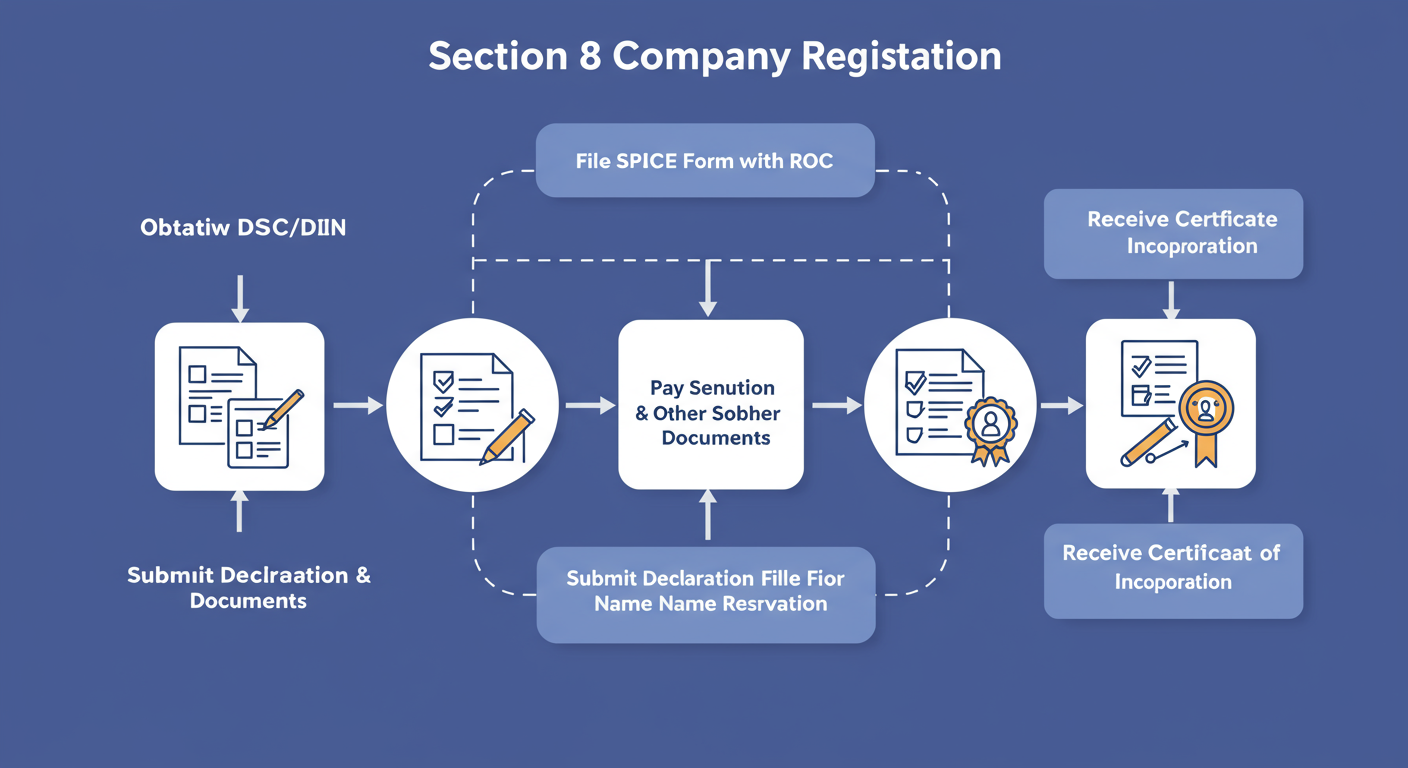
Registering a Section 8 Company is a fully digital process managed through the Ministry of Corporate Affairs (MCA) portal. While it seems straightforward, the devil is in the details. One small error can lead to weeks of delays. Follow this proven process carefully.
- Step 1: Obtain DSC and Director Identification Numbers (DIN)
Before you can file anything, all proposed directors need a Digital Signature Certificate (DSC). Think of this as your secure digital identity for all MCA filings. Simultaneously, each director must apply for a DIN. You can’t be a director without one. - Step 2: Reserve Your Unique Name (SPICe+ Part A)
Your name is your brand. It must be unique and reflect your non-profit nature. You’ll file the SPICe+ Part A form to reserve a name. The name must include a suffix like Foundation, Forum, Association, Federation, Chambers, Confederation, or Council. The words ‘Private Limited’ or ‘Limited’ are not used.
💡 Pro Tip
Before filing for a name, conduct a thorough trademark search and check the MCA database for similar-sounding names. A name rejection is one of the most common and frustrating delays. Have at least two name options ready to go.
- Step 3: Draft the Charter Documents (MoA & AoA)
This is the soul of your company. The Memorandum of Association (MoA) defines your objects—the specific charitable activities you will undertake. Be detailed and comprehensive. The Articles of Association (AoA) define the internal rules of governance. Both documents must contain clauses explicitly prohibiting the distribution of profits and outlining the procedure for winding up. - Step 4: File the Main Application (SPICe+ Part B)
This is the big one. You’ll file the integrated SPICe+ Part B form, which bundles applications for incorporation, DINs, PAN, and TAN. You must attach your drafted MoA, AoA, and several other critical documents:- Proof of the registered office address (e.g., rental agreement).
- Identity and address proof for all directors/subscribers.
- A declaration from a practicing professional (CA, CS, or CWA) in Form INC-14 certifying compliance.
- A detailed three-year projection of your company’s estimated income and expenditure.
⚠️ Watch Out
The three-year financial projection is not a formality. The Registrar of Companies (RoC) scrutinizes this to ensure your plans are viable and your objectives are realistic. Vague or overly optimistic projections are a major red flag and can lead to rejection. Be specific about your planned sources of income (donations, grants, service fees) and expenses.
- Step 5: Receive License and Certificate of Incorporation
Once the RoC and the Central Government are satisfied with your application, they will issue a license in Form INC-16. This license officially grants your company its non-profit status under Section 8. Immediately after, the RoC will issue the Certificate of Incorporation (COI). Congratulations, your Section 8 Company is now a legal entity!
The Compliance Tightrope: Staying Legal and Credible
Registration is just the beginning. The credibility of a Section 8 Company comes from its adherence to a strict compliance calendar. Falling behind isn’t an option; it can lead to heavy penalties and even the revocation of your license. Trust me on this one, you need to be diligent from day one. What is an OPC? One Person Company Explained
Here’s a summary of your non-negotiable annual duties: A Comprehensive Guide on How to Add New Director in Private Limited Company: Steps and Compliance
| Compliance Task | Relevant Form | General Due Date | Consequence of Failure |
|---|---|---|---|
| Annual Financial Statements | AOC-4 | Within 30 days of AGM | High daily penalties |
| Annual Return | MGT-7 | Within 60 days of AGM | High daily penalties |
| Income Tax Return | ITR-7 | October 31st | Loss of tax exemptions, penalties |
| Board Meetings | N/A (Minutes required) | At least one every 6 months | Non-compliance, poor governance |
| Annual General Meeting (AGM) | N/A (Minutes required) | Within 6 months of FY end | Penalties, non-compliance |
💡 Pro Tip
Don’t try to manage compliance with a spreadsheet. From day one, use a compliance management tool or retain a Company Secretary (CS) firm. The cost is a fraction of the potential penalties and the peace of mind is priceless. It allows you to focus on your mission, not on deadlines.
Beyond these, you must also apply for 12A and 80G registrations with the Income Tax Department. Registration under Section 12A exempts your income from tax, while 80G allows your donors to claim a tax deduction on their contributions—a massive incentive for fundraising.
⚠️ Watch Out
A common misconception is that directors of a Section 8 Company cannot be paid. This is false. Directors can receive reasonable remuneration for professional services rendered. However, ‘reasonable’ is a subjective term. The payment must be justifiable, approved by the board, and not a disguised profit distribution. Paying an exorbitant salary to a founder-director is a fast track to losing your license.
Your Mission Needs a Strong Foundation. Build It with Section 8.
Look, starting a non-profit is an act of passion. But passion alone doesn’t build a sustainable organization that can create change for decades. For that, you need structure, credibility, and trust. In 2026, the Section 8 Company provides the strongest possible foundation for any serious social entrepreneur in India.
It’s not the easiest path. It demands professionalism and a commitment to transparency. But the rewards are immense: unparalleled credibility with donors, a clear governance structure that enables scale, and the legal framework to attract significant institutional and corporate funding. You’re not just starting an NGO; you’re building a social enterprise designed for impact.
Your next step? Don’t get lost in the forms just yet. Take a step back and refine your mission. Clearly define the problem you want to solve and the activities you will undertake. A crystal-clear mission is the bedrock of your MoA and the guiding star for your entire journey.
❓ Frequently Asked Questions
Can a Section 8 Company generate profit?
Absolutely. A Section 8 Company is encouraged to have sustainable revenue streams. The critical rule is that any profit (or ‘surplus’) cannot be distributed to members as dividends. It must be plowed back into the organization to further its charitable objectives.
What’s the difference between an NGO and a Section 8 Company?
Think of “NGO” (Non-Governmental Organization) as a general category, like “vehicle.” A Section 8 Company is a specific type of NGO, like “electric car.” It’s a legal structure for registering a non-governmental organization under India’s Companies Act, 2013. Other types include Trusts and Societies.
Can directors of a Section 8 Company draw a salary?
Yes, but with caution. Directors can be paid a reasonable salary for legitimate, professional services provided to the company. This must be an arm’s-length transaction and not a way to siphon off profits. It’s wise to have this policy clearly defined in your Articles of Association (AoA).
Are Section 8 Companies automatically tax-exempt?
No, this is a critical point. Incorporation under Section 8 does not grant automatic tax exemption. You must separately apply to the Income Tax Department for registration under Section 12A/12AA to get your income exempted from tax. Without this, your surplus will be taxable.
How long does Section 8 registration take in 2026?
While the process is digital, it’s not instant. Assuming all your documents are perfectly in order, you can expect the entire process—from name reservation to receiving the final Certificate of Incorporation—to take approximately 20-30 working days. Any errors in documentation can significantly extend this timeline.
Read Also:
- Verify Any Indian Company in 2026
- Form MGT-14 Filing: The Ultimate Guide for 2026
- Form ADT 1 Filing: The Ultimate 2026 Guide to Compliance – Visual Story
- ROC Filing Guide 2026: Master Your Company’s Compliance
- Appointment of Auditor: A 7-Step Guide for 2026 Compliance
- Form DPT-3 Filing Guide 2026: Avoid Penalties & Master Compliance