
Have you ever felt like you’re driving a car by only looking in the rearview mirror? You see exactly where you’ve been, but you have no idea what’s coming. That’s what running a business with only financial accounting feels like. It gives you a perfect, polished history of your past performance, but it won’t help you dodge the potholes right in front of you.
Here’s the thing: there’s another, more powerful dashboard at your disposal. It’s called management accounting, and it’s the secret weapon of the world’s most successful companies. It’s your forward-facing GPS, your real-time engine diagnostics, and your strategic roadmap all in one.
In this article, we’re not just going to list the dry, textbook definitions. We’re going to uncover the critical difference between financial and management accounting through real-world scenarios. You’ll learn precisely how to use both—not as separate chores, but as a powerful, integrated system to make smarter decisions, unlock hidden profits, and confidently steer your business into the future. Let’s get started.
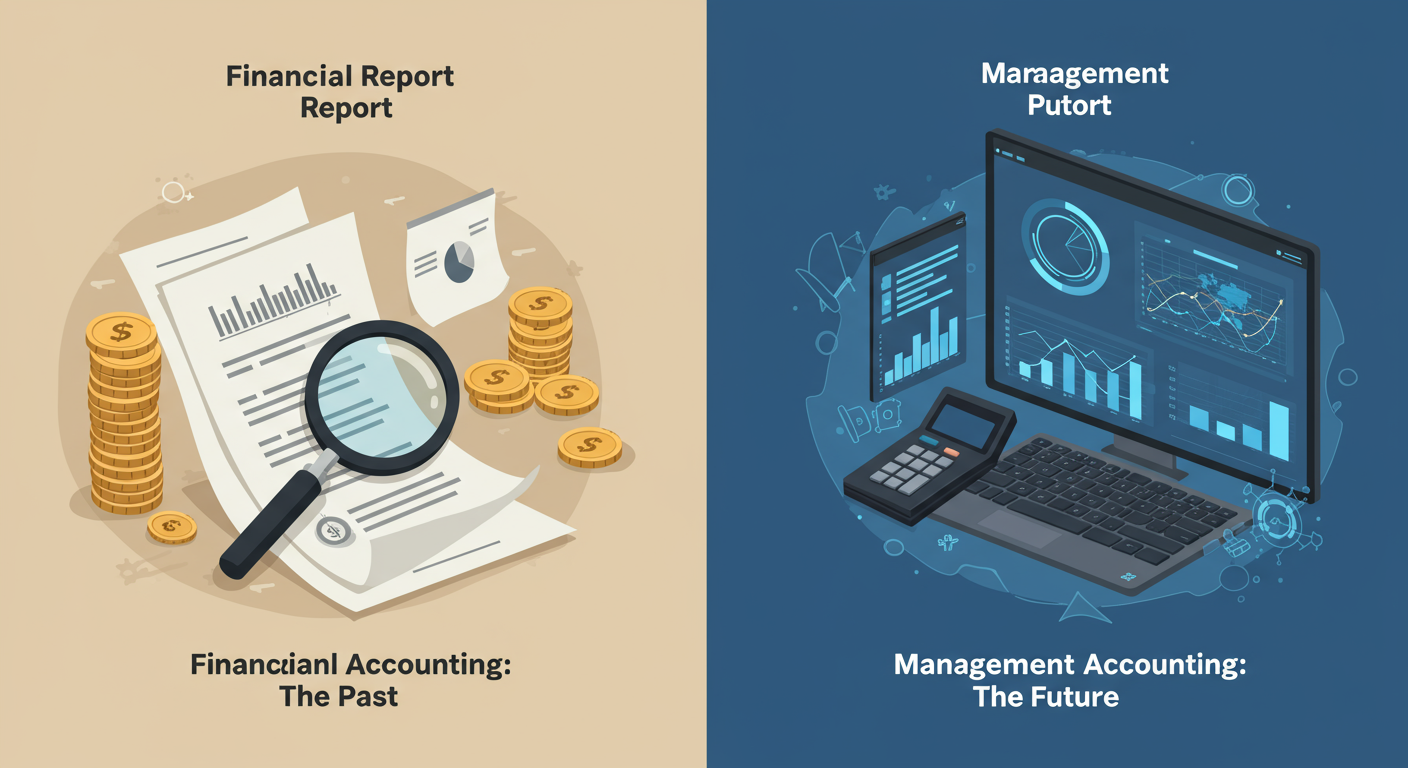
Financial Accounting: The Official Scorecard for the World
Financial accounting is the formal process of recording, summarizing, and reporting a company’s financial transactions. Think of it as your business’s official, public-facing report card. Its audience is external—investors, banks, creditors, and government agencies like the IRS.
Because this information is for outsiders, it has to be incredibly reliable and standardized. This is where strict rules come into play. In the U.S., companies must follow Generally Accepted Accounting Principles (GAAP), as set by the Financial Accounting Standards Board (FASB). In many other parts of the world, the standard is the International Financial Reporting Standards (IFRS). These rules ensure that when an investor looks at your company’s profit, it’s calculated the same way as your competitor’s.
The end products are the three core financial statements:
- The Income Statement: Did we make a profit or a loss over the last quarter or year?
- The Balance Sheet: What do we own (assets) and what do we owe (liabilities) at a specific moment in time?
- The Statement of Cash Flows: Where did our cash come from, and where did it go?
This is all backward-looking. It’s a historical record. It’s essential for compliance and building trust, but it’s not designed to help you run your day-to-day operations.
Management Accounting: The Internal Playbook for Winning
If financial accounting is the scorecard, management accounting (or managerial accounting) is the coach’s secret playbook. Its only audience is internal—you, your managers, and your team leaders. Its sole purpose is to help you make better decisions. Period.
Because it’s for internal use, there are no rigid rules. Flexibility is its superpower. The reports are tailored to answer specific, forward-looking questions:
- “Should we invest $50,000 in this new marketing campaign? What’s the projected ROI?”
- “Our material costs for Product X are 15% over budget. Why? And how do we fix it next month?”
- “Which of our three service lines is the most profitable? Should we cut the underperformer?”
- “How much inventory do we need to order to meet the sales forecast for the holiday season?”
Management accounting combines financial data with operational data (like units produced, hours worked, or customer satisfaction scores) to create actionable insights. It’s about looking at the road ahead, not just the road behind.
⚠️ Watch Out
A common trap for growing businesses is trying to make strategic decisions using only financial accounting reports. An income statement might show you’re profitable overall, but it won’t tell you that one specific product is losing you money hand over fist, subsidized by your winners. That’s an insight only management accounting can provide.
Financial vs. Management Accounting: The Head-to-Head Comparison
Let’s break it down. The fundamental difference between financial and management accounting becomes crystal clear when you see them side-by-side. After analyzing hundreds of business financial systems, we’ve found these seven distinctions are the most critical to understand.
| Dimension | Financial Accounting (The Scorecard) | Management Accounting (The Playbook) |
|---|---|---|
| 1. Primary Users | External parties: Investors, creditors, banks, government, regulators. | Internal parties: Executives, managers, team leads, employees. |
| 2. Purpose | Report on past performance and financial health. Focus on compliance and stewardship. | Aid in future planning, controlling operations, and decision-making. Focus on strategy and improvement. |
| 3. Rules & Standards | Mandatory adherence to external rules (GAAP/IFRS). Legally required. | No mandatory rules. Guided by the principle of “usefulness” for management. Entirely optional. |
| 4. Time Orientation | Historical. Reports on what has already happened. | Future-oriented. Creates forecasts, budgets, and what-if scenarios. |
| 5. Scope | Aggregated. Focuses on the company as a whole. | Segmented. Breaks down data by department, product, project, or region. |
| 6. Reporting Frequency | Fixed schedule (e.g., quarterly, annually). | As-needed (e.g., daily, weekly, monthly, on-demand). |
| 7. Type of Information | Primarily objective, verifiable, and monetary financial data. | Uses both financial data and subjective, non-financial information (e.g., customer satisfaction, market share). |
🎯 Key Takeaway
Financial accounting provides a standardized, historical report for outsiders to ensure compliance and build trust. Management accounting provides customized, forward-looking insights for insiders to make strategic decisions and improve performance.
Putting It All Together: A Real-World Scenario
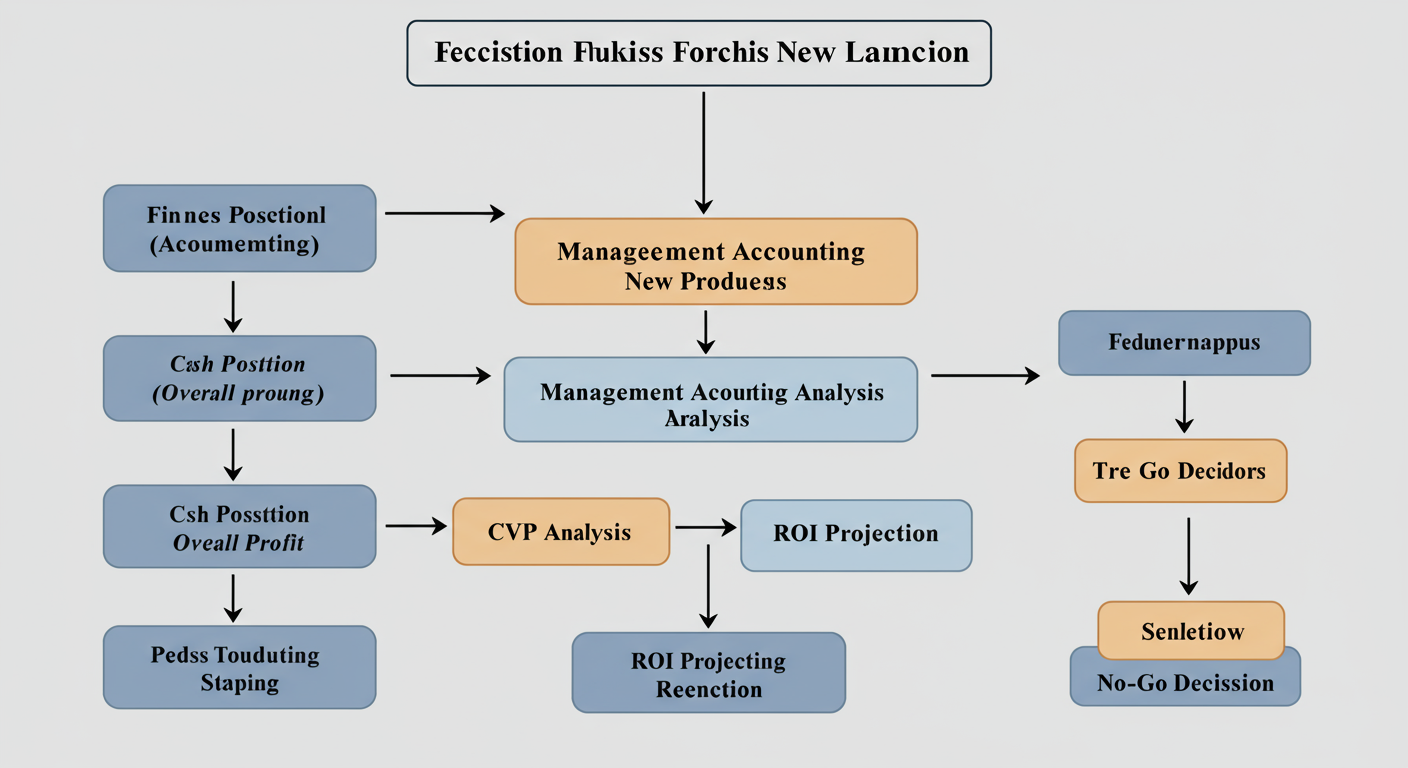
Theory is great, but let’s see how this plays out in practice. Imagine you run “Crafty Mugs,” a successful e-commerce store. You’re considering launching a new, personalized mug line.
How do the two accounting disciplines help you make this multi-thousand dollar decision?
Financial Accounting’s Contribution (The “What”):
Your financial accountant provides the Q3 Income Statement. It shows a healthy net profit of $45,000. The Balance Sheet shows you have $60,000 cash on hand. This tells you the business is healthy and you can afford to consider an expansion.
Management Accounting’s Contribution (The “How” and “Should We”):
Your management accountant (or you, wearing that hat) takes that raw data and digs deeper:
- Cost-Volume-Profit (CVP) Analysis: They calculate the variable cost per personalized mug (blank mug, printing ink, packaging) and the fixed costs for the new printing equipment. They determine you need to sell 850 mugs just to break even.
- Budgeting & Forecasting: They create a detailed budget for the launch, including marketing spend, and forecast potential sales for the next three quarters based on market research and past sales trends of similar products.
- Pricing Analysis: They model different price points ($25, $28, $30) to see how each impacts the break-even point and overall profitability.
The difference is stark. Financial accounting said, “You have the money.” Management accounting answers, “Yes, but here’s exactly what needs to happen for this to be a profitable venture and not a cash-draining mistake.” The Comprehensive Guide to Income Tax Return Filing: Step-by-Step E-Filing Process and Essential Checklist
💡 Pro Tip
From day one, set up your Chart of Accounts with management reporting in mind. Don’t just have a generic “Marketing Expense” account. Create sub-accounts like “Marketing – Google Ads,” “Marketing – Social Media,” and “Marketing – Content.” This makes it infinitely easier to analyze the ROI of specific channels later on. GST E-Way Bill Generation Rules India 2026: Mastering Compliance and Avoiding Penalties
Why You Need Both: The Two Gears of a Financial Engine
It’s a huge mistake to view these as an “either/or” choice. They are two essential gears in the same machine. They are deeply interconnected and rely on each other to function. Niti Aayog Darpan Registration Process: A Comprehensive Step-by-Step Guide for NGOs
“In our experience advising hundreds of businesses, the ones that stall are those that neglect one side of the accounting equation. You can’t have a great game plan (management accounting) if your scorecard (financial accounting) is inaccurate. And a perfect scorecard is useless if you don’t have a plan to improve it.”
The raw data—sales, purchases, payroll—is captured by your financial accounting system. That’s the single source of truth. A management accountant then takes that verified data, re-arranges it, and enriches it with other information to build their strategic reports. Garbage in, garbage out. The quality of your management insights is directly dependent on the accuracy of your financial bookkeeping.
Here’s a simple way to start integrating them.
A 3-Step Guide to Integrating Your Accounting
- Automate Your Financial Data Capture: Use modern accounting software (like QuickBooks, Xero, or Wave) to automatically pull in transactions from your bank and credit cards. This ensures your base data is accurate and up-to-date with minimal effort.
- Schedule a Monthly “Numbers” Meeting: Dedicate 90 minutes each month. Spend the first 30 minutes reviewing your financial statements (the “what”). Spend the next 60 minutes on management reports—analyzing trends, comparing budget vs. actuals, and asking “why” (the “so what”).
- Identify One Key Metric (KPI) to Track Weekly: Don’t try to analyze everything at once. Start with one forward-looking number that matters. For an e-commerce store, it could be ‘Average Order Value’. For a SaaS company, ‘Customer Churn Rate’. This simple act starts building the muscle of management accounting.
⚠️ Watch Out
Avoid “analysis paralysis.” The beauty of management accounting is its flexibility, but this can also be a curse. Don’t create 50-page reports that no one has time to read. Focus on simple, clear dashboards that answer the most critical questions for your team. If a report doesn’t lead to a potential decision, it’s probably a waste of time.
The Impact on Decision-Making: A Before-and-After View
Let’s see the tangible impact of embracing both accounting disciplines.
| Business Decision | Without Management Accounting | With Management Accounting |
|---|---|---|
| Setting Prices | Prices based on competitor’s prices or a “gut feeling” markup. | Prices are set based on a clear understanding of variable costs, fixed costs, and desired profit margin per unit. |
| Evaluating a New Project | “We have enough cash in the bank, let’s go for it!” | Decision is based on a detailed budget, break-even analysis, and a projected return on investment (ROI). |
| Managing a Budget Overrun | “Our costs were high last quarter.” (End of story) | “Our material costs for Product X were 15% over budget because Supplier B increased prices. Let’s get quotes from Suppliers C and D.” |
💡 Pro Tip
You don’t need to hire a full-time CFO to get started. For many small to medium-sized businesses, a fractional CFO or a skilled management accountant on a contract basis can provide these insights for a fraction of the cost. The ROI on this expertise is almost always immediate.
❓ Frequently Asked Questions
Is one type of accounting more important than the other?
No, that’s like asking if the engine or the steering wheel is more important in a car. They serve different, but equally vital, functions. Financial accounting keeps you legal and credible for the outside world. Management accounting keeps you competitive and profitable on the inside.
Is management accounting mandatory?
Nope. Unlike financial accounting, which is required by law for most companies, management accounting is completely optional. However, based on hands-on testing with businesses of all sizes, it’s virtually impossible to scale a company effectively without it. It’s a choice between flying blind and flying with instruments.
Do I need to be an accountant to use management accounting?
Absolutely not. The principles are for managers and owners. While an accountant prepares the reports, you are the one who uses them. You just need to learn what questions to ask, like “What’s our most profitable service?” or “What’s the cost per lead from our latest campaign?”
What are the career paths for each type of accountant?
Financial accountants often become auditors, tax specialists, or corporate controllers preparing public reports. Management accountants work inside a company as financial analysts, budget directors, and cost accountants, often rising to roles like Controller or CFO. The Institute of Management Accountants (IMA) is an excellent resource for exploring these career paths.
Can a small business get by with just financial accounting?
In the very beginning, yes. But the moment you hire your first employee or your operations become even slightly complex, you’re leaving money on the table without basic management accounting. Even a simple budget or tracking profit per project is a form of management accounting that can have a huge impact.
Your Next Move: From Scorekeeper to Strategist
So, what’s the real difference between financial and management accounting? It’s the difference between being a scorekeeper and being the team captain.
Financial accounting gives you the final score. It’s non-negotiable, essential, and tells you if you won or lost the last game. Management accounting is the strategy session, the practice drills, and the real-time adjustments that help you win the next game.
A truly successful business doesn’t just report on its history; it actively writes its future. By embracing both disciplines, you transform accounting from a boring compliance task into your most powerful strategic tool.
Your next step is simple. Look at the last financial report you received. Did it spark any strategic decisions? If not, it’s time to start asking “why” and “what if.” It’s time to demand your playbook, not just your scorecard.