
What’s the one compliance mistake that can unravel a company’s reputation overnight? It’s not a missed tax deadline. It’s not a minor HR slip-up. It’s getting the appointment of auditor wrong.
Think of it as the foundation of your company’s financial house. If that foundation is cracked—if the appointment is non-compliant, rushed, or poorly considered—everything built on top of it becomes unstable. Investors get nervous, banks pull credit lines, and regulators start asking questions you don’t want to answer.
But here’s the thing: mastering this process isn’t just about avoiding penalties. It’s about building a fortress of financial credibility. This isn’t another dry legal brief. This is your playbook for turning a mandatory compliance task into a strategic advantage. You’ll learn the step-by-step process, the common traps to avoid, and how to choose an auditor who doesn’t just check boxes but actually adds value to your business.
Why Your Auditor is More Than Just a “Compliance Check”
Before we dive into the legal nuts and bolts, let’s get one thing straight. Too many businesses view their auditor as a necessary evil—a cost center required by law. That’s a massive strategic error.
A great auditor is your company’s independent financial watchdog. Their job is to scrutinize your financial statements and provide an unbiased opinion on whether they present a “true and fair view” of your company’s health. This isn’t just jargon. It has real-world impact:
- Unlocks Capital: Try getting a significant bank loan or attracting serious venture capital without audited financials. You won’t get far. An auditor’s signature is a seal of credibility that lenders and investors depend on.
- Builds Stakeholder Trust: From minority shareholders to major suppliers, everyone you do business with gains confidence from a clean audit report. It proves your books are clean and your operations are transparent.
- Deters Internal Fraud: The simple knowledge that a professional third party will be examining the books is a powerful deterrent against fraudulent activities. In our experience, companies with regular, thorough audits have far fewer instances of internal financial misconduct.
- Improves Your Processes: A sharp auditor won’t just look at the final numbers. They’ll assess your internal controls. Their recommendations can help you plug financial leaks, streamline accounting processes, and operate more efficiently.
In short, stop thinking of the audit fee as a cost. Start thinking of it as an investment in credibility, security, and operational excellence.
The Legal Blueprint: Auditor Appointments Under the Companies Act, 2013
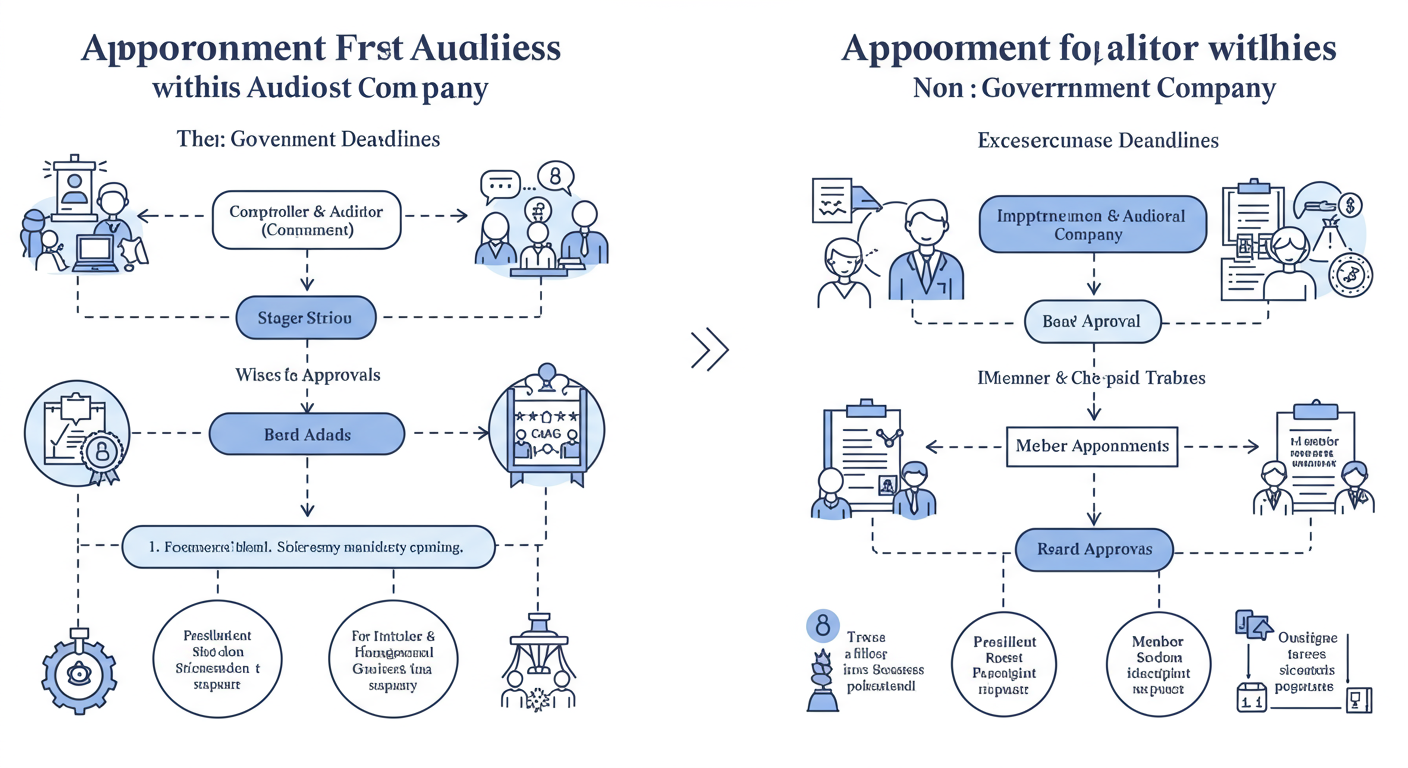
The entire process for the appointment of auditor in India is dictated by the Companies Act, 2013, primarily under Section 139. The law makes a clear distinction between appointing your very first auditor and all subsequent ones. Getting the timelines right is critical.
First Auditor vs. Subsequent Auditors: Key Differences
For a brand-new company, the clock starts ticking from the moment of incorporation. For established companies, the process is tied to the Annual General Meeting (AGM) cycle. Here’s a breakdown of the core differences.
| Aspect | First Auditor (New Company) | Subsequent Auditor (Established Company) |
|---|---|---|
| Appointing Body | 1. Board of Directors 2. Members (if Board fails) |
Members (Shareholders) at the AGM |
| Timeline (Non-Govt Co.) | Within 30 days of incorporation by the Board. If they fail, within 90 days by members at an EGM. | At the first AGM, and then at every 6th AGM. |
| Term of Office | Holds office only until the conclusion of the first AGM. | Holds office for a 5-year term (from the conclusion of the AGM of appointment to the conclusion of the 6th AGM). |
| Key Form | Form ADT-1 (within 15 days of appointment) | Form ADT-1 (within 15 days of appointment) |
⚠️ Watch Out
The 30-day deadline for the Board to appoint the first auditor is strict. Missing it forces you to call an Extraordinary General Meeting (EGM), which is costly, time-consuming, and signals to shareholders that the Board dropped the ball on its very first compliance task. Don’t make this first impression.
The 7-Step Playbook for a Flawless Auditor Appointment
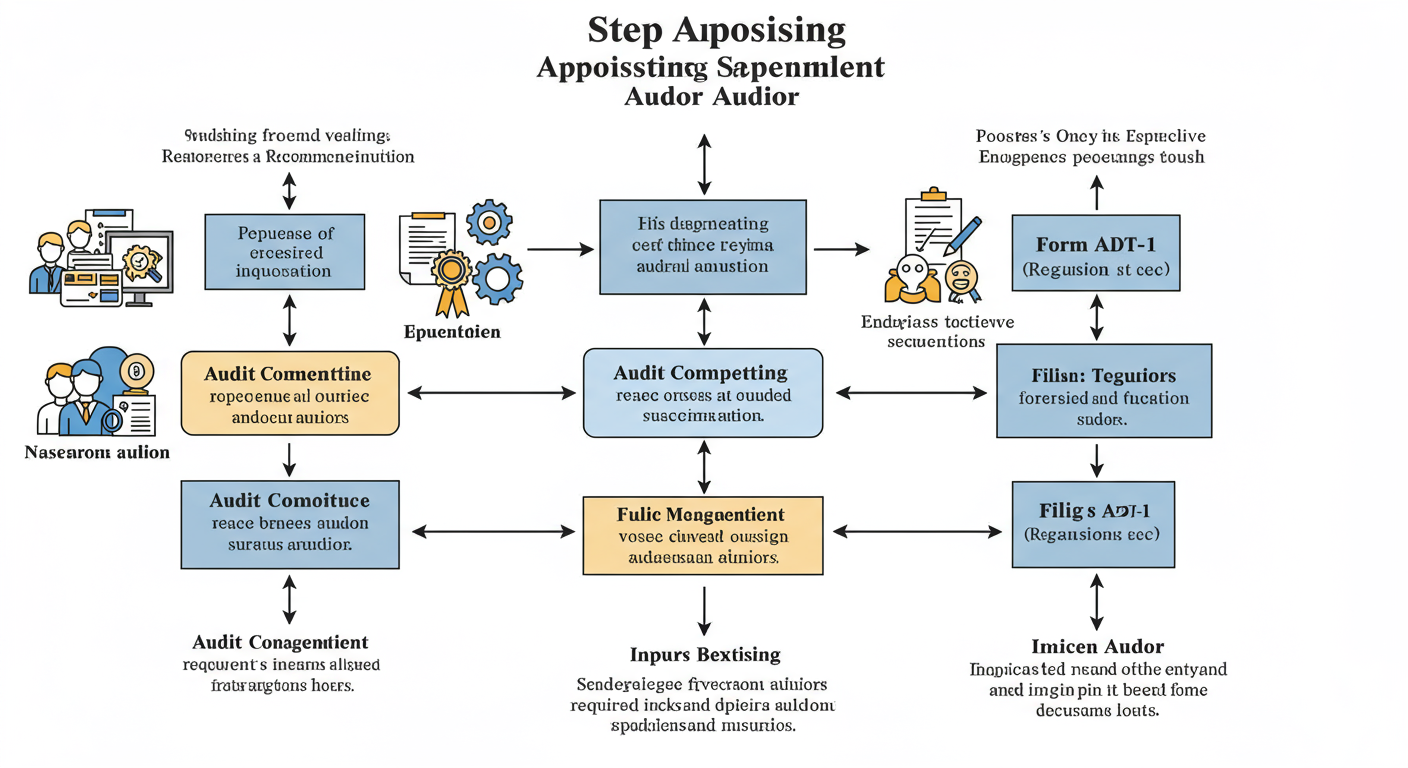
Appointing a subsequent auditor for the standard 5-year term is a formal process. It requires coordination between the Audit Committee (if applicable), the Board of Directors, and the shareholders. Follow this battle-tested process to ensure you’re 100% compliant.
- Step 1: Obtain Consent and Eligibility Certificate. Before you even think about proposing an auditor, you must get two documents from them:
- A written consent to act as the auditor if appointed.
- A certificate confirming they are eligible for the appointment under the Companies Act, 2013, and that the appointment is within the limits prescribed (i.e., they don’t audit too many companies). This certificate is a non-negotiable legal requirement.
- Step 2: Audit Committee Recommendation. If your company is required to have an Audit Committee (under Section 177), their role is to evaluate and recommend a candidate to the Board. The Board can disagree, but if they do, they must state their reasons in the Board’s report.
- Step 3: Board Resolution. The Board of Directors considers the recommendation and passes a resolution to propose the auditor’s appointment to the shareholders at the next AGM. This formalizes the Board’s choice.
- Step 4: Issue AGM Notice. The notice calling the AGM must include the appointment of the auditor as an item of ordinary business. It should clearly state the name of the proposed auditor or firm.
- Step 5: Shareholder Approval via Ordinary Resolution. At the AGM, the shareholders vote. A simple majority (an Ordinary Resolution) is needed to formalize the appointment. This is the moment the auditor is officially appointed.
- Step 6: Inform the Auditor. While they’ve already consented, the company must formally communicate the appointment to the auditor. This is typically done via a formal appointment letter.
- Step 7: File Form ADT-1 with the ROC. This is the final, crucial step. The company has 15 days from the date of the AGM to file Form ADT-1 with the Registrar of Companies (ROC). This form is the official public record of the appointment. I’ve seen companies celebrate a successful AGM and forget this step, leading to unnecessary penalties. Set a calendar reminder the day of the AGM.
💡 Pro Tip
When obtaining the eligibility certificate (Step 1), ask the proposed auditor to also provide a brief profile of their firm, their experience in your industry, and the key personnel who will be handling your audit. This helps the Board and Audit Committee make a more informed decision, moving beyond just a compliance check.
Beyond the Basics: How to Choose the Right Auditor
Compliance is the baseline, not the goal. The real value comes from choosing an auditor who is a strategic fit for your company. Here’s what to look for, based on real-world experience from countless audit cycles.
Independence is Non-Negotiable
The law is crystal clear on this. Section 141 of the Companies Act lists disqualifications. An auditor cannot be an employee, have certain business relationships, or have relatives in key positions at your company. But true independence is also a mindset. During interviews, ask them: “Describe a time you had a difficult disagreement with a client’s management. How did you handle it?” Their answer will reveal more than any checklist.
Industry Expertise Matters. A Lot.
An auditor who understands the nuances of SaaS revenue recognition, manufacturing inventory valuation, or e-commerce chargebacks is infinitely more valuable than a generalist. They know where the risks are. They speak your language. Ask for case studies or references from companies in your sector. According to established audit principles, understanding the entity and its environment is a foundational part of any quality audit.
Don’t Fall for the “Cheapest Fee” Trap
An audit is not a commodity. An unusually low fee is a massive red flag. It can mean the firm is cutting corners, using inexperienced staff, or simply doesn’t understand the scope of work required. This can lead to a poor-quality audit that misses critical issues, ultimately costing you more in the long run. A fair fee reflects the expertise and rigor required to do the job right.
🎯 Key Takeaway
The appointment of an auditor is a foundational pillar of corporate governance, not just a procedural formality. A compliant process protects you from legal risk, while a strategic choice of auditor enhances your company’s credibility and financial integrity. FSSAI Registration: Guide for Food Businesses
The “Musical Chairs” Rule: Mandatory Auditor Rotation Explained
To prevent auditors from becoming too cozy with a company’s management, the Companies Act, 2013, introduced mandatory rotation for certain classes of companies. This ensures a fresh pair of eyes reviews the books periodically. Mastering the Income Tax Refund Status Check: A Comprehensive Guide to Tracking and Resolving Delays
This isn’t for everyone. The rotation rules apply to:
- All listed companies.
- Other specific large companies, as detailed in the table below.
Once an auditor completes their maximum term, they must enter a cooling-off period of five years, during which they cannot be re-appointed by the same company. This is a key provision enforced by professional bodies like the Institute of Chartered Accountants of India (ICAI) to uphold auditor independence.
Auditor Rotation Applicability & Terms (as of 2026)
| Company Type | Applicability Threshold | Max Term (Individual) | Max Term (Audit Firm) |
|---|---|---|---|
| Listed Company | All | 1 term of 5 years | 2 terms of 5 years (10 total) |
| Unlisted Public Co. | Paid-up capital ≥ ₹10 crore | 1 term of 5 years | 2 terms of 5 years (10 total) |
| Private Limited Co. | Paid-up capital ≥ ₹50 crore | 1 term of 5 years | 2 terms of 5 years (10 total) |
| Any of the above | Borrowings/Deposits ≥ ₹50 crore | 1 term of 5 years | 2 terms of 5 years (10 total) |

💡 Pro Tip
If your company is approaching the rotation thresholds, start planning for the transition at least 18-24 months in advance. Finding, vetting, and onboarding a new audit firm that understands your business takes time. A rushed transition is a recipe for disaster.
When Things Go Wrong: Filling a Casual Vacancy
What happens if your auditor resigns, dies, or becomes disqualified mid-term? This creates a “casual vacancy.” The procedure for filling it depends on why the vacancy occurred.
- Vacancy due to Resignation: This is treated seriously. The Board of Directors must appoint a new auditor within 30 days. But that’s not all. This appointment must be approved by the shareholders at a general meeting held within three months of the Board’s recommendation. The resigning auditor also has a legal duty to file Form ADT-3 with the ROC, explaining their reasons for leaving.
- Vacancy for Any Other Reason (e.g., death): The process is simpler. The Board of Directors can fill the vacancy within 30 days, and no shareholder approval is required.
⚠️ Watch Out
An auditor’s resignation is a major red flag for regulators and investors. The reasons stated in Form ADT-3 will be scrutinized. Ensure you have a clear and transparent process for managing the transition and communicating with stakeholders to maintain confidence.
❓ Frequently Asked Questions
What is Form ADT-1 and when is it filed?
Form ADT-1 is the official notice filed with the Registrar of Companies (ROC) to inform them of an auditor’s appointment. It must be filed by the company within 15 days of the appointment, which is typically the date of the AGM where the shareholders approved it.
Who is disqualified from being an auditor?
Section 141 of the Companies Act, 2013, lists several disqualifications. Key ones include: an officer or employee of the company; a partner or employee of an officer/employee of the company; a person whose relative is a director or key manager; or anyone with certain levels of indebtedness or business relationships with the company. You can find the full list in the official Companies Act, 2013 e-book from the Ministry of Corporate Affairs.
Can we remove an auditor before their 5-year term ends?
Yes, but it’s intentionally difficult to ensure auditor independence. You need to get prior approval from the Central Government, and then pass a Special Resolution (requiring 75% shareholder approval) at a general meeting. The auditor must be given a fair chance to be heard. It’s a serious, complex, and public process.
Is annual ratification of the auditor still required?
No. This old rule was removed by the Companies (Amendment) Act, 2017. Once an auditor is appointed for a five-year term at an AGM, they hold office for the full term without needing annual re-approval from shareholders, simplifying the process.
What’s the difference between an Ordinary and a Special Resolution?
An Ordinary Resolution requires a simple majority of votes (more than 50%) to pass. It’s used for routine business like appointing an auditor. A Special Resolution is for more significant matters (like removing an auditor) and requires a supermajority of at least 75% of the votes to pass.
Your Next Step: From Compliance to Confidence
The appointment of an auditor is one of the most important governance responsibilities your company will undertake. Getting it right isn’t just about ticking a legal box—it’s about building a foundation of trust with every investor, lender, and partner.
You now have the complete playbook. You understand the legal framework, the step-by-step process, and the strategic considerations that separate great companies from the rest. You know the timelines, the forms, and the pitfalls to avoid.
Your next step is to review your current process. Is it robust? Are you planning ahead for auditor rotation? Are you treating your auditor as a strategic partner? Use this guide to benchmark your procedures and elevate your company’s approach to financial integrity. Don’t just aim for compliance; aim for confidence.