
The Easiest Way to Lose ₹5,000? Ignore This One Form.
Picture this: a single, forgotten compliance task. It takes 15 minutes, costs nothing, but ignoring it triggers an instant ₹5,000 penalty and deactivates your Director Identification Number (DIN). Suddenly, you can’t sign documents, you can’t be appointed to a new board, and your professional credibility takes a hit. This isn’t a scare tactic; it’s the reality for thousands of Indian directors every single year.
This is the high cost of neglecting your annual DIR-3 KYC filing.
But it doesn’t have to be you. In this in-depth guide, we’re cutting through the jargon and government-speak. You’ll get a crystal-clear, step-by-step blueprint to complete your director KYC for 2026, whether you’re a first-timer or a seasoned pro. We’ll show you which method to use, how to avoid common pitfalls, and how to secure your DIN in minutes. Let’s make sure your name isn’t on the penalty list this year.
What is DIR-3 KYC, Really? (It’s More Than Just Paperwork)
Think of your Director Identification Number as your passport to the corporate world. The DIR-3 KYC is simply the mandatory annual renewal of that passport. Introduced by the Ministry of Corporate Affairs (MCA), it’s a system to verify and update the contact details of every single person holding a DIN.
Why the strictness? The primary goal, mandated under Rule 12A of the Companies (Appointment and Qualification of Directors) Rules, 2014, is to boost corporate transparency. By ensuring the MCA has the correct, OTP-verified mobile number and email for every director, it helps clamp down on shell companies and fraudulent directorships. It’s a critical mechanism for maintaining a clean and accountable corporate registry.
Here’s the thing: it’s a personal obligation. It’s tied to you, the individual DIN holder, not the company you work for. Forgetting this distinction is where many directors get into trouble.
Who Absolutely MUST File DIR-3 KYC? The Mandate Explained
The rule is simple, but its reach is wide. If you have a DIN, you must file. Period. Let’s break down who falls under this mandate, because some of these might surprise you.
Every individual who was allotted a DIN on or before March 31st, 2026, and whose DIN is in an ‘Approved’ status, must complete their KYC for the financial year 2025-26. This includes:
- Active Directors: This is the obvious one. If you’re currently on the board of one or more companies, filing is mandatory.
- Disqualified Directors: Even if you’ve been disqualified for any reason, as long as your DIN exists, you are still legally required to file your annual KYC.
- “Dormant” DIN Holders: This is the group that gets caught most often. Perhaps you were a director years ago, resigned, but never surrendered your DIN. If you hold a DIN, you must file DIR-3 KYC every year, even if you aren’t associated with any company.
⚠️ Watch Out
The most common mistake we see is assuming “I’m not a director anymore, so I don’t need to file.” This is incorrect. The compliance is linked to holding a DIN, not your current employment status. If you have a DIN, the MCA expects you to verify your details annually.
The Two Paths to Compliance: E-Form vs. Web KYC in 2026
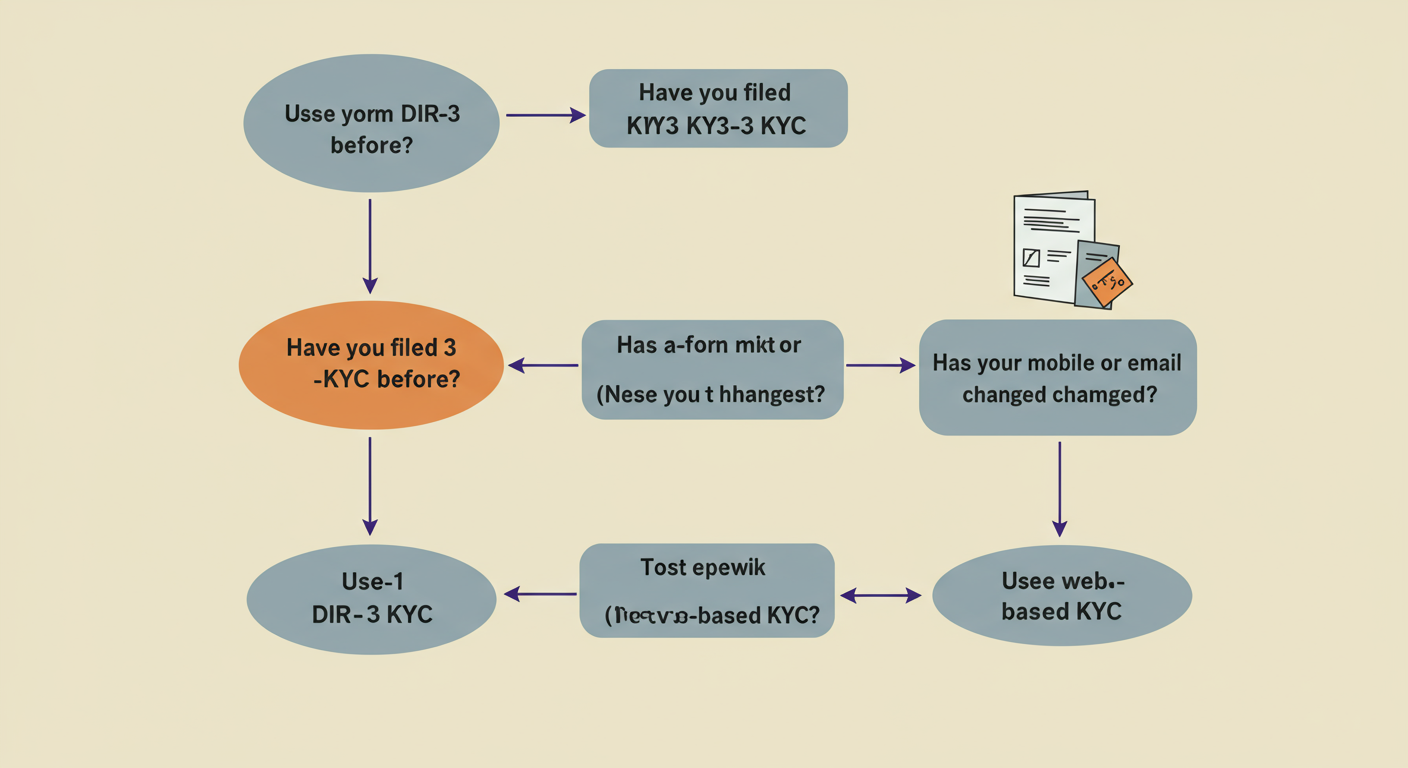
The MCA provides two distinct methods for DIR-3 KYC filing. Choosing the right one is the key to a fast, hassle-free experience. Your choice depends entirely on two factors: whether you’ve filed before and if your contact details have changed.
Based on our experience helping hundreds of directors, the web-based KYC is a lifesaver for those eligible. It takes less than five minutes. The e-Form, while necessary in certain cases, requires more steps and professional involvement.
| Feature | e-Form DIR-3 KYC | Web-based DIR-3 KYC |
|---|---|---|
| Who Should Use It? | First-time filers OR anyone whose mobile/email has changed since the last filing. | Directors who have filed before AND have no changes in their mobile number or email ID. |
| Process | Download form, fill details, verify OTPs, attach documents, get it certified by a professional (CA/CS/CMA), and upload. | Login to MCA portal, enter DIN, verify pre-filled data, and confirm with OTPs. Done. |
| Professional Certification? | Yes, mandatory certification by a practicing CA, CS, or CMA. | No, it’s a self-declaration process. No professional signature is needed. |
| Time Required | 1-2 hours (including coordination with a professional) | ~5 minutes |
| Filing Fee (before due date) | ₹0 | ₹0 |
Your No-Fail Filing Blueprint: A Step-by-Step Guide
Ready to get it done? Follow the exact steps for your situation below. The annual deadline is September 30th, 2026. Don’t wait until the last week when the portal slows down.
Method 1: Filing via e-Form DIR-3 KYC (For First-Timers or if Details Changed)
This method is more involved, so follow carefully. You’ll need your Digital Signature Certificate (DSC) and a practicing professional on standby.
- Download the Form: Go to the official MCA portal. Navigate to ‘MCA Services’ -> ‘Company e-Filing’ -> ‘Company Forms Download’ and find the e-Form DIR-3 KYC.
- Pre-fill the Form: Open the PDF form and enter your DIN. Click ‘Pre-fill’. Your name, father’s name, and DOB will be auto-populated. Verify them.
- Enter and Verify Contacts: This is the crucial step. Enter your personal mobile number and personal email ID. Click ‘Send OTP’. You’ll receive separate OTPs on your phone and email.
- Enter OTPs: Input the OTPs in the designated fields. They are valid for only 10 minutes, so be quick!
- Attach Documents: Attach self-attested copies of your PAN and Aadhaar. For address proof, a recent bank statement or utility bill works. Ensure scans are clear.
- Professional Certification: Send the form to your practicing Chartered Accountant (CA), Company Secretary (CS), or Cost Accountant (CMA). They will verify your documents and digitally sign the form.
- Final Submission: Affix your own DSC to the form. Now, log in to the MCA portal and upload the signed form. An SRN (Service Request Number) will be generated, confirming your submission.
💡 Pro Tip
Before starting the e-Form process, check the validity of your DSC using the MCA’s “Associate DSC” service. An expired or un-associated DSC is a common point of failure that can cause last-minute panic.
Method 2: Filing via Web-based Service (The 5-Minute Method)
If you’ve filed before and your details are unchanged, this is for you. It’s incredibly simple.
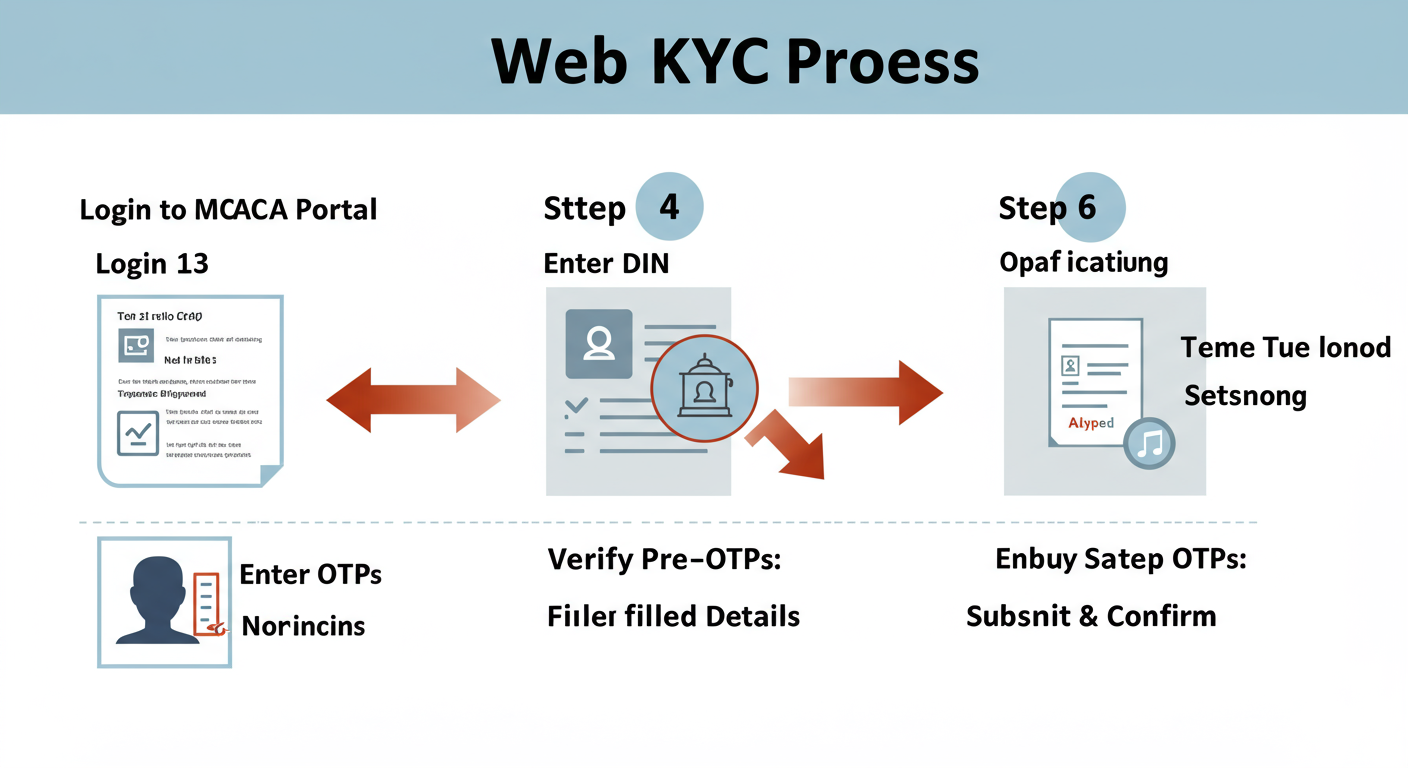
- Login to MCA V3: Go to the MCA portal and log in with your credentials.
- Find the Service: Navigate the menu: MCA Services > DIN Services > DIR-3 KYC Web.
- Enter Your DIN: A new page will open. Enter your DIN and submit.
- Review Your Details: Your pre-filled data (Name, Mobile, Email) will appear on the screen. Double-check that everything is 100% correct.
- Verify with OTPs: Click ‘Send OTP’. Enter the OTPs received on your registered mobile and email.
- Submit and Finish: Click ‘Submit’. You’ll see a success message with an SRN. That’s it! Your KYC is done for the year. You’ll also get a confirmation email.
🎯 Key Takeaway
The DIR-3 KYC is a mandatory annual compliance for every individual holding a DIN, regardless of their current directorship status. Use the simple web-based process if your details are unchanged; otherwise, use the e-Form. Filing before the September 30th deadline is free and essential to avoid a ₹5,000 penalty and DIN deactivation.
The High Cost of Inaction: Penalties, Deactivation, and Headaches
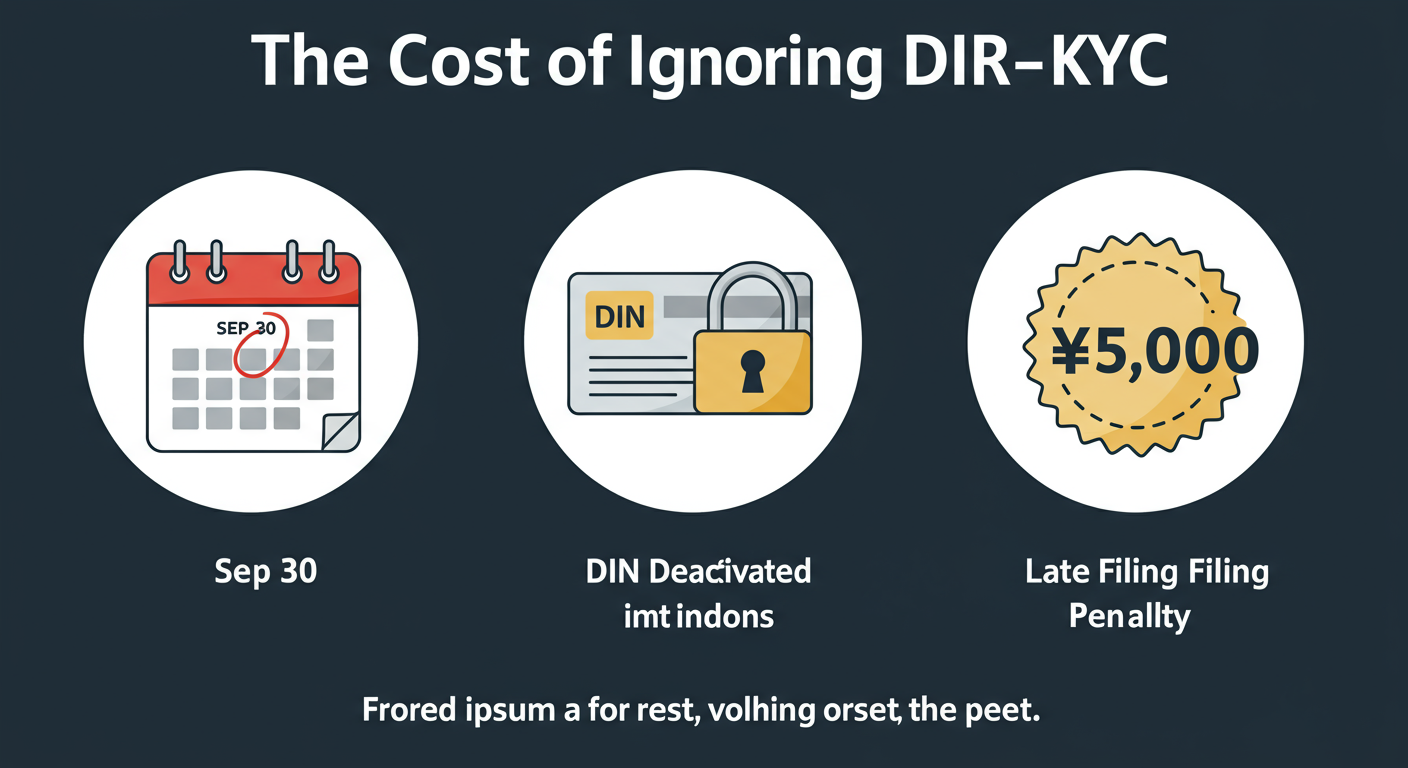
What happens if you miss the September 30th deadline? The consequences are automatic and severe. The MCA’s system will flag your DIN for non-compliance on October 1st. Top 7 Key Benefits of 12A Registration for Nonprofits
“As per the provisions of Rule 12A of the Companies (Appointment and Qualification of Directors) Rules, 2014, the DIN of an individual who has not submitted his e-form DIR-3-KYC will be deactivated.” – Ministry of Corporate Affairs
This isn’t just a slap on the wrist. A deactivated DIN has real-world implications: Mastering the GST Late Fee Calculation: Rules, Caps, and Compliance Strategies
- You’re Barred: You cannot be appointed as a new director in any company.
- You’re Silenced: You cannot sign any statutory documents for the company you’re currently a director of.
- You’re Penalized: To reactivate your DIN, you must file the overdue DIR-3 KYC e-Form and pay a non-negotiable flat fee of ₹5,000.
Here’s a simple before-and-after look at what happens to your DIN status.
| Scenario | DIN Status Before Sep 30 | DIN Status After Sep 30 (if KYC is missed) | Reactivation Cost |
|---|---|---|---|
| Compliant Director | Active | Active | ₹0 |
| Non-Compliant Director | Active | Deactivated due to non-filing of DIR-3 KYC | ₹5,000 |
⚠️ Watch Out
The ₹5,000 penalty is just the direct cost. The indirect cost of a deactivated DIN can be much higher. Imagine a crucial board resolution or a major business deal being stalled because you, a key signatory, are unable to sign. The professional embarrassment and potential business loss far outweigh the penalty.
Your Pre-Filing Checklist: Gather These Now
To ensure a smooth filing, have these items ready before you begin. Scrambling for documents at the last minute is a recipe for frustration.
- ✅ Your DIN: The 8-digit number itself.
- ✅ Personal Mobile Number & Email ID: Make sure you have access to both for OTPs. Do not use a shared or official email.
- ✅ Aadhaar Card & PAN Card: For self-attested scanned copies.
- ✅ Digital Signature Certificate (DSC): A valid Class 3 DSC is mandatory for e-Form filing. Not needed for Web KYC.
- ✅ Professional’s Details (for e-Form only): The membership number and DSC of your chosen CA, CS, or CMA.
💡 Pro Tip
Create a dedicated folder on your computer named “KYC Documents” with clear, legible scans of your PAN, Aadhaar, and a recent address proof (like a PDF bank statement). This simple organization saves you time every single year.
Providing accurate information is a fundamental responsibility of a director, as outlined in the Companies Act, 2013. This annual filing is a direct reflection of that duty. For a broader understanding of a director’s responsibilities, the principles of corporate governance provide excellent context.
❓ Frequently Asked Questions
What is the exact due date for DIR-3 KYC filing in 2026?
The due date for completing your annual DIR-3 KYC for the financial year 2025-26 is September 30th, 2026. There is no government fee if you file on or before this date.
What happens if I miss the DIR-3 KYC deadline?
If you fail to file by September 30th, the MCA will automatically mark your DIN as ‘Deactivated’. To reactivate it, you must file the e-Form DIR-3 KYC (web-based filing is not allowed for reactivation) and pay a flat penalty of ₹5,000.
I have a DIN but I’m not a director in any company. Do I still need to file?
Yes, absolutely. The compliance is tied to holding a DIN, not your current directorship status. From real-world cases, we know this is the most common reason people get penalized. If you have a DIN, you must file.
Can I use my assistant’s or a family member’s email for the OTP?
No. This is a critical point. The mobile number and email address must be personal to the director. The entire purpose of the OTP verification is to confirm the identity and contact details of the individual director. Using someone else’s details defeats the purpose and is against the rules.
My mobile number has changed. Can I still use the web-based KYC?
No. If any of your core KYC details—specifically your mobile number or email ID—have changed, you must use the more detailed e-Form DIR-3 KYC. The web service is strictly for those with zero changes to their contact information.
Is there any fee for filing DIR-3 KYC on time?
No. If you complete your DIR-3 KYC filing (either via e-Form or web) on or before the September 30th deadline, there are no government fees. It is completely free.
Don’t Be a Statistic: Secure Your DIN Today
The DIR-3 KYC is not a complex hurdle. It’s a simple, annual check-in that protects your professional standing. Yet, every year, thousands of directors are caught off guard, facing penalties and the hassle of a deactivated DIN.
You now have the complete playbook for 2026. You know which path to take, the exact steps to follow, and the pitfalls to avoid. The difference between a compliant, active director and one facing a ₹5,000 penalty is about 15 minutes of proactive effort.
Here’s your next step: Block 15 minutes in your calendar right now. Label it “DIR-3 KYC Filing.” If your details are unchanged, use the web-based service and be done in minutes. If they’ve changed, start the e-Form process today. Don’t let this simple task become a costly problem.