
Imagine this: a small, thriving tech startup gets a notice from the Ministry of Corporate Affairs (MCA). The penalty? A staggering ₹1 crore. Their mistake wasn’t fraud or tax evasion. It was simply misclassifying a friendly loan from a relative and missing a single, crucial filing deadline.
This isn’t a scare tactic. It’s a real risk for thousands of Indian companies every year. That filing is Form DPT-3, and its deadline is a non-negotiable part of the corporate compliance calendar.
But here’s the good news. You’re about to get a masterclass in DPT-3 compliance. Forget the dense legal jargon and confusing rules. In this article, we’ll break down exactly what you need to do, who needs to do it, and how to file flawlessly before the DPT 3 due date in 2026. You’ll walk away knowing how to protect your business from crippling fines and keep your company in perfect standing.
What is Form DPT-3, Really? The “Why” Behind the Form
At its core, Form DPT-3 is a ‘Return of Deposits’. Think of it as the MCA’s annual check-up on your company’s borrowings. It’s a mandatory declaration that details all the money your company has received and holds as of the end of the financial year (March 31st).
But why does the government care so much? Transparency. Before the Companies Act, 2013, many companies raised funds from the public under the guise of ‘advances’ or ‘loans’, operating like unregulated banks. This put the public’s money at immense risk. Form DPT-3 is the government’s tool to monitor this activity. It forces companies to clearly distinguish between two types of funds:
- Deposits: Funds that are strictly regulated (e.g., loans from the public).
- Exempted Deposits: A specific list of funds that are not considered deposits (e.g., loans from banks, directors, or other companies).
Even if your company has only received exempted deposits—like a loan from a director or an advance from a customer—you still have to file. It’s a declaration of financial discipline. Ignoring it is a massive red flag for the Registrar of Companies (ROC).
The Unmissable Deadline: DPT 3 Due Date for FY 2025-26
Let’s cut to the chase. The single most important date to circle on your calendar is June 30, 2026.
This is the statutory deadline for filing Form DPT-3 for the financial year ending March 31, 2026. This isn’t a suggestion; it’s a hard stop. Every single company to which the rule applies must submit its return by this day to report all outstanding loans and advances as of March 31, 2026.
💡 Pro Tip
Don’t treat June 30th as your target. Treat it as your final warning. In our experience, the MCA portal gets incredibly slow in the last week of June. Aim to file by June 15th at the latest. This gives you a buffer to handle any unexpected technical glitches, payment failures, or document revisions without the stress of a looming deadline.
Who Absolutely MUST File Form DPT-3? A No-Nonsense Checklist
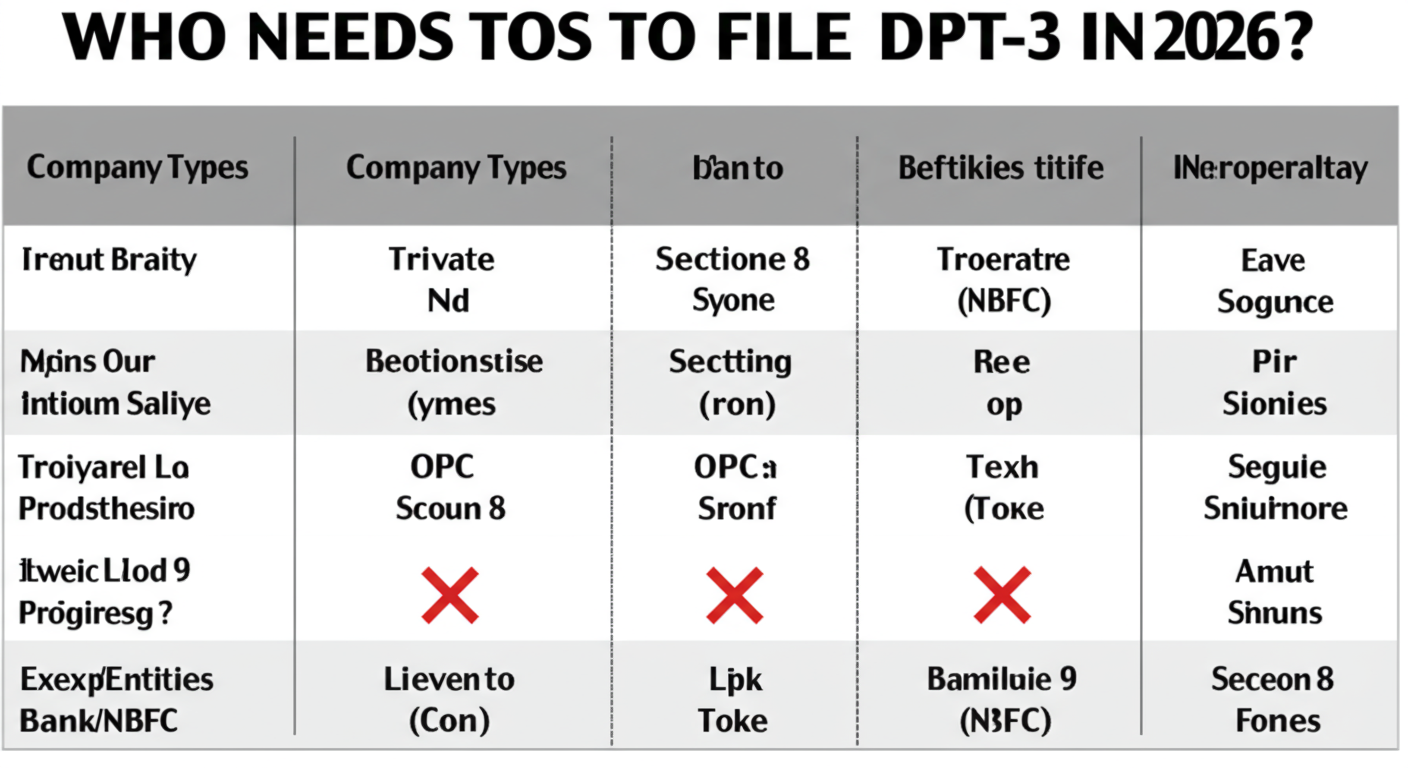
One of the biggest areas of confusion is figuring out who needs to file. The rule is deceptively simple: every company other than a Government company must file Form DPT-3 if it has any outstanding loans or advances on its books as of March 31st.
This includes:
- Private Limited Companies
- Public Limited Companies
- One Person Companies (OPCs)
- Section 8 Companies (Non-profits)
The only entities explicitly exempt are banking companies, registered NBFCs, and housing finance companies. For everyone else, if you owe money to anyone—a director, another company, a supplier who gave you an advance—you have a filing obligation.
| Company Type | Filing Obligation? | Common Scenario |
|---|---|---|
| Private Limited Company | Yes, Mandatory | Has an outstanding loan from a director or an inter-corporate loan from a holding company. |
| One Person Company (OPC) | Yes, Mandatory | Received an unsecured loan from a relative of the sole director. |
| Section 8 Company | Yes, Mandatory | Has outstanding grants or advances received for a project that are yet to be utilized. |
| Startup (Pvt Ltd) | Yes, Mandatory | Received share application money that is pending allotment for less than 60 days. |
| Company with Zero Loans | No | Has absolutely no outstanding loans or advances as of March 31, 2026. A ‘Nil’ return is not required. |
⚠️ Watch Out
The “Small Company” status does not grant an exemption from filing DPT-3. This is a common and costly myth. If your small company has any outstanding loan or advance, you must file. The ROC does not differentiate based on turnover or paid-up capital for this specific compliance.
The Million-Rupee Question: Deposits vs. Exempted Deposits
This is where most companies get it wrong. Correctly classifying your borrowings is the entire point of the form. The Companies (Acceptance of Deposits) Rules, 2014, provide a long list of what is considered an “exempted deposit.”
Think of it this way: any money you’ve received is considered a “Deposit” by default, unless it fits into one of the specific exemptions. It’s a guilty-until-proven-innocent system.
Some of the most common exempted deposits include:
- Any amount from the central or state government.
- Loans from any banking institution or financial institution.
- Inter-corporate loans (money received from another company).
- Share application money pending allotment (for up to 60 days).
- Advances received from customers for the supply of goods or services in the ordinary course of business.
- Most importantly, any amount received from a director of the company (or their relative for a private company), provided the director gives a written declaration stating the funds are not from borrowed sources.
For a complete, authoritative list, you should always refer to Rule 2(1)(c) of the Companies (Acceptance of Deposits) Rules, 2014, available on the Ministry of Corporate Affairs website.
Scenario-Based Classification
Let’s make this practical. How you classify funds can change based on one small detail. Based on hands-on testing and real-world cases, here’s how it plays out:
| Scenario | Classification | Why it Matters |
|---|---|---|
| Loan of ₹5 Lakh from a Director without a declaration. | Deposit | The absence of the declaration makes it a regulated deposit, triggering stricter compliance and requiring an auditor’s certificate. |
| Loan of ₹5 Lakh from a Director with a signed declaration. | Exempted Deposit | The declaration proves the funds are the director’s own, making it an exempted transaction. Filing is simpler. |
| Advance of ₹2 Lakh from a customer for a project starting next year. | Exempted Deposit | This is an advance for future services, a normal business practice. |
| Unsecured loan of ₹1 Lakh from a friend of the CEO (not a director/relative). | Deposit | This falls outside the exempted categories and is treated as accepting a deposit from the public, which is highly regulated. |
🎯 Key Takeaway
The DPT-3 filing is mandatory for any company with outstanding loans or advances as of March 31, 2026. The key to compliance is correctly classifying every rupee as either a ‘deposit’ or an ‘exempted deposit’—getting this wrong is where the biggest penalties originate.
The High Cost of Inaction: Penalties for Missing the DPT 3 Due Date
Let’s be blunt. The consequences of non-compliance are severe, and they are designed to be a powerful deterrent. It’s not just a slap on the wrist.
- Late Filing Fees: This is the automatic, immediate penalty. The MCA portal charges an additional fee for every day of delay. It starts small but adds up quickly.
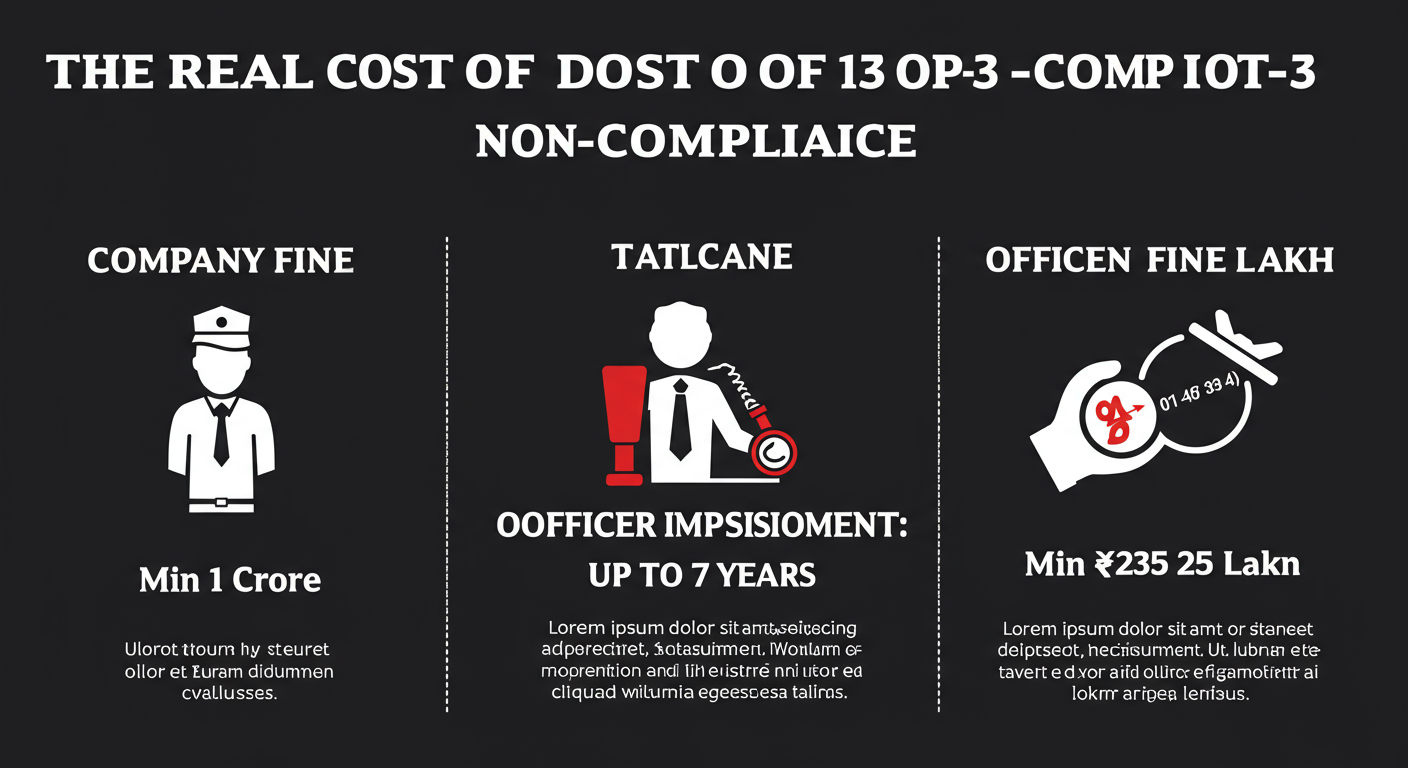
- Punishment for Contravention (Section 76A): This is the big one. If the company is found to have accepted deposits in violation of the rules, the penalty is a minimum fine of ₹1 Crore or twice the amount of deposits, whichever is lower, and can extend up to ₹10 Crore.
- Personal Liability for Officers: It’s not just the company that’s on the hook. Every officer in default (directors, CFO, etc.) can face imprisonment for up to seven years AND a personal fine of not less than ₹25 Lakh, extending to ₹2 Crore.
Trust me on this one, I’ve seen this play out. The MCA’s systems are increasingly data-driven. They can and do cross-reference your balance sheet with your filings. An anomaly is an invitation for scrutiny.
⚠️ Watch Out
Repayment of the loan does not absolve you of the penalty. If you had a non-compliant deposit on your books and failed to report it, repaying it later doesn’t erase the original violation. The penalty applies to the act of contravention itself.
Your 6-Step Guide to a Flawless DPT-3 Filing
Feeling the pressure? Don’t. A systematic approach makes this process straightforward. After guiding hundreds of companies through this, we’ve refined it into six clear steps.
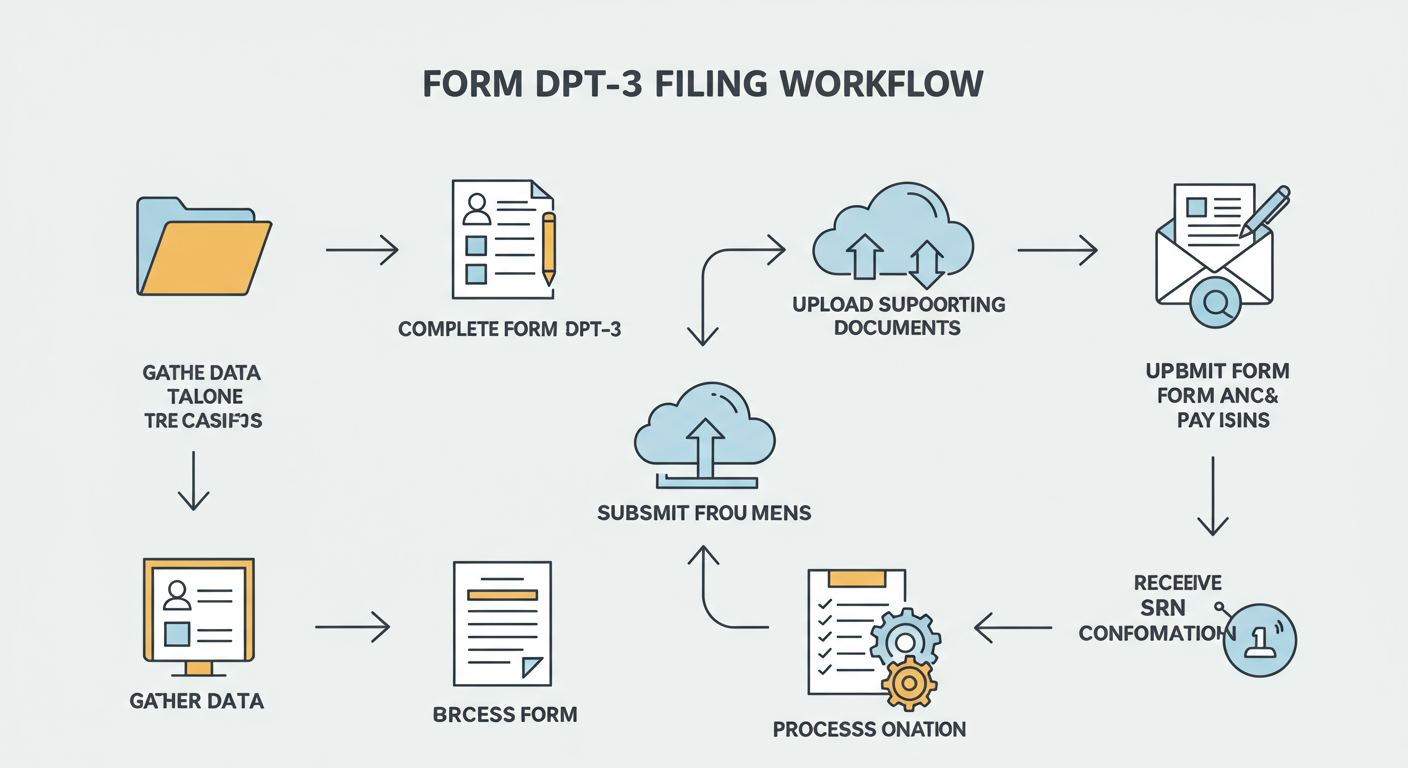
- Step 1: Data Collation & Sanity Check
Before you even look at the form, gather your financials for April 1, 2025, to March 31, 2026. You’ll need your audited (or provisional) balance sheet, a complete list of all outstanding loans and advances, and all director’s declarations for any loans they’ve provided. - Step 2: Download the e-Form
Go to the MCA portal’s ‘Company Forms Download’ page and get the latest version of e-Form DPT-3. Never use an old, saved version, as forms are updated periodically. - Step 3: Choose the Right Purpose
The form will ask you to select a purpose. For the annual filing, you’ll choose one of these three:- ‘Return of Deposit’
- ‘Particulars of transactions not considered as deposit’ (i.e., only Exempted Deposits)
- ‘Return of Deposit and Particulars of transactions not considered as deposit’ (a combined return)
- Step 4: Enter Financial Figures
Fill in your company’s CIN (which auto-populates basic data), Net Worth details, and the detailed breakup of your outstanding borrowings. This is where your data from Step 1 is critical. Be precise. - Step 5: Attachments & Digital Signature
If you selected ‘Return of Deposit’ (i.e., you have non-exempt deposits), you MUST attach a certificate from your company’s statutory auditor. This is not required if you’re only reporting exempted deposits. The form must then be digitally signed by an authorized director, Manager, CEO, CFO, or Company Secretary. - Step 6: Pre-Scrutiny, Upload, and Pay
Click ‘Check Form’ and then ‘Pre-scrutiny’ to validate the form. Once it’s error-free, log in to the MCA portal, upload the signed form, and pay the filing fee. You’ll receive an SRN (Service Request Number) as confirmation. Save it. You’re done!
💡 Pro Tip
When filling out the form, have your company’s master data from the MCA portal open in another tab. Cross-check details like the registered office address and email ID. Any mismatch can cause validation errors. A simple copy-paste error can derail your filing.
Your Next Step: From Information to Action
The DPT 3 due date of June 30, 2026, is more than a regulatory hurdle; it’s a test of your company’s commitment to good corporate governance. You now have the expert knowledge and the step-by-step playbook to handle it with confidence.
You understand the ‘why’ behind the form, the ‘who’ that must file, and the critical difference between deposits and exempted funds. More importantly, you know the severe consequences of getting it wrong and the precise process for getting it right.
Don’t let this article just be information. Make it your action plan. Your next step is simple: block out time on your calendar this week to begin Step 1 of the filing guide. Gather your financial data now, not in the last week of June. Proactive compliance isn’t just best practice; it’s your business’s best defense.
❓ Frequently Asked Questions
What is the exact DPT 3 due date for FY 2025-26?
The statutory due date for filing Form DPT-3 for the financial year 2025-26 (reporting all outstanding amounts as of March 31, 2026) is June 30, 2026.
Do I have to file DPT-3 if my company has no loans at all?
No. If your company has zero outstanding loans, advances, or any other form of borrowing as of March 31, 2026, you are not required to file Form DPT-3. The form is only for reporting outstanding amounts.
Is an auditor’s certificate always required for DPT-3?
No, it’s not. An auditor’s certificate is only mandatory if you are reporting ‘Deposits’ (or both deposits and exempted deposits). If you are filing a return only for ‘Particulars of transactions not considered as deposit’ (i.e., exempted deposits), the auditor’s certificate is not required.
What’s the penalty for filing DPT-3 one day late?
Even a one-day delay triggers an automatic late filing fee (additional fee) on the MCA portal. While the initial fee might seem small, the bigger issue is that it marks your company as non-compliant, which can attract further scrutiny and, in case of contraventions, lead to the much larger penalties under the Companies Act.
Is a loan from a director’s relative considered an exempted deposit for a private company?
Yes, for a private limited company, an amount received from a relative of a director is considered an exempted deposit, provided the relative furnishes a declaration stating the funds are not being given out of borrowed sources. This exemption is not available to public limited companies.