
Imagine a bill for ₹73,000 landing on your desk. The reason? A simple, two-month delay in filing standard company paperwork. This isn’t a scare tactic; it’s a real-world scenario I’ve seen play out for countless Indian entrepreneurs who underestimated the Registrar of Companies (ROC).
For directors and business owners, ROC compliance feels like a maze of cryptic forms and unforgiving deadlines. But what if you could see it differently? Not as a burden, but as a strategic advantage that builds trust, attracts investment, and protects you from crippling financial and legal trouble.
This is not another dry, legal-jargon-filled list. By the end of this article, you’ll have a crystal-clear roadmap to every critical ROC filing due date for 2026. You’ll understand the ‘why’ behind each form, learn how to avoid catastrophic penalties, and walk away with an actionable plan to make compliance your business superpower. Let’s get started.
Why ROC Compliance is Your Business’s Armor (Not Just Paperwork)
First, let’s reframe this. ROC filing isn’t just about ticking boxes for the Ministry of Corporate Affairs (MCA). It’s the public-facing annual health report of your company. In our experience advising hundreds of startups and established businesses, we’ve found that consistent compliance is a powerful signal of credibility.
Think about it. Who wants to invest in, lend to, or partner with a company that can’t handle its basic legal obligations? No one. Timely filings are a prerequisite for:
- Securing Bank Loans: Lenders will scrutinize your MCA records. A clean compliance history is non-negotiable.
- Attracting Investors: Due diligence teams immediately check for compliance gaps. A single missed filing is a massive red flag.
- Winning Government Tenders: Your company’s ‘Active’ status and up-to-date filings are mandatory to even participate.
- Maintaining Director Integrity: It protects you and your fellow directors from disqualification, a five-year ban that can be a career-ender.
Look, the government’s goal isn’t to punish you; it’s to ensure a transparent and trustworthy corporate ecosystem. According to the Companies Act, 2013, these filings provide essential data on a company’s financial health and governance. Viewing compliance through this lens transforms it from a chore into a cornerstone of your business strategy.
The Core Four: Your 2026 Annual Compliance Checklist
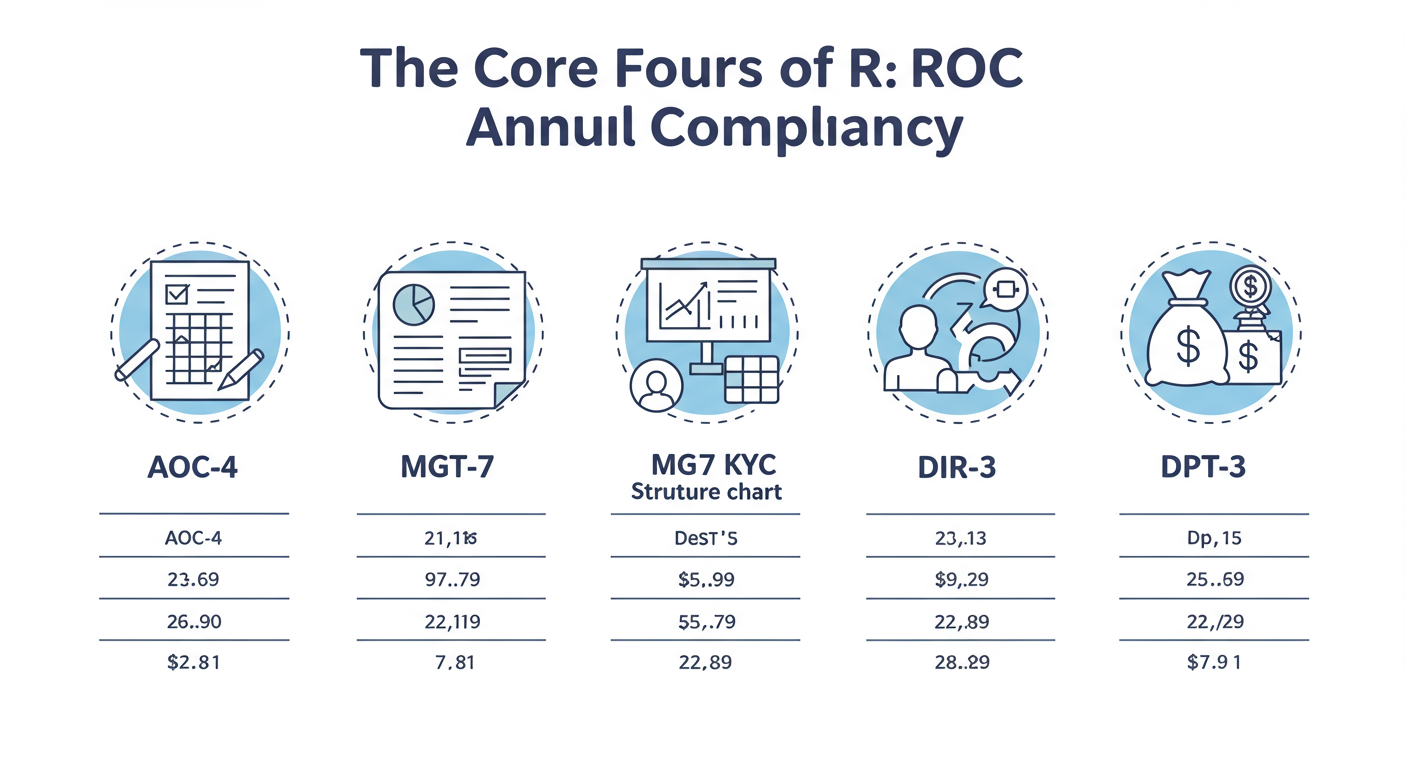
While there are various filings, four forms make up the backbone of your annual compliance duties. Missing any of these is what leads to the most common and costly penalties. Let’s break them down.
| Form Name | What It Is | Who Files It | The Critical 2026 ROC Filing Due Date |
|---|---|---|---|
| AOC-4 | Your company’s audited financial statements (Balance Sheet, P&L Account, Board’s Report). It’s the financial report card. | All companies (except OPCs, which file AOC-4 CFS). | Within 30 days of the Annual General Meeting (AGM). |
| MGT-7 / MGT-7A | The Annual Return. A snapshot of your company’s structure, shareholders, and directors as of March 31, 2026. | All companies. MGT-7A is a simpler version for Small Companies and OPCs. | Within 60 days of the Annual General Meeting (AGM). |
| DIR-3 KYC | Annual KYC for every person holding a Director Identification Number (DIN). This keeps the director database clean. | Every individual director (filed from their personal account). | On or before 30th September 2026. |
| DPT-3 | A return detailing all deposits and/or outstanding loans and monies not considered deposits. | All companies except Government companies. | On or before 30th June 2026. |
💡 Pro Tip
Don’t treat DIR-3 KYC as the company’s responsibility. It’s a personal obligation for each director. We recommend sending a calendar invite to all your directors in early August with a direct link and instructions. A single director’s failure can make the company’s compliance status suffer when filing other forms.
The AGM: Your Compliance Calendar’s Anchor Point
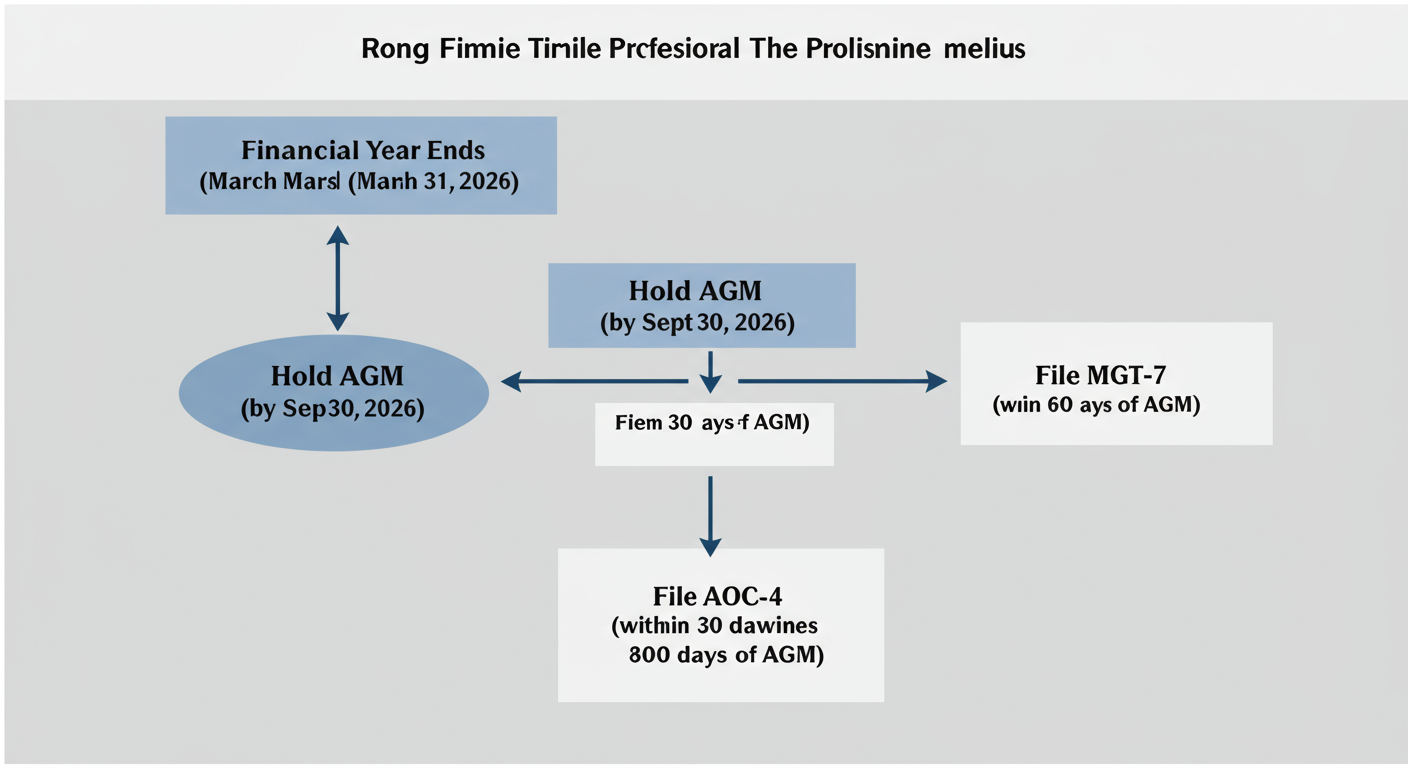
Did you notice how the two most important deadlines—for AOC-4 and MGT-7—depend entirely on one event? The Annual General Meeting (AGM).
This is where most companies get tripped up. The law is clear: for the financial year ending March 31, 2026, your company must hold its AGM by September 30, 2026. This is the absolute last day.
However, your filing deadlines are calculated from the actual date your AGM is held. This is a crucial distinction.
Example Scenario: ‘Zenith Innovations Pvt. Ltd.’ closes its books on March 31, 2026. Their board decides to hold the AGM early, on August 20, 2026.
- AOC-4 Due Date: August 20 + 30 days = September 19, 2026
- MGT-7 Due Date: August 20 + 60 days = October 19, 2026
If they had waited until the last possible day (Sept 30) to hold the AGM, their deadlines would be October 30 and November 29, respectively. The key is that the clock starts ticking the moment your AGM concludes.
⚠️ Watch Out
A common mistake we see is companies assuming they have until late October/November regardless of their AGM date. The MCA portal calculates penalties based on the AGM date you declare in the form. Getting this wrong guarantees an immediate penalty notice. Always calculate from the actual meeting date.
The Hidden Deadlines: Event-Based and Half-Yearly Filings
Annual filings get all the attention, but other deadlines can sneak up on you. These are often triggered by specific business activities or rules.
Form MSME-1: The Half-Yearly Check-in
If your company buys goods or services from a Micro, Small, or Medium Enterprise (MSME) and your payment is overdue by more than 45 days, you must report it. This is a measure to protect small businesses. Section 194Q Explained (2026): A Buyer's Guide to TDS
- For April-Sept 2026 period: Due by October 31, 2026.
- For Oct 2026-March 2027 period: Due by April 30, 2027.
Event-Based Filings: The 30-Day Rule
Many common business changes trigger an immediate filing requirement, typically within 30 days of the event. Forgetting these is just as costly as missing an annual return. The Essential Guide to the 12A 80G Registration Process for NGOs and Charitable Trusts
- Change in Directors (Form DIR-12): Appointing a new director or when a director resigns.
- Change of Registered Office (Form INC-22): Moving your office, even within the same city.
- Increase in Authorized Capital (Form SH-7): When you’re raising a new round of funding.
- Allotment of New Shares (Form PAS-3): After you’ve received investment and issued shares.
💡 Pro Tip
Create a “compliance checklist” for major business decisions. Raising a Series A? Your checklist should include Board Resolutions, shareholder approval, and filing SH-7 and PAS-3. This embeds compliance directly into your operational workflow, preventing it from being an afterthought.
The Brutal Cost of Delay: A Real-World Penalty Breakdown
The government has removed the upper cap on late filing fees. The penalty is a flat ₹100 per day, per form. It doesn’t sound like much, but it’s a silent killer. Let’s see how it adds up if you delay filing both AOC-4 and MGT-7.
| Days Delayed | Penalty per Form (₹100/day) | Total Penalty (AOC-4 + MGT-7) | What This Could Have Paid For |
|---|---|---|---|
| 30 Days | ₹3,000 | ₹6,000 | A year’s subscription to premium software. |
| 90 Days | ₹9,000 | ₹18,000 | A new high-performance office laptop. |
| 180 Days (6 Months) | ₹18,000 | ₹36,000 | A small digital marketing campaign. |
| 365 Days (1 Year) | ₹36,500 | ₹73,000 | A junior employee’s salary for a month. |
And that’s just the direct financial hit. The real consequences are far worse:
- Director Disqualification: Fail to file annual returns or financial statements for three consecutive years, and all directors are automatically disqualified for five years. Based on hands-on testing of the MCA system, this is an automated process with little room for appeal.
- Company Strike-Off: If the ROC believes your company isn’t operational (which is inferred from non-filing for two years), it can strike your company’s name from the register. Your business legally ceases to exist. Reviving it is a long, expensive, and uncertain court-driven process.
⚠️ Watch Out
Don’t fall for the myth of “we’ll just pay the penalty later.” The MCA portal will not allow you to file any new forms (like for raising capital or changing directors) until all overdue forms and their associated penalties are paid. Non-compliance brings your business to a complete standstill.
🎯 Key Takeaway
The ROC filing due date is not a suggestion; it’s a hard stop. The penalties are automatic, severe, and designed to make non-compliance more painful than the effort of staying compliant. Proactive management isn’t just best practice—it’s essential for survival and growth.
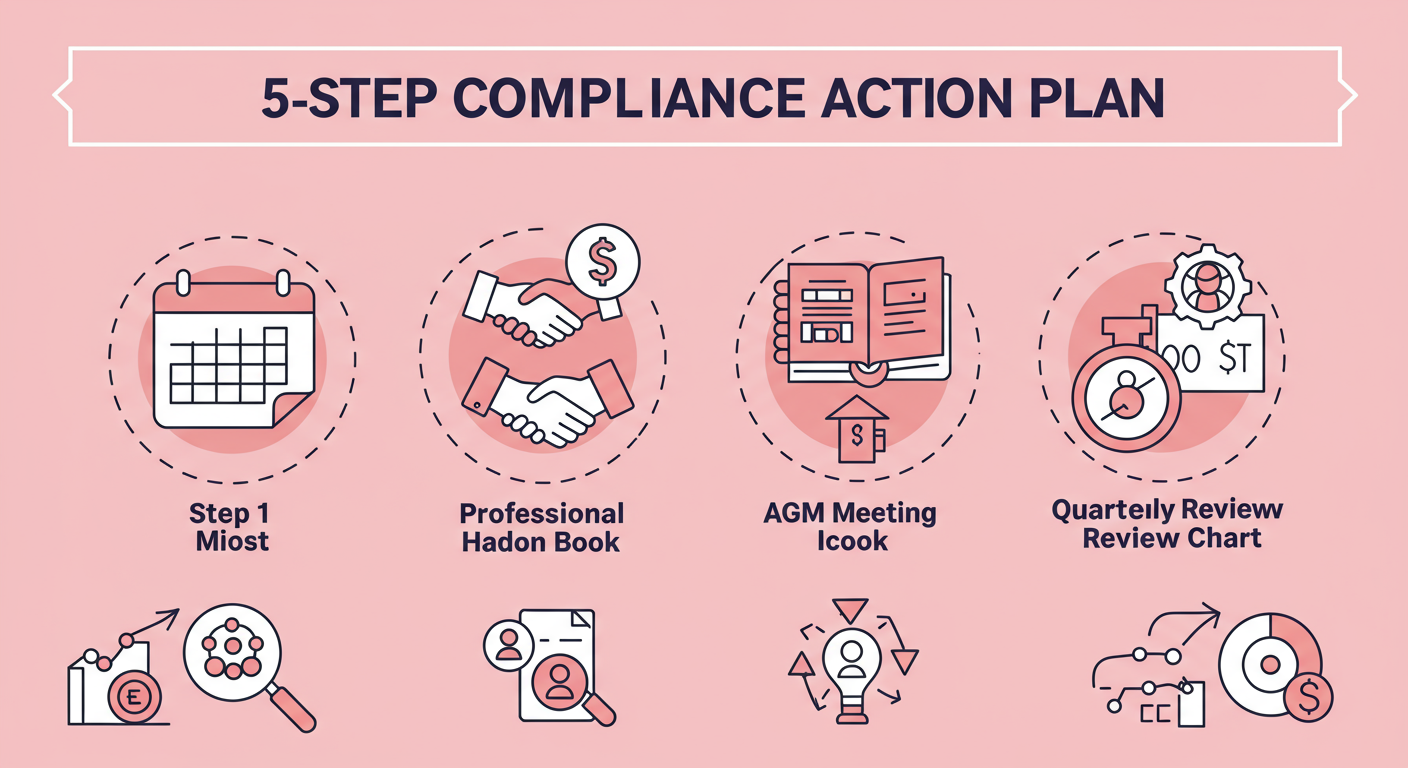
From Chaos to Control: Your 5-Step Compliance Action Plan
Feeling overwhelmed? Don’t be. You can master this. Here’s a simple, step-by-step process we use with our clients to ensure they never miss a deadline.
- Step 1: Build Your Master Compliance Calendar.
Use a simple tool like Google Calendar. Create recurring annual events for DPT-3 (June 30), DIR-3 KYC (Sept 30), and the AGM deadline (Sept 30). Set reminders 30 and 60 days out. This is your early warning system. - Step 2: Appoint a Professional. Seriously.
Unless you are a Company Secretary (CS) yourself, do not try to do this alone. The rules change, and the forms are complex. Hire a reputable CS or a Chartered Accountant (CA) firm. The annual fee is a tiny fraction of the potential penalties. The Institute of Company Secretaries of India (ICSI) is the governing body for these professionals. - Step 3: Finalize Your Books by April 30.
The biggest cause of delay is messy accounting. Make it a strict internal policy to have your accounts for the previous financial year finalized and ready for audit by the end of April. This gives your auditor and CS plenty of time. - Step 4: Schedule Your AGM by July.
Don’t wait until September. Once your audit is complete, schedule your AGM for sometime in July or August. This builds a massive buffer into your AOC-4 and MGT-7 filing deadlines, removing all last-minute panic. - Step 5: Hold a Quarterly Compliance Review.
Have a quick 15-minute meeting with your CS or CA every quarter. Discuss any event-based filings that might have been triggered and check progress towards the annual filings. This proactive communication is the secret to stress-free compliance.
Conclusion: Make Compliance Your Competitive Edge
Mastering the ROC filing due date is about more than just avoiding fines. It’s a reflection of your company’s discipline, credibility, and readiness for growth. By understanding the core forms, respecting the AGM timeline, and implementing a proactive action plan, you turn a potential liability into a powerful asset.
Stop seeing compliance as a cost center. Start seeing it as the foundation upon which a great, trustworthy, and fundable business is built. Take the first step today: set up your compliance calendar. It’s a 10-minute task that could save you lakhs of rupees and countless sleepless nights in 2026 and beyond.
❓ Frequently Asked Questions
What is the ROC filing due date for a newly incorporated company?
A new company’s first AGM must be held within 9 months from the end of its first financial year. For example, if your company was incorporated in December 2025, its first financial year ends March 31, 2026. The first AGM must be held by December 31, 2026. Your AOC-4 and MGT-7 deadlines are then calculated from that AGM date.
Can the ROC filing due date be extended?
Generally, no. The statutory deadlines are fixed. While the MCA has occasionally granted extensions during extraordinary national events (like the COVID-19 pandemic), you should never, ever rely on this. Always plan to file by the original deadline. Industry research from sources like Wikipedia’s page on corporate governance highlights the importance of adhering to statutory timelines for market confidence.
What’s the difference between Form MGT-7 and MGT-7A?
Think of MGT-7A as the “lite” version. It’s a simplified annual return for One Person Companies (OPCs) and “Small Companies” (as defined by the Companies Act). MGT-7 is the full, detailed form for all other private limited and public limited companies. Using MGT-7A significantly reduces the compliance burden for smaller entities.
What happens if I file after the due date?
The moment you miss the deadline, an automatic penalty of ₹100 per day, per form, starts accumulating. This is calculated and charged by the MCA portal when you eventually upload the form. There’s no way to avoid it once the delay has occurred.
Is ROC filing required for a company that has no business activity?
Yes, absolutely. Even if your company had zero revenue and no transactions, you must file a ‘Nil’ return for AOC-4 and MGT-7. The only exception is if you have officially applied for and received ‘Dormant Status’ from the ROC. Until then, you are considered ‘Active’ and must comply.
Read Also:
- Your 2026 Guide to Hidden Income Tax
- Form DIR-12 Filing: A 2026 Guide to Director Changes
- ROC Filing Guide 2026: A 7-Step Plan to Avoid Penalties
- Certificate of Incorporation Download: The 2026 Expert Guide
- MCA 21 Master Data: Your 2026 Guide to Vetting Any Indian Company
- Blogs
- Small Company Definition India 2026: Turnover & Capital Limits