Picture this: You just closed a major deal, purchasing ₹70 lakh worth of raw materials. You pay your supplier, everything seems fine. Then, months later, your accountant delivers shocking news. A tax rule you barely knew existed has just disallowed 30% of that purchase as a business expense, adding a massive, unexpected amount to your tax bill.
This isn’t a scare tactic. It’s a reality for thousands of Indian businesses caught off guard by Section 194Q of the Income Tax Act.
Introduced in 2021, this rule fundamentally shifted the tax compliance burden for high-value goods purchases onto the buyer. If your business has a turnover exceeding ₹10 crore, you are now a tax collector for the government, whether you know it or not. Getting it wrong is brutally expensive.
But don’t worry. This article isn’t just another dry legal summary. It’s your battle-tested playbook. We’ll break down exactly who needs to comply, how to do it flawlessly, and how to navigate the confusing overlap with other tax laws. By the end, you’ll have the confidence to manage Section 194Q like a pro.
What is Section 194Q? The 30-Second Explanation
At its core, Section 194Q is a provision that mandates Tax Deduction at Source (TDS) on the purchase of goods. Think of it as the government’s way of getting an early look at large B2B transactions.
Here’s the deal: If you’re a ‘buyer’ with a significant turnover, you are required to deduct a small percentage of tax (TDS) before paying your supplier for goods. This applies only when your total purchases from that single supplier cross a specific threshold within a financial year.
The goal? To create a clear audit trail for high-value transactions and ensure better tax compliance from both sides. It’s a simple concept with complex implications. Let’s get into the specifics.
The Litmus Test: Does Section 194Q Apply to You?
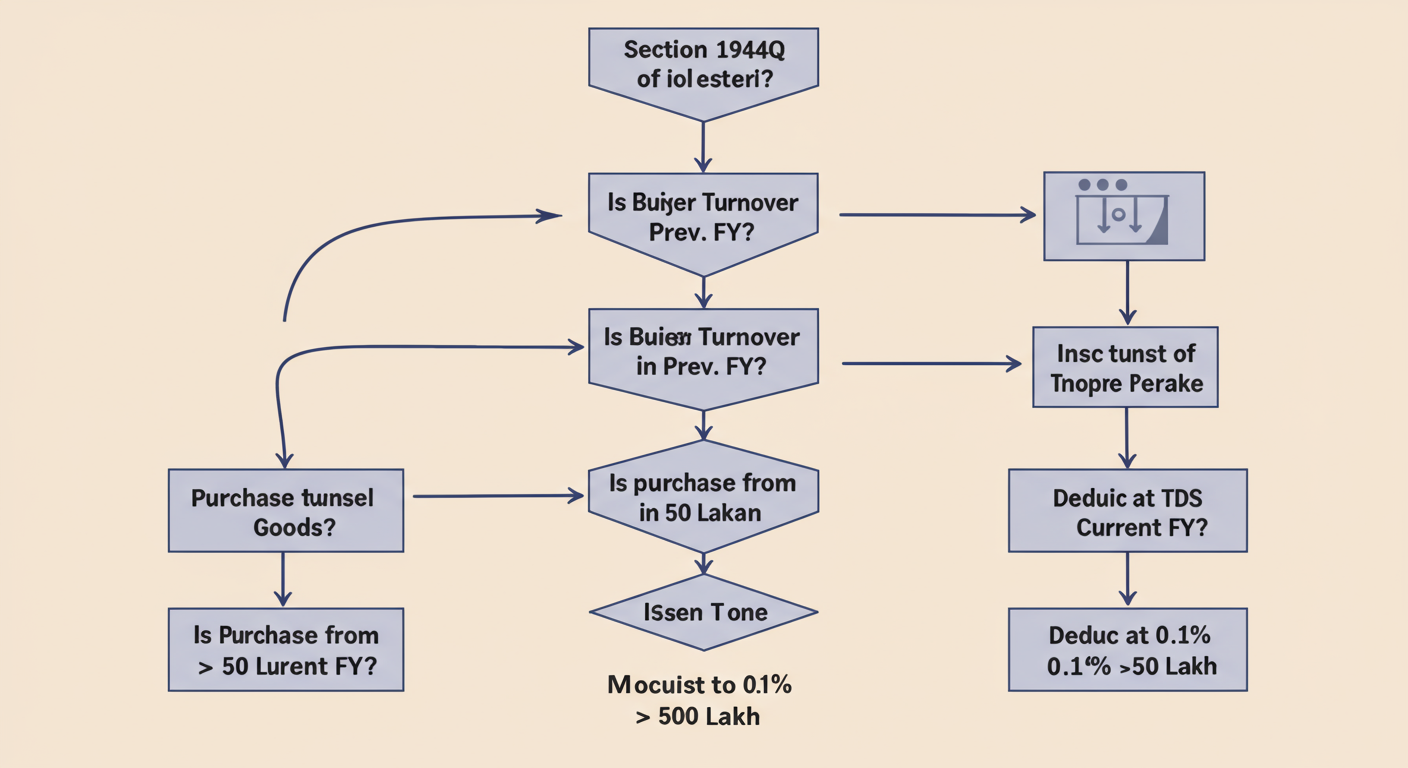
Not every business needs to worry about this. The rules are targeted specifically at larger entities. To figure out if you’re on the hook, you need to pass a two-part test.
Ask yourself these two questions:
- The Turnover Test: Was my business’s total sales, gross receipts, or turnover more than ₹10 crore in the immediately preceding financial year? (For FY 2025-26, you’d check your turnover for FY 2024-25).
- The Purchase Test: Am I purchasing goods from a single resident seller where the total value will exceed ₹50 lakh in the current financial year?
If you answered “Yes” to both questions, then congratulations—you are required to deduct TDS under Section 194Q.
⚠️ Watch Out
The timing is critical. The ₹10 crore turnover threshold is based on the previous financial year. If your turnover crosses ₹10 crore for the first time this year, your Section 194Q liability will only begin in the next financial year. Don’t make the mistake of applying it prematurely.
Here’s a simple table to make it crystal clear:
| Your Business Scenario (in FY 2025-26) | Turnover in FY 2024-25 | Purchases from a Single Seller | Is Section 194Q Applicable? |
|---|---|---|---|
| Startup with growing sales | ₹8 Crore | ₹60 Lakh | No (Turnover test failed) |
| Established SME | ₹15 Crore | ₹45 Lakh | No (Purchase test failed) |
| Large Manufacturer | ₹50 Crore | ₹75 Lakh | Yes (Both tests passed) |
| First year crossing the threshold | ₹12 Crore (Turnover in FY 2025-26) | ₹80 Lakh | No (Check is based on FY 2024-25 turnover) |
The Core Mechanics: How to Calculate and Deduct TDS
Once you’ve confirmed that Section 194Q applies, the next step is execution. The “when” and “how much” are non-negotiable.
When to Deduct TDS?
The law is specific: TDS must be deducted at the time of credit of such sum to the account of the seller OR at the time of payment, whichever is earlier.
This “whichever is earlier” clause is a classic tax trap. Let’s say you receive goods and an invoice on March 25th and you enter it into your accounting system. You’ve just “credited the seller’s account.” Your liability to deduct TDS arises immediately, even if you don’t actually pay the invoice until April 15th. Waiting until payment day is a compliance failure.
How Much TDS to Deduct?
The TDS is calculated only on the amount exceeding ₹50 lakh. Not the whole amount. The rate depends on one crucial factor: your seller’s PAN.
- Standard Rate: 0.1% of the purchase value exceeding ₹50 lakh.
- Higher Rate (if Seller’s PAN is not available): A punishing 5%.
Trust me on this one, you absolutely want to avoid that 5% rate. It’s designed to force compliance. Always ensure you have the valid PAN of every supplier you might cross the threshold with.
Let’s walk through a real-world scenario. Imagine ‘Zenith Manufacturing’ (your company) had a turnover of ₹22 crore last year. In FY 2025-26, you’re buying components from ‘Apex Parts’.
- June 10: You buy parts worth ₹35 lakh. (Total: ₹35 lakh. No TDS yet).
- September 5: You buy more parts worth ₹20 lakh. (Total: ₹55 lakh. The threshold is now crossed).
- December 1: You buy a final batch worth ₹15 lakh. (Total: ₹70 lakh).
Here’s how the TDS calculation plays out:
- On the September 5th purchase: The total purchase hit ₹55 lakh. You deduct TDS on the amount that crossed the threshold. That’s ₹5 lakh (₹55L – ₹50L).
TDS = 0.1% of ₹5,00,000 = ₹500. - On the December 1st purchase: Since the ₹50 lakh threshold is already crossed, you deduct TDS on the full invoice amount of this purchase.
TDS = 0.1% of ₹15,00,000 = ₹1,500.
Total TDS deducted for the year from Apex Parts: ₹2,000.
The Big Showdown: 194Q vs. 206C(1H) Explained
This is where most of the confusion happens. Around the same time as 194Q, the government also had Section 206C(1H), which requires the seller to collect tax (TCS) on the sale of goods over ₹50 lakh.
So, what happens when a transaction falls under both? Who blinks first? The buyer or the seller?
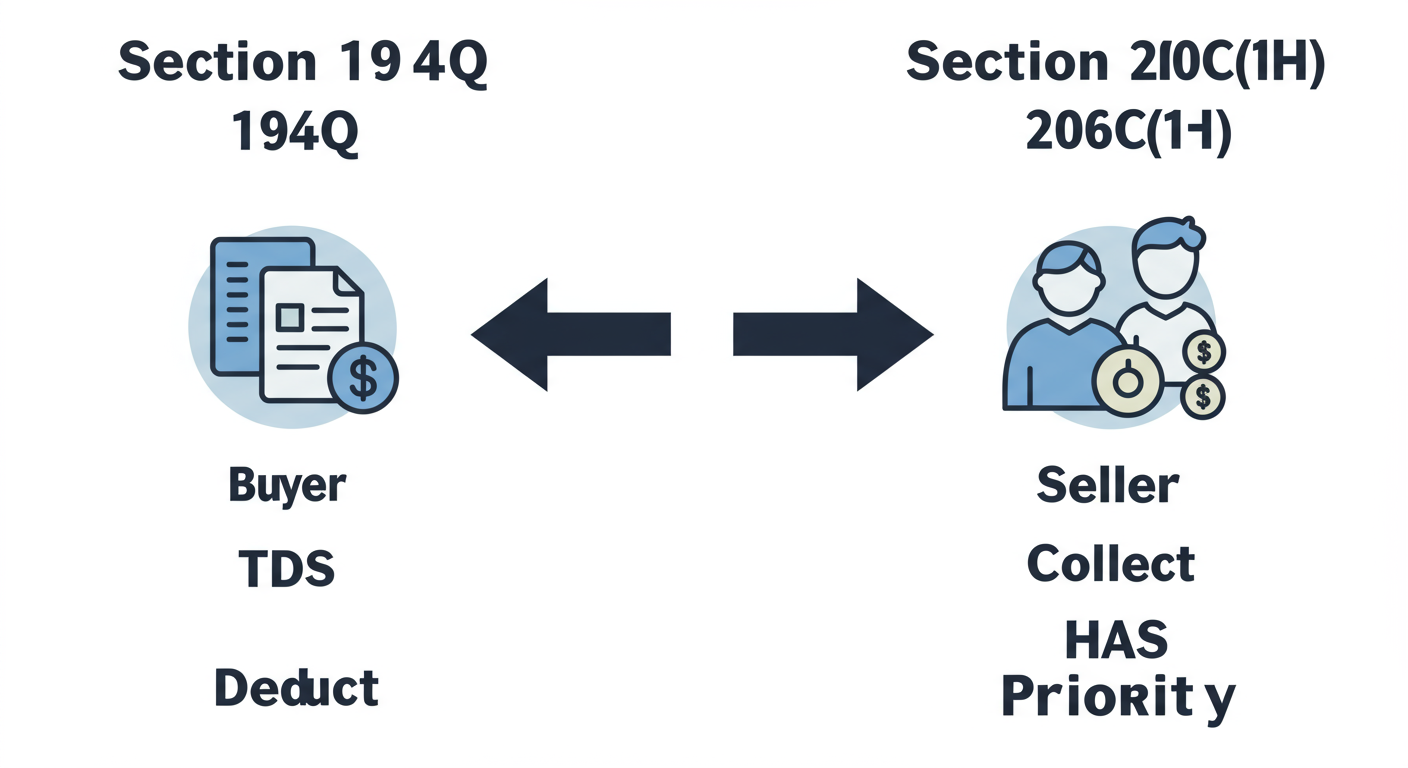
The law provides a clear hierarchy: Section 194Q (Buyer’s TDS) always overrides Section 206C(1H) (Seller’s TCS).
If a transaction is liable for TDS under Section 194Q, the buyer must deduct TDS. The seller is then automatically absolved of their duty to collect TCS under Section 206C(1H) for that same transaction.
In our experience advising businesses, this is the number one source of disputes between buyers and suppliers. The key is proactive communication. A Complete Guide to the Belated ITR Filing Process: Penalties, Steps, and Consequences
💡 Pro Tip
At the start of each financial year, send a declaration letter to all your major suppliers. State that your turnover exceeds ₹10 crore and you will be deducting TDS under Section 194Q on purchases over ₹50 lakh. This prevents them from incorrectly collecting TCS from you and creating reconciliation headaches later. GST Refund Process: How to Claim Excess Tax Paid
This comparison table breaks down the conflict:
| Attribute | Section 194Q (TDS) | Section 206C(1H) (TCS) |
|---|---|---|
| Responsibility | Buyer to deduct tax | Seller to collect tax |
| Trigger Event | Purchase of goods > ₹50 Lakh | Receipt of sale consideration > ₹50 Lakh |
| Applicable To | Buyer with turnover > ₹10 Crore | Seller with turnover > ₹10 Crore |
| Rate | 0.1% (5% if no PAN) | 0.1% (1% if no PAN) |
| Who Wins in a Conflict? | Section 194Q Prevails | Duty is extinguished if 194Q applies |
Your Step-by-Step Compliance Playbook for 2026
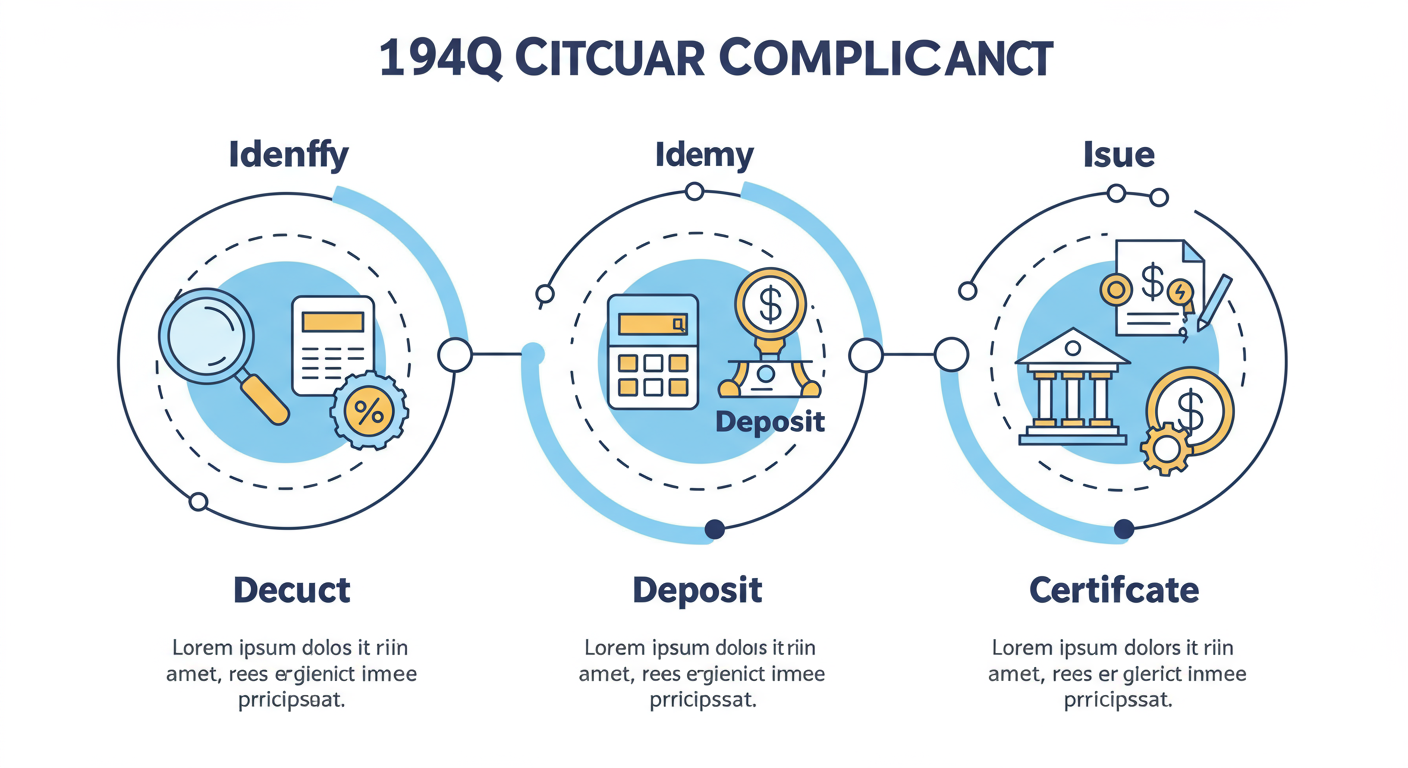
Feeling overwhelmed? Don’t be. Compliance is a process. Follow these five steps, and you’ll stay on the right side of the law.
- Identify & Track: At the beginning of FY 2025-26, review your supplier list. Flag all suppliers from whom you purchased more than, say, ₹35-40 lakh last year. These are your “watch list” suppliers. Set up alerts in your accounting system to notify you when purchases from them approach the ₹50 lakh threshold.
- Deduct Correctly: Once the threshold is breached, ensure your accounts payable team deducts TDS at 0.1% (assuming you have their PAN) from all subsequent invoices from that supplier for the rest of the year.
- Deposit on Time: The TDS amount you deduct must be deposited with the government by the 7th of the following month. A delay here attracts interest penalties. For example, TDS deducted in November must be paid by December 7th.
- File Quarterly Returns: You must report all your 194Q deductions by filing a quarterly TDS return in Form 26Q. This tells the tax department who you deducted from and how much.
- Issue TDS Certificates: After filing your return, you must issue a Form 16A to your supplier. This is their proof that you’ve paid the tax on their behalf, which they can then claim as a credit in their own tax filings.
The High Cost of Getting It Wrong: Penalties & Disallowance
The government isn’t messing around with enforcement. The penalties for non-compliance are severe and can directly impact your profitability.
The Big One: Disallowance of Expenditure
This is the hammer. According to Section 40(a)(ia) of the Income Tax Act, if you fail to deduct TDS as required under 194Q, or if you deduct it but fail to deposit it with the government, 30% of the value of that purchase is disallowed as a business expense.
Let’s go back to our initial example. You bought ₹70 lakh of goods from one supplier. You were liable to deduct TDS on ₹20 lakh but forgot.
- Purchase value where TDS was missed: ₹20,00,000
- Disallowed amount (30%): ₹6,00,000
That ₹6 lakh is now added back to your taxable profit. Assuming a 25% corporate tax rate, that’s an extra ₹1,50,000 in tax liability, all because you missed a TDS deduction of just ₹2,000 (0.1% of ₹20 lakh). It’s a massively disproportionate penalty.
⚠️ Watch Out
This 30% disallowance applies even if the seller has paid all their taxes correctly. The onus is entirely on you, the buyer. The tax department doesn’t care if it results in double taxation; they are penalizing your specific compliance failure.
Interest and Other Penalties
On top of the disallowance, you’ll also face:
- Interest for late deduction: 1% per month from the date it was deductible.
- Interest for late payment: 1.5% per month from the date of deduction.
- Late filing fees for Form 26Q: ₹200 per day, up to the amount of TDS.
These smaller penalties can add up quickly, turning a minor oversight into a significant financial drain.
💡 Pro Tip
Modern accounting software (like Zoho, Tally Prime, etc.) has built-in modules for TDS compliance. Based on hands-on testing, properly configuring these tools can automate 90% of the tracking and calculation process, drastically reducing the risk of human error. It’s a small investment that can save you a fortune.
🎯 Key Takeaway
Section 194Q makes large-scale buyers responsible for TDS on goods purchases. It always overrides the seller’s duty to collect TCS under 206C(1H). The penalty for non-compliance—a 30% disallowance of your purchase expense—is severe, making proactive tracking and communication absolutely essential for your financial health.
Exemptions: When 194Q Does Not Apply
Finally, it’s important to know when you don’t have to deduct TDS under this section. The law provides a few specific carve-outs:
- TDS Deducted Elsewhere: If the transaction is already subject to TDS under another section of the Act (e.g., Section 194C for work contracts), 194Q does not apply.
- TCS Collected Elsewhere: If TCS is collectible under any provision of Section 206C, other than 206C(1H), then 194Q is not applicable. This typically covers items like scrap, minerals, or motor vehicles above a certain value.
- Specific Transactions: The provision does not apply to transactions in securities and commodities traded on recognized stock exchanges. It also exempts transactions in electricity, renewable energy certificates, and energy-saving certificates.
- Imports: Section 194Q applies only to purchases from a resident seller. Import transactions are outside its scope.
For the most up-to-date details, you can always refer to official circulars from the Central Board of Direct Taxes (CBDT).
❓ Frequently Asked Questions
Is GST included when calculating the ₹50 lakh purchase threshold?
No. The CBDT has clarified that TDS should be deducted on the base value of the goods, excluding any GST component, provided the GST is indicated separately on the invoice. This applies to both the ₹50 lakh threshold calculation and the actual TDS deduction.
Does Section 194Q apply to the purchase of services or software?
No, it’s exclusively for the ‘purchase of goods’. Services are covered by other TDS sections like 194J or 194C. The classification of software as ‘goods’ or ‘services’ can be complex; however, most off-the-shelf software purchases are treated as goods, while customized software development is often a service. It’s best to consult a tax professional for specific cases, as per the definitions in the Tax Deduction at Source framework.
What if I make an advance payment to a supplier?
Since the rule is “credit or payment, whichever is earlier,” an advance payment triggers TDS liability immediately if the ₹50 lakh threshold has already been crossed for that supplier. You must deduct TDS on the advance amount at the time of payment.
Does this apply to purchases from the government?
No. The definition of ‘seller’ under Section 194Q excludes the Central Government, a State Government, or any person notified by the Government. So, you do not need to deduct TDS on payments made to these entities.
What happens if I deduct TDS but forget to file the Form 26Q return?
This is still a major compliance failure. Even if you’ve paid the tax to the government, failing to file the return means your supplier cannot see the TDS credit in their Form 26AS and cannot claim it. This will lead to disputes and you will be liable for late filing fees and potential penalties. The full text of the law can be found in the Income Tax Act, 1961.
Conclusion: Mastering 194Q Is Not Optional
Section 194Q isn’t just another line item in the tax code; it’s a fundamental shift in compliance responsibility that directly affects your company’s cash flow and bottom line. Ignoring it is a high-stakes gamble you can’t afford to lose.
The path to mastery is clear: understand the thresholds, communicate proactively with your suppliers to resolve the 194Q vs. 206C(1H) conflict, and implement a rock-solid process for tracking, deducting, and reporting. The cost of a mistake—a 30% expense disallowance—is simply too high for a “we’ll figure it out later” approach.
Your next step? Don’t just close this tab. Open your accounting software right now. Run a report on your top 15 suppliers by purchase volume from last year. That’s your starting list. Begin the process today, and turn a potential compliance nightmare into a routine business function.