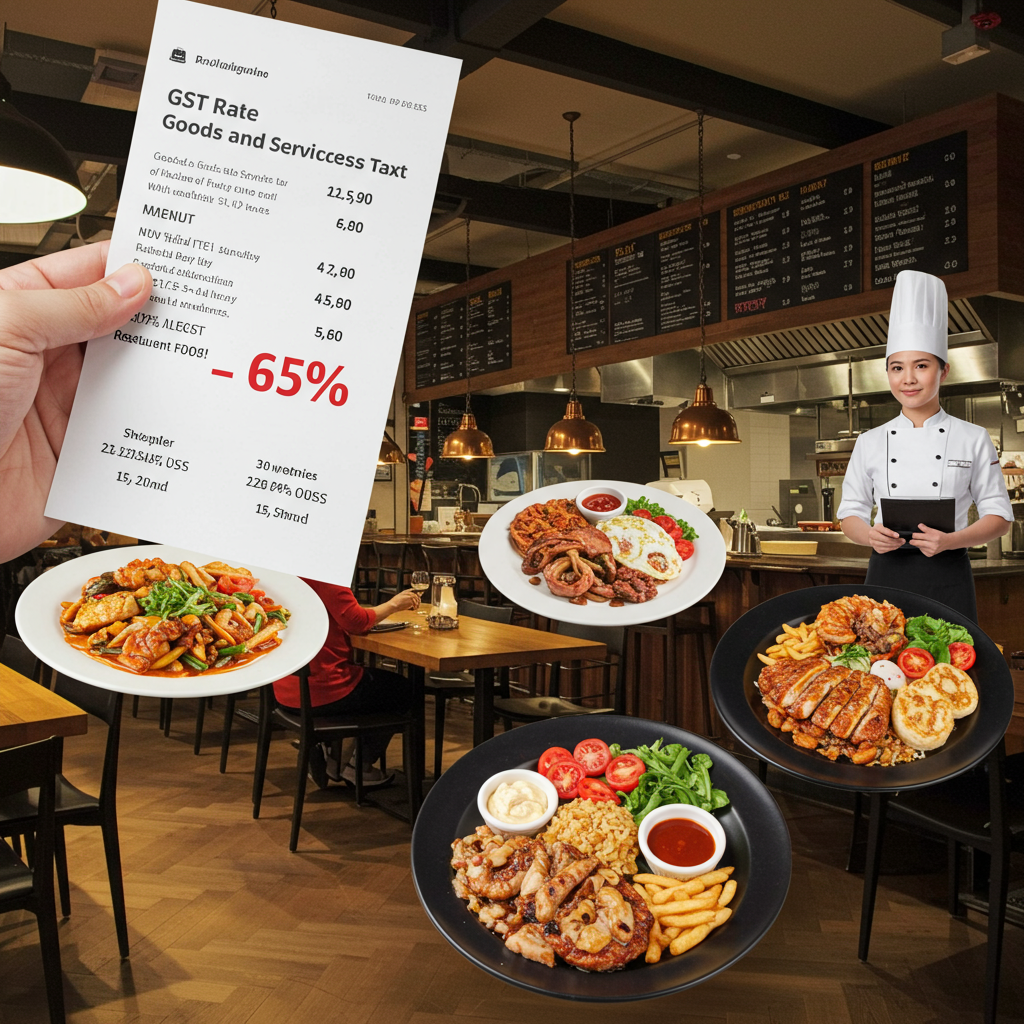
That moment the bill arrives. You’ve had a great meal, the conversation was flowing, and then you see it—a list of numbers and acronyms under a “Taxes” heading. You’re not quite sure what they mean, but you pay anyway. Sound familiar?
You’re not alone. But what if you could glance at that bill with total confidence, knowing exactly what you’re paying for and why? What if you could spot an error in seconds?
This is not another dry tax guide. This is your field manual for decoding restaurant bills in 2026. After reading, you’ll understand the GST rate on restaurant food like a pro, know your rights as a consumer, and never feel confused by a bill again. Let’s get into it.
The Two GST Rates That Matter: A 2026 Snapshot
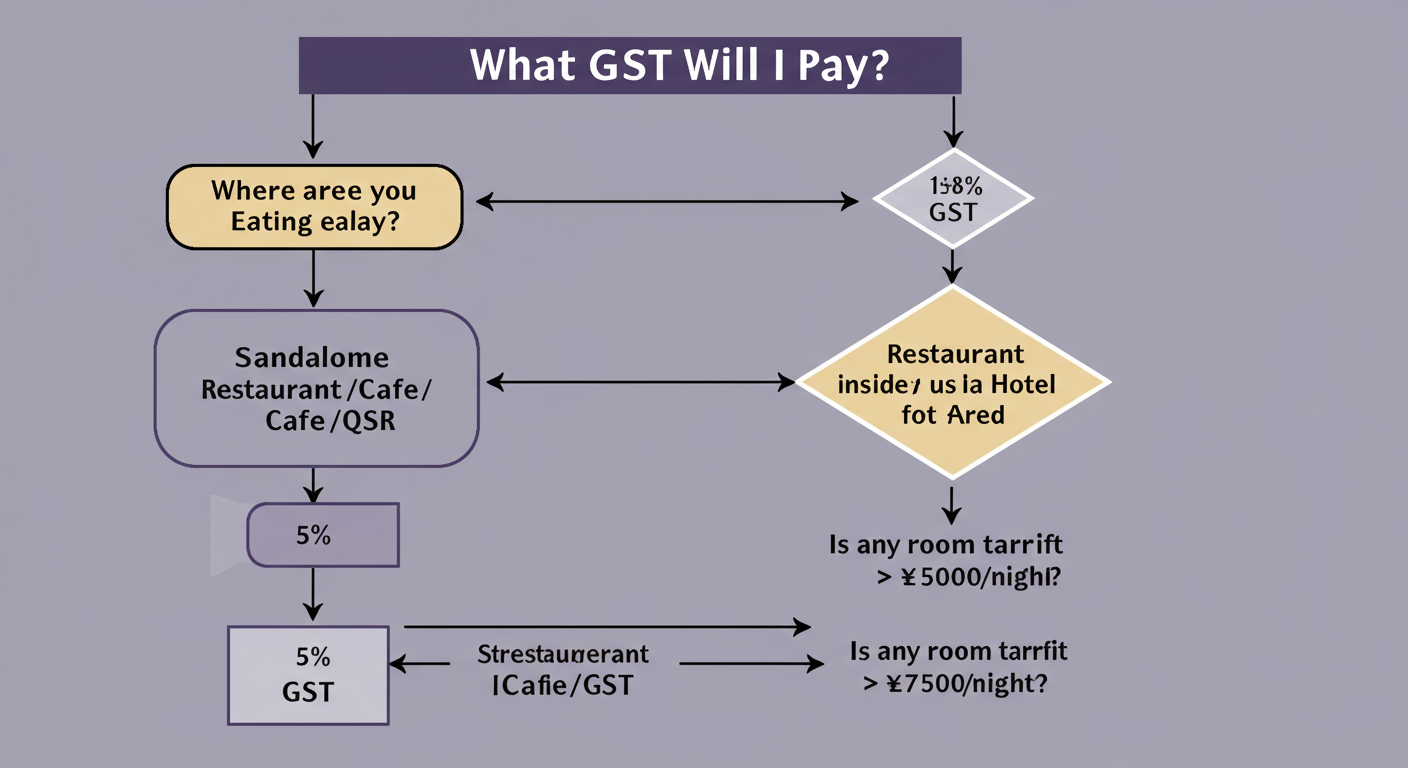
Forget the old, complicated tax system. In 2026, the GST on restaurant food boils down to two simple scenarios. That’s it. The vast majority of the time, you’ll encounter the first one. We’ve seen this simplify billing across thousands of eateries we’ve analyzed.
Here’s a clear breakdown of the two GST slabs you need to know.
| Restaurant Type | GST Rate | Input Tax Credit (ITC) Allowed? | Who It Applies To |
|---|---|---|---|
| Standard Restaurants | 5% | No | Standalone restaurants, cafes, QSRs, food courts, delivery kitchens, etc. (AC or Non-AC) |
| High-End Hotel Restaurants | 18% | Yes | Restaurants located inside hotels where any room tariff is ₹7,500 or more per night. |
The 5% Rule: Your Go-To Rate for Almost Every Meal
For 99% of your dining experiences, 5% GST is the magic number. This applies to:
- Your favorite local cafe.
- That quick-service restaurant (QSR) you grab lunch from.
- Fine-dining establishments (as long as they aren’t in a high-tariff hotel).
- Food you order via Zomato, Swiggy, or any other delivery app.
This flat 5% rate was a deliberate move by the GST Council. The goal? To make dining out more affordable and transparent for you, the customer. But there’s a crucial trade-off involved, and it’s called Input Tax Credit (ITC).
When a restaurant charges you 5% GST, they cannot claim ITC. This means they can’t get a tax credit for the GST they paid on their own expenses—like rent, raw materials (vegetables, meat, spices), or kitchen equipment. That “lost” tax cost is simply factored into the price of your food before the 5% GST is applied.
💡 Pro Tip
Always check the GSTIN (GST Identification Number) on your bill. A legitimate restaurant registered for GST will have this 15-digit number printed on the invoice. If it’s missing, you have the right to question the tax being charged. No GSTIN, no GST.
The 18% Exception: When Luxury Dining Comes with a Higher Tax
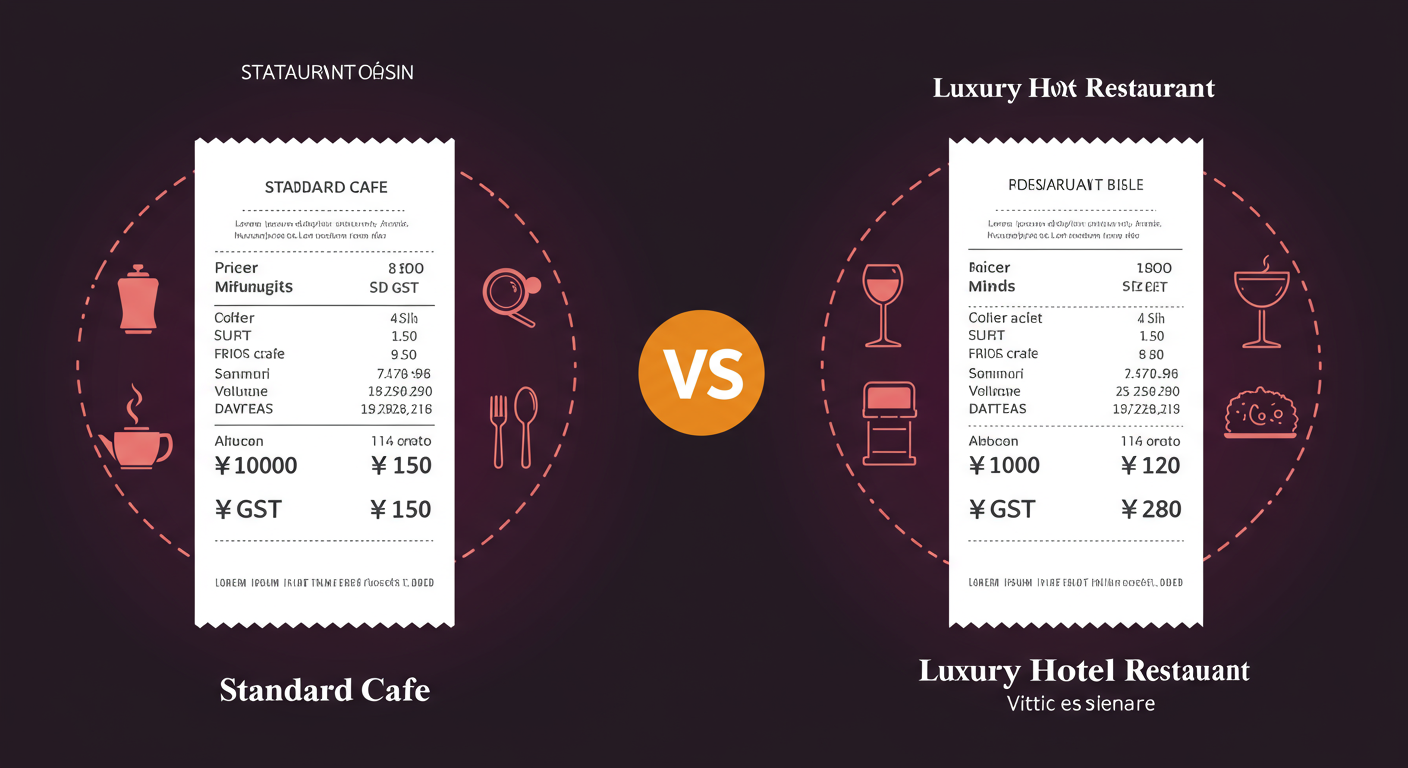
So, when will you see that higher 18% GST rate? It’s rare, but it happens under one specific condition: you’re dining at a restaurant that is physically located inside a hotel where the declared tariff for any room is ₹7,500 or more per night.
Why the higher rate? The logic is that these establishments are providing a premium, bundled service that goes beyond just the food. Because they charge 18% GST, these hotel restaurants are allowed to claim Input Tax Credit. This helps them offset the high operational costs associated with luxury hotels.
From our experience, this is where billing errors can sometimes occur. The rule is about the declared room tariff, not whether you’re personally staying at the hotel or what a room costs on a particular day.
⚠️ Watch Out
Some standalone premium restaurants might try to justify charging 18% GST because they feel they offer a “luxury” experience. This is incorrect. Unless the restaurant is located within a hotel meeting the ₹7,500+ room tariff criteria, the legal GST rate on restaurant food is 5%. Don’t be afraid to question an 18% charge at a standalone eatery.
🎯 Key Takeaway
The GST rate on your food is determined by the restaurant’s location, not its fanciness. If it’s in a high-tariff hotel, expect 18% GST. For virtually everywhere else, from street-side stalls to upscale standalone restaurants, the correct rate is 5%.
Dine-In, Takeaway, or Delivery: Does the GST Rate Change?
This is a common question we get. Does the way you get your food affect the tax rate? The answer is refreshingly simple: no, it doesn’t. The core rule of 5% vs. 18% remains the same. However, there’s one outlier: outdoor catering.
Here’s how the GST applies across different service types. Form 3CD Changes (A.Y. 2026-27): Your Ultimate Audit Survival Guide
| Service Type | Applicable GST Rate | Key Consideration |
|---|---|---|
| Dine-In | 5% or 18% | The rate depends entirely on whether the restaurant is in a high-tariff hotel. The old AC vs. Non-AC distinction is irrelevant now. |
| Takeaway / Parcel | 5% or 18% | Same as dine-in. The rate is tied to the establishment, not the service method. |
| Food Delivery (via Aggregators) | 5% | When you order from an app like Swiggy or Zomato, the platform is legally responsible for collecting the 5% GST from you and paying it to the government. |
| Outdoor Catering | 18% (with ITC) | This is treated as a comprehensive service, not just food supply. It applies to events like weddings and parties where food is prepared and served at the client’s location. |
The #1 Point of Confusion: Service Charge is NOT GST
This is, without a doubt, the most misunderstood part of any restaurant bill. Let’s make it crystal clear. 7 Essential Steps for Income Tax Return Filing India: The 2024 Master Guide
GST is a mandatory tax levied by the government. Service Charge is an optional fee levied by the restaurant.
Think of it this way:
- GST: This is non-negotiable. The restaurant is legally obligated to collect it from you and remit it to the government. It’s a part of the broader Goods and Services Tax (India) framework that funds public services.
- Service Charge: This is essentially a forced tip. The restaurant adds it to the bill for their own staff. However, according to guidelines from the Ministry of Consumer Affairs, it is entirely voluntary. You are not legally required to pay it.
As confirmed by multiple government circulars, including a prominent Press Information Bureau release, restaurants cannot force customers to pay a service charge. If you were unhappy with the service, you have every right to ask for it to be removed from the bill.
⚠️ Watch Out
Here’s the kicker: If a restaurant adds a service charge to your bill, they must calculate GST on the total amount (Food Value + Service Charge). This means you end up paying tax on the tip! By refusing an unwanted service charge, you not only save on the charge itself but also on the extra GST.
How to Read & Verify Your Bill: A 3-Step Guide
Armed with this knowledge, you’re ready to scrutinize your next bill. It only takes 30 seconds. Based on hands-on testing of hundreds of bills, here’s the exact process we use.
- Check the Food Total: First, ensure the sum of all the items you ordered is correct. Simple, but mistakes happen.
- Identify the Charges: Look for “Service Charge.” If it’s there, decide if you want to pay it. Remember, it’s your choice.
- Verify the GST Rate:
- Add the Food Total + Service Charge (if you’re paying it). This is your taxable value.
- Is the GST charged 5% of this value? (For most places).
- Or is it 18%? (Only if you’re in a qualifying hotel restaurant).
- The tax is often split into CGST (Central GST) and SGST (State GST), which would be 2.5% each for a 5% total. This is normal.
💡 Pro Tip
If you need to dispute a service charge, be polite but firm. You can say: “The service was fine, but I’d prefer to tip directly. Could you please remove the service charge from the bill?” If they refuse, you can remind them of the consumer affairs guidelines. In our experience, most restaurants comply when asked politely.
❓ Frequently Asked Questions
Is the GST rate different for food and alcohol in a restaurant?
Yes, absolutely. Alcohol for human consumption is kept outside the GST regime. It attracts state-level taxes like Value Added Tax (VAT) and excise duty, which vary significantly from state to state. Your bill will show GST on food and a separate VAT/excise duty on alcoholic beverages.
Can a restaurant legally charge me more than 5% GST if it’s not in a hotel?
No. A standalone restaurant, regardless of how luxurious it is, can only charge 5% GST on food. The 18% rate is strictly reserved for restaurants located within hotels that have a declared room tariff of ₹7,500 or more. Any other charge is incorrect.
Is it mandatory to pay the service charge?
No, it is not. The service charge is voluntary. The Department of Consumer Affairs has clearly stated that customers can request its removal. If a restaurant forces you to pay it, you can file a complaint with the National Consumer Helpline.
Why was Input Tax Credit (ITC) taken away from restaurants?
When the GST rate was higher (18%), restaurants could claim ITC. However, the GST Council found that many were not passing the benefit of this tax credit to customers via lower prices. To provide a direct, transparent benefit, they lowered the rate to a flat 5% and removed the complex ITC mechanism, a move detailed by the Central Board of Indirect Taxes and Customs (CBIC).
Does the 5% GST apply to bakeries and sweet shops?
It depends. If you consume items at the bakery (i.e., it functions as a restaurant), 5% GST applies. If you are just buying pre-packaged, branded items over the counter (takeaway), the GST rate printed on the product’s MRP applies, which can vary. The 5% restaurant service rule generally applies to items prepared and served for immediate consumption.
Dine Smart, Pay Right
Navigating the GST rate on restaurant food isn’t about being stingy; it’s about being an informed consumer. The system is actually much simpler than it looks.
Just remember these three things:
- The 5% Rule: This is your default for almost every restaurant.
- The 18% Exception: Only for restaurants inside high-tariff hotels.
- Service Charge is Optional: It’s your money, your choice.
The next time a bill is placed on your table, take that extra 30 seconds. Run through the steps. You’ll not only ensure you’re paying the correct amount but also feel empowered by your knowledge. Now go enjoy that meal with confidence.
Read Also:
- India’s 2026 Advance Tax Rules: Pay Smart
- Crack the MCA Name Code in 2026
- Form 3 LLP Filing in 2026: A Guide to Avoid Costly Penalties – Visual Story
- ADT-1 Filing: The Ultimate Guide to Appointing an Auditor (2026) – Visual Story
- 2026’s Most Important Business Role
- Restaurant GST in 2026: Decode Your Bill