
You have a brilliant idea. You’ve got the skills. You’re ready to be your own boss. But then you hit a wall of confusing jargon: LLP, OPC, Private Limited… it’s enough to make your head spin. What if I told you that for 90% of first-time entrepreneurs, the answer is ridiculously simple?
Forget the complex paperwork and expensive consultants for a moment. The fastest, cheapest, and most direct path to formalizing your hustle is the sole proprietorship. It’s the unsung hero of the Indian startup ecosystem, powering millions of freelancers, consultants, and small shop owners.
But simplicity can be deceptive. This isn’t just another dry “how-to” list. In the next five minutes, you’ll get an insider’s look at how proprietorship firm registration *actually* works in 2026. We’ll bust common myths, expose the one critical risk you can’t ignore, and give you the exact, battle-tested steps to go from idea to official business this week. Let’s get started.
Is a Proprietorship Right for You? The 30-Second Litmus Test
Before we dive into the “how,” let’s tackle the “if.” Choosing your business structure is the single most important decision you’ll make at this stage. It dictates your liability, your taxes, and your ability to grow. So, is a proprietorship your launchpad or a potential trap?
Here’s the deal. A proprietorship is a perfect fit if you’re:
- A freelancer, consultant, or solo service provider.
- Testing a new business idea with your own funds (bootstrapping).
- Running a small, local retail or service business.
- Your primary goal is simplicity and low cost, and you don’t need outside investment right now.
The core concept is this: You and the business are the same legal entity. The business’s profits are your profits. But its debts are also your debts. This is the fundamental trade-off. For a clearer picture, let’s see how it stacks up against the more complex alternatives.
| Feature | Sole Proprietorship | LLP (Limited Liability Partnership) | Private Limited Company |
|---|---|---|---|
| Owner Liability | Unlimited (Personal assets are at risk) | Limited (To capital contribution) | Limited (To share value) |
| Setup Cost & Time | Lowest (1-3 days) | Moderate (10-15 days) | Highest (15-25 days) |
| Annual Compliance | Minimal (ITR filing) | Moderate (Annual returns, statements) | High (Board meetings, audits, MCA filings) |
| Fundraising Potential | Very Low (Personal loans only) | Moderate (Some investor interest) | High (Can raise equity from VCs/Angels) |
| Best For | Solo founders, freelancers, small businesses | Professional firms, startups with co-founders | Startups aiming for high growth & funding |
⚠️ Watch Out
The term “unlimited liability” isn’t just legal jargon. I’ve seen it play out. A client of ours, a small event planner, ran into trouble when a major event was cancelled. The business couldn’t cover the vendor advances. Because she was a proprietor, the vendors could legally pursue her personal savings to recover their dues. This is the single biggest risk you must be comfortable with before starting.
The “Registration” Myth: How Proprietorships Are *Actually* Formed in 2026
Here’s a secret most people get wrong: there is no single “Proprietorship Registration Certificate” issued by the central government. It doesn’t exist. So, how do you prove your business is real?
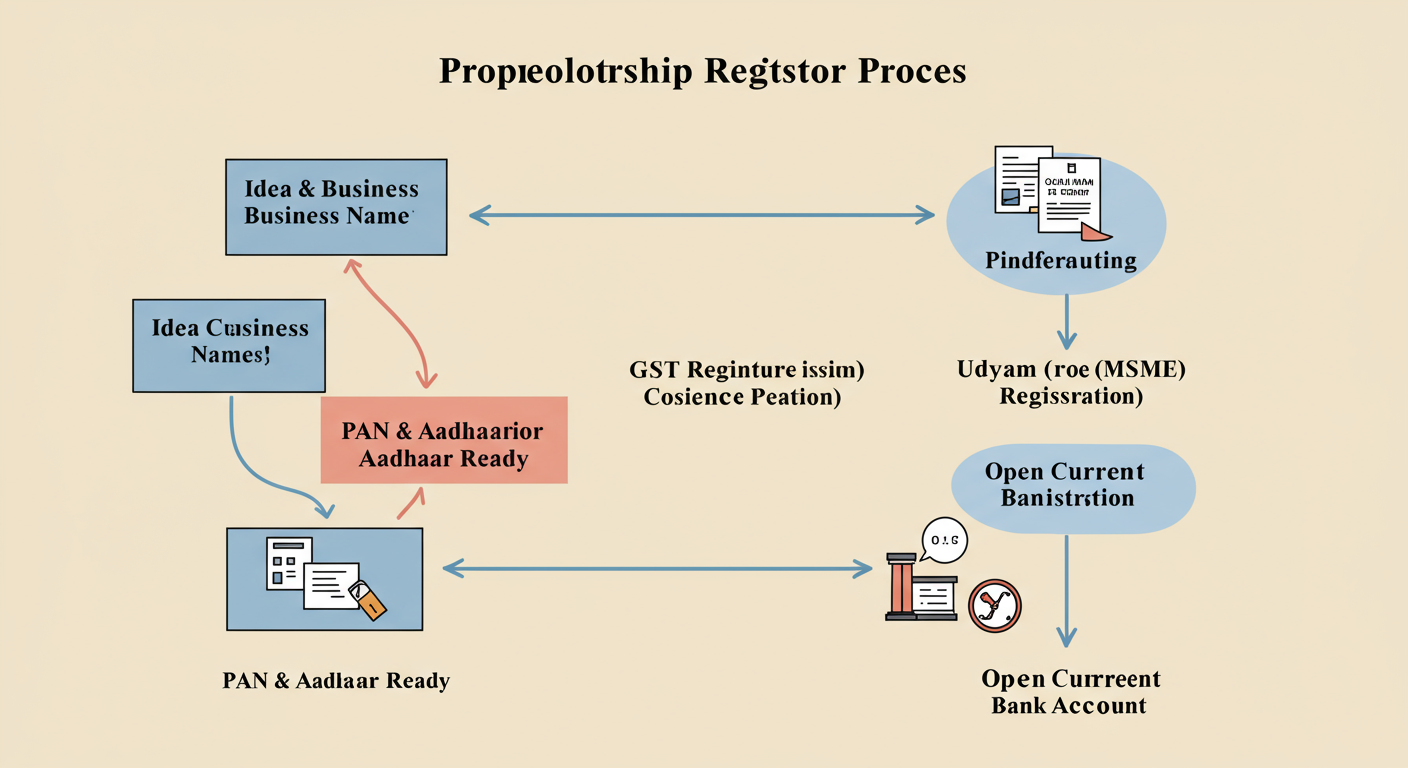
You establish your proprietorship by collecting a set of other registrations that act as proof of your business’s existence. The ultimate goal of this process is typically to open a current bank account in your business’s name. Banks require at least two of these official documents to do so.
Step-by-Step Guide to Establishing Your Proprietorship
- Choose a Unique Business Name: This is your brand. You can operate under a “trade name” (e.g., “Apex Digital Solutions”) that’s different from your personal name. Just ensure it doesn’t contain words like “Private Limited,” “LLP,” or “Group,” which imply a different corporate structure.
- Get Your PAN & Aadhaar in Order: Your personal PAN card is the primary identifier for your proprietorship. The business does not get a separate PAN. Ensure your Aadhaar is linked to your mobile number, as it’s required for most OTP-based online registrations.
- Obtain Key Business Registrations (Your Proof): This is the most critical step. You’ll need at least one, but ideally two, of the following:
- Udyam (MSME) Registration: This is a must-do. It’s a free, instant, online registration on the government’s Udyam Registration Portal that classifies your business as a Micro, Small, or Medium Enterprise. It’s a powerful document for opening a bank account and unlocks benefits like priority loans and government schemes.
- GST Registration: If your annual turnover is projected to exceed ₹40 lakh (for goods) or ₹20 lakh (for services), Goods and Services Tax registration is mandatory. Even if it’s not, voluntary registration is a strong proof of business and allows you to claim input tax credits.
- Shops and Establishment Act License: If you have a physical office or shop, most states require this license from the local municipal authority. It regulates working conditions and hours.
- Open a Current Bank Account: With your PAN, Aadhaar, and at least two of the business registrations from Step 3, walk into any bank. Opening a current account is the final act that formalizes your business. It separates your personal and business finances—a crucial step for clean bookkeeping.
💡 Pro Tip
When choosing a business name, do a quick search on the Ministry of Corporate Affairs (MCA) portal and the trademark registry. This ensures your chosen name isn’t already taken by a company or registered as a trademark, saving you a major headache down the line if you decide to incorporate.
Your Proprietorship Document Checklist
Feeling overwhelmed? Don’t be. It’s simpler than it looks. Based on our experience helping hundreds of entrepreneurs, here’s a straightforward checklist of what you’ll need. Having these ready will make the process incredibly smooth.
| Document | Purpose | Notes |
|---|---|---|
| PAN Card | Primary identity for all financial transactions and taxes. | The proprietor’s personal PAN is used. No separate PAN for the firm. |
| Aadhaar Card | Identity and address proof; required for e-verification. | Ensure your mobile number is linked for OTPs. |
| Address Proof (Business) | To register your official place of business. | Can be a utility bill (electricity, water) or a rental agreement. If working from home, an NOC from the property owner may be needed. |
| Bank Account Details | For GST/Udyam registration. | A cancelled cheque or bank statement from your personal savings account is needed initially. |
| Photograph | Passport-sized photograph of the proprietor. | Required for most registration portals. |
💡 Pro Tip
Create a dedicated folder on your computer or cloud storage (like Google Drive) for these documents. Scan and save high-quality digital copies of everything. This simple act of organization will save you hours of searching when you need to upload them for various registrations.
🎯 Key Takeaway
A proprietorship offers unmatched simplicity and control, making it the best entry point for most solo entrepreneurs. However, this simplicity comes at the cost of unlimited personal liability. Your core decision is balancing the ease of starting up against the risk to your personal assets.
The Growth Path: When to Upgrade from a Proprietorship
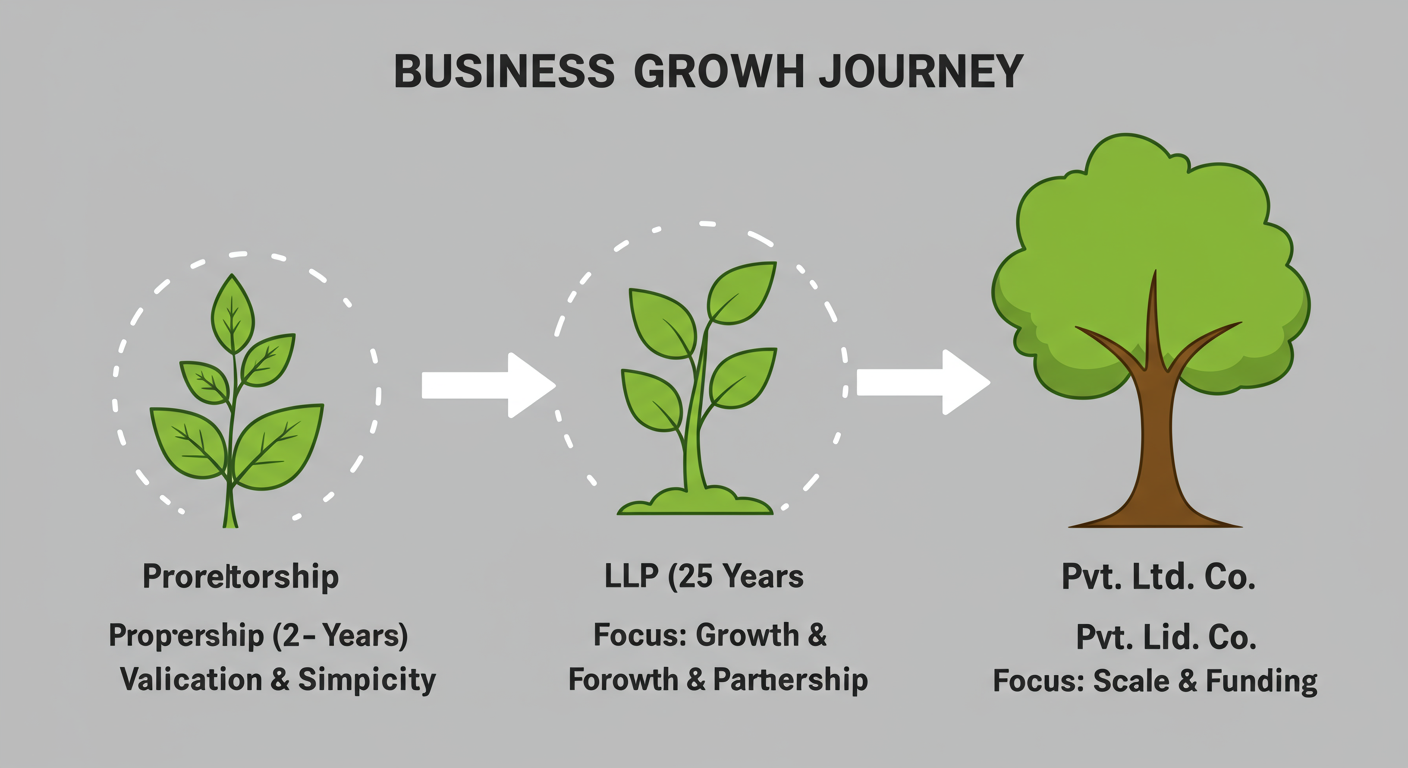
A proprietorship is a fantastic starting point, but it’s not always the final destination. Smart entrepreneurs know when to level up. As your business matures, the very things that made a proprietorship attractive—simplicity and low compliance—can become limiting. 7 Critical GST Return Due Dates Every Business Owner Must Know (2025 Guide)
Look for these triggers to know when it’s time to consider converting to a Limited Liability Partnership (LLP) or a Private Limited Company (Pvt. Ltd.): 7 Critical Rules for Income From Other Sources Tax Calculation (2025 Guide)
- You Need Funding: Angel investors and Venture Capitalists cannot invest in a proprietorship. If you want to raise equity funding, you must convert.
- Your Revenue & Debts Are Growing: As your business takes on larger loans, bigger clients, and higher risks, the “unlimited liability” becomes a terrifying prospect. Conversion protects your personal assets.
- You’re Bringing on a Partner: A proprietorship is, by definition, for one person. If you want to bring on a co-founder with an equity stake, you’ll need to form an LLP or a company.
- You Want to Build a Lasting Brand: A company has “perpetual succession,” meaning it can outlive its founders. This adds credibility and makes it easier to build long-term value and eventually sell the business.
⚠️ Watch Out
Don’t wait too long to upgrade. The conversion process involves valuing your business assets and transferring them to the new entity, which can have tax implications. It’s often smoother and more tax-efficient to convert when the business is still at a manageable size, rather than waiting until it’s a large, complex operation.
❓ Frequently Asked Questions
How is a proprietorship taxed in India?
A proprietorship isn’t a separate taxable entity. All business profits are “passed through” to you, the owner. You simply add the net profit to your other income (like salary or interest) and pay tax according to your personal income tax slab. You can find the latest slab rates on the official Income Tax Department portal.
Can I hire employees in a proprietorship?
Yes, absolutely. You can hire employees just like any other business. However, you will be responsible for complying with labor laws, such as deducting TDS on salaries (if applicable), and potentially registering for PF and ESI depending on the number of employees.
What happens to the business if the proprietor dies?
Legally, the proprietorship ceases to exist upon the death of the owner. It lacks “perpetual succession.” The business assets become part of the owner’s estate and are distributed to legal heirs, but the business entity itself dissolves. This is a key reason why growing businesses convert to a company structure.
How much does it cost to start a proprietorship in 2026?
The government registration costs are virtually zero (Udyam is free, GST is free). The main costs are for any professional help you might hire (typically ₹2,000 – ₹5,000) and any state-specific licenses like the Shops and Establishment license, which can cost ₹500 – ₹2,000 depending on your state.
Can I run multiple businesses under one proprietorship?
No. You can run multiple business activities under a single trade name and GST number. For example, “Apex Solutions” could offer both web design and content writing. However, if you want to run two completely separate brands (e.g., a tech consultancy and a bakery), it’s cleaner and more professional to establish them separately, even if both are proprietorships.
Your First Step into the Business World
The journey of a thousand miles begins with a single step. For you, the aspiring entrepreneur, that step doesn’t have to be a giant leap into a complex corporate structure. The proprietorship firm is your accessible, powerful, and immediate launchpad.
It strips away the noise, allowing you to focus on what truly matters: building your product, finding your customers, and making your first sale. It’s about action over administration.
Yes, you must respect the risk of unlimited liability. As you grow, you’ll need to be savvy about when to upgrade. But for now? Embrace the simplicity. Your next step isn’t to hire a lawyer. It’s to decide on your business name, get your documents in order, and open that current bank account.
You’re ready. Go make it official.