Picture this: a brilliant startup founder lands their first major investment. The deal is done, the money is wired. They immediately use a chunk of it to buy a prime piece of real estate as a long-term asset. Smart move, right? Wrong. The transaction is declared legally void, the deal collapses, and the company is thrown into chaos. Why? Because their company’s charter never gave them the power to invest in real estate.
This isn’t just a scary story. It’s a real-world consequence of misunderstanding two of the most foundational documents in business: the Memorandum of Association (MOA) and the Articles of Association (AOA).
Getting these right isn’t just boring legal paperwork. It’s about defining your company’s very DNA. In this deep dive, you’ll learn the critical difference between MOA and AOA, why it’s the bedrock of your business, and how to use these documents to build a fortress, not a house of cards. Let’s get into it.
What is a Memorandum of Association (MOA)? The Company’s Constitution
Think of the MOA as your company’s constitution. It’s a public, legally binding document that sets the absolute boundaries of your operations. It defines who you are and what you can (and, more importantly, cannot) do. It’s your company’s charter, its birth certificate, and its ultimate mandate all rolled into one.
According to the Companies Act, this document is non-negotiable for incorporation. It primarily governs the company’s relationship with the outside world—investors, lenders, customers, and regulators. Everyone dealing with your company is legally presumed to have read and understood your MOA. Ignorance isn’t an excuse.
From our experience advising hundreds of founders, the MOA is where vision meets legal reality. It contains six non-negotiable clauses:
- The Name Clause: Your company’s official, legal name. It must end with “Private Limited” or “Limited,” depending on your company type. No creativity here, just legal fact.
- The Registered Office Clause: This specifies the state or territory where your registered office is located. It determines your legal jurisdiction.
- The Objects Clause: This is the big one. It defines the purpose and primary business activities for which the company was formed. Any action taken outside this scope is legally void. We’ll come back to this.
- The Liability Clause: This declares the extent of liability for the members. For most startups, this is “limited by shares,” meaning a shareholder’s personal assets are protected.
- The Capital Clause: This states the company’s maximum authorized share capital. You can’t issue shares beyond this limit without formally amending the MOA.
- The Subscription Clause: A declaration by the first subscribers (the founding shareholders) confirming their intent to form the company and take a specified number of shares.
💡 Pro Tip
When drafting your Objects Clause, be specific but forward-thinking. Instead of just “to develop software,” consider “to design, develop, market, and sell software applications, provide related consulting services, and engage in research and development of emerging technologies.” This gives you room to grow without needing a complex MOA amendment later.
What is an Articles of Association (AOA)? The Company’s Rulebook
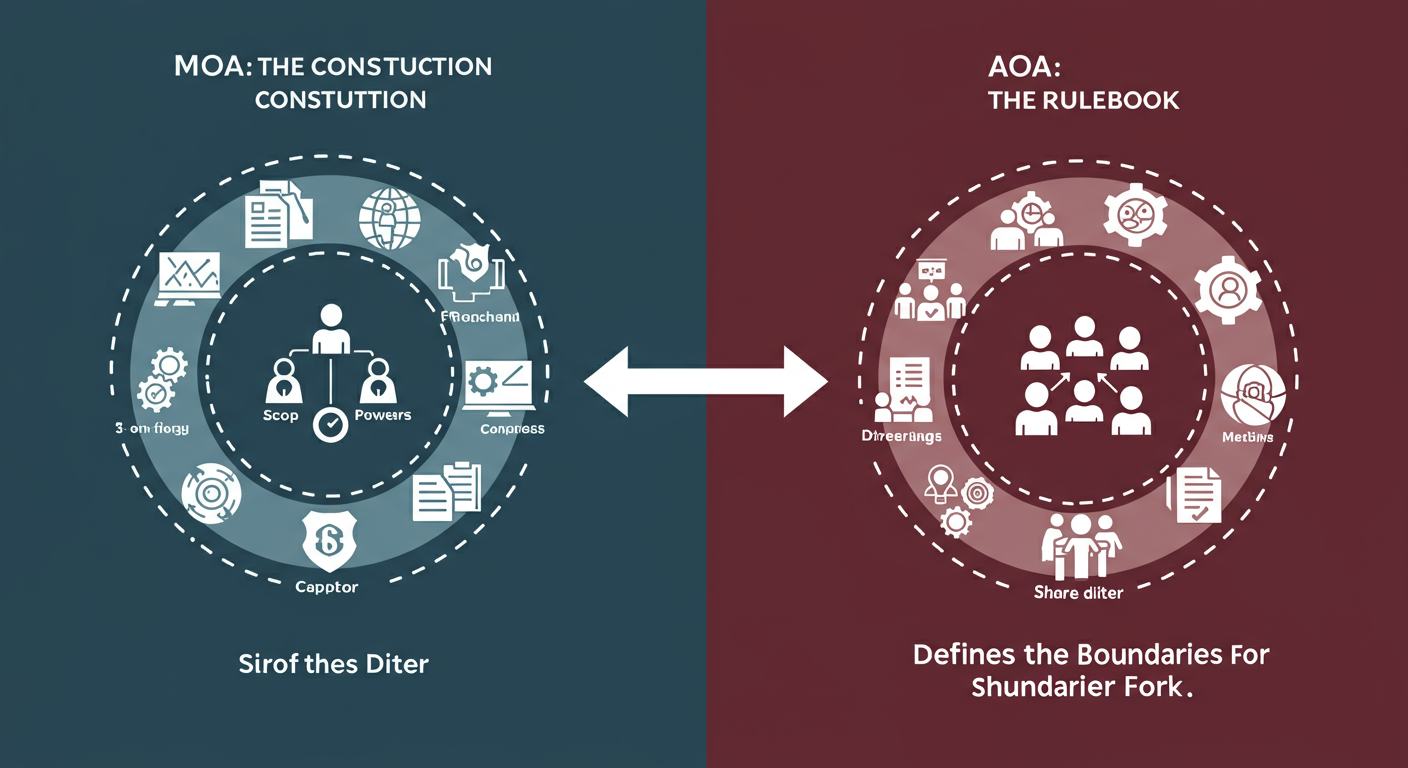
If the MOA is the constitution, the AOA is the internal rulebook or operating manual. It governs the day-to-day management and administration of the company. It’s all about the how.
How are board meetings conducted? How are directors appointed or removed? What are the rights of different classes of shareholders? How are shares transferred? The AOA holds the answers.
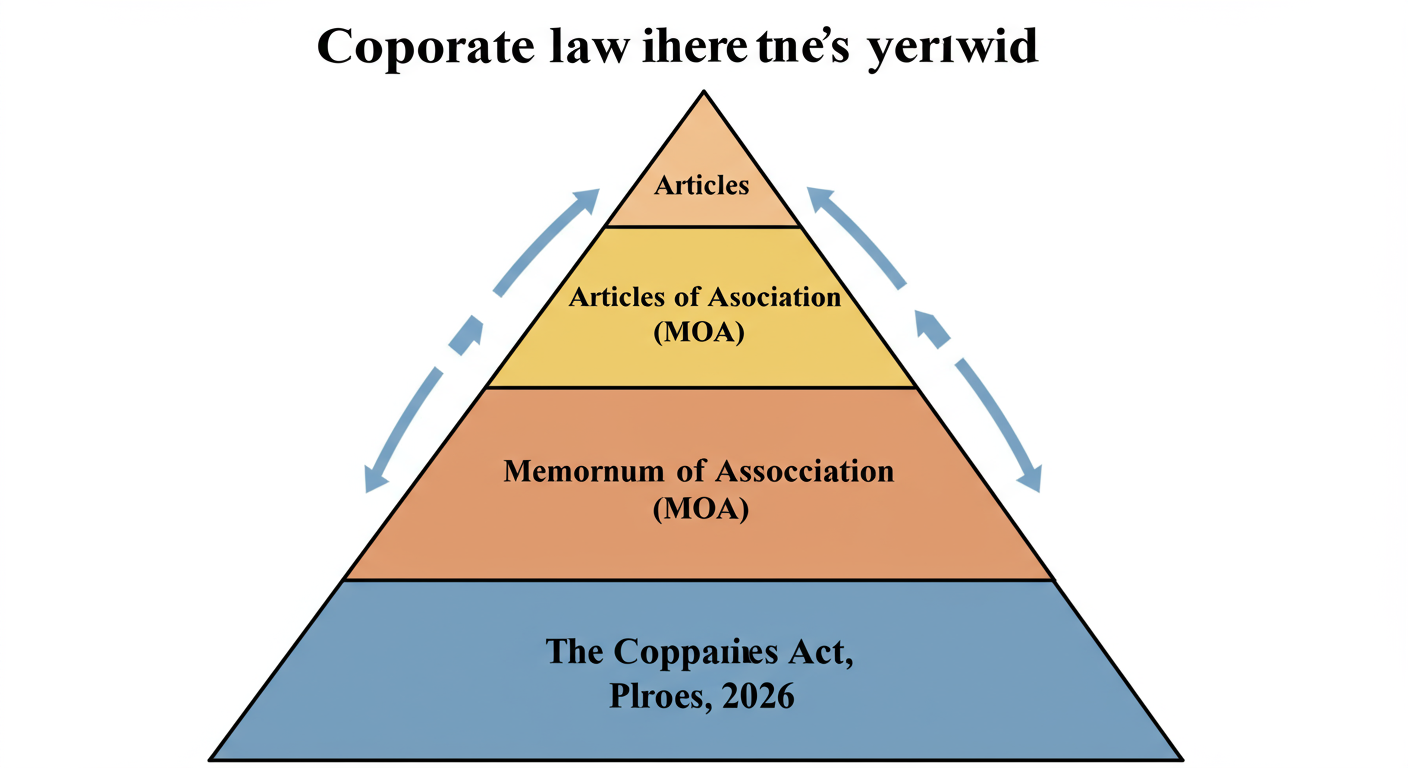
Unlike the MOA, which is outward-facing, the AOA is inward-facing. It manages the relationship between the company, its directors, and its shareholders. Crucially, the AOA is subordinate to the MOA. It can set any rule you like, as long as it doesn’t contradict the MOA or the Companies Act.
Think of it like this: The MOA says your company’s purpose is to build electric cars. The AOA details the rules for the board meetings where you’ll decide how to build them.
MOA vs. AOA: The Head-to-Head Comparison
Let’s cut through the legal jargon. The fundamental difference between MOA and AOA boils down to scope, authority, and flexibility. One sets the playground, the other sets the rules of the game played within it.
Here’s a direct comparison of the key attributes we’ve seen trip up founders most often.
| Attribute | Memorandum of Association (MOA) | Articles of Association (AOA) |
|---|---|---|
| Primary Purpose | Defines the company’s charter, scope, and powers. The “What” and “Why.” | Defines the internal rules for management and administration. The “How.” |
| Relationship | Governs the relationship with the outside world (investors, creditors). | Governs the internal relationship between members and the company. |
| Legal Status | The supreme, foundational document. It overrides the AOA. | Subordinate to the MOA and the Companies Act. |
| Scope | Sets the uncrossable boundaries of the company’s activities. | Operates entirely within the boundaries set by the MOA. |
| Legal Consequence of Breach | Acts beyond the MOA are ultra vires (absolutely void) and cannot be ratified. | Acts beyond the AOA can be ratified by a shareholder resolution, if within the MOA’s scope. |
| Mandatory? | Yes, every company must have a custom MOA. | A company can adopt a default template (e.g., Table F), but a custom AOA is standard practice. |
⚠️ Watch Out
Never use a generic, off-the-shelf AOA template without having it reviewed by a legal professional. These templates often lack specific clauses on shareholder rights, drag-along/tag-along rights, or share vesting schedules that are critical for startups seeking investment.
The Doctrine of Ultra Vires: The One Rule You Can’t Break
This is where the rubber meets the road. The concept of ultra vires (Latin for “beyond the powers”) applies exclusively to the MOA. It’s the legal principle that makes the MOA so powerful.
Any act or transaction by the company that falls outside its Objects Clause is legally null and void from the start. It’s not just a breach of contract; it’s as if the action never happened in the eyes of the law.
Here’s the kicker: an ultra vires act cannot be made valid, even if every single shareholder agrees to it unanimously. The company simply does not have the legal capacity to perform the act.
Let’s go back to our opening story. The founder’s tech company had an Objects Clause focused on software development. Buying real estate for investment was completely unrelated. Therefore, the act was ultra vires. The seller could void the contract, and the directors who authorized it could be held personally liable for misusing company funds.
This is the most critical difference between MOA and AOA. An act against the AOA is an internal misstep that can be fixed. An act against the MOA is a foundational legal failure that can’t. Optimizing Your Compliance: Understanding the CMP-08 Filing Due Date and Composition Scheme Returns
🎯 Key Takeaway
The MOA is the master document that defines what is legally possible for your company. The AOA is the subordinate rulebook that dictates how to operate within those possibilities. Any conflict is always resolved in favor of the MOA. 7 Critical Rules for Input Tax Credit GST Every Business Must Master in 2025
Altering Your Corporate DNA: How to Amend the MOA and AOA
As your business evolves, you might need to change these documents. Maybe you’re pivoting to a new market, or you need to create a new class of shares for investors. The amendment process itself highlights the hierarchical difference between the two.
Altering the MOA is deliberately difficult. It’s like amending a country’s constitution. It requires a special resolution (a 75% majority vote from shareholders) and, in many cases, approval from government bodies like the Registrar of Companies (ROC) or even the Central Government.
Altering the AOA is much simpler. It still requires a special resolution from shareholders, but it’s an internal affair. As long as the change doesn’t violate the MOA or the Companies Act, you don’t need external approval.
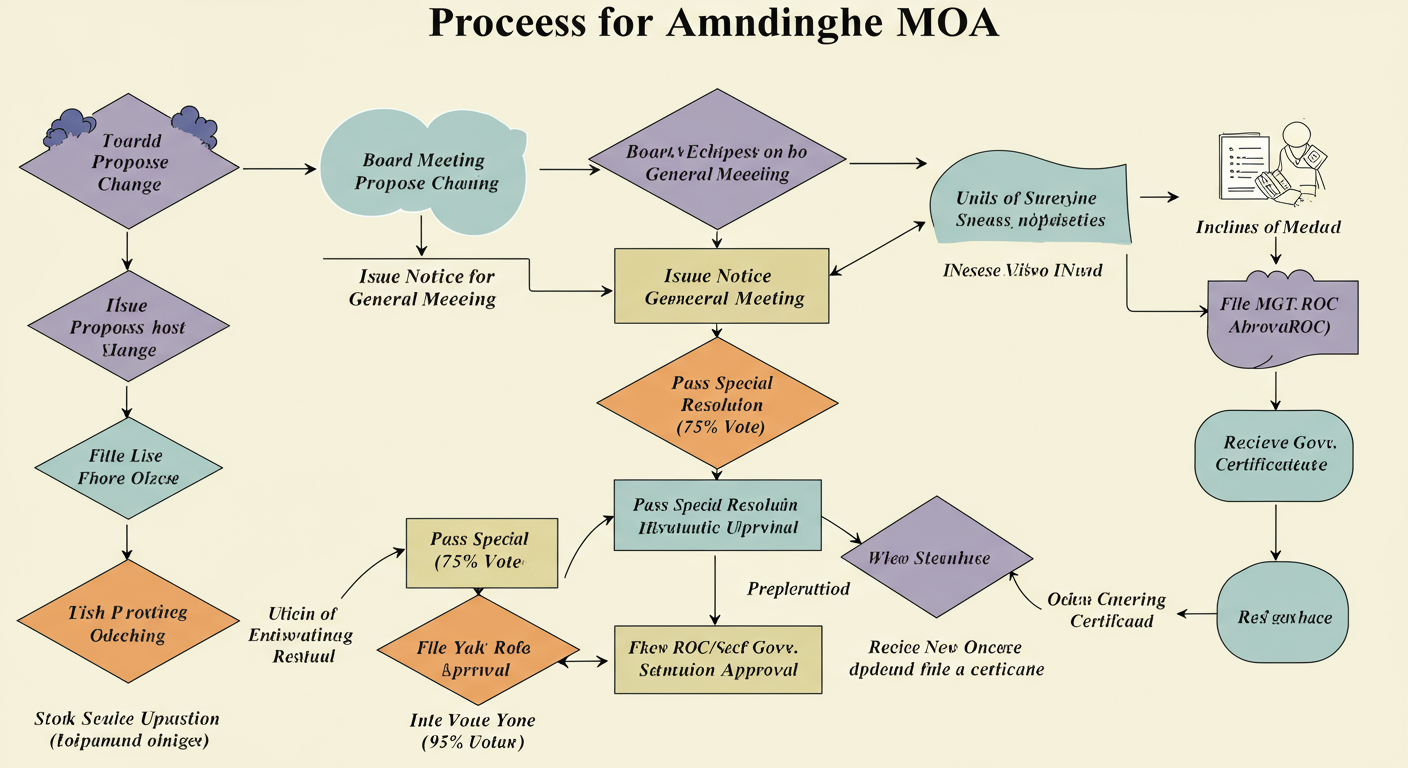
Here’s a quick breakdown of the process differences:
| Step | Amending the MOA | Amending the AOA |
|---|---|---|
| 1. Resolution Type | Special Resolution (75% shareholder majority) is mandatory. | Special Resolution (75% shareholder majority) is mandatory. |
| 2. External Approval | Often required. Approval from the Registrar of Companies (ROC) or Central Government may be needed, especially for name or object changes. | Not required. This is a purely internal matter, provided the change is legal and consistent with the MOA. |
| 3. Complexity & Time | High. The process can take several weeks or even months due to external dependencies. | Low. Can be completed quickly after the shareholder meeting. |
| 4. Core Principle | Protects external stakeholders (creditors, investors) from sudden, drastic changes to the company’s purpose or structure. | Allows the company internal flexibility to adapt its governance as it grows. |
💡 Pro Tip for Investors
Before you invest, scrutinize the AOA for clauses on ‘drag-along’ and ‘tag-along’ rights, ‘right of first refusal’ (ROFR), and anti-dilution provisions. These internal rules, not found in the MOA, will dictate your power and protection as a minority shareholder.
Why This Matters: A View from the Trenches
Understanding the difference between MOA and AOA isn’t just for lawyers. It has massive, practical implications for everyone involved in the business.
- For Founders: These documents are your shield and your guide. A well-drafted MOA and AOA prevent disputes, clarify roles, and create a stable structure that attracts investment. Getting it wrong early on creates legal debt that will absolutely come back to haunt you during due diligence. Trust me on this one.
- For Investors: The MOA’s Objects Clause tells you where your money can legally go. The AOA tells you what rights you have and how decisions are made. After testing hundreds of pitch decks, I can tell you that savvy investors look at these documents as a proxy for founder seriousness and good corporate governance.
- For Directors: Your authority is defined by these documents. Acting beyond the MOA can lead to personal liability. Ignoring the procedures in the AOA can invalidate board decisions. This is your operational playbook.
⚠️ Watch Out for Liability
If you’re a director who approves an action that is ultra vires (beyond the MOA), you could be held personally liable to repay the company for any losses incurred. The corporate veil won’t protect you when you’ve knowingly acted outside the company’s constitutional powers.
❓ Frequently Asked Questions
Which is more important, the MOA or AOA?
The MOA is definitively more important. It’s the supreme, foundational charter of the company. The AOA is subordinate and must comply with everything stated in the MOA. In any conflict between the two, the MOA always wins.
Can a company operate without an AOA?
Technically, a company limited by shares can adopt a default set of articles provided by the Companies Act (like Table F). However, this is almost never a good idea. In practice, every serious company drafts a custom AOA to fit its unique needs, especially regarding shareholder agreements and governance.
What’s the biggest mistake founders make with the MOA’s Objects Clause?
Based on real-world cases, the biggest mistake is being too narrow. If your clause only says “to sell handmade candles online,” you could be in legal trouble if you want to start selling candle-making kits or offering workshops. It’s a balance: be specific enough to provide clarity but broad enough to allow for natural business evolution.
How can I see a company’s MOA and AOA?
Both the MOA and AOA are public documents. For most jurisdictions, you can access them through the corporate affairs ministry or company registrar’s online portal by paying a small fee. This is a standard part of any serious due diligence process.
Do I really need a lawyer to draft these?
Yes. Don’t try to save a few dollars here. While you don’t legally need a lawyer, engaging a corporate lawyer or a Company Secretary is the smartest investment you can make. These are complex legal documents that form the foundation of your entire business. A small mistake now can cost you millions later.
The Final Word: Build on a Solid Foundation
Look, the difference between MOA and AOA isn’t just an exam question for law students. It’s the architectural blueprint of your business.
The MOA is your foundation—strong, deep, and hard to change. It tells the world what your company exists to do. The AOA is the internal framework built upon that foundation—the rules that allow for efficient, fair, and scalable day-to-day operations.
Ignoring the hierarchy and purpose of these documents is like building a skyscraper without a blueprint. It might stand for a while, but it’s destined to fail. Take the time to get them right from day one. Your future self—and your future investors—will thank you for it.