
Picture this: a founder celebrates a record sales quarter, only to find a notice from the Ministry of Corporate Affairs (MCA). The penalty for a missed filing? A staggering sum that wipes out a chunk of their hard-earned profit. This isn’t a scare tactic. It’s a reality we’ve seen play out for countless businesses in India.
The world of corporate compliance can feel like a minefield, and the ROC filing due dates are the hidden triggers. Missing them isn’t a simple administrative slip-up; it’s a direct hit to your company’s finances, credibility, and even your directors’ futures.
But it doesn’t have to be this way. This article isn’t just another list of dates. It’s your strategic playbook for 2026. You’ll get a crystal-clear compliance calendar, learn the costly mistakes to avoid, and walk away with a battle-tested plan to make ROC filings a seamless part of your business rhythm, not a source of year-end panic.
Why ROC Compliance is Your Business’s Health Report (Not Just Paperwork)
Think of the Registrar of Companies (ROC) as the official record-keeper of your business’s entire lifecycle. The filings you submit are more than just mandatory forms; they are public declarations of your company’s health and integrity. They tell shareholders, investors, banks, and the government that you’re operating transparently and responsibly.
Meeting every ROC filing due date is a fundamental pillar of good corporate governance. It’s a non-negotiable requirement under the Companies Act, 2013. Here’s why it’s so critical:
- Builds Unshakeable Trust: Timely filings are a massive E-E-A-T (Experience, Expertise, Authoritativeness, Trustworthiness) signal. It shows potential investors and lenders that your house is in order, making it infinitely easier to secure funding.
- Maintains Active Status: Consistent failure to file can lead the ROC to mark your company as ‘Inactive’ or, worse, strike its name from the register entirely. Poof. Your legal entity is gone.
- Avoids Crippling Penalties: The MCA’s penalty regime is designed to hurt. We’re talking about daily fines that accumulate without any upper limit. More on that brutal math later.
In short, your compliance record is your business’s reputation written in stone. Let’s make sure it’s a good one.
The 2026 ROC Calendar for Private Limited Companies (FY 2025-26)
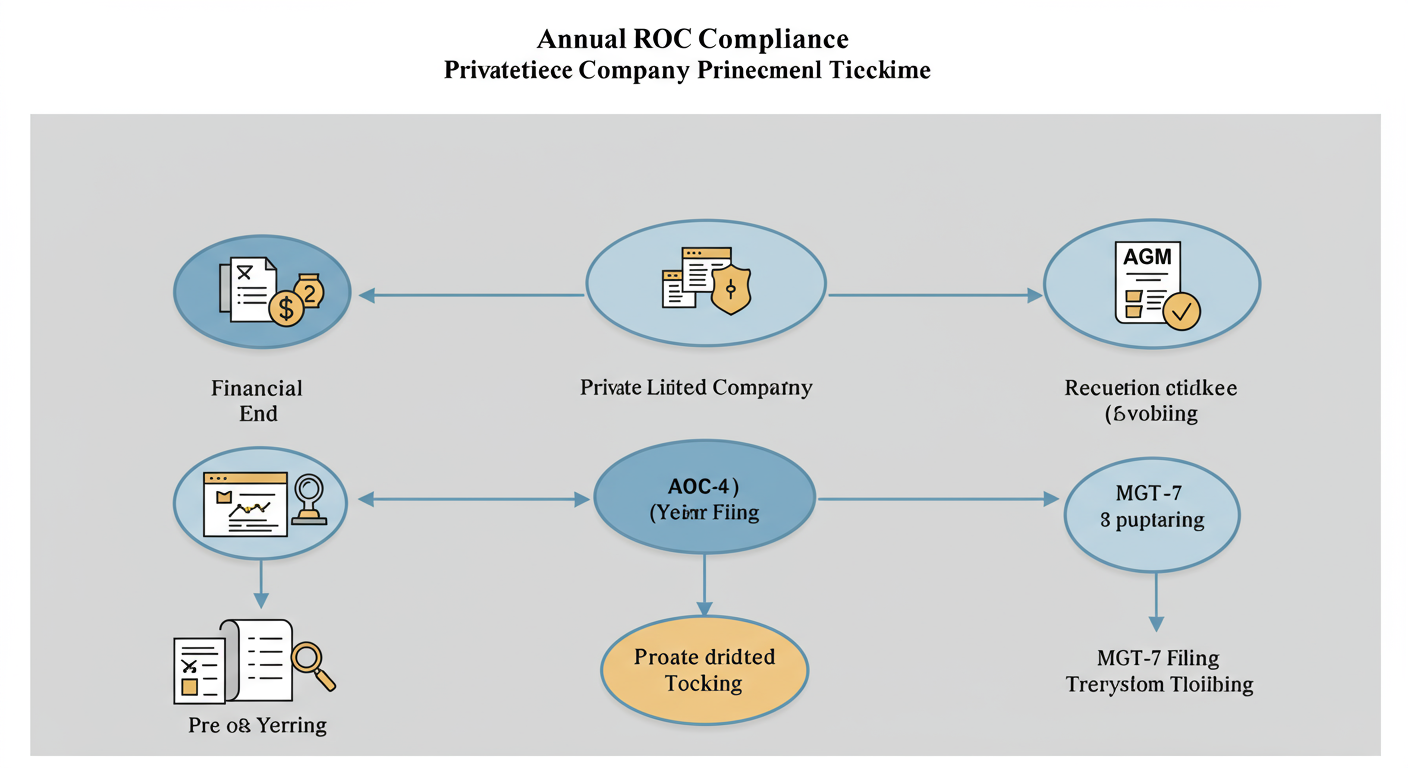
For Private Limited Companies, the compliance clock starts ticking after the financial year ends on March 31, 2026. The key milestone is the Annual General Meeting (AGM), which must be held by September 30, 2026. All major filing deadlines are calculated from the date of your AGM.
Here’s your at-a-glance calendar for the core annual filings.
| Form Name | Purpose | Due Date for FY 2025-26 |
|---|---|---|
| Form AOC-4 | Filing of Financial Statements (Balance Sheet, P&L Account, Board’s Report). | Within 30 days of the AGM (e.g., by October 30, 2026, if AGM is on Sep 30). |
| Form MGT-7/MGT-7A | Filing the Annual Return with details of directors, shareholders, etc. (MGT-7A is for Small Companies & OPCs). | Within 60 days of the AGM (e.g., by November 29, 2026, if AGM is on Sep 30). |
| Form ADT-1 | Notifying the ROC about the appointment of a new auditor. | Within 15 days of the AGM where the auditor was appointed. |
Other Critical Dates to Mark in Red:
- Form DPT-3 (Return of Deposits): Must be filed by June 30, 2026, for money received during the financial year ending March 31, 2026.
- DIR-3 KYC (Director’s KYC): Every Director Identification Number (DIN) holder must file this annually by September 30, 2026.
💡 Pro Tip
Don’t wait for September to talk to your auditor. Based on our experience, the most successful companies start finalizing their accounts in April. This gives your auditor ample time and prevents a last-minute rush where mistakes are more likely to happen. A clean, early audit is the secret to a stress-free filing season.
The Streamlined Path: ROC Due Dates for LLPs in 2026
Limited Liability Partnerships (LLPs) enjoy a simpler compliance structure because their deadlines aren’t tied to an AGM. The dates are fixed directly from the financial year-end (March 31, 2026).
- Form 11 (Annual Return): This form summarizes the LLP’s partners and their contributions. It’s a snapshot of the LLP’s management structure.
- Due Date: May 30, 2026 (60 days from FY end).
- Form 8 (Statement of Account & Solvency): This is the LLP’s financial declaration, confirming its solvency and detailing its assets and liabilities.
- Due Date: October 30, 2026 (30 days from the end of six months of the FY).
⚠️ Watch Out
A common mistake we see is LLP partners mixing up the due dates for Form 8 and Form 11. They are six months apart! Missing the May 30th deadline for Form 11 is one of the most frequent (and easily avoidable) sources of penalties for LLPs. Set a separate, early reminder for this one.
Pvt Ltd vs. LLP: A Head-to-Head Compliance Breakdown
Choosing the right business structure has long-term implications for your compliance burden. While both are popular, their annual requirements differ significantly. Here’s a direct comparison to help you understand the operational load.
| Compliance Factor | Private Limited Company (Pvt Ltd) | Limited Liability Partnership (LLP) |
|---|---|---|
| Annual General Meeting (AGM) | Mandatory | Not Required |
| Core Annual Forms | AOC-4 (Financials), MGT-7 (Annual Return) | Form 8 (Accounts), Form 11 (Annual Return) |
| Statutory Audit | Mandatory, regardless of turnover. | Only required if turnover exceeds ₹40 Lakhs OR contribution exceeds ₹25 Lakhs. |
| Board Meetings | Minimum of 4 per year. | No minimum requirement. |
| Overall Complexity | Higher | Lower |
This table makes it clear: LLPs offer a much leaner compliance path. However, Pvt Ltd companies are often preferred for raising equity capital from venture capitalists. The choice depends entirely on your long-term business goals.
🎯 Key Takeaway
ROC compliance is not an administrative task; it’s a strategic function. The 2026 deadlines are fixed, but the penalties for missing them are unlimited. Proactive planning is the only defense against financial and reputational damage.
The Real Cost of Delay: Penalties That Can Sink Your Business
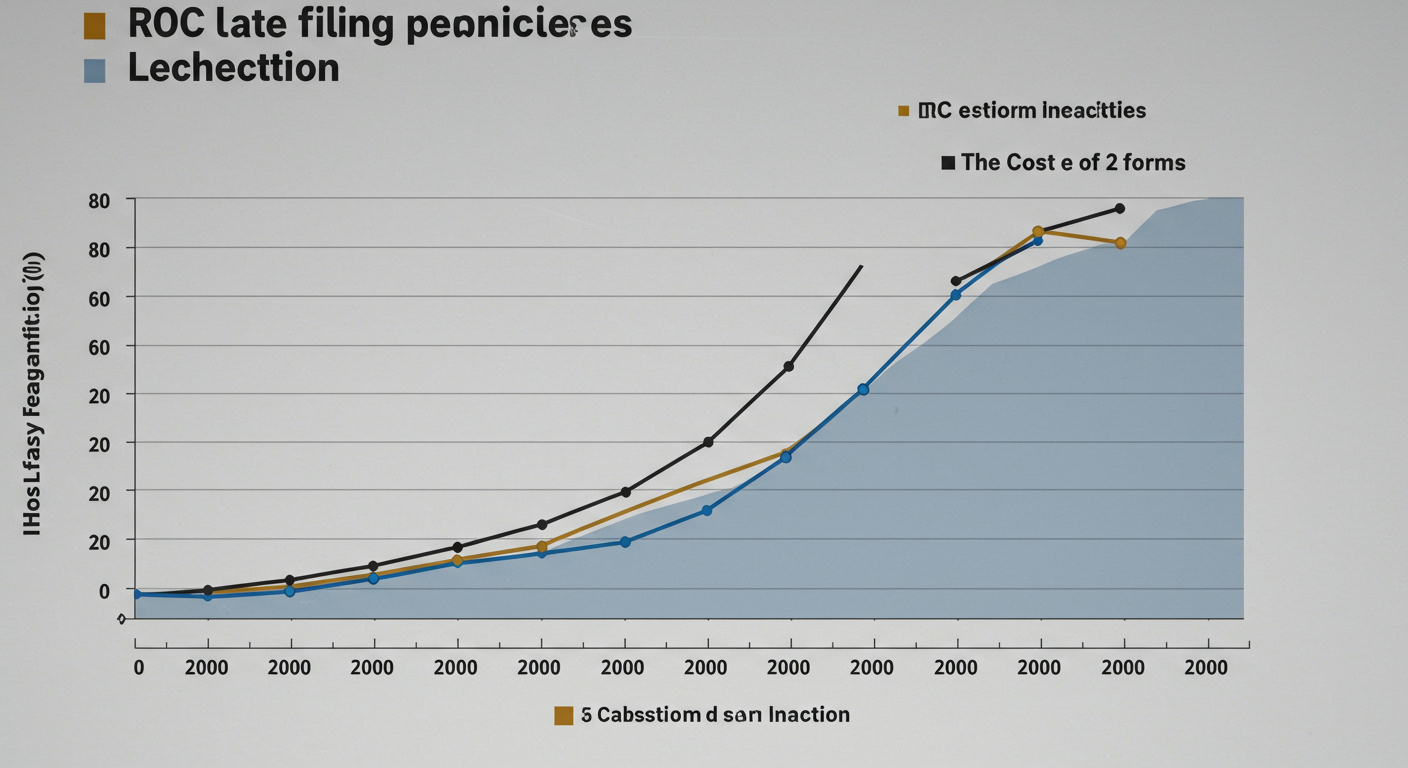
Let’s get brutally honest about what happens when you miss an ROC filing due date. The MCA has a simple, punishing rule for late filings of forms like AOC-4, MGT-7, Form 8, and Form 11:
An additional fee of ₹100 per day, per form, with no upper limit.
It sounds small. It’s not. Let’s run the numbers. 11 Crucial MSME Registration Benefits Explained (2025 Guide)
Imagine your Pvt Ltd company misses the deadlines for both AOC-4 and MGT-7 by just 90 days.
– Penalty for AOC-4: 90 days x ₹100/day = ₹9,000
– Penalty for MGT-7: 90 days x ₹100/day = ₹9,000
Total Penalty: ₹18,000. How to Apply PAN 2.0 – PAN Card with QR Code
That’s for a relatively short delay on just two forms. We’ve seen companies rack up penalties well into six figures for prolonged negligence. This is cash that could have been reinvested into marketing, hiring, or product development.
But the financial hit is only the beginning. The other consequences are even more severe:
- Director Disqualification: Fail to file financial statements or annual returns for three straight years, and all company directors can be disqualified for five years. Trust me on this one, I’ve seen it lock talented entrepreneurs out of starting or joining new ventures.
- Company Strike-Off: The ROC can literally erase your company from the register, assuming it’s defunct. Reinstating it is a long, expensive, and painful legal process.
- Frozen Bank Accounts: In many cases, banks will freeze the company’s accounts upon learning of its non-compliant or “Struck Off” status. Operations grind to a halt.
⚠️ Watch Out
The “no upper cap” on penalties is the most dangerous part. A small oversight left unchecked for a year can result in a penalty of ₹36,500 for a single form. Don’t assume there’s a limit. There isn’t.
Your Step-by-Step Guide to Flawless ROC Filing
Staying compliant is about building a system, not relying on memory. Here’s a simple, actionable process to follow.
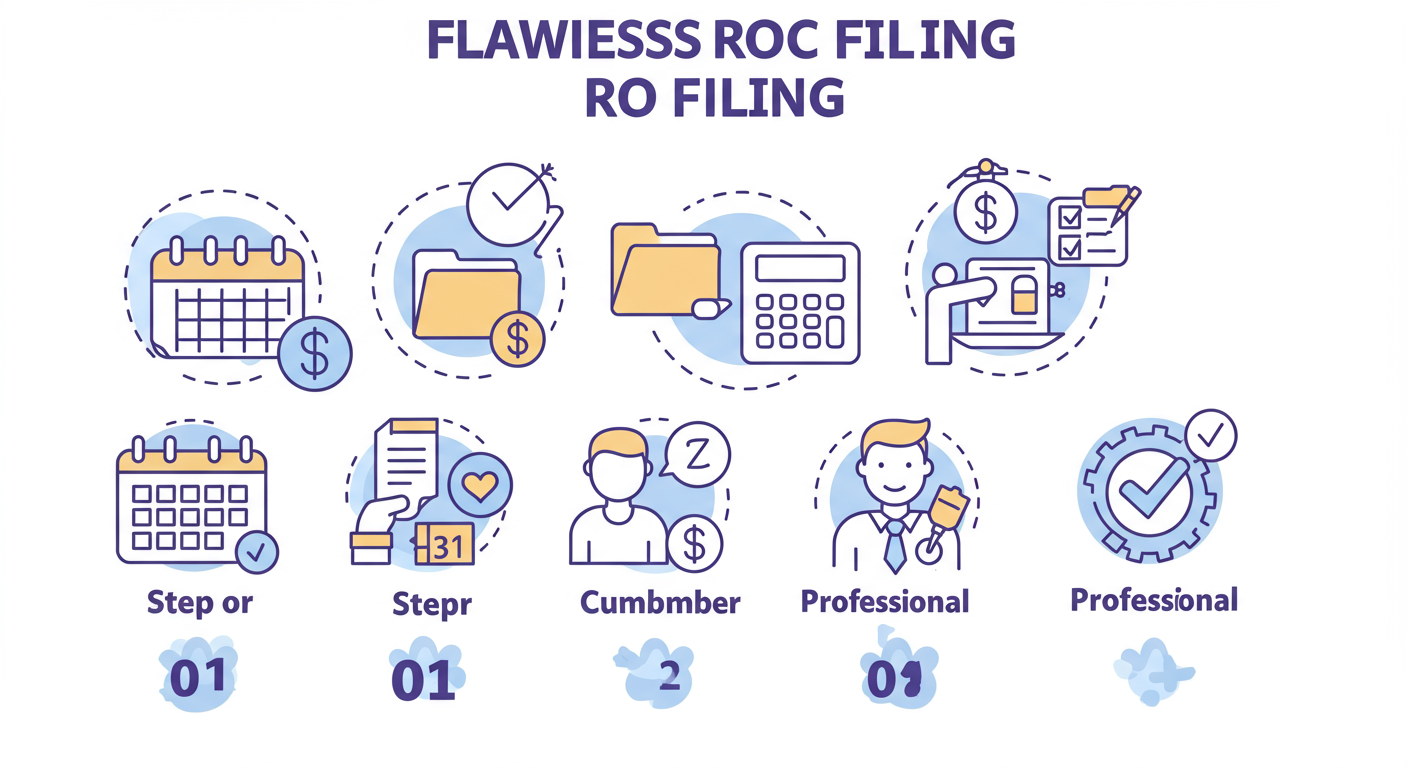
- Create Your Compliance Command Center: Don’t just use a calendar. Create a shared document or project management board (like Trello or Asana) with every single due date for 2026. Assign a clear owner for each filing. Set reminders for 30, 15, and 7 days before each deadline.
- Organize Documents Year-Round: Create a dedicated cloud folder (e.g., on Google Drive or Dropbox) for all compliance documents. As soon as a board meeting happens, save the minutes. When you get a major invoice, file it. Don’t wait until year-end to hunt for documents.
- Finalize Accounts by April 30th: This is non-negotiable. As soon as the financial year ends on March 31st, get your bookkeeper and accountant to close the books. This is the single most important step to ensure a smooth audit and timely filing.
- Engage a Professional Early: Don’t hire a Company Secretary (CS) or Chartered Accountant (CA) in September. Engage them in April or May. This gives them time to review your books, advise on any issues, and prepare the forms without rushing.
- Review and File Before the Deadline: Never aim to file on the due date. The MCA portal can be slow or crash during peak traffic. Aim to file everything at least one week in advance. This buffer is your safety net.
💡 Pro Tip
When hiring a compliance professional, ask them one question: “How do you communicate upcoming deadlines to your clients?” A great firm won’t just file for you; they’ll proactively manage your calendar and send you multiple reminders. Look for a partner, not just a filer.
Conclusion: From Chore to Strategic Advantage
Let’s be clear. Managing your ROC filing due dates isn’t just about avoiding penalties. It’s about building a resilient, trustworthy, and fundable business. A clean compliance history is one of your most valuable, yet overlooked, assets.
You now have the complete 2026 calendar, a clear view of the risks, and a step-by-step plan to take control. The next move is yours.
Don’t close this tab and forget. Take 10 minutes, right now. Open your calendar and block out the key dates we’ve outlined: DPT-3 in June, the AGM deadline in September, and the AOC-4/MGT-7 deadlines in October and November. It might be the most profitable 10 minutes you spend all year.
❓ Frequently Asked Questions
What happens if a company fails to hold its AGM on time?
Failing to hold an AGM by the September 30th deadline is a direct violation of the Companies Act, 2013. The company and its officers can face significant fines. More importantly, it’s a major red flag for investors and can trigger a deeper inquiry from the ROC.
Can the ROC filing due dates for 2026 be extended?
You should never count on it. While the MCA has occasionally granted extensions during national emergencies (like the COVID-19 pandemic), these are rare exceptions. For planning purposes, always assume the statutory deadlines are final and absolute.
What’s the real difference between Form MGT-7 and MGT-7A?
Think of MGT-7A as the “short form.” It’s a simplified annual return designed for One Person Companies (OPCs) and ‘Small Companies’. According to the Companies Act, a Small Company has a paid-up capital under ₹4 crore and turnover under ₹40 crore, making their compliance burden lighter. All other private companies must file the more detailed Form MGT-7.
Do I need to file ROC returns for an inactive or dormant company?
Yes, absolutely. A company with zero revenue or activity must still complete its annual filings. The only way to reduce this burden is to officially apply for ‘Dormant Status’ with the ROC. A dormant company has much simpler, minimal filing requirements, but you must apply for the status first.
What is DIR-3 KYC and why is the penalty so specific?
DIR-3 KYC is an annual verification for anyone holding a Director Identification Number (DIN). It’s how the MCA ensures its director database is current. The due date is September 30th. If you miss it, your DIN is deactivated, and you’ll face a flat penalty of ₹5,000 to reactivate it. It’s a simple filing with a costly and inconvenient penalty for missing it.
Read Also:
- Section 8 Company Registration: The Definitive 2026 Guide
- MCA Name Availability 2026: The Ultimate Guide to Approval
- Inside India’s Corporate Giants 2026
- How to View Company Master Data in India (2026 Pro Guide)
- MOA and AOA Difference (2026): A Founder’s Strategic Guide
- Appointment of Auditor: A 7-Step Guide for 2026 Compliance
- FSSAI 2026: Renew or Risk It All
- Form MGT-14 Filing: The Ultimate Guide for 2026
- Who is a Promoter? The 7 Roles of a Company’s Architect (2026)
- MGT-7 Due Date 2026: A Guide to Filing & Avoiding Penalties