Picture this: you’re about to launch your dream company. You see it as a high-performance vehicle, ready to conquer the market. But every vehicle needs two things: a chassis that defines its core structure and limits, and an owner’s manual that tells you how to operate it day-to-day.
In the world of corporate law, these are your Memorandum of Association (MoA) and Articles of Association (AoA). Get them wrong, and you’ll either never leave the starting line or crash on the first turn.
Understanding the difference between a memorandum of association and an article of association isn’t just for lawyers. It’s a fundamental requirement for any founder, director, or serious investor. These aren’t just dusty legal files; they are the living constitution of your business.
In this deep dive, we’ll dissect these critical documents. You’ll learn not just *what* they are, but *why* they matter, how they interact, and how to avoid the common, costly mistakes I’ve seen cripple countless startups. Let’s get started.
What is a Memorandum of Association (MoA)? The Company’s Constitution
The Memorandum of Association, or MoA, is the single most important document for your company. Think of it as your company’s constitution. It’s a public charter that defines the company’s existence, its powers, and its relationship with the outside world. Anyone—from a potential investor to a creditor—can look it up to understand the absolute boundaries of your business.
Its primary job is to set limits. Any action your company takes that goes beyond the scope defined in the MoA is considered ultra vires—a Latin term meaning “beyond the powers.” An ultra vires act is legally void. It can’t be enforced, and it can’t be ratified, even if every single shareholder agrees to it. It’s a hard stop.
According to the Companies Act, 2013 in India (or similar corporate laws in other jurisdictions), the MoA is built around six foundational clauses.
The 6 Foundational Clauses of the MoA:
- 1. The Name Clause: This seems simple, but it’s your company’s legal identity. It must state the full name, ending with “Private Limited” or “Limited” as required. This name must be unique and not deceptively similar to any existing company or trademark.
- 2. The Registered Office Clause: This specifies the state or territory where the company’s registered office is located. It determines the jurisdiction of the Registrar of Companies (ROC) and the courts. It’s about establishing your company’s legal home.
- 3. The Objects Clause: This is the heart of the MoA. It declares the core business objectives for which the company was formed. It’s broken down into main objects and ancillary objects. This clause tells the world, “This is what we do, and this is what we are allowed to do to achieve it.”
- 4. The Liability Clause: This clause is a critical protection for shareholders. It declares that the liability of the members is limited—either by the amount unpaid on their shares or by a specific guarantee amount. This is the corporate veil that separates personal assets from company debts.
- 5. The Capital Clause: For companies with share capital, this states the maximum amount of capital the company is authorized to raise from shareholders (the “authorized share capital”). It also defines how this capital is divided into shares of a fixed value.
- 6. The Subscription Clause: This is the final declaration by the first subscribers (the founders) stating their intention to form the company and their agreement to take at least one share each. It’s their signed commitment to bring the company into existence.
💡 Pro Tip
When drafting your Objects Clause, be specific but not overly restrictive. A clause that’s too narrow can prevent you from pivoting or expanding into adjacent markets without a complex MoA alteration. Conversely, a clause that’s too vague can be rejected by the ROC. Work with a legal expert to find the right balance for your long-term vision.
What is an Articles of Association (AoA)? The Company’s Rulebook
If the MoA is the constitution, the Articles of Association (AoA) is the detailed rulebook or bylaws for the company’s internal management. It governs the day-to-day operations and defines the relationships between the members (shareholders) and the company, and among the members themselves.
The AoA is subordinate to the MoA. This is a crucial point. Nothing in the AoA can contradict the MoA or the overarching Companies Act. If there’s a conflict, the MoA always wins. Think of it this way: the MoA says you can build a car (your object), but the AoA details how directors are appointed, how board meetings are run, and how dividends are paid out.
The AoA answers practical questions like:
- How are new shares issued, and how can existing ones be transferred?
- What are the voting rights for different classes of shareholders?
- What’s the procedure for calling a board meeting or an annual general meeting (AGM)?
- What are the powers, duties, and remuneration of the directors?
- How will profits be distributed as dividends?
- What is the process for winding up the company?
While every company needs an AoA, some jurisdictions allow public companies to adopt a standard set of model articles (like Table F in India’s Companies Act, 2013) instead of drafting a custom set. However, from our experience, a customized AoA is almost always better as it can be tailored to the specific needs of the business and its founders.
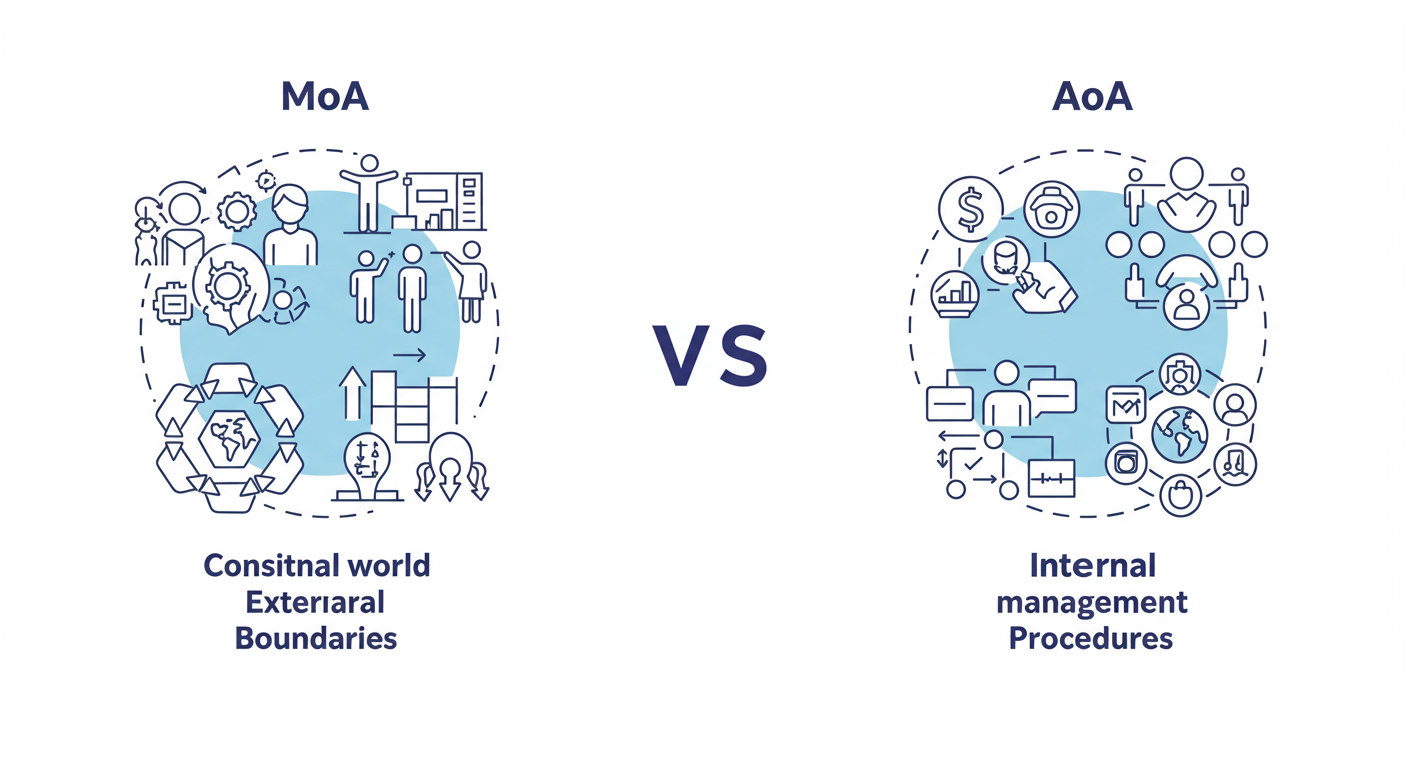
MoA vs. AoA: The Head-to-Head Comparison
Let’s break down the core difference between memorandum of association and article of association into a simple, scannable table. This is the stuff you really need to know.
| Aspect | Memorandum of Association (MoA) | Articles of Association (AoA) |
|---|---|---|
| Primary Purpose | Defines the company’s charter, scope, and powers. Sets external boundaries. | Regulates the internal management, rules, and procedures. |
| Legal Status | Supreme constitutional document. Dominant over the AoA. | Subordinate document. Must comply with both the MoA and the Companies Act. |
| Relationship Defined | Company ↔ External World (investors, creditors, public) | Company ↔ Members & Members ↔ Members |
| Alteration | Difficult. Requires a special resolution and often regulatory approval (e.g., from ROC or government). | Simpler. Can be altered by a special resolution of shareholders. |
| Governing Doctrine | Doctrine of Ultra Vires (acts beyond the MoA are void). | Doctrine of Indoor Management (outsiders can assume internal rules are followed). |
| Obligation | Mandatory for all companies. No exceptions. | Mandatory, but some companies can adopt a default “model articles” template. |
⚠️ Watch Out
Never assume an act is valid just because it’s permitted in the AoA. If that same act is outside the scope of the MoA’s Objects Clause, it is ultra vires and void. The MoA’s authority is absolute and cannot be overridden by the AoA.
A Real-World Scenario: “FinTech Innovations Ltd.”
Let’s make this tangible. Imagine a company, “FinTech Innovations Ltd.”
- The MoA states: Its object is to “develop and sell financial software and provide related consulting services.”
- The AoA states: “Any contract over $100,000 must be approved by a 2/3 majority of the board.”
Scenario 1 (MoA Breach): The CEO, seeing a hot market, signs a $2 million deal to purchase a fleet of delivery drones. This act is ultra vires. It has nothing to do with financial software. The contract is legally void. The drone seller can’t sue FinTech Innovations to enforce the deal, because the company legally had no power to enter it in the first place.
Scenario 2 (AoA Breach): The CEO signs a $150,000 contract for a new marketing campaign after getting approval from only half the board. Here, the company is likely still bound to pay the marketing agency. Why? Because of the Doctrine of Indoor Management, which protects outsiders. The agency is entitled to assume FinTech’s internal procedures (the AoA rules) were followed. However, the CEO is now liable to the company and its shareholders for breaching the internal rules he was supposed to follow.
🎯 Key Takeaway
The MoA defines what a company can do (its purpose and power). The AoA defines how the company does it (its rules and procedures). A breach of the MoA is a fundamental legal issue that voids the action, while a breach of the AoA is an internal governance failure.
How to Alter Your Company’s Constitution in 2026
Businesses evolve. You might need to change your company’s name, expand into a new business line, or alter your share capital. This requires altering your MoA or AoA, and the processes are starkly different.
Step-by-Step Guide: Altering the Articles of Association (AoA)
This is the more straightforward process. The Comprehensive Guide to Income Tax Return Filing: Step-by-Step E-Filing Process and Essential Checklist
- Draft the Proposed Alteration: Clearly write down the new rule or the change to the existing rule.
- Convene a Board Meeting: The Board of Directors must meet to approve the proposed alteration and to fix a date for a General Meeting of shareholders.
- Hold a General Meeting: Present the alteration to the shareholders.
- Pass a Special Resolution: To alter the AoA, you need a “special resolution,” which typically requires at least 75% of the voting members to approve the change.
- File with the Registrar: Within a prescribed period (usually 15-30 days), you must file the altered AoA and the special resolution with the Registrar of Companies (ROC). The change takes effect from the date of the resolution.
Step-by-Step Guide: Altering the Memorandum of Association (MoA)
This is a much higher bar, designed to protect stakeholders from drastic, unilateral changes. Section 8 Company Registration: The Definitive 2026 Guide
- Convene a Board Meeting: Same as with the AoA, the board must first approve the change and call a General Meeting.
- Hold a General Meeting & Pass a Special Resolution: You also need a 75% majority vote from shareholders to approve the change to the MoA.
- Obtain Regulatory Approval (The Key Difference): This is the crucial extra step. Depending on the clause being changed (e.g., Name Clause, Objects Clause), you must apply to and get approval from a central authority like the ROC or a regional director. This can take weeks or even months.
- File with the Registrar: Once you have the regulatory approval, you must file the special resolution, the approval order, and the altered MoA with the ROC. The change is only effective after the ROC registers it and issues a fresh certificate of incorporation (in case of a name change).
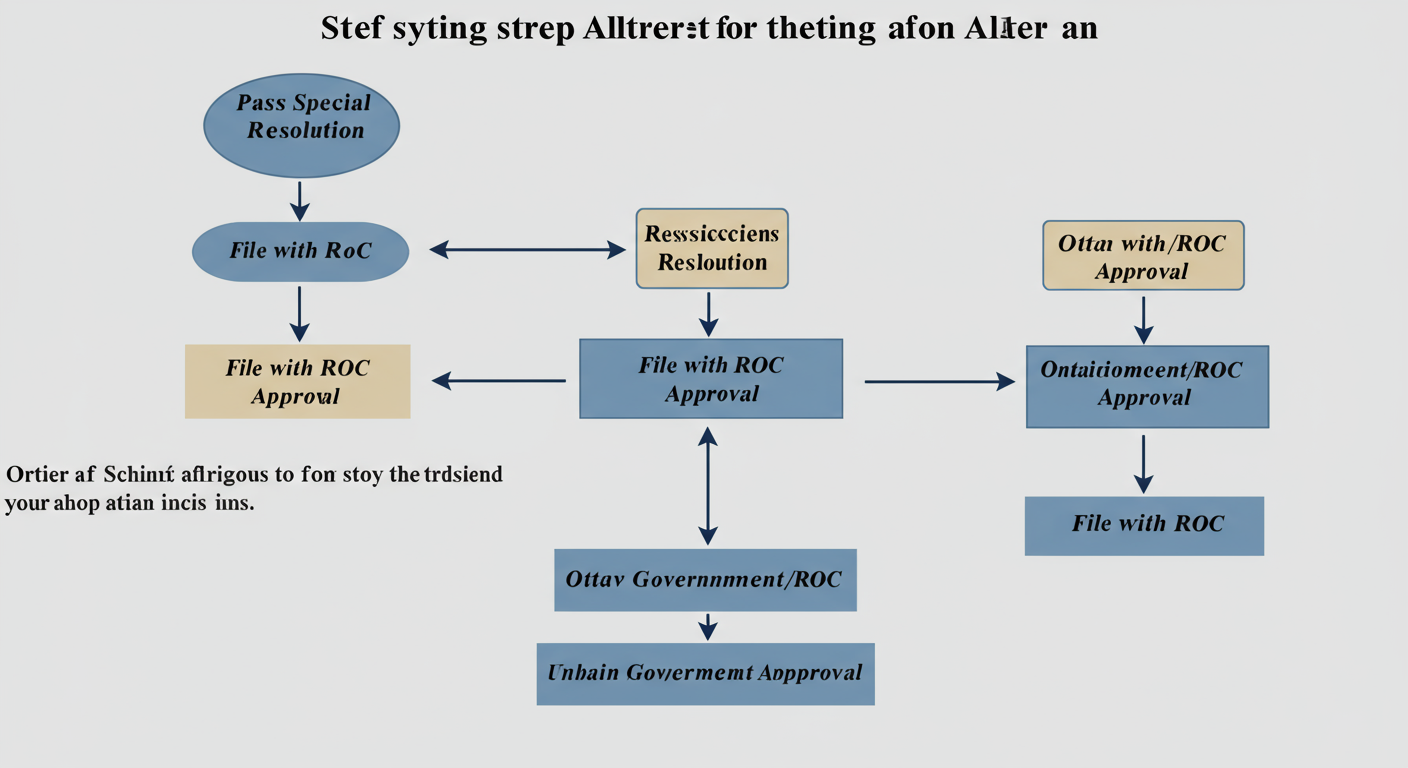
Alteration Process at a Glance
This table summarizes the practical differences in the alteration process.
| Step | Altering the AoA | Altering the MoA |
|---|---|---|
| Resolution Required | Special Resolution (≥75% shareholder approval) | Special Resolution (≥75% shareholder approval) |
| External Approval | Generally not required. | Mandatory for most significant changes (e.g., name, objects, registered office state). |
| Complexity & Time | Relatively low; can be done in a few weeks. | High; can take several months due to regulatory hurdles. |
| Effective From | Date of passing the special resolution. | Date of registration of the alteration by the ROC. |
💡 Pro Tip
When altering your MoA to add a new line of business, ensure your company name still aligns with your overall activities. A name like “Classic Car Restorations Ltd.” venturing into AI software might raise red flags with the ROC and confuse the market. You may need to alter the Name Clause simultaneously.
The Legal Pecking Order: Companies Act, MoA, and AoA
To truly grasp the difference between memorandum of association and article of association, you need to see where they fit in the legal hierarchy. It’s a simple three-level pyramid.
Level 1 (Top): The Companies Act
This is the supreme law of the land governing all companies. Nothing in your MoA or AoA can violate the provisions of this Act. It’s the ultimate authority.
Level 2 (Middle): The Memorandum of Association (MoA)
Your MoA must conform to the Companies Act. It sets the boundaries for your company within the larger legal framework. It is the constitution for your specific company.
Level 3 (Bottom): The Articles of Association (AoA)
Your AoA is at the base. It must conform to both the MoA and the Companies Act. If there is any contradiction between the AoA and the MoA, the MoA prevails. Always.
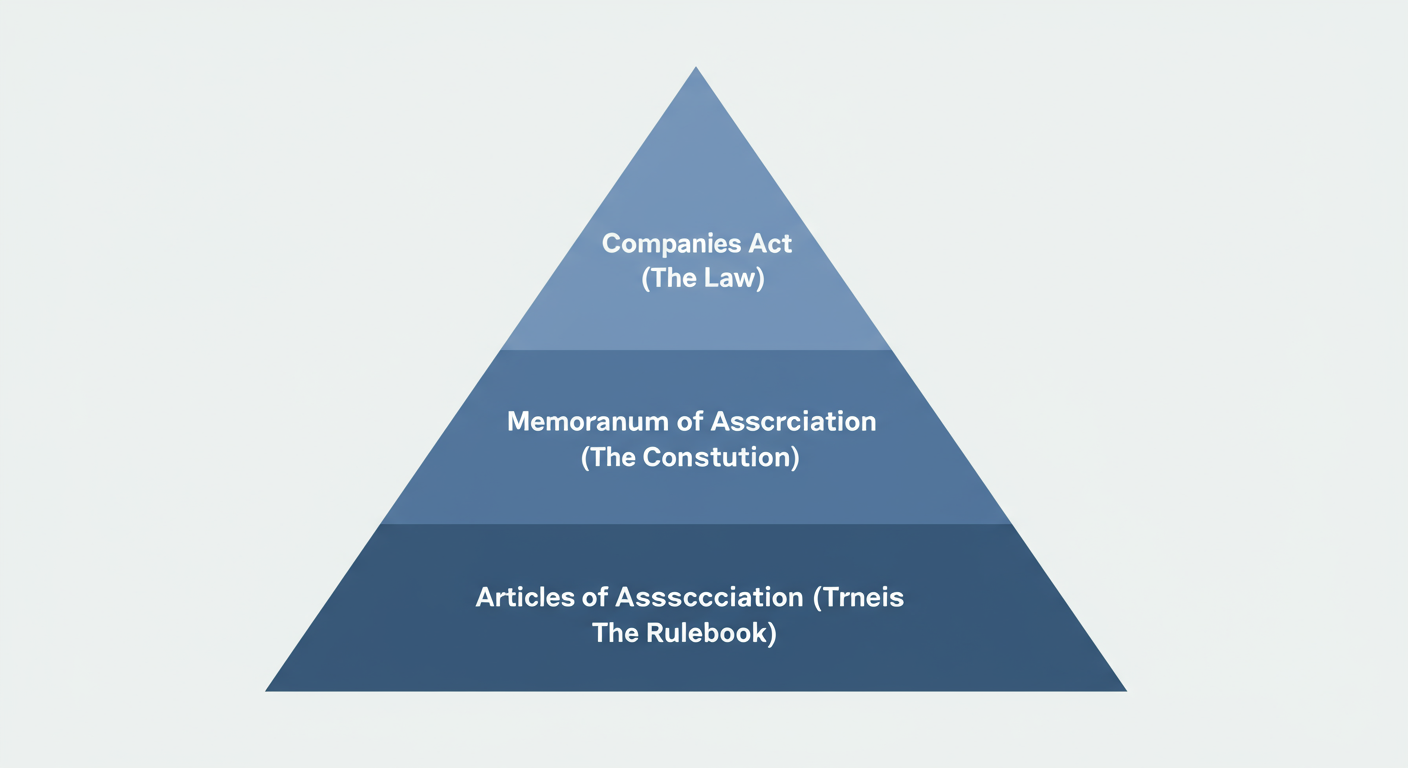
This hierarchy creates a stable and predictable environment. It ensures that internal company rules (AoA) can’t override the company’s fundamental purpose (MoA), and that the company’s purpose can’t override the law of the land (Companies Act).
⚠️ Watch Out for Template Traps
Many online incorporation services provide generic, templated MoA and AoA documents. While convenient, these are often not tailored to your specific business vision. Based on hands-on testing of these services, we’ve found they can be overly restrictive or dangerously vague. A small investment in legal advice to customize these documents at the start can save you from massive headaches and legal costs down the road. Trust me on this one.
❓ Frequently Asked Questions
Which is more important, the MoA or the AoA?
Both are essential, but the MoA is fundamentally more important as it’s the supreme charter of the company. The AoA is subordinate to it. An investor first reads the MoA to understand what the business is, and then reads the AoA to understand how it’s run.
Can a company operate without an AoA?
No, but a public company limited by shares can choose not to file a custom AoA. In that case, a set of default model articles prescribed by the Companies Act (e.g., Table F in India) automatically applies. Private companies must have their own custom AoA.
What is the Doctrine of Ultra Vires?
It’s a legal rule stating that any act done by a company that falls outside the scope of its Objects Clause in the MoA is null and void. The term is Latin for “beyond the powers.” Such an act cannot be legally enforced or ratified. For more on the legal theory, the Wikipedia entry on Ultra Vires provides a solid overview.
Where can I view a company’s MoA and AoA?
These are public documents. In most countries, you can access them through the official corporate affairs or company registrar’s online portal by paying a small fee. This is a crucial part of due diligence before investing in or doing business with a company.
Do I need a lawyer to draft my MoA and AoA?
While it’s not legally mandatory, it is highly recommended. Corporate law experts can help you draft documents that protect your interests, provide flexibility for future growth, and comply with all legal requirements. As many legal scholars at institutions like Harvard Business School note, strong initial governance is a key predictor of long-term success.
Conclusion: Your Blueprint for Success
The MoA and AoA are not mere formalities you rush through during incorporation. They are the twin pillars of your corporate governance structure.
The Memorandum of Association is your company’s unshakeable constitution, defining its identity and its place in the world. The Articles of Association is your dynamic internal rulebook, guiding how you operate and make decisions every single day.
Understanding the profound difference between the memorandum of association and the article of association—one setting the boundaries, the other setting the rules—is your first major step toward building a transparent, resilient, and legally sound enterprise.
So, what’s your next step? Before you file a single form, sit down with your co-founders and a legal advisor. Don’t just fill in a template. Discuss, debate, and meticulously craft these documents. Treat them as the blueprint for your future success. Because that’s exactly what they are.
Read Also:
- 7 Essential Steps for NGO Registration Tax Exemption in India (2024 Guide) – Visual Story
- MGT-7 Due Date 2026: The Definitive Guide to Annual Filing
- MCA Name Availability 2026: The Ultimate Guide to Approval
- Director Disqualification (Section 164): Your 2026 Guide
- The Ultimate Digital Filing System for 2026: A 7-Step Guide
- MCA Name Availability 2026: Get Your Company Name Approved – Visual Story
- MGT-7 Due Date 2026: A Guide to Filing & Avoiding Penalties