You’re about to approve a purchase order for ₹60 lakh. Everything looks good. Then, a nagging thought hits you. “Wait… aren’t we supposed to deduct some tax on big purchases now?”
That small moment of panic is something finance managers and business owners across India have felt since Section 194Q came into effect. It’s a seemingly minor compliance rule that carries shockingly large penalties if ignored. Get it wrong, and you could face a 30% disallowance on your purchase expenses, turning a profitable deal into a financial nightmare.
But it doesn’t have to be complicated. Forget the dense legal jargon. This article will give you the straight-up, practical knowledge you need. We’ll break down exactly who is liable, how to comply, and how to navigate the confusing overlap with TCS provisions. By the end, you’ll have the confidence to handle 194Q TDS like a pro.
🎯 Key Takeaway
If your business turnover exceeded ₹10 crore last financial year, you must track your total purchases from every single resident supplier. The moment your purchases from one supplier cross ₹50 lakh in the current year, 194Q TDS applies to every rupee you pay them above that threshold.
What is Section 194Q TDS? The Plain English Version
Let’s cut through the noise. Section 194Q of the Income Tax Act is a rule that makes certain large businesses responsible for deducting tax when they buy goods.
Think of it this way: the government wants to keep a better eye on high-value transactions. Instead of just relying on sellers to report their income, they’ve deputized large buyers to act as tax collectors at the source. It’s a strategic move to increase transparency and widen the tax net.
Introduced effective July 1, 2021, this provision shifts the compliance burden. If you’re a big player, you’re now part of the tax compliance chain for your suppliers. It’s not about generating massive tax revenue upfront—the 0.1% rate is tiny. It’s about data. It’s about creating a clear audit trail for transactions that might otherwise be underreported.
Are You on the Hook? The 194Q Applicability Checklist for 2026
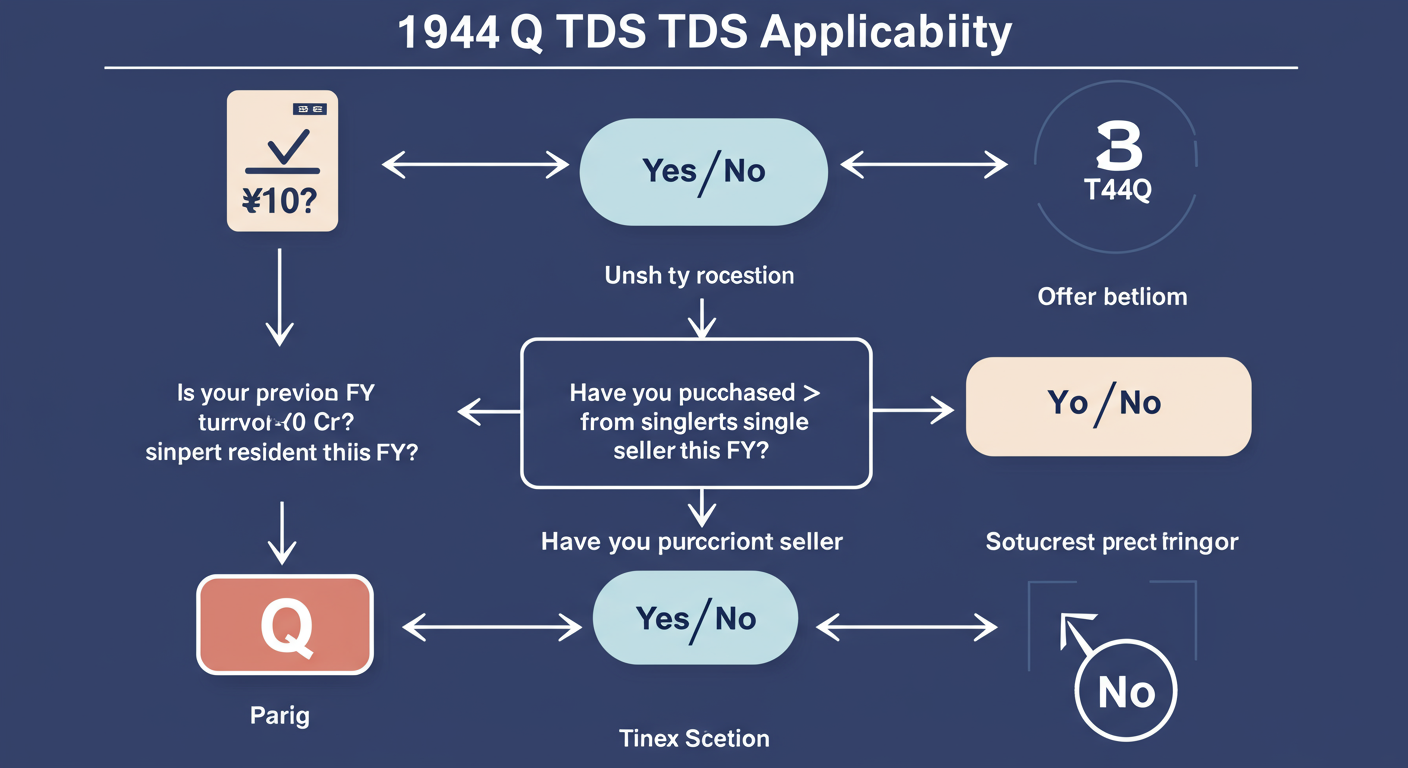
This is the most important question to answer. The rules for 194Q TDS are specific and triggered by two key conditions. You are only liable if you meet both.
- The Buyer Turnover Test: Your total sales, gross receipts, or turnover from your business must have exceeded ₹10 crore during the financial year immediately preceding the current one. For the current financial year (FY 2026-27), you need to look at your turnover from FY 2025-26.
- The Purchase Threshold Test: You are purchasing goods from a single resident seller, and the total value of these purchases exceeds (or is expected to exceed) ₹50 lakh within the current financial year.
Here’s a simple breakdown:
| Condition | Threshold | Relevant Financial Year |
|---|---|---|
| Your Business Turnover | Exceeds ₹10 Crore | The year before the purchase (e.g., FY 2025-26 for purchases in FY 2026-27) |
| Purchase from a Single Seller | Exceeds ₹50 Lakh | The current financial year of the purchase (e.g., FY 2026-27) |
Let’s make this real. Imagine your company’s turnover in FY 2025-26 was ₹15 crore. You pass the first test. Now, in August 2026, you buy goods worth ₹70 lakh from ‘Supplier ABC’. You’ve crossed the second threshold. Your duty is to deduct TDS not on the full ₹70 lakh, but on the amount over the limit: ₹70 lakh – ₹50 lakh = ₹20 lakh.
⚠️ Watch Out
The ₹50 lakh threshold is per seller, per financial year. You must track your cumulative purchases from each supplier. A series of small ₹5 lakh invoices from the same seller can quickly add up and trigger your TDS liability mid-year.
The Big Showdown: 194Q (TDS) vs. 206C(1H) (TCS)
This is where most of the confusion happens. There’s another section, 206C(1H), that requires sellers with a turnover above ₹10 crore to collect tax at source (TCS) on sales over ₹50 lakh. It sounds identical, right? So who does what?
The law provides a clear hierarchy, a golden rule that you must remember:
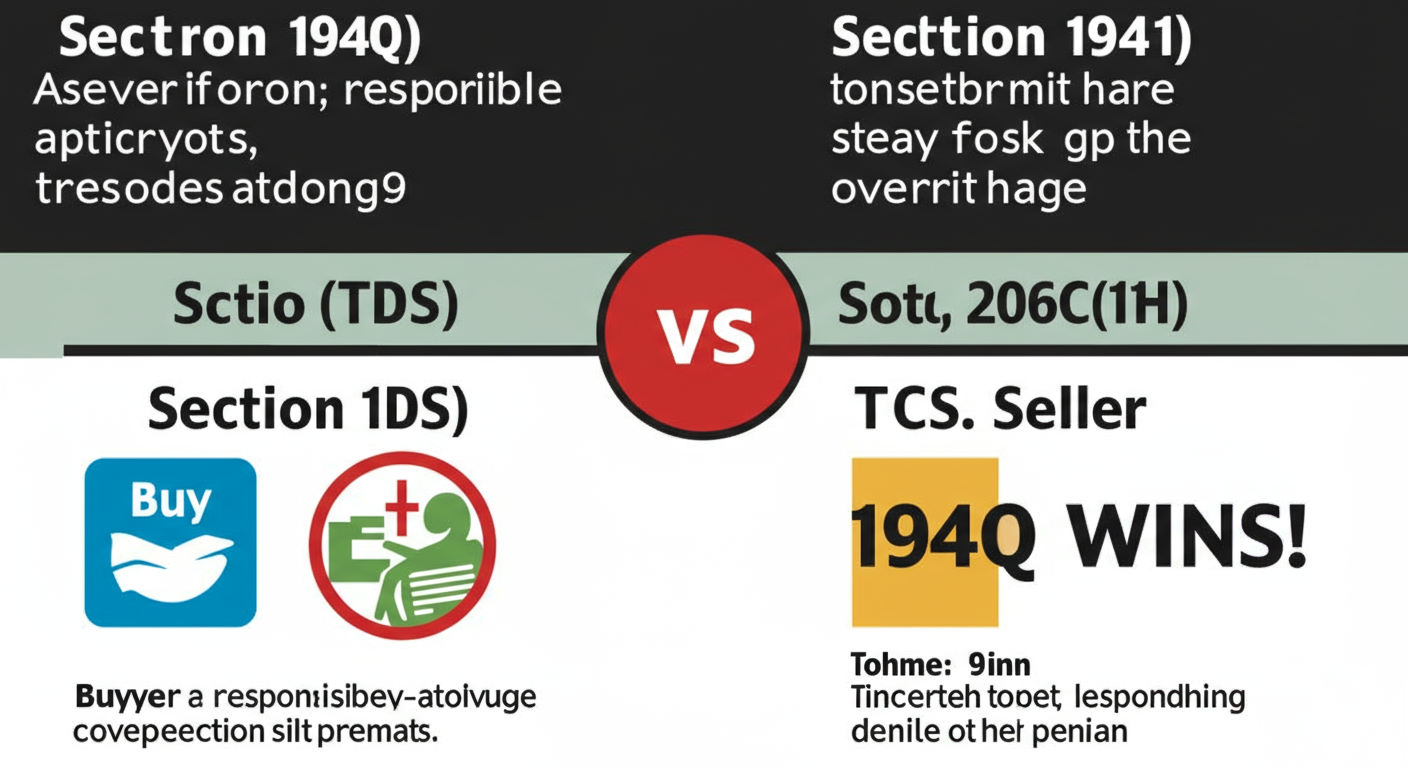
Section 194Q always overrides Section 206C(1H).
If a transaction is covered by both sections (i.e., both buyer and seller have turnovers > ₹10 crore), the responsibility falls squarely on the buyer to deduct TDS under 194Q. The seller, in this case, is explicitly exempt from collecting TCS on that same transaction.
Here’s a head-to-head comparison:
| Aspect | Section 194Q (TDS on Purchase) | Section 206C(1H) (TCS on Sale) |
|---|---|---|
| Who is Responsible? | The Buyer | The Seller |
| What is the Action? | Deduct tax from payment | Collect tax with payment |
| Primary Trigger | Buyer’s turnover > ₹10 Cr | Seller’s turnover > ₹10 Cr |
| Transaction Trigger | Purchase from a seller > ₹50 Lakh | Sale to a buyer > ₹50 Lakh |
| Rate (with PAN) | 0.1% | 0.1% |
| The Overlap Rule | Dominates. If 194Q applies, 206C(1H) does not. | Subordinate. Only applies if the buyer is NOT liable under 194Q. |
In our experience, the best way to handle this is with proactive communication. If you’re liable under 194Q, inform your major suppliers at the beginning of the financial year. This prevents them from incorrectly charging you TCS and saves you both a massive reconciliation headache.
💡 Pro Tip
Draft a standard declaration letter at the start of each financial year. Send it to all suppliers from whom you anticipate purchases exceeding ₹25-30 lakh. This letter should state that your turnover exceeds ₹10 crore and you will be deducting TDS under 194Q once the ₹50 lakh threshold is met, instructing them not to collect TCS.
Mastering Compliance: A Step-by-Step Guide to 194Q TDS
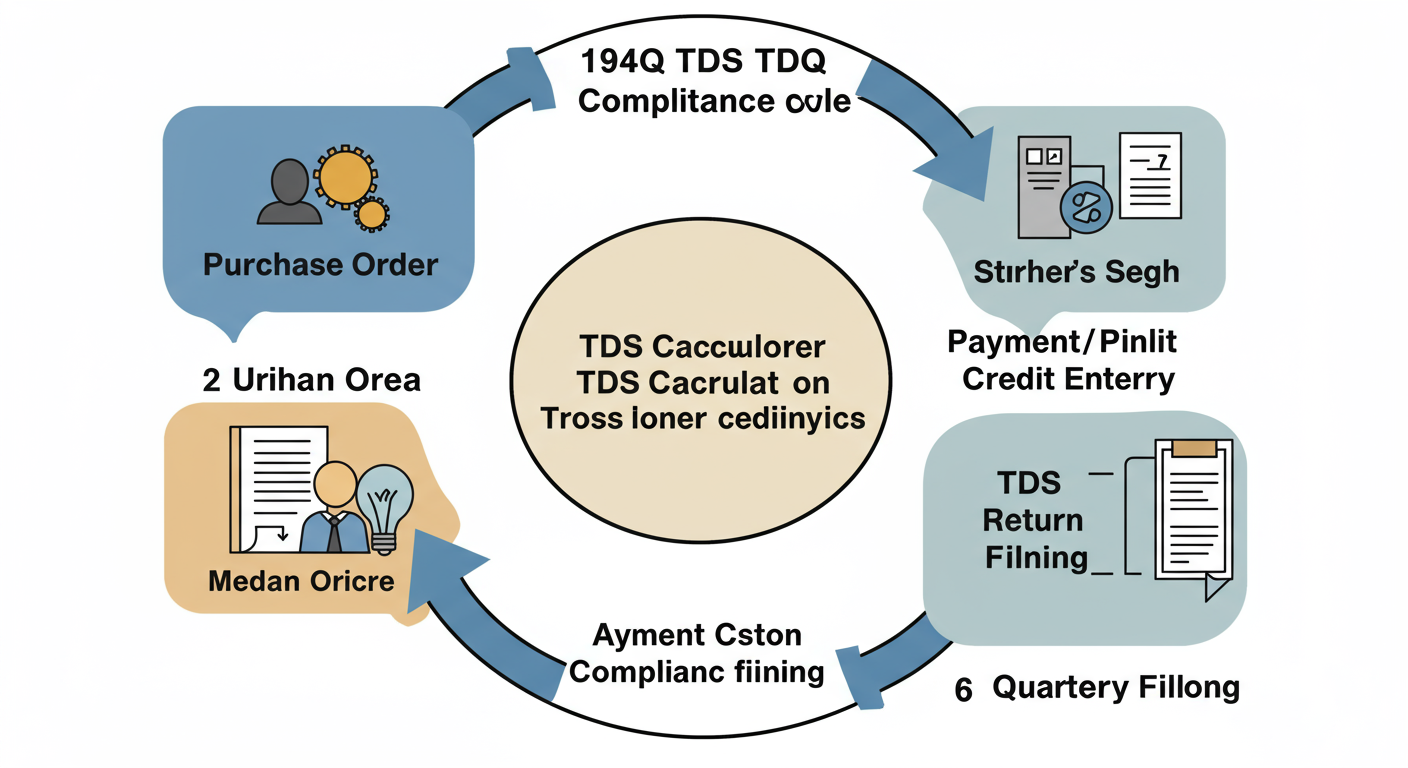
Once you’ve confirmed your liability, compliance is a procedural game. Follow these steps, and you’ll stay on the right side of the law.
- Verify Seller’s PAN: This is non-negotiable. Before anything else, get your seller’s Permanent Account Number (PAN). If they don’t provide it or it’s invalid, the TDS rate jumps from a manageable 0.1% to a punitive 5%.
- Track Purchase Thresholds: Your accounting system must track cumulative purchases from every single resident supplier for the financial year. This is the only way to know when you’re about to cross the ₹50 lakh limit.
- Calculate the TDS Amount: The TDS is 0.1% of the purchase value exceeding ₹50 lakh. On a total purchase of ₹75 lakh, you deduct TDS on ₹25 lakh (₹75L – ₹50L). The TDS amount would be ₹2,500 (0.1% of ₹25,00,000).
- Deduct at the Right Time: The law is clear: deduct TDS at the time of crediting the seller’s account in your books or at the time of payment, whichever is earlier. This means even if you haven’t paid the invoice, the moment you book it as a liability, the TDS obligation is triggered.
- Deposit the Tax: The TDS amount you’ve deducted must be deposited with the government using Challan ITNS-281 by the 7th of the following month.
- File Quarterly Returns: You must report all 194Q deductions in your quarterly TDS return, Form 26Q. This provides the government with the transaction details and allows the seller to claim credit for the tax you’ve paid on their behalf.
The High Cost of Getting It Wrong: Penalties & Disallowances
Here’s where the rubber meets the road. Non-compliance isn’t just a slap on the wrist; it’s a direct hit to your bottom line. The concept of TDS is central to India’s tax framework, and the penalties for failing to comply are severe.
Interest Charges
This is the first layer of pain. The government charges interest for delays:
- Late Deduction: 1% interest per month from the date it was deductible until the date it’s actually deducted.
- Late Deposit: 1.5% interest per month from the date of deduction until the date it’s paid to the government.
The Real Monster: 30% Disallowance of Expenditure
This is the penalty that can cripple a business. According to Section 40(a)(ia) of the Income Tax Act, if you fail to deduct TDS under 194Q, 30% of the purchase value on which TDS was applicable will be disallowed as a business expense.
Let’s run the numbers. You make a purchase of ₹1 crore from a supplier. TDS is applicable on ₹50 lakh (the amount over the threshold). You forget to deduct the TDS of ₹5,000 (0.1% of ₹50 lakh).
The consequence? The tax department can disallow 30% of that ₹50 lakh. That’s ₹15 lakh added back to your taxable profit. Assuming a corporate tax rate of 25%, that’s an extra ₹3,75,000 in tax liability. All because you missed a ₹5,000 deduction.
⚠️ Watch Out
The 30% disallowance is the real killer. I’ve seen this firsthand turn profitable quarters into losses for otherwise compliant businesses. It’s not a penalty on the tax amount; it’s a penalty on your purchase cost, directly inflating your taxable income.
Smart Exclusions: When Does 194Q Not Apply?
Demonstrating expertise means knowing the exceptions to the rule. Based on official CBDT clarifications, like Circular No. 13 of 2021, 194Q is not applicable in several specific scenarios:
- Transactions where TDS is deductible under another section (e.g., Section 194C for work contracts).
- Purchases of services (194Q is exclusively for goods).
- Transactions in securities and commodities traded on recognized stock exchanges.
- Transactions involving electricity, renewable energy certificates, and energy-saving certificates.
- Purchases from a non-resident seller.
- Import transactions.
Trust me on this one, knowing these exclusions can save you from over-compliance and unnecessary process burdens.
💡 Pro Tip
Automate, automate, automate. Configure your accounting software (like Tally, Zoho Books, or SAP) to flag suppliers as they approach the ₹50 lakh threshold. You can set up custom alerts and even create separate TDS ledgers for 194Q to make tracking and filing Form 26Q almost effortless.
❓ Frequently Asked Questions
Is GST included when calculating the ₹50 lakh threshold?
No. The CBDT has clarified that for checking the ₹50 lakh purchase threshold, you should exclude the GST amount. However, once the threshold is crossed, you must deduct TDS on the total invoice value, which includes GST.
What if the seller’s PAN is invalid or not provided?
If the seller fails to provide a valid PAN, you are required by Section 206AA of the Income Tax Act to deduct TDS at a much higher rate of 5%. This is a significant penalty, making PAN verification a critical first step.
Does 194Q TDS apply to the purchase of capital goods like machinery?
Yes. The term ‘goods’ is not specifically defined for this section, so it takes its broad, general meaning. This includes raw materials, finished products for resale, and capital assets like machinery, furniture, and vehicles.
My turnover was below ₹10 crore last year but will cross it this year. Am I liable?
No, not for this year. Liability is determined by your turnover in the preceding financial year. If your turnover in FY 2025-26 was below ₹10 crore, you are not liable for 194Q TDS during FY 2026-27, even if your current turnover is soaring. Your liability would begin in the next financial year, FY 2027-28.
Do I need to deduct TDS on advance payments for goods?
Yes. The rule is “payment or credit, whichever is earlier.” An advance is a form of payment. If you’ve already crossed the ₹50 lakh threshold with a seller (or the advance itself causes you to cross it), you must deduct TDS at the time of making that advance payment.
Your Next Step: From Compliance Chaos to Control
Section 194Q isn’t a suggestion; it’s a fundamental compliance task for any large-scale business in India. Ignoring it is a financial risk you simply can’t afford to take.
Let’s boil it all down. Your action plan is simple:
- Check Your Status: First, confirm if your turnover last year crossed ₹10 crore. If not, you can relax for this year.
- Implement Tracking: If you are liable, set up a robust system to track cumulative purchases per supplier. Don’t get caught by surprise.
- Communicate & Automate: Inform your suppliers, verify their PANs, and use your accounting software to automate as much of the process as possible.
By embedding these checks into your procurement and accounting workflow, you transform 194Q TDS from a source of anxiety into a routine, manageable task. You’ll avoid devastating penalties, build stronger relationships with your suppliers, and run a smoother, more compliant business.