Picture this: you’ve just paid a marketing agency for a brilliant campaign. The invoice is cleared, and you’re celebrating the results. A year later, a notice from the Income Tax Department lands on your desk. The subject? Failure to deduct tax on that very payment. Suddenly, you owe interest, penalties, and 30% of that expense is disallowed, artificially inflating your taxable profit.
This isn’t a scare tactic. It’s a reality for thousands of businesses every year who misunderstand one of the most critical tax provisions in India: Section 194C of the Income Tax Act, 1961.
Forget the dense legal jargon. This article will break down everything you *actually* need to know. We’ll give you the confidence to handle payments to contractors, transporters, and advertisers without fear. You’ll learn who must deduct, when, how much, and exactly how to stay compliant in 2026. Let’s make sure you’re never on the receiving end of that notice.
So, What Exactly is Section 194C? (The 30-Second Explanation)
At its heart, Section 194C is a system for pre-collecting income tax. Think of it as the government’s way of getting a small advance on a contractor’s income, directly from the source of that income—you, the payer.
It mandates that if you pay a resident contractor for performing any specified ‘work’, you must deduct a small percentage as Tax Deducted at Source (TDS) before releasing the full payment. This isn’t an extra tax; it’s simply a mechanism. The contractor gets credit for this deducted amount when they file their own tax return.
The goal is simple: improve tax compliance and ensure a steady flow of revenue for the government. For you, understanding it is non-negotiable for sound financial health.
The First Question: Are YOU Liable to Deduct TDS?
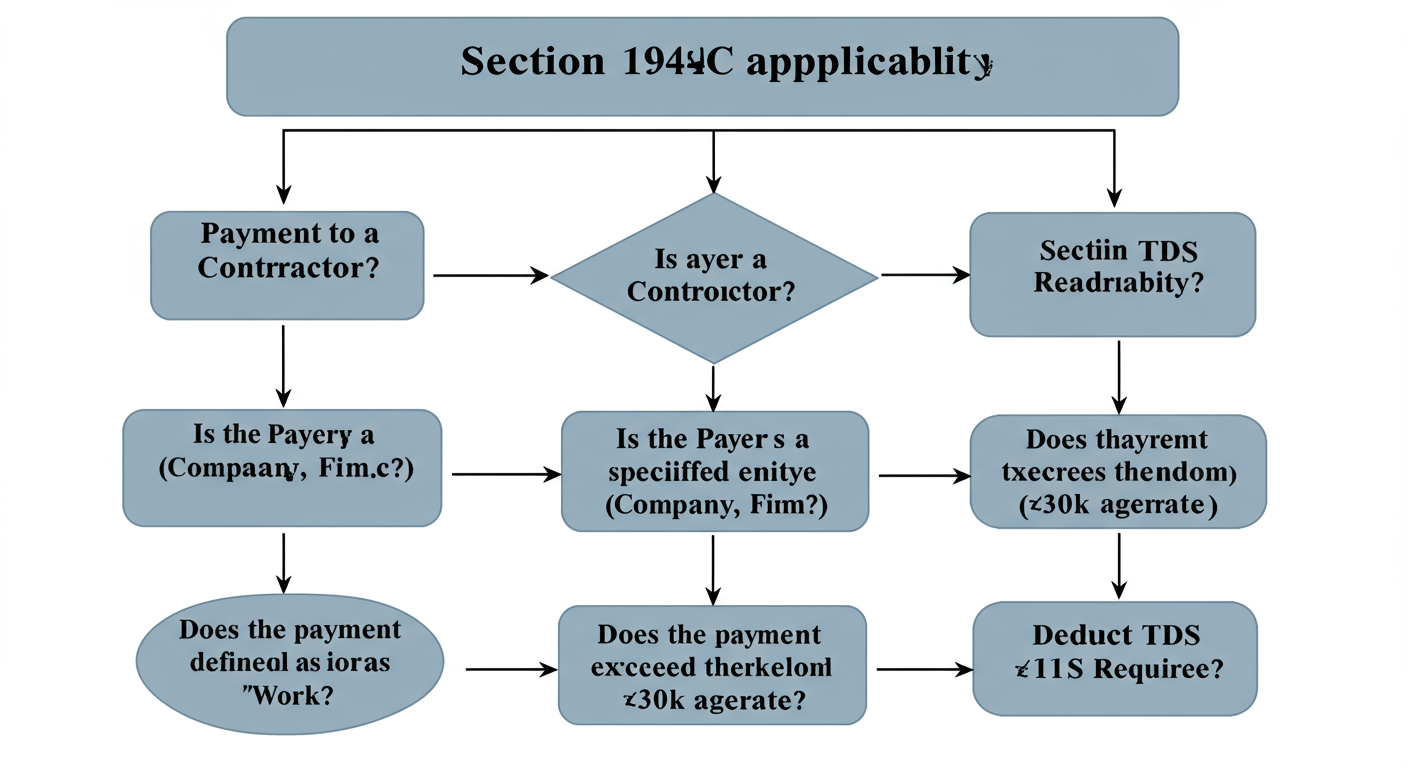
Before you worry about rates or definitions, you need to know if this rule even applies to you. Section 194C doesn’t apply to everyone. The law specifies a list of ‘payers’ who are required to deduct TDS. If you’re on this list, compliance is mandatory.
- The Government: Central or State Government bodies.
- All Companies: Public limited, private limited—it doesn’t matter.
- All Firms: This includes partnership firms and Limited Liability Partnerships (LLPs).
- Local Authorities: Think Municipal Corporations.
- Trusts & Societies: Any registered society or cooperative society.
- Individuals and Hindu Undivided Families (HUFs): Here’s the key distinction. An individual or HUF is only liable if their accounts needed to be audited in the *immediately preceding financial year*. This typically means your business turnover exceeded ₹1 crore or professional gross receipts were over ₹50 lakh.
Crucially, this section only applies to payments made to resident contractors. Payments to non-residents are a different ballgame, governed by Section 195.
⚠️ Watch Out
The “Individual/HUF” rule is a common trap. If your business grows and you cross the audit threshold in one year, you become responsible for deducting TDS on contractor payments in the very next year. Many newly successful entrepreneurs miss this switch.
Defining ‘Work’: The Most Misunderstood Part of 194C
This is where things get tricky. Section 194C doesn’t apply to *all* services. It applies to payments for ‘work’. But what does the Income Tax Act consider ‘work’? It’s not just construction. The definition is specific and broad:
- Advertising: Payments to ad agencies for creating or placing ads.
- Broadcasting and Telecasting: Includes the production of programs for TV or radio.
- Carriage of Goods or Passengers: Payments to transporters using any mode of transport *other than railways*.
- Catering: Providing food and beverages for events, canteens, etc.
- Manufacturing or Supplying a Product: This is a big one. It applies only when a product is made to a customer’s specific requirement using material supplied by that customer (or their associate). If the contractor uses their own material, it’s generally considered a ‘contract of sale’, and 194C does not apply.
Think of it this way: buying a ready-made table from a store is a ‘sale’. Hiring a carpenter to build a custom table using wood you provide is ‘work’. This distinction is vital.
The Numbers Game: TDS Rates & Thresholds for 2026
Okay, you’ve determined you’re a liable payer and the service qualifies as ‘work’. Now, let’s talk numbers. The government provides thresholds to avoid burdening small transactions.
TDS is NOT required if:
- A single payment to a contractor is ₹30,000 or less, AND
- The total aggregate payments to that same contractor in the financial year are ₹1,00,000 or less.
The moment you cross *either* of these limits, TDS becomes applicable on the entire amount.
| Payee (Contractor) Type | TDS Rate (If PAN is provided) | TDS Rate (If PAN is NOT provided) |
|---|---|---|
| Individual or Hindu Undivided Family (HUF) | 1% | 20% |
| Any other entity (Company, Firm, LLP, etc.) | 2% | 20% |
The 20% rate for no-PAN cases is not a suggestion; it’s a strict rule under Section 206AA. Always, always get the contractor’s PAN before releasing payment.
💡 Pro Tip
Should you deduct TDS on the GST component of an invoice? The answer is a clear NO. According to CBDT Circular No. 23/2017, if the GST is shown separately on the invoice, TDS is calculated only on the basic, taxable value of the service. This simple check can save you from over-deducting and creating accounting headaches.
The Compliance Gauntlet: A Step-by-Step Guide to 194C
Deducting the tax is just the first step. Proper compliance is a cycle. Miss any step, and you’re in trouble. Based on our experience helping hundreds of businesses, here’s the foolproof process. The Comprehensive Guide to Income Tax Return Filing: Step-by-Step E-Filing Process and Essential Checklist
- Step 1: Verify the Contractor. Before anything else, confirm the contractor’s status (Individual, Firm, etc.) and obtain their PAN. Verify the PAN on the official tax portal to ensure it’s valid.
- Step 2: Deduct at the Right Time. TDS must be deducted at the time of payment OR when you credit the expense to the contractor’s account in your books—whichever is earlier. This is a critical detail many miss.
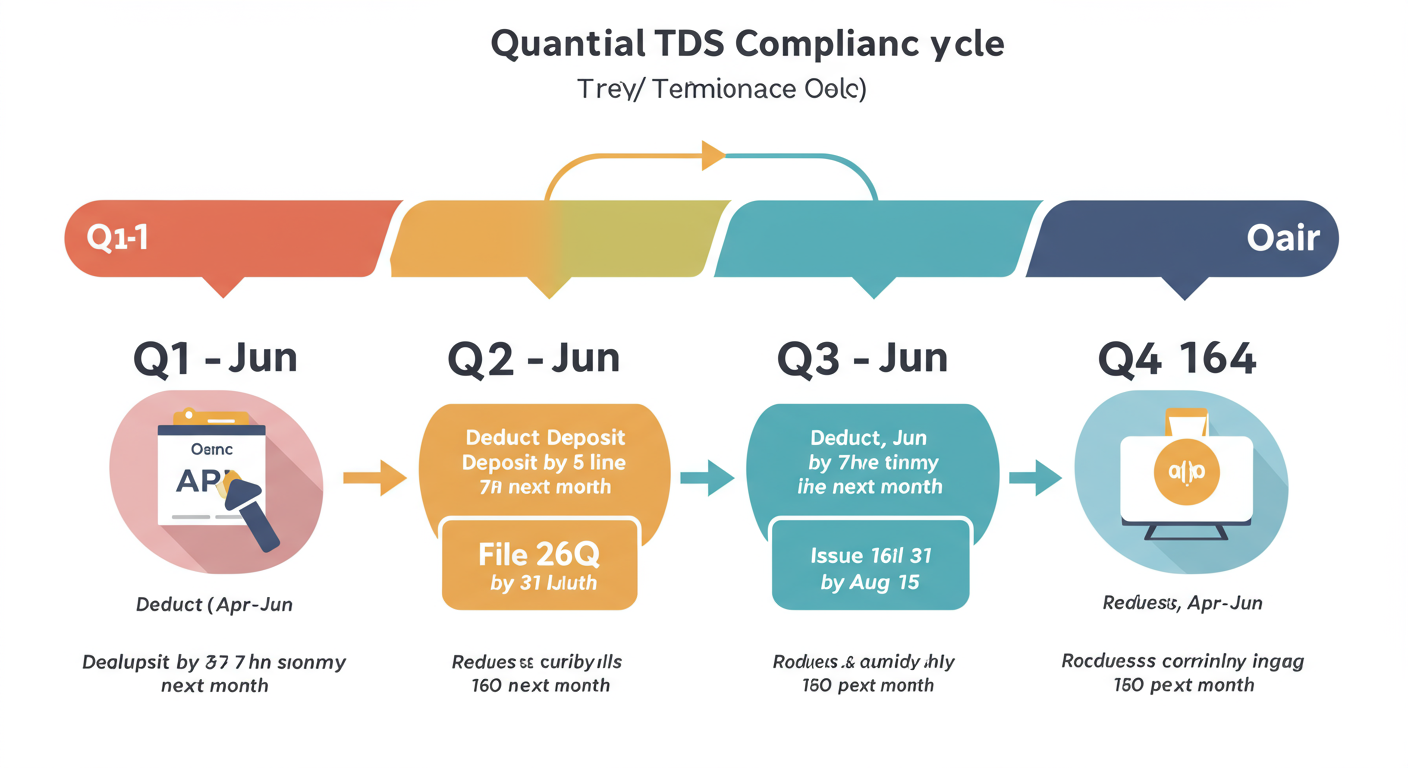
- Step 3: Deposit the TDS. You must deposit the deducted tax with the government using Challan ITNS 281. The due date is the 7th of the next month. (For tax deducted in March, the deadline is April 30th). You can do this online via the Protean (formerly NSDL) portal.
- Step 4: File Quarterly Returns. You must report all these deductions by filing a quarterly TDS return in Form 26Q.
- Step 5: Issue TDS Certificate. After filing the return, you must download Form 16A from the TRACES portal and provide it to your contractor. This is their proof that you’ve paid the tax on their behalf.
⚠️ Watch Out
The aggregate limit of ₹1,00,000 is the biggest trap. Let’s say you pay a caterer ₹25,000 in April, May, and June. No TDS is needed. But in July, you pay another ₹25,000. The total hits ₹1,00,000. You are now liable to deduct TDS on the *entire* ₹1,00,000, not just the amount over the limit. You must have a system to track cumulative payments per vendor.
Special Cases & Exemptions You Can’t Ignore
While the rules are strict, there are a few important exceptions where 194C doesn’t apply.
- Personal Payments: If an individual or HUF hires a contractor for a purely personal purpose (e.g., catering for a private wedding, not a business event), no TDS is required.
- Lower/Nil Deduction Certificate: A contractor can apply to the tax department (using Form 13) for a certificate allowing you to deduct tax at a lower rate, or not at all. If they provide this certificate, you must follow it.
💡 Pro Tip: The Transporter Exemption
Payments to a transport contractor are exempt from TDS if they own 10 or fewer goods carriages at any time during the year. However, this isn’t automatic. To claim this benefit, the transporter must provide you with a signed declaration stating this fact, along with their PAN. Without this specific declaration in your records, you are still liable to deduct TDS at 1% or 2%.
The Real Cost: What Happens If You Get It Wrong?
Non-compliance isn’t just a slap on the wrist. The consequences are severe and designed to hurt.
| Mistake | Consequence |
|---|---|
| Late Deduction of TDS | Interest at 1% per month from the date it was deductible to the date it was deducted. |
| Late Deposit of TDS | Interest at 1.5% per month from the date of deduction to the date of deposit. |
| Failure to Deduct/Deposit | Disallowance of 30% of the expenditure under Section 40(a)(ia). This means you can’t claim 30% of that payment as a business expense, which directly increases your taxable profit and tax liability. |
| Late Filing of Returns | Late filing fees under Section 234E (₹200 per day) and potential penalties. |
Trust me on this one, the 30% disallowance is the real killer. Paying a ₹1,00,000 invoice and then being told you can only claim ₹70,000 as an expense is a painful and entirely avoidable financial hit.
🎯 Key Takeaway
Section 194C is more than a tax rule; it’s a fundamental business process. Mastering the thresholds (₹30k single/₹1L aggregate) and the specific definition of ‘work’ are your two biggest shields against penalties. Automate tracking of vendor payments to avoid accidentally crossing the aggregate limit.
Your Next Step: From Knowledge to Action
You now have a clear, expert-level understanding of Section 194C. You know who it applies to, what ‘work’ means, the exact rates for 2026, and the step-by-step compliance process. More importantly, you understand the severe financial cost of getting it wrong.
Knowledge without action is useless. Here’s your next step: this week, pull up the payment records for your top 5 vendors from the last quarter. For each one, ask yourself:
- Is this ‘work’ under 194C?
- Have I crossed the single or aggregate payment threshold?
- Did I deduct, deposit, and report the TDS correctly?
Don’t wait for a notice to find a problem. By making this simple check a regular part of your financial review, you transform TDS compliance from a source of anxiety into a routine hallmark of a well-run, responsible business.
❓ Frequently Asked Questions
What’s the difference between Section 194C and Section 194J?
It’s all about the nature of the service. Section 194C is for ‘work’ like advertising, catering, and transport (TDS rates 1%/2%). Section 194J is for ‘professional and technical services’ like legal, engineering, or software development fees (TDS rate typically 10%). If you hire a coder to build an app, it’s 194J. If you hire a caterer for a company event, it’s 194C.
I made a payment for work but forgot to deduct TDS. What should I do now?
The best course of action is to deposit the TDS amount from your own pocket immediately, along with the applicable interest for the delay. You can try to recover this amount from the contractor later. This proactive step is far better than waiting for the tax department to discover the error, which would lead to the 30% expense disallowance.
Is TDS applicable on payments to a courier agency?
Yes. The ‘carriage of goods’ clause covers payments to courier agencies. Since it’s a mode of transport other than railways, payments to courier services are subject to TDS under Section 194C, provided the threshold limits are crossed.
What if a contract involves both ‘work’ and ‘sale’ (a composite contract)?
This is a complex area. The best practice, recommended by tax experts, is to have a clear bifurcation in the invoice. If the invoice distinctly separates the value of the materials (sale) from the value of the labor/service (work), you only need to deduct TDS on the ‘work’ component. If it’s a single, consolidated bill, TDS may become applicable on the entire amount. Clear contract drafting is key here.
Can a contractor claim a refund for the TDS I deducted?
Absolutely. The TDS you deposit (and for which you provide Form 16A) appears in the contractor’s Form 26AS. They get full credit for this amount against their total income tax liability for the year. If the TDS paid is more than their final tax bill, they will receive a refund from the Income Tax Department after filing their return.