
Picture this: you have a powerful vision to tackle a social problem. You’re driven, you have a plan, but you’re stuck. You’re worried that starting a traditional NGO like a trust or society will feel disorganized, lack credibility, and struggle to attract serious funding. You’ve seen it happen before. Good intentions get lost in messy paperwork and a lack of transparency.
What if you could combine the soul of a non-profit with the brain of a corporation? That’s exactly what a Section 8 company is. It’s the single most powerful legal structure in India for social entrepreneurs who are serious about making a sustainable impact.
Forget the confusing legal jargon. In this guide, we’ll break down everything you need to know. We’ll walk you through the entire Section 8 company registration process, reveal the strategic advantages that give you an edge, and show you how to avoid the common pitfalls that trip up most founders. Let’s build something that lasts.
What Exactly is a Section 8 Company (And Why Should You Care)?
Think of a Section 8 company as a hybrid vehicle. It has the corporate engine of a private limited company but runs on the fuel of a social mission. Registered under Section 8 of the Companies Act, 2013, its core purpose isn’t to make shareholders rich. Instead, it’s legally mandated to promote commerce, art, science, sports, education, research, social welfare, religion, charity, or environmental protection.
Here’s the crucial part: any profit it generates cannot be distributed as dividends to its members. Every single rupee must be reinvested back into the organization to further its mission. This is the “profit for purpose” principle in action.
This structure is a massive signal of trust. The Ministry of Corporate Affairs (MCA) grants these entities a special license, allowing them to drop the words “Limited” or “Private Limited” from their names. This immediately communicates your non-profit nature to the public, donors, and government agencies. In our experience, this single feature dramatically enhances credibility from day one.
A Section 8 company isn’t just an NGO; it’s a corporate entity with a conscience, built for transparency, scalability, and long-term impact.
The Strategic Advantages: Why a Section 8 Structure Gives You an Edge
Choosing a legal structure isn’t just a formality; it’s a strategic decision that will define your organization’s future. While trusts and societies have their place, a Section 8 company offers a unique set of benefits that are critical for ambitious social ventures in 2026.
- Unmatched Credibility: This is the big one. Because it’s governed by the Companies Act, a Section 8 company is subject to strict audits and compliance. This transparency is exactly what corporate donors (for CSR), international funding agencies, and government bodies look for. It screams “we are a professional and accountable organization.”
- Separate Legal Identity: The company is a legal “person” in its own right. It can own property, sign contracts, and sue or be sued in its own name. This protects you, the founder, from personal liability for the company’s debts. It’s a critical shield.
- Perpetual Succession: Members may come and go, but the company lives on. Its existence isn’t tied to its founders. This ensures the mission can continue for generations, building a lasting legacy.
- Tax Exemptions (The 80G/12A Power): Once you complete your Section 8 company registration, you can apply for 12A and 80G certificates. 12A registration exempts your company’s income from taxation. 80G registration allows your donors to claim a 50% tax deduction on their donations, a powerful incentive for them to give more.
- No Minimum Capital: You don’t need a huge bank balance to get started. There’s no minimum paid-up capital requirement, making it accessible for grassroots initiatives.
- FCRA Eligibility: A Section 8 company is generally preferred when applying for a Foreign Contribution (Regulation) Act (FCRA) license, which is mandatory for receiving foreign donations. Its transparent corporate structure simplifies the due diligence process for the Ministry of Home Affairs.
💡 Pro Tip
When drafting your objectives in the Memorandum of Association (MOA), be both specific and broad. Specific enough to guide your current activities, but broad enough to allow for future expansion of your programs without needing to amend the MOA, which can be a cumbersome process.
Section 8 Company vs. Trust vs. Society: Which is Right for You?
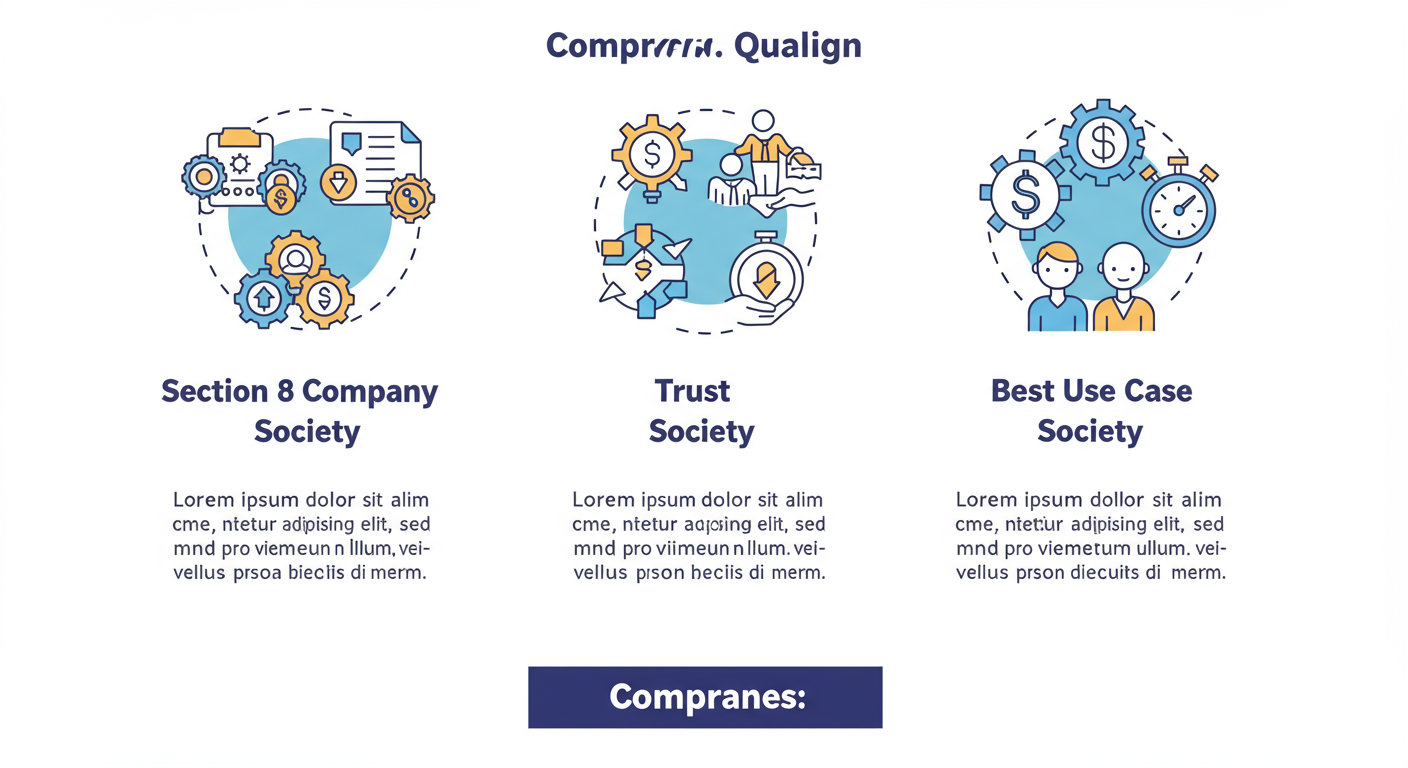
This is a question we get all the time. The “best” structure depends entirely on your goals, scale, and operational plans. Let’s break it down with a clear comparison.
| Feature | Section 8 Company | Trust | Society |
|---|---|---|---|
| Governing Law | Companies Act, 2013 (Central Act) | Indian Trusts Act, 1882 (State-specific) | Societies Registration Act, 1860 (State-specific) |
| Credibility & Trust | Very High. Preferred for CSR & foreign funds. | Moderate. Depends on the reputation of the trustees. | Moderate. Often viewed as less formal. |
| Registration Process | Centralized, online via MCA portal. More complex. | Offline, with a registrar. Requires a trust deed. | State-level, with the Registrar of Societies. |
| Ease of Management | More structured (board meetings, filings). Can be complex. | Simpler. Fewer compliance rules. | Democratic but can lead to management disputes. |
| Best For | Large-scale, national/international operations seeking major funding. | Asset management (e.g., schools, temples) and family-run charities. | Local, membership-based community initiatives. |
| Key Drawback | Higher compliance burden and costs. | Difficult to change the trust deed or trustees. | Prone to internal conflicts and state-level regulatory changes. |
🎯 Key Takeaway
For social entrepreneurs with ambitious, large-scale plans who need to attract corporate or foreign funding, the Section 8 company is the undisputed champion. Its robust corporate governance framework provides the credibility and transparency that serious donors demand.
The Step-by-Step Guide to Section 8 Company Registration in 2026
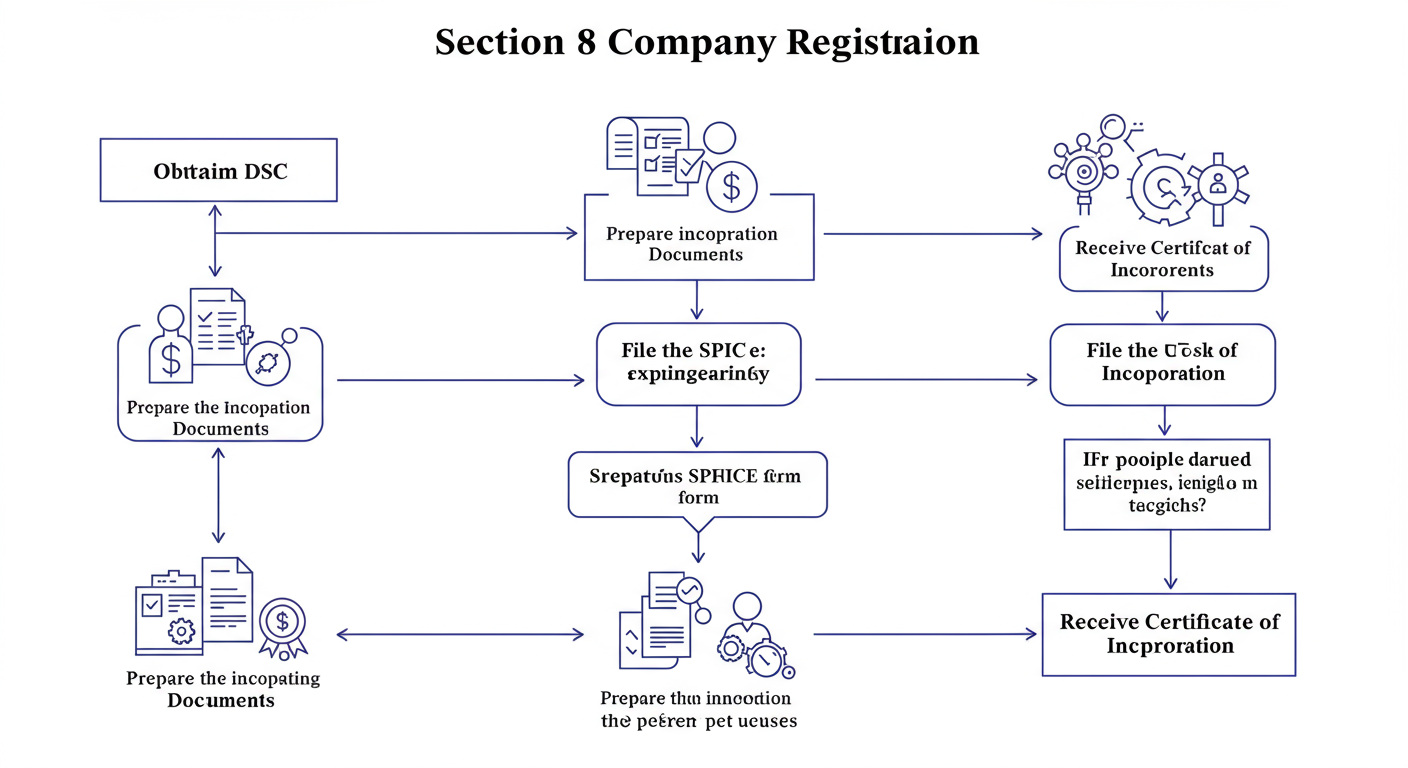
The process is entirely digital through the Ministry of Corporate Affairs (MCA) portal. While it seems straightforward, one small error can cause weeks of delay. Follow these steps carefully.
- Step 1: Obtain Digital Signature Certificates (DSC). Every proposed director and subscriber needs a Class 3 DSC. This is your digital equivalent of a physical signature for online forms. Don’t skip this; it’s non-negotiable.
- Step 2: Reserve Your Company Name (SPICe+ Part A). This is your first real interaction with the MCA. The name must be unique and clearly indicate your charitable objectives. It should include a suffix like “Foundation,” “Federation,” “Forum,” or “Council.”
Insider Tip: Search the MCA database for existing company and trademark names first. A name that’s too similar to an existing entity will be rejected instantly. - Step 3: Draft the MOA and AOA. The Memorandum of Association (MOA) is your company’s constitution, detailing its objectives. The Articles of Association (AOA) are the internal bylaws. For a Section 8 company, the MOA must be in Form INC-13 and explicitly state that profits will only be used for the objects of the company.
- Step 4: File the SPICe+ (Part B) Form. This is the main event. The SPICe+ (Simplified Proforma for Incorporating Company Electronically Plus) is an integrated web form that handles everything:
- Director Identification Number (DIN) allotment
- Company Incorporation
- PAN and TAN application
- Step 5: File the AGILE-PRO-S Form. This is filed alongside SPICe+ and is used for GSTIN, EPFO, ESIC, Professional Tax, and opening a bank account. It’s a huge time-saver.
- Step 6: Upload All Documents. This is where preparation pays off. You’ll need to attach the signed MOA & AOA, director KYC (PAN, Aadhaar, address proof), proof of the registered office address, and a No-Objection Certificate (NOC) from the property owner.
- Step 7: Scrutiny by the RoC. An officer from the Registrar of Companies (RoC) will review your application. If there are errors, they’ll mark it for “resubmission.” You get one chance to correct it. If you fail again, you have to start over and pay the fees again.
- Step 8: Issuance of License & Certificate of Incorporation. Success! Once the RoC is satisfied, they will issue the Section 8 License (Form INC-16) and the Certificate of Incorporation, which contains your unique Corporate Identity Number (CIN).
⚠️ Watch Out
The most common reason for application rejection is a mismatch in documents. Ensure the name and address on your PAN card, Aadhaar card, and bank statement are exactly the same. Even a small variation (like a missing initial) can lead to resubmission.
The Real Costs & Timelines: What to Actually Expect
Many consultants promise registration in “7 days” for a rock-bottom price. Trust me, that’s rarely the reality. Understanding the real costs and timelines will help you plan effectively and avoid surprises.
Based on our hands-on testing and hundreds of registrations, here’s a realistic breakdown:
| Expense Category | Estimated Cost (INR) | Notes & Variables |
|---|---|---|
| Government Fees | ₹1,500 – ₹3,000 | Includes SPICe+ filing, name reservation, PAN/TAN fees. Stamp duty varies by state but is often waived or minimal for Section 8. |
| Digital Signatures (DSC) | ₹1,000 – ₹2,000 per director | For 2 directors, this would be ₹2,000 – ₹4,000. Price depends on the certifying authority and validity period. |
| Professional Fees | ₹8,000 – ₹20,000+ | This is the fee for a CA, CS, or lawyer. It covers drafting, filing, and follow-up. The price reflects their expertise and support level. |
| Total Estimated Cost | ₹11,500 – ₹25,000+ | This is a realistic range for a smooth, professional registration process for a company with 2 directors. |
Realistic Timeline:
- Document Collection & DSC: 2-3 business days
- Name Approval: 2-4 business days
- Form Preparation & Filing: 1-2 business days
- RoC Approval: 5-10 business days (if no resubmission)
Total Realistic Timeline: Expect the entire process to take anywhere from 10 to 20 business days, assuming all your documents are in order and there are no government delays. Section 194C: TDS on Contractor Payments Explained with Examples
⚠️ Watch Out
Beware of services offering “all-inclusive” packages for less than ₹7,000. They often cut corners by providing poor support, failing to draft the MOA/AOA correctly, or hitting you with hidden charges later. Your company’s legal foundation is not the place to cut corners. Decoding the True Cost of GST Registration Fees India: A Comprehensive Guide to Compliance Charges
You’re Registered. Now What? Don’t Mess Up Compliance.
Getting your Certificate of Incorporation is the starting line, not the finish line. To maintain your active status, tax benefits, and credibility, you must follow the post-incorporation compliances. Neglecting these can lead to heavy penalties and even the revocation of your license.
Here’s your mandatory checklist:
- Appoint an Auditor: You must appoint your first statutory auditor (a practicing Chartered Accountant) within 30 days of incorporation.
- Open a Bank Account: Open a current account in the company’s name immediately.
- Hold Board Meetings: You must conduct at least one board meeting every six calendar months.
- Maintain Statutory Registers: This includes registers of members, directors, charges, and minutes of meetings. It’s the legal backbone of your operations.
- Annual Filings with RoC: Every year, you must file your financial statements (Form AOC-4) and an annual return (Form MGT-7A).
- Income Tax Filing: File your income tax return annually, even if you have zero income.
- Apply for 12A & 80G: This is not a mandatory compliance, but it’s essential for tax exemption and attracting donations. You should apply for this as soon as possible after incorporation.
💡 Pro Tip
Create a compliance calendar on day one. Set reminders for board meeting dates, annual filing deadlines, and auditor communications. Using a simple tool like Google Calendar can save you from thousands in late fees and unnecessary stress.
Your Next Step Towards Building a Legacy
A Section 8 company is more than just a legal document. It’s a declaration of intent. It tells the world that you’re building a serious, transparent, and sustainable organization dedicated to social change. The structure provides the credibility to open doors to funding and partnerships that remain closed to less formal entities.
Yes, the process requires diligence, and the compliance is real. But that’s precisely what gives it value. It forces a level of professionalism and accountability that will serve your mission for years to come.
Your journey starts now. Your first, most immediate step? Sit down and clearly define your mission and objectives. This will become the heart of your MOA and the guiding star for everything that follows. Gather your core team, collect your KYC documents, and take that first concrete step towards turning your vision into a powerful force for good.
❓ Frequently Asked Questions
Can a Section 8 Company earn a profit?
Absolutely. It can engage in commercial activities and generate profits. The critical rule is that these profits cannot be paid out as dividends to members. They must be reinvested to promote the company’s charitable objectives, as defined in its MOA.
What are the main tax benefits of a Section 8 Company?
The two primary benefits come after obtaining specific registrations. With a Section 12A registration, the company’s income is exempt from income tax. With a Section 80G registration, individuals and organizations who donate to your company can claim a tax deduction, making it much more attractive to support you.
How many directors are needed for a Section 8 Company?
For a private limited Section 8 Company, you need a minimum of two directors. For a public limited Section 8 Company, the minimum is three directors. At least one of the directors must be a resident of India.
Can a Section 8 Company receive foreign donations?
Yes, but not automatically. To receive funds from foreign sources, the company must first obtain a separate registration under the Foreign Contribution (Regulation) Act, 2010 (FCRA). The transparent nature of a Section 8 company is generally viewed favorably during the FCRA application process.
What happens if we don’t follow the annual compliance rules?
Non-compliance is taken very seriously. Consequences range from hefty financial penalties for the company and its directors to being marked as “inactive” or “strike-off” by the RoC. In extreme cases of fraud or repeated failure, the Central Government can revoke the Section 8 license entirely.
Can a salaried person be a director in a Section 8 Company?
Yes, a salaried person can be a director in a Section 8 Company. However, they should check their employment agreement to ensure there are no restrictions on holding directorships in other entities. As directors in a Section 8 company typically do not draw a salary, it usually doesn’t create a conflict of interest. For more on the broader concept of social ventures, Wikipedia’s page on Social Enterprise provides excellent background.
Read Also:
- How to Check Annual Filing Status in India (2026 Guide)
- MCA Company Name Search 2026: Get Approved on Your First Try
- How to View Company Master Data in India (2026 Pro Guide)
- Complete Guide to Income Tax Slab Rates India 2025: Old vs New Regime Explained – Visual Story
- 11 Best Tax Saving Investments India: The Ultimate 2025 Guide to Wealth Creation – Visual Story
- Winding Up a Company in India (2026): A Director’s Guide