Are you overpaying for compliance? Seriously. Thousands of Indian businesses are drowning in paperwork and procedural costs they could legally avoid. The reason? They don’t realize they qualify as a ‘small company’ under the latest 2026 government definition.
This isn’t just about semantics. It’s a financial and operational lifeline.
Qualifying as a small company unlocks a “lite” version of corporate law, slashing your compliance burden, reducing penalties, and freeing up your most valuable resources: time and money. The thresholds have changed significantly in recent years, and many entrepreneurs are still operating on outdated information.
In this deep dive, you’ll get the definitive, up-to-date 2026 criteria. We’ll show you exactly how to check your status, what game-changing benefits you can unlock, and the critical mistakes to avoid. Let’s see if you can start saving today.
What is a ‘Small Company’ in 2026? The Official Criteria
First, let’s clear up a common misconception. The term ‘small company’ has nothing to do with your employee count, office size, or brand recognition. It’s a specific legal classification defined in Section 2(85) of the Companies Act, 2013.
At its core, a small company is a private limited company that stays below two specific financial ceilings. It’s a designation created by the Ministry of Corporate Affairs (MCA) to foster an ‘ease of doing business’ environment for smaller enterprises that don’t have the resources of a massive corporation.
Think of it as a fast-track lane on the compliance highway. But to get in, you need the right ticket.
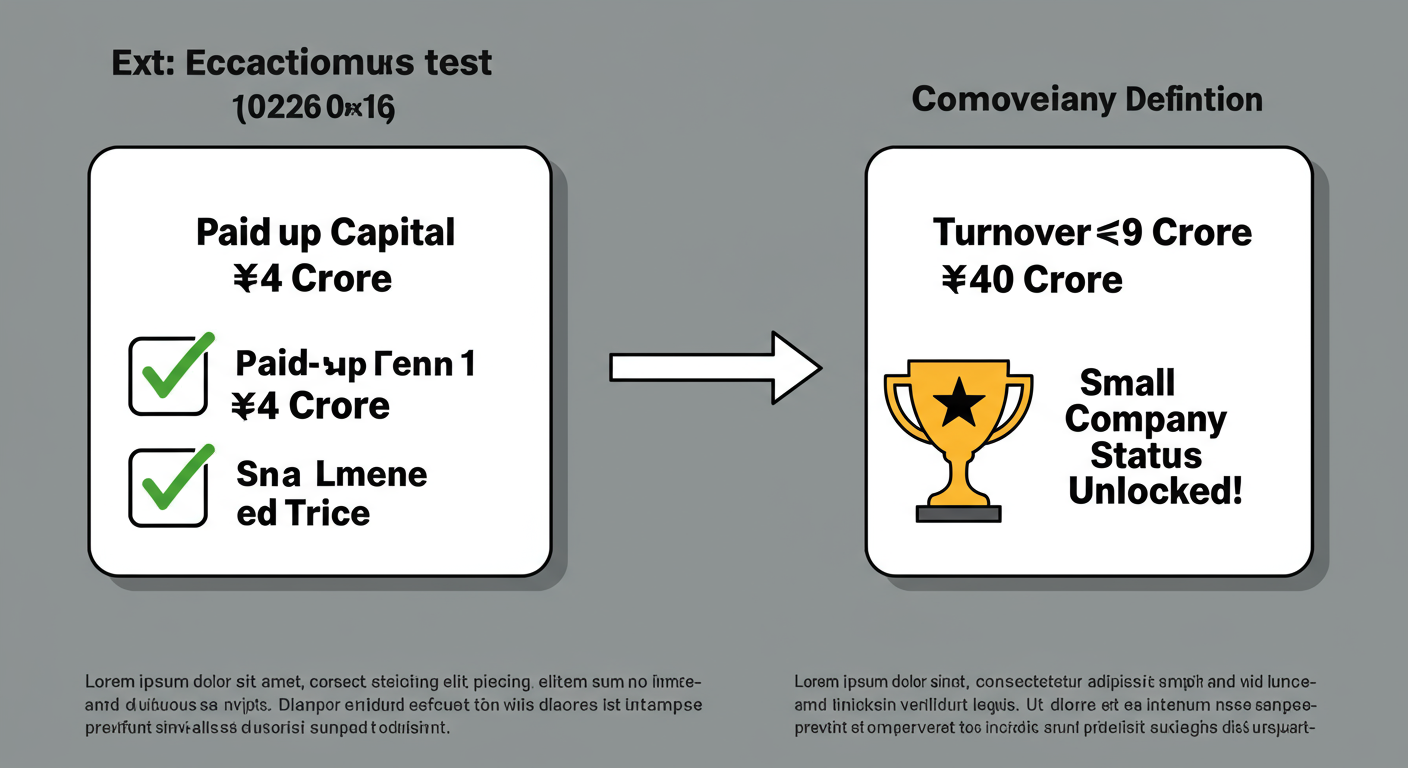
As of 2026, to qualify as a small company, a private company must satisfy BOTH of the following conditions based on its last audited financial statements:
- Paid-up Share Capital: Does not exceed ₹4 Crores.
- Turnover: Does not exceed ₹40 Crores.
The word ‘AND’ is the most important one here. You must be under both limits. If you meet the capital criteria but exceed the turnover limit (or vice-versa), you don’t qualify. It’s an all-or-nothing deal.
The Thresholds Have Changed—Dramatically
These limits haven’t always been so generous. The government has progressively increased the thresholds to bring more businesses into the fold. Understanding this evolution shows just how significant the current definition is.
Many businesses are still referencing the 2021 limits, leaving significant benefits on the table. Look at how much the goalposts have moved:
| Period | Paid-up Capital Limit | Turnover Limit |
|---|---|---|
| Before April 1, 2021 | ≤ ₹50 Lakhs | ≤ ₹2 Crores |
| From April 1, 2021 | ≤ ₹2 Crores | ≤ ₹20 Crores |
| Current (From Sep 15, 2022, onwards) | ≤ ₹4 Crores | ≤ ₹40 Crores |
As you can see, the current turnover limit is a staggering 20 times higher than it was just a few years ago. This was a deliberate policy decision to boost the MSME sector, and if you haven’t re-evaluated your status since these changes, you absolutely must.
💡 Pro Tip
Your company’s status is determined by the figures in your audited financial statements for the preceding financial year. For example, to determine your status for FY 2025-26, you would look at your audited financials from March 31, 2025. This isn’t a real-time calculation.
The 2026 Litmus Test: Real-World Scenarios
Let’s make this crystal clear. Based on our experience advising hundreds of companies, this is where confusion often arises. Here are some practical scenarios using the current ₹4 Crore / ₹40 Crore limits.
- Scenario A: Qualifies.
- Paid-up Capital: ₹3 Crore (✅ Below ₹4 Cr)
- Turnover: ₹35 Crore (✅ Below ₹40 Cr)
- Result: This company is a small company. It meets both conditions.
- Scenario B: Does NOT Qualify.
- Paid-up Capital: ₹1 Crore (✅ Below ₹4 Cr)
- Turnover: ₹42 Crore (❌ Exceeds ₹40 Cr)
- Result: This company is not a small company. It failed the turnover test.
- Scenario C: Does NOT Qualify.
- Paid-up Capital: ₹4.5 Crore (❌ Exceeds ₹4 Cr)
- Turnover: ₹25 Crore (✅ Below ₹40 Cr)
- Result: This company is not a small company. It failed the capital test.
⚠️ Watch Out
The “Turnover” figure refers to your ‘Revenue from Operations’ as per the Profit and Loss Account. Don’t confuse it with profit or other income. Similarly, “Paid-up Share Capital” is the specific figure from your Balance Sheet, not the authorized capital. Using the wrong numbers is a common and costly error.
The “Gotcha” Clause: Who Can NEVER Be a Small Company?
Now for the critical exceptions. Even if your company’s financials are well within the ₹4 Cr / ₹40 Cr limits, you are automatically disqualified from being a small company if you are:
- A Holding Company or a Subsidiary Company: This is the biggest trap. If your company holds another company, or if it is owned by another corporate body (Indian or foreign), it cannot be a small company. Period. We’ve seen startups with minimal revenue lose their small company status simply because they accepted an investment that made them a subsidiary of the investor’s holding company.
- A Section 8 Company: These are non-profit organizations registered for charitable purposes. They operate under a completely different set of rules and exemptions.
- A Company or Body Corporate governed by any Special Act: This includes entities like insurance companies (governed by the IRDA Act), banking companies (Banking Regulation Act), electricity generation companies, etc. These industries have their own specific regulatory frameworks.
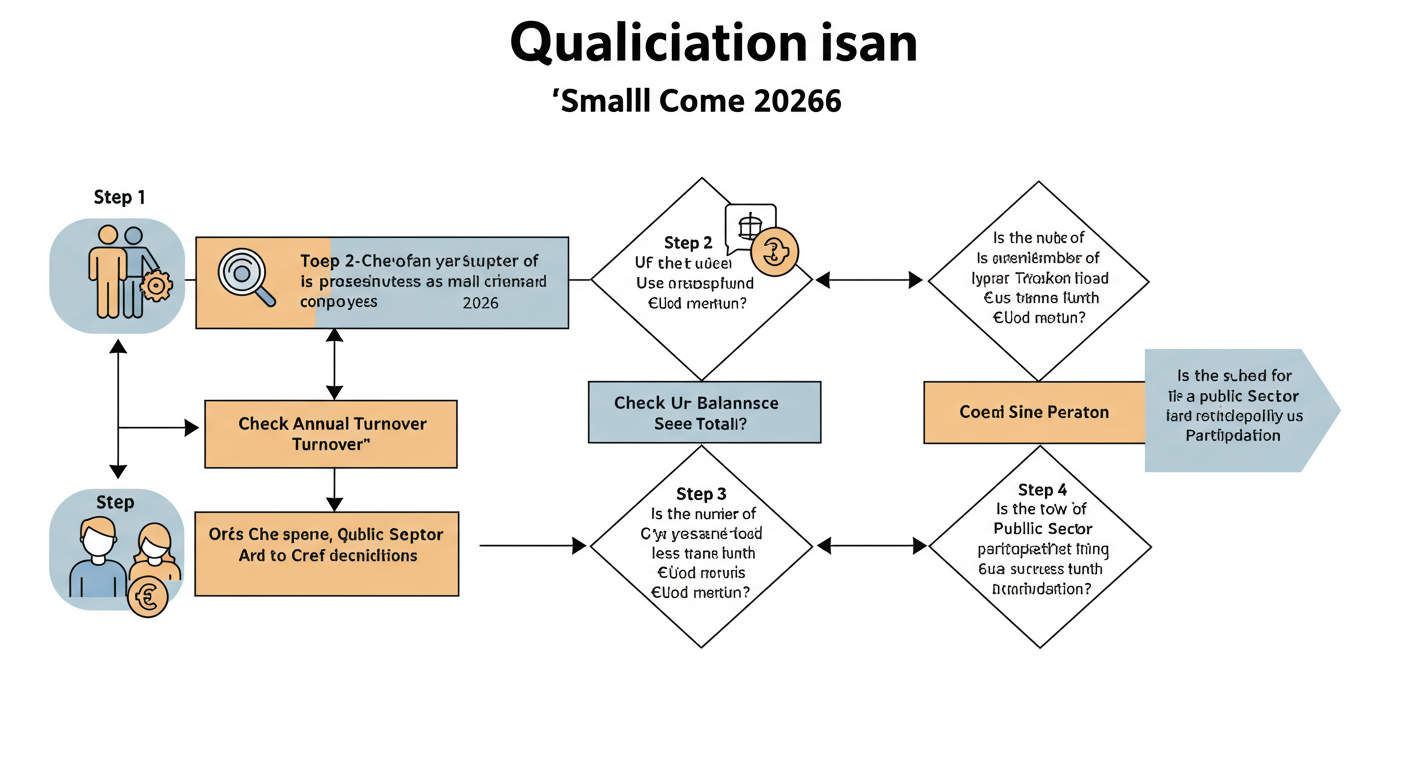
- Get Your Documents: Locate your company’s latest audited financial statements for the preceding financial year (i.e., the Balance Sheet and Profit & Loss Account as of March 31, 2025, to check for FY 2025-26).
- Check Paid-Up Capital: Look at the ‘Equity and Liabilities’ side of your Balance Sheet. Find the line item for “Paid-up Share Capital.” Is that figure less than or equal to ₹4 Crores?
- Check Turnover: Open your Profit and Loss Account. Find the line item for “Revenue from Operations.” Is that figure less than or equal to ₹40 Crores?
- Run the Exclusion Check: Confirm your company is not a holding company, a subsidiary of another company, a Section 8 company, or governed by a Special Act.
- 7 Essential Steps for NGO Registration Tax Exemption in India (2024 Guide) – Visual Story
- How to View Company Master Data in India (2026 Pro Guide)
- COVID Tax Rules: Your 2026 Audit Guide
- Unlock Your 2026 Property Tax Credit
- AOC 4 Due Date 2026: The Definitive Guide to Filing & Penalties
- MCA21 Company Master Data: Your 2026 Due Diligence Guide
- ROC Filing Guide 2026: Master Your Company’s Compliance
- Form DPT-3 Filing Guide 2026: Avoid Penalties & Master Compliance
end>
Trust me on this one: always check this exclusion list before you celebrate meeting the financial criteria. The subsidiary clause, in particular, trips up a surprising number of businesses.
🎯 Key Takeaway
For 2026, a ‘small company’ is a private entity with paid-up capital under ₹4 crore AND turnover under ₹40 crore. This status is a gateway to massive compliance relief but is instantly voided if the company is a holding, subsidiary, or special act entity. Advance Tax Payment India: 2024 Rules, Due Dates & Calculato
The Payoff: 5 Game-Changing Benefits of Being ‘Small’
So, you’ve checked the numbers, reviewed the exclusions, and confirmed you qualify. What’s the prize? The benefits are tangible and directly impact your bottom line and operational agility. LEI Registration Process: Quick Guide & Requirements
Here’s a direct comparison of the compliance burden: How to Start a Construction Company in India – Guide 2024-25
| Compliance Task | Small Company | Other Private Company |
|---|---|---|
| Board Meetings | Only 2 per year (one each half-year) | Minimum 4 per year (one each quarter) |
| Annual Return | Simple, abridged Form MGT-7A | Detailed, complex Form MGT-7 |
| Financial Statements | No Cash Flow Statement required | Cash Flow Statement is mandatory |
| Auditor Rotation | Not required | Mandatory rotation of auditors after a set term |
| Penalties for Non-Compliance | Lesser penalties for many offenses | Higher, standard penalties apply |
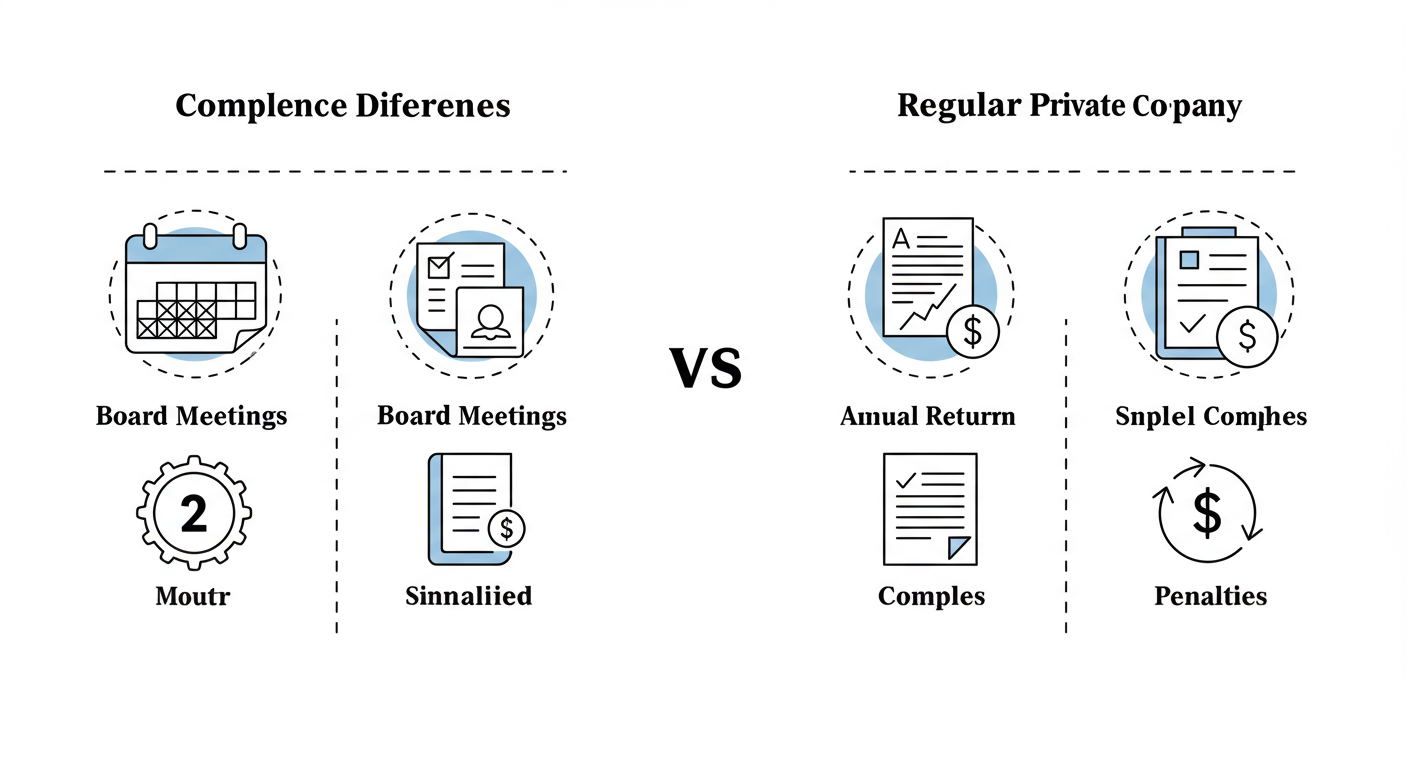
The implications are huge. Holding half the number of board meetings saves immense coordination time for directors. Filing a simpler annual return reduces professional fees and complexity. And not needing a cash flow statement simplifies your year-end accounting process significantly.
💡 Pro Tip
The abridged annual return, Form MGT-7A, can often be prepared and certified by a director alone, whereas the full Form MGT-7 for larger companies must be certified by a Company Secretary. This alone can represent a significant cost saving each year.
How to Check Your Status: A 4-Step Guide for 2026
Ready to find out where you stand? Don’t guess. Follow these simple steps.
If you answered “yes” to all relevant checks, congratulations! Your company qualifies as a small company for the current financial year.
⚠️ Watch Out
This status isn’t permanent. It’s assessed every single year. A high-growth year that pushes your turnover past ₹40 crores will mean you lose your small company status for the *following* year and must step up to the full compliance regime. Plan ahead for this transition!
❓ Frequently Asked Questions
What are the exact small company limits for 2026?
For 2026, the limits are a paid-up share capital not exceeding ₹4 crores AND a turnover not exceeding ₹40 crores, as per the latest amendments from the Ministry of Corporate Affairs (MCA).
Does the small company definition apply to LLPs or Proprietorships?
No. This definition is exclusive to private limited companies registered under the Companies Act, 2013. Limited Liability Partnerships (LLPs), Partnership Firms, and Sole Proprietorships are governed by different laws and do not fall under this classification.
What happens if my company crosses a threshold mid-year?
Your status for an entire financial year is determined based on the audited figures of the *preceding* financial year. For instance, even if your turnover crosses ₹40 crores in October 2025, you would retain your small company status for all of FY 2025-26 if your turnover was below the limit on March 31, 2025. You would lose the status starting from the next financial year, FY 2026-27.
Can a public company be a small company?
No, a public company can never be a small company, regardless of its size. The definition in Section 2(85) explicitly states that a small company must be a “private company.”
Is a subsidiary of a foreign company in India eligible?
No. The exclusion for subsidiary companies applies universally. If an Indian private limited company is a subsidiary of any other corporate body, whether Indian or foreign, it cannot be classified as a small company, even if it meets the financial criteria. According to industry research, this is a point of frequent confusion for foreign-funded entities.
Don’t Assume—Verify and Save
The government has thrown a lifeline to a huge segment of Indian businesses with the expanded small company definition. The current ₹4 Crore capital and ₹40 Crore turnover thresholds are a massive opportunity to streamline your operations and cut unnecessary costs.
But this opportunity is worthless if you don’t act on it. Too many entrepreneurs operate on autopilot, paying for compliance they no longer need because they’re working with outdated information.
So here’s your next step. Don’t just read this and forget it. Pull out your latest financials right now. Run the numbers through the 4-step check. Verify your status. You could be sitting on a goldmine of savings in time, money, and administrative headaches. Make sure you claim it.