
Let’s be honest. Your business idea is only half the battle. The other half? Choosing a legal structure that won’t cripple you before you even start. Get it wrong, and you could be facing personal liability, tax nightmares, and a closed door from every investor you meet. Get it right, and you build a fortress for your vision.
For thousands of ambitious founders across India, that fortress is the Pvt Ltd Company. But is it the right choice for you?
This isn’t another dry, legal-jargon-filled post. This is your 2026 founder’s playbook. We’ll cut through the noise and give you the unvarnished truth about what it takes to register and run a Private Limited Company in India. You’ll learn the incredible benefits, the hidden drawbacks, and the exact steps to get it done right the first time.
So, What Exactly is a Pvt Ltd Company? (The Simple Explanation)
Think of a Pvt Ltd Company as its own person. Seriously. In the eyes of the law, it’s a separate legal entity. It can own property, sign contracts, rack up debt, and even sue or be sued—all in its own name. This is a massive deal because it means the company’s problems aren’t your problems.
This structure is governed by India’s Companies Act, 2013, and it’s the gold standard for any business with serious growth ambitions. It requires a minimum of two members (shareholders) and two directors. Why is it so popular? Because it perfectly balances protection for the founders with the flexibility needed to scale.
It’s the difference between building a sandcastle and laying the foundation for a skyscraper.
Pvt Ltd vs. Other Structures: Making the Right Call in 2026
Before you jump on the Pvt Ltd bandwagon, you need to understand the landscape. Choosing the wrong entity is a classic, and costly, rookie mistake. Based on our experience advising hundreds of startups, the choice almost always boils down to these four options.
Here’s a no-fluff breakdown to help you decide.
| Feature | Pvt Ltd Company | LLP (Limited Liability Partnership) | OPC (One Person Company) | Sole Proprietorship |
|---|---|---|---|---|
| Liability | Limited to share capital. Personal assets are 100% protected. | Limited to partner’s contribution. Some protection. | Limited to share capital. Full protection for the single owner. | Unlimited. Your personal assets are at risk for business debts. |
| Investor Friendliness | Excellent. The only structure VCs and Angel Investors will fund. Easy to issue shares (ESOPs). | Poor. Cannot issue equity shares. Not suitable for external funding. | Poor. Cannot raise equity funding easily. Limited to one member. | None. No concept of shares or external equity investors. |
| Compliance Burden | High. Requires board meetings, annual filings (AOC-4, MGT-7), and an auditor. | Medium. Fewer compliance requirements than a Pvt Ltd company. | Medium. Slightly less compliance than a Pvt Ltd, but more than an LLP. | Very Low. No formal registration or compliance, just tax filings. |
| Best For | Startups seeking funding, scalable businesses, and founders wanting maximum credibility and protection. | Professional service firms (CAs, lawyers), family businesses with no funding plans. | Solo founders who want limited liability but aren’t ready for a full Pvt Ltd structure. | Freelancers, small local businesses, and individuals testing a business idea. |
🎯 Key Takeaway
A Pvt Ltd Company is the undisputed choice for startups planning to raise funds, scale aggressively, and attract top talent with ESOPs. While other structures offer simplicity, they create significant roadblocks to high growth.
The 7 Undeniable Benefits of a Pvt Ltd Company
Why do founders put up with the extra paperwork? Because the strategic advantages are immense. These aren’t just bullet points on a list; they are foundational pillars for building a valuable enterprise.
1. The “Iron Shield” of Limited Liability
This is the big one. Imagine your business takes a loan and can’t repay it. If you’re a sole proprietor, creditors can come after your house, your car, your personal savings. Everything. With a Pvt Ltd company, they can only touch the company’s assets. Your personal wealth is safe. This peace of mind allows you to take calculated business risks without betting the farm.
2. Unlocks the Door to Funding
Let’s be crystal clear: if you ever want to raise money from Venture Capitalists (VCs) or angel investors, you must be a Pvt Ltd company. It’s non-negotiable. Why? Because investors need equity—shares in your company. Only a Pvt Ltd structure allows for the clean, regulated issuance and transfer of shares that the entire investment world is built on.
💡 Pro Tip
Even if you’re bootstrapping now, incorporate as a Pvt Ltd if funding is on your 2-3 year roadmap. Converting an LLP or proprietorship later is a complex, time-consuming, and expensive process that can derail a live funding deal. Start right from day one.
3. Attracts Top Talent with ESOPs
In a competitive market, you can’t always compete on salary alone. The secret weapon for early-stage startups? Employee Stock Option Plans (ESOPs). A Pvt Ltd company can easily create an ESOP pool, giving key employees a small piece of the company. This transforms them from mere employees into partners in your vision, dramatically boosting loyalty and motivation.
4. Builds Instant Credibility and Trust
Which sounds more professional: “Dave’s Web Design” or “Innovate Web Solutions Pvt. Ltd.”? The “Pvt. Ltd.” suffix instantly signals that you’re a serious, registered entity. All your details are on the public Ministry of Corporate Affairs (MCA) portal, which adds a layer of transparency that vendors, partners, and high-value clients appreciate. It shows you’re here for the long haul.
5. Perpetual Succession: The Business Outlives You
A Pvt Ltd company has its own life, separate from its owners. If a shareholder passes away, goes bankrupt, or exits the business, the company continues to exist without any disruption. This continuity is vital for long-term contracts, employee confidence, and building a legacy brand that can last for generations.
6. Easy Ownership Transfer
Need to bring on a new co-founder? Want to sell a portion of your business? Planning your exit strategy? In a Pvt Ltd company, ownership is represented by shares. Transferring ownership is as simple as signing a share transfer form and paying stamp duty. It’s a clean, straightforward process compared to the nightmare of redrafting partnership deeds or selling off individual assets.
7. Access to Government Schemes & Tenders
The Indian government, through initiatives like Startup India, offers a range of benefits, tax exemptions, and grants. Guess what? Most of these are exclusively for registered entities like Pvt Ltd companies. Being incorporated opens up a world of opportunities that unregistered businesses simply can’t access.
⚠️ Watch Out
Don’t be fooled by the “no minimum capital” rule. While you can technically start with ₹1, it signals a lack of seriousness to investors and banks. We recommend a minimum authorized capital of ₹1,00,000. It doesn’t need to be deposited upfront, but it establishes a more credible financial base.
The Step-by-Step Pvt Ltd Company Registration Process for 2026
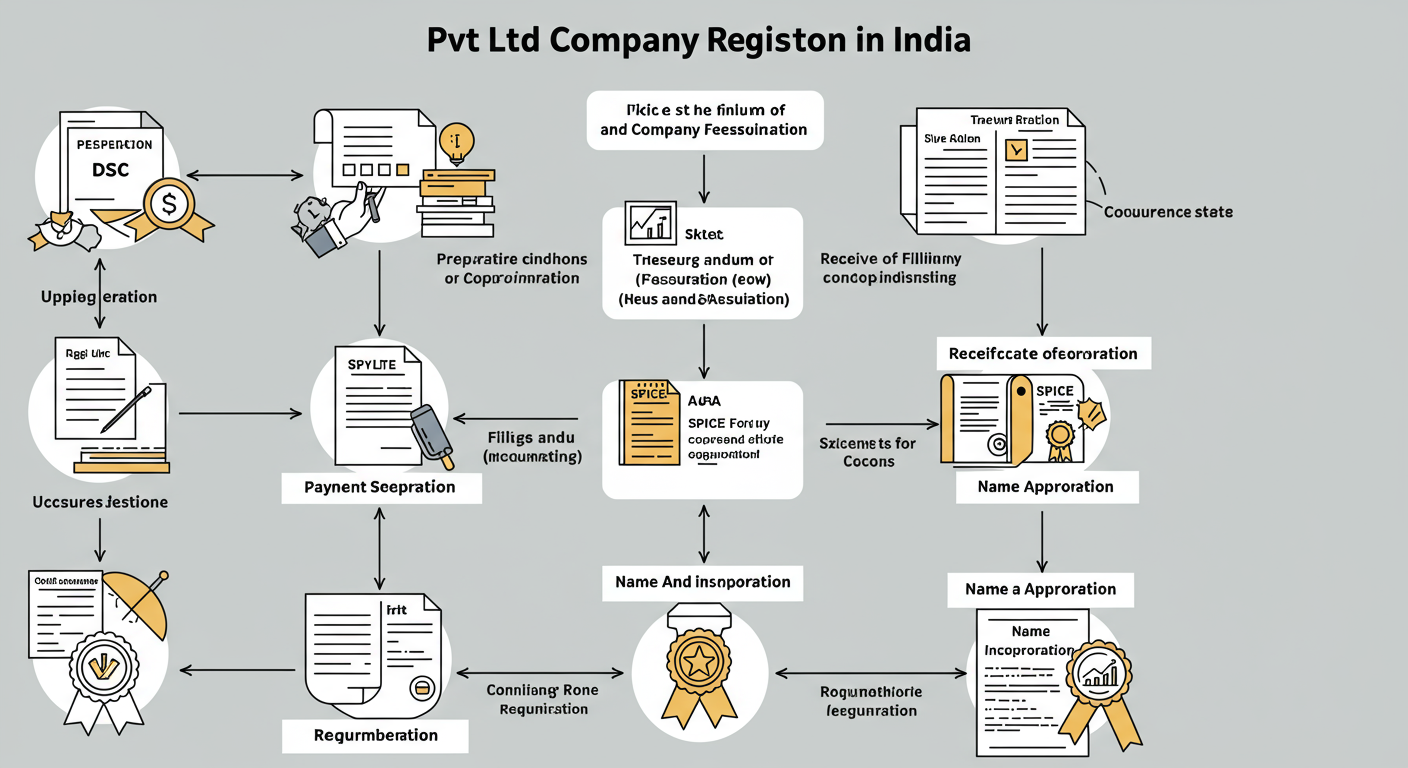
Thanks to the Ministry of Corporate Affairs (MCA), the registration process is now consolidated into a single online form called SPICe+ (“Simplified Proforma for Incorporating Company Electronically Plus”). While it’s “simplified,” every step needs to be perfect.
Here’s your roadmap:
- Step 1: Obtain Digital Signature Certificates (DSC). All proposed directors and subscribers need a Class 3 DSC. This is your electronic signature for all online filings. Think of it as your digital passport.
- Step 2: Reserve Your Unique Company Name. This is done via Part A of the SPICe+ form. You can submit two name options. The name must be unique and not infringe on any existing trademarks. A quick search on the trademark registry is a smart first move.
- Step 3: Prepare the Incorporation Documents. This is the most critical part. You’ll need to draft the Memorandum of Association (MoA), which defines your business objectives, and the Articles of Association (AoA), which are the internal rules of your company. These are now filed electronically (e-MoA and e-AoA).
- Step 4: Fill and File SPICe+ Part B. This is the main event. This integrated form handles everything:
- Director Identification Number (DIN) allotment
- Company incorporation
- PAN and TAN application
- GSTIN, EPFO, ESIC, and Professional Tax registration
You’ll need to attach the signed e-MoA, e-AoA, and declarations from directors.
- Step 5: Receive Your Certificate of Incorporation (COI). Once the Registrar of Companies (RoC) verifies and approves your application (usually within a few days), they will issue the COI. This is your company’s birth certificate. Your company’s PAN and TAN will be mentioned on it. Congratulations, you’re officially in business!
Life After Incorporation: Your Mandatory Compliance Checklist
Getting registered is just the starting line. The real work is staying compliant. Ignoring these responsibilities can lead to crippling penalties and even director disqualification. Trust me on this one, I’ve seen founders pay dearly for neglecting this.
💡 Pro Tip
From day one, use accounting software and hire a professional (a CS or CA firm) to manage your compliance. The cost is a tiny fraction of the penalties you’ll face for mistakes. Think of it as insurance for your company’s legal health.
Here’s a summary of your new annual duties:
| Compliance Task | Description | Typical Deadline |
|---|---|---|
| First Board Meeting | The first meeting of the Board of Directors must be held. | Within 30 days of incorporation. |
| Appoint First Auditor | You must appoint a statutory auditor for the company. | Within 30 days of incorporation. |
| Commencement of Business | File Form INC-20A after depositing share capital in the company bank account. | Within 180 days of incorporation. |
| Annual Financial Statements | File your audited balance sheet and P&L account with the RoC using Form AOC-4. | Within 30 days of the Annual General Meeting (AGM). |
| Annual Return | File a summary of the company’s details (directors, shareholders) with the RoC using Form MGT-7. | Within 60 days of the Annual General Meeting (AGM). |
| Income Tax Return | File the company’s annual income tax return. | Typically September 30th or October 31st. |
⚠️ Watch Out
The “Commencement of Business” (Form INC-20A) is a step many new founders miss. If you don’t file this declaration within 180 days, the RoC can strike your company’s name off the register, and you’ll face a hefty penalty. It’s a simple step with severe consequences if ignored.
❓ Frequently Asked Questions
How many directors are needed for a Pvt Ltd company?
You need a minimum of two directors to start a Pvt Ltd company. You can have a maximum of fifteen. At least one of these directors must be a resident of India, meaning they have stayed in India for at least 182 days during the previous financial year.
Can a foreign national be a director or shareholder?
Absolutely. India’s FDI policy allows foreign nationals to be directors and/or shareholders in an Indian Pvt Ltd company, subject to certain sector-specific regulations. However, the requirement of having at least one resident Indian director still applies.
Do I need a physical office to register a company?
No, you don’t need a dedicated commercial office. You must provide a registered office address in India, but this can be a residential address (your home, for example). You’ll just need to provide a No Objection Certificate (NOC) from the property owner and a utility bill as proof of address.
What’s the difference between Authorized Capital and Paid-up Capital?
Think of Authorized Capital as the maximum amount of capital the company is allowed to raise. It’s like the credit limit on a card. Paid-up Capital is the actual amount of money the shareholders have paid to purchase shares. You can start with a lower paid-up capital and increase it later, as long as it’s within your authorized limit.
How long does the registration process take in 2026?
If all your documents are in order and your proposed name is unique, the entire process can be completed surprisingly quickly. From applying for the DSC to receiving your Certificate of Incorporation, it typically takes about 7-10 working days. Any delays are usually due to name rejection or document errors.
The Final Verdict: Is a Pvt Ltd Company Your Next Move?
Look, choosing a business structure isn’t just a box to tick. It’s a strategic decision that defines your company’s future. For the solo freelancer or small local shop, a proprietorship might be enough. But for the entrepreneur with a vision—a vision to scale, to innovate, to attract investment, and to build an enduring brand—the Pvt Ltd Company isn’t just the best option. It’s the only option.
Yes, it demands more discipline and diligence in compliance. But the trade-off is a powerful legal shield, unmatched credibility, and a direct pathway to funding. It’s the framework that turns a great idea into a great company.
So, if you’re ready to move beyond the drawing board and build something substantial, the answer is clear. It’s time to incorporate.
Read Also:
- MSME GST Mastery: Your 2026 Cheatsheet
- MoA vs AoA (2026): 7 Key Differences You MUST Know
- Pvt Ltd Company Registration in India: The 2026 Founder’s Playbook
- 10 Essential Rules of GST for E-Commerce Sellers: The Ultimate Compliance Guide – Visual Story
- Hidden Contract Dangers to Spot in 2026
- Maharashtra PT 2026: Pay Online Easily