Picture this: two founders, Maya and Rohan, launch their businesses on the same day. Maya, starting a design consultancy, opts for a Limited Liability Partnership (LLP). Rohan, building a tech product, chooses a Private Limited Company (Pvt Ltd). A year later, Maya is thriving with low overheads and simple compliance. Rohan, however, just closed a $500,000 seed round—something Maya’s LLP structure would have made nearly impossible.
This isn’t just a story. It’s the critical crossroad every Indian entrepreneur faces. The LLP vs Pvt Ltd decision isn’t a mere legal formality; it’s the foundational choice that will dictate your company’s future in funding, flexibility, and scalability. Get it right, and you pave a smooth road to success. Get it wrong, and you could face costly restructuring or missed opportunities down the line.
Forget the dense legal jargon. This guide cuts through the noise. We’ll give you the unvarnished truth, based on our experience with hundreds of startups, to help you confidently choose the right launchpad for your specific business dream in 2026.
LLP vs. Pvt Ltd: The 30-Second Decision-Maker
Don’t have time for the full deep dive yet? Here’s the bottom line. This table gives you a high-level snapshot to quickly gauge which structure aligns with your immediate goals.
| Feature | ✅ Limited Liability Partnership (LLP) | 🚀 Private Limited Company (Pvt Ltd) |
|---|---|---|
| Best For | Professional services, bootstrapped businesses, family ventures. | Tech startups, businesses seeking VC/Angel funding, scalable enterprises. |
| Fundraising | Difficult. No concept of equity shares. Relies on partner capital or debt. | Ideal. Can issue equity shares, ESOPs, and convertible notes. |
| Annual Compliance | Low. Fewer filings, audit only after a high turnover/contribution threshold. | High. Mandatory audits, board meetings, multiple ROC filings. |
| Setup & Annual Cost | Lower | Higher |
| Credibility | Good, but seen as a partnership. | Excellent. The gold standard for investors and large clients. |
Now, let’s unpack what these differences *really* mean for your business.
The LLP Deep Dive: Partnership Meets Protection
A Limited Liability Partnership, governed by the LLP Act, 2008, is a brilliant hybrid. Think of it as a traditional partnership that went to the gym and got a suit of armor. You get the operational flexibility and collaborative spirit of a partnership, but with the crucial benefit of limited liability.
What does that mean in practice? If the business incurs debt or faces a lawsuit, your personal assets—your home, your car, your savings—are safe. The liability is limited to the capital you’ve contributed to the LLP. It’s a separate legal entity, just like a company.
Based on our hands-on work, LLPs are the go-to structure for professional firms (think architects, lawyers, consultants) and small-to-medium businesses that are self-funded and prioritize simplicity over complex corporate hierarchies. The entire relationship between partners is governed by a single, powerful document: the LLP Agreement. It’s your constitution, defining everything from profit sharing to decision-making powers.
💡 Pro Tip
Don’t use a generic template for your LLP Agreement. This is the most critical document for your business. Invest in professional legal help to draft a custom agreement that clearly outlines partner roles, exit clauses, and dispute resolution mechanisms. A well-drafted agreement can save you from massive headaches later.
The Pvt Ltd Deep Dive: Built for Scale and Investment
A Private Limited Company is the undisputed champion for startups with high-growth ambitions. Governed by the more rigid Companies Act, 2013, a Pvt Ltd is the most credible and scalable business structure in India.
Why? Because it introduces a clear separation between owners (shareholders) and management (the Board of Directors). This structure is instantly recognizable and trusted by investors, banks, and international clients. When a Venture Capitalist (VC) invests, they aren’t just giving you money; they’re buying a piece of your company. This is done by issuing equity shares, a mechanism that is native to the Pvt Ltd structure but completely absent in an LLP.
“In the world of venture capital, a Private Limited Company isn’t just a preference; it’s a prerequisite. The entire ecosystem of funding, from term sheets to ESOPs, is built around the concept of share capital.”
This structure is designed for one primary purpose: growth. It allows you to raise capital, attract top talent with Employee Stock Ownership Plans (ESOPs), and build a corporate governance framework that can support a large, complex organization.
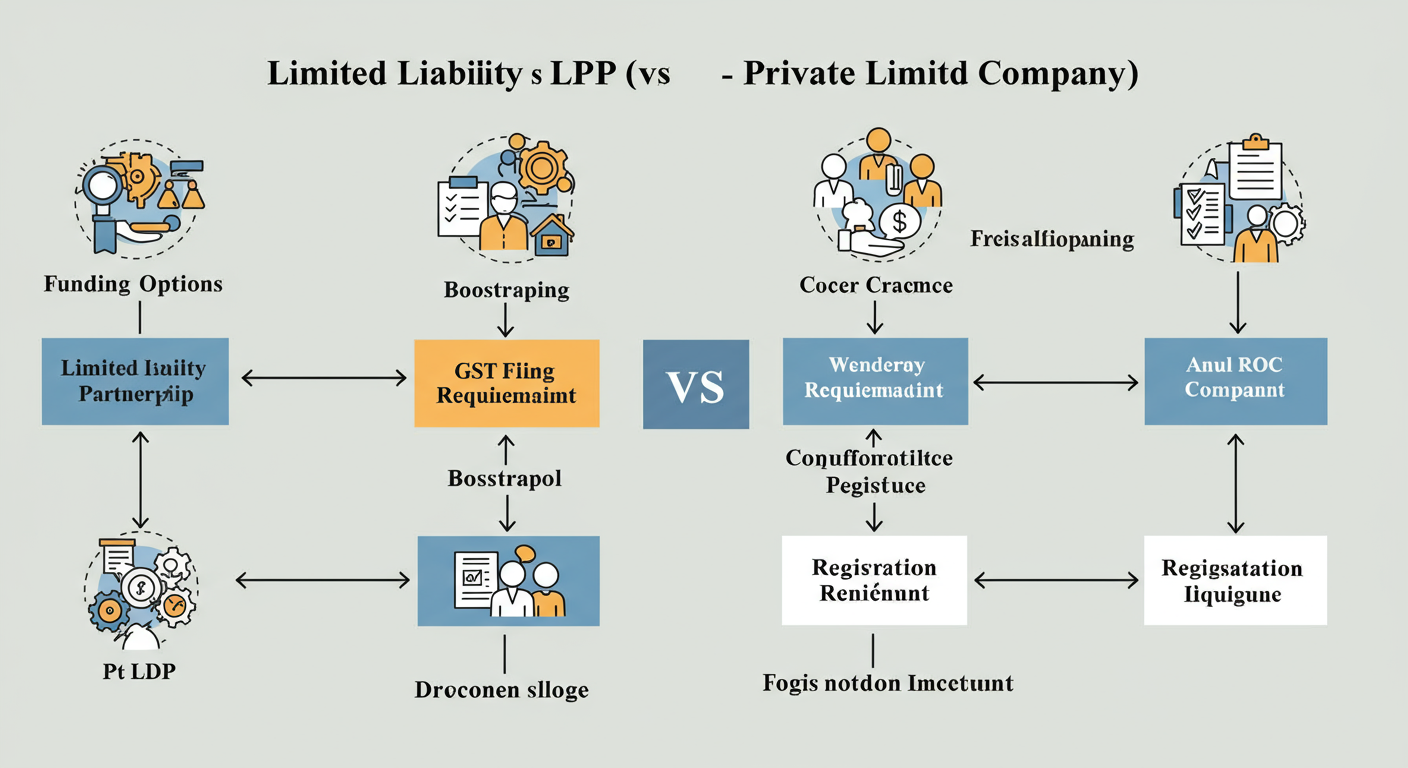
The Head-to-Head Battle: A Detailed Breakdown
Let’s move beyond the basics and get into the nitty-gritty. The real choice in the LLP vs Pvt Ltd debate lies in these critical operational differences.
Factor 1: Compliance & Costs
This is where the difference is most stark. An LLP is a dream for founders who hate paperwork.
- LLP: You’re mainly looking at two annual filings: Form 11 (Annual Return) and Form 8 (Statement of Account & Solvency). A statutory audit is only mandatory if your turnover crosses ₹40 lakhs or partner contribution exceeds ₹25 lakhs. This translates to significantly lower annual maintenance costs.
- Pvt Ltd: Brace yourself. The compliance is extensive. You have mandatory board meetings, an Annual General Meeting (AGM), appointment of a statutory auditor from day one, and a host of filings with the Registrar of Companies (ROC). From our experience, the annual compliance cost for a Pvt Ltd can be 3-5 times higher than for an LLP.
⚠️ Watch Out
The “hidden costs” of Pvt Ltd non-compliance are severe. Missing filing deadlines can lead to hefty daily penalties and can even result in the disqualification of directors. Don’t underestimate the administrative overhead; budget for a good company secretary or compliance service from the start.
Factor 2: Fundraising & Investor-Friendliness
This is the deal-breaker for most tech startups.
- LLP: You can’t issue shares. Period. Funding is limited to contributions from existing partners or taking on debt (loans). Angel investors and VCs are almost never interested in this structure because there’s no straightforward way for them to take an equity stake.
- Pvt Ltd: This is its superpower. You can issue various classes of shares (equity, preference), offer ESOPs to employees, and raise funds through convertible notes. The structure provides a clear “capitalization table” (cap table) that shows exactly who owns what percentage of the company—a document that is fundamental to any investment discussion.
Factor 3: Taxation Impact
The tax implications are different and can impact your take-home profits. An LLP is taxed at a flat 30% (plus cess/surcharge). The profits, once taxed at the LLP level, are tax-free in the hands of the partners.
A Pvt Ltd is subject to corporate tax rates (which can be lower for new manufacturing companies or those under certain turnover thresholds). However, when the company distributes these profits to shareholders as dividends, those dividends are then taxed again in the hands of the shareholders at their applicable slab rates. This can lead to a form of double taxation.
Let’s see a simplified example for a business with ₹10,00,000 in profit to be distributed. LEI Registration Process: Quick Guide & Requirements
| Particulars | LLP Scenario | Pvt Ltd Scenario |
|---|---|---|
| Profit Before Tax | ₹10,00,000 | ₹10,00,000 |
| Corporate/LLP Tax (approx. 31.2%) | (₹3,12,000) | (₹3,12,000) *Assuming 30% + cess |
| Profit After Tax | ₹6,88,000 | ₹6,88,000 |
| Tax on Distribution (in Partner/Shareholder hands) | ₹0 (Exempt) | Taxed at individual’s slab rate (e.g., 30% on ₹6,88,000 = ₹2,06,400) |
| Net In-Hand Amount | ₹6,88,000 | ₹4,81,600 |
Note: This is a simplified illustration. Actual tax calculations depend on many factors, including surcharge, cess, and individual tax slabs. Consult a tax advisor. Audit Last Date 2026: The Ultimate Compliance Calendar & Guide
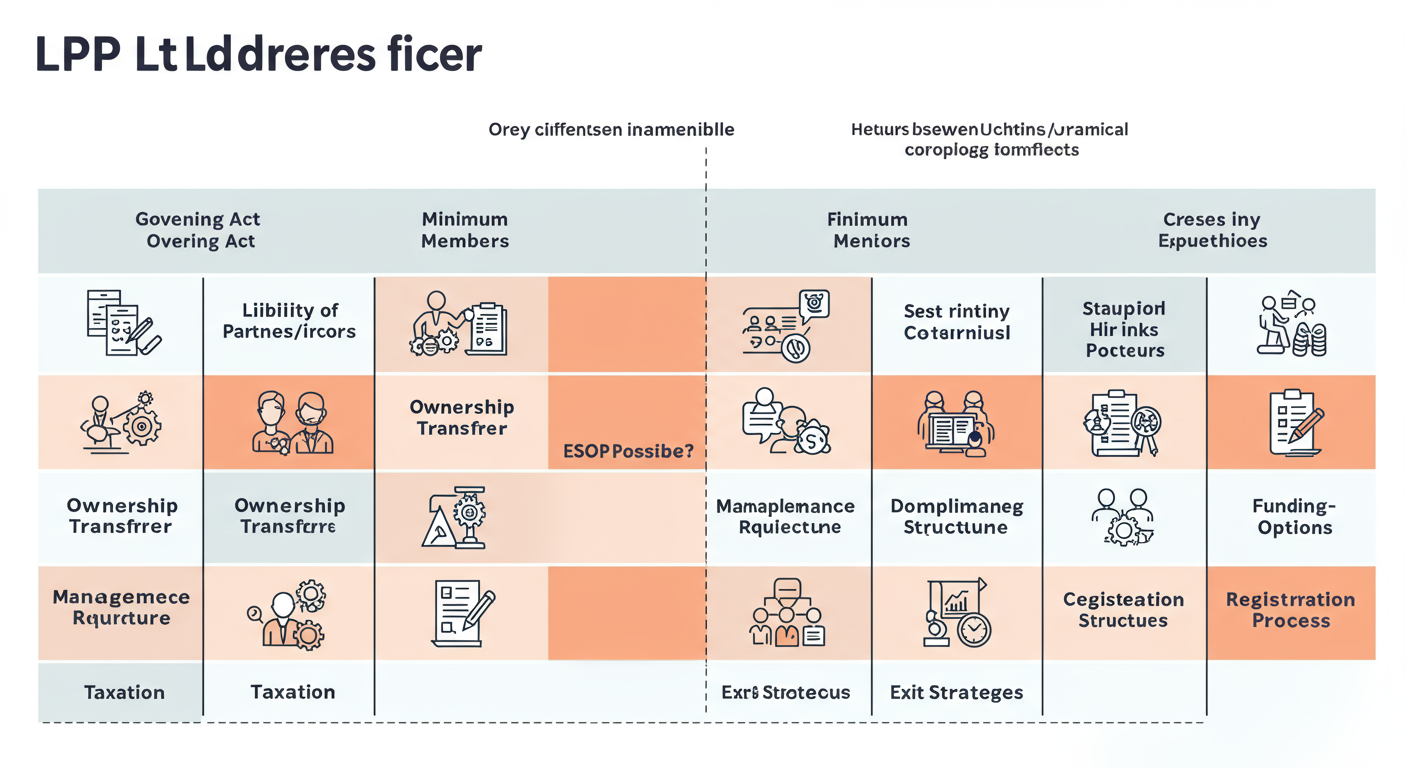
Factor 4: Ownership Transfer & Exit Strategy
How easy is it to sell your stake or bring in a new owner?
- LLP: It’s cumbersome. Transferring ownership requires amending the LLP Agreement and getting consent from the other partners. It’s a procedural hassle.
- Pvt Ltd: It’s incredibly simple. Ownership is represented by shares. To transfer ownership, you just transfer the shares by signing a share transfer form. This ease of transfer is another reason investors prefer it.
💡 Pro Tip
If you’re starting a Pvt Ltd with co-founders, insist on a ‘Shareholders’ Agreement’ from day one. This legal document, separate from the company’s Articles of Association, governs the relationship between shareholders, outlining rules for selling shares, what happens if a founder leaves (vesting), and how to resolve deadlocks. It’s a business-saver.
🎯 Key Takeaway
The LLP vs Pvt Ltd choice boils down to a single question: Are you building a lifestyle business or a high-growth venture? Choose an LLP for operational simplicity and low costs. Choose a Pvt Ltd if you ever plan to raise equity funding from external investors.
Can You Switch Tracks? The LLP to Pvt Ltd Conversion
What if you start as an LLP and later decide you need to raise VC funding? Good news: you can convert. The Companies Act, 2013, allows for the conversion of an LLP into a Private Limited Company. After testing this process, we can confirm it’s feasible but requires meticulous planning.
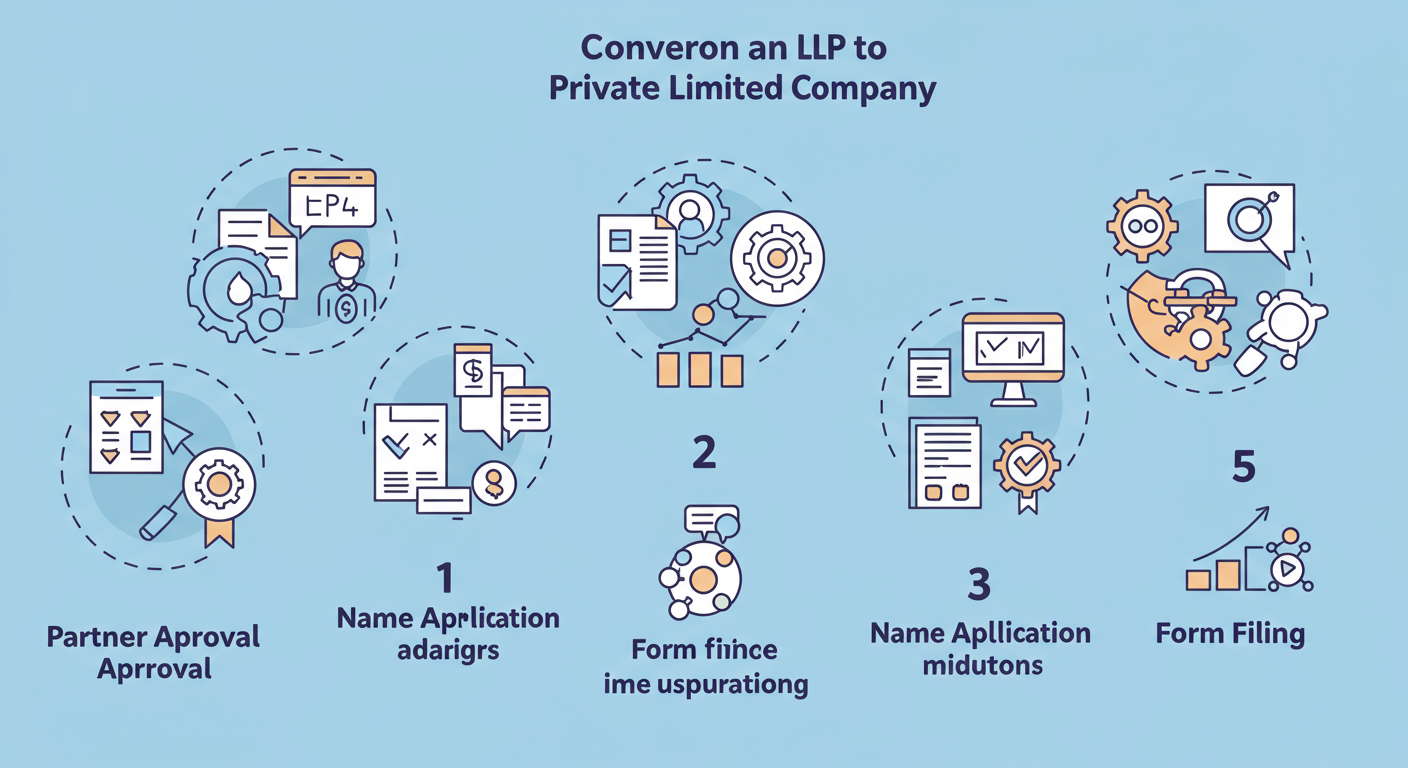
Here’s a simplified overview of the steps involved:
- Meet Pre-conditions: Ensure you have at least 2 partners (who will become shareholders) and secure approval from the majority of partners for the conversion.
- Name Reservation: Apply for the name of your new Private Limited Company using the SPICe+ Part A form on the MCA portal.
- File Conversion Form: File Form URC-1 along with the main SPICe+ incorporation form. This requires a ton of documentation, including details of the LLP and a statement of assets and liabilities.
- Draft MOA & AOA: You’ll need to draft the Memorandum of Association and Articles of Association for the new company.
- Receive Certificate of Incorporation: Once the ROC is satisfied with all documents, they will issue a new Certificate of Incorporation for the Private Limited Company.
⚠️ Watch Out
Conversion isn’t a simple switch-flip. It’s a legal process that takes time (typically 3-4 weeks) and money. You’ll need to update your PAN, TAN, bank accounts, and all other registrations. It’s better to choose the right structure from the start if you’re certain about your funding path.
Conclusion: Your Business, Your Blueprint
Look, there’s no universal “best” choice in the LLP vs Pvt Ltd showdown. The best structure is the one that serves as the right blueprint for your unique vision.
An LLP is your fortress of simplicity. It’s perfect for professional services, bootstrapped businesses, and ventures where operational flexibility and low overhead are paramount. It gives you protection without the bureaucratic drag.
A Private Limited Company is your rocket ship. It’s built for one thing: growth. If your roadmap includes angel investors, venture capital, ESOPs, and rapid scaling, the Pvt Ltd isn’t just an option—it’s a necessity. The higher compliance is the price of admission for playing in the big leagues, a fact well-understood in the Startup India ecosystem.
Your next step? Don’t just think about where your business is today. Map out where you want it to be in one, three, and five years. Your long-term vision holds the answer. Choose the foundation that won’t just support your business now, but will empower its future growth.
❓ Frequently Asked Questions
Can a single founder start an LLP or a Pvt Ltd?
No, both structures require a minimum of two people. An LLP needs at least two partners, and a Pvt Ltd needs at least two shareholders. If you’re a solo entrepreneur, the correct legal structure to consider is a One Person Company (OPC), which can later be converted into a Pvt Ltd.
Which structure is cheaper to maintain annually in 2026?
An LLP is significantly cheaper to maintain. Its lower compliance burden (no mandatory audit until a certain threshold, fewer meetings, simpler filings) results in much lower annual professional fees compared to a Pvt Ltd, which requires a mandatory statutory audit and extensive secretarial compliance from its first year.
Is Foreign Direct Investment (FDI) possible in an LLP?
Yes, FDI is allowed in LLPs through the automatic route, but with a major catch. It’s only for sectors where 100% FDI is permitted without any performance-linked conditions. For most foreign investors and in sectors with specific rules, a Pvt Ltd remains the far more straightforward and preferred entity for investment.
For a tech startup, is there any reason to choose an LLP over a Pvt Ltd?
Frankly, no. If you’re a tech startup with any ambition of raising external capital, a Pvt Ltd is the only viable choice. The ability to issue equity and ESOPs is non-negotiable for attracting investors and top tech talent. Starting as an LLP would only create a future hurdle requiring a costly and time-consuming conversion.
Can partners in an LLP receive a salary?
Yes, but it’s more accurately termed “remuneration.” For a partner to draw remuneration, it must be explicitly authorized by a clause in the LLP Agreement. The agreement should clearly define the terms and amount. This remuneration is a deductible expense for the LLP, which can be a tax-efficient way to pay working partners.
Read Also:
- Your CIN Certificate in 2024: 7 Key Facts Every Business Owner Must Know – Visual Story
- Form 11 LLP Filing 2026: A Guide to Avoiding Crippling Penalties
- Crack the MCA Name Code in 2026
- MGT Full Form: 7 Key Forms & Their Role in Corporate Compliance – Visual Story
- COVID Tax Rules: Your 2026 Audit Guide
- MCA Name Search 2026: The Definitive Guide to Company Name Approval – Visual Story
- Verify Any Indian Company in 2026
- FSSAI 2026: Renew or Risk It All
- 2026 E-Filing: Your Guide to Easy Taxes
- Form 11 LLP Filing 2026: A Complete Guide to Annual Returns
- Form 3 LLP Filing in 2026: A Guide to Avoid Costly Penalties
- Beat Crippling ROC Fines in 2026