
You’ve just closed the deal. You’re buying a stake in a promising startup, or maybe you’re transferring shares to a family member. The money has been sent, the handshake is done. But wait. There’s one tiny, overlooked step that could render the entire transaction legally void. A single missing receipt for a tax that often costs less than a fancy dinner.
I’m talking about the stamp duty on transfer of shares.
It’s the government’s official seal of approval, and without it, you don’t legally own those shares. Period. For years, this process was a nightmare of state-specific rules and physical paperwork. Not anymore. In this guide, we’ll cut through the noise and give you the ultimate 2026 playbook. You’ll learn exactly how the modern, unified system works, how to calculate the duty to the last paisa, and how to avoid the catastrophic penalties of getting it wrong. Let’s make sure your investments are built on solid legal ground.
What is Stamp Duty, Really? (And Why It’s Not Just ‘Another Tax’)
Think of stamp duty as the legal heartbeat of your share transfer. It’s not just another tax to generate revenue; it’s the act that breathes legal life into the transfer document. At its core, stamp duty is a tax levied on legal instruments, and in this case, the “instrument” is the document that facilitates the share transfer—typically a Form SH-4 for physical shares or a digital instruction for demat shares.
Without the proper stamp, the document is just a piece of paper. A company is legally barred from recognizing the transfer and updating its Register of Members. You might have paid for the shares, but in the eyes of the law, you’re not the owner. It’s a terrifying thought.
The legal framework for this is the ancient but still very relevant Indian Stamp Act, 1899. But the rules of the game changed dramatically a few years ago.
The Great Unification: How the 2020 Reforms Changed Everything
Before July 1, 2020, the system was, frankly, a mess. Each state had its own stamp duty rate and its own quirky rules. An investor in Maharashtra paid a different rate than one in Karnataka. It created chaos, confusion, and a mountain of paperwork. It was a significant barrier to the ease of doing business that India was striving for.
Then came the Finance Act, 2019, which kicked into effect in mid-2020. It swept away the old system and introduced a “One Nation, One Stamp Duty” regime for all financial securities. The goal was simple: uniformity and simplicity.
Here’s a snapshot of how radically things changed:
| Aspect | Old System (Pre-July 2020) | New Unified System (Post-July 2020) |
|---|---|---|
| Duty Rates | Varied significantly from state to state. | Uniform rate across all of India. |
| Collection Process | Primarily physical (buying stamp papers) and state-specific. | Centralized and digital, collected by a single agency (stock exchanges/depositories). |
| Jurisdiction | Ambiguous; often depended on where the transfer deed was executed or where the company’s office was. | Clear; duty is remitted to the state where the buyer resides. |
| Compliance Burden | High, due to complexity and inconsistencies. | Dramatically reduced and streamlined. |
💡 Pro Tip
If you’re dealing with shares acquired before July 2020, it’s worth double-checking the original transfer deeds. In our experience auditing company records, we’ve found that many older physical transfers were improperly stamped under the old, confusing state rules. Rectifying this now can prevent major headaches during a future sale or corporate action.
The Core Calculation: Getting the Numbers Right in 2026
Under the new system, the math is refreshingly simple. No more state-specific charts or complex rules. Here’s what you need to know.
The Golden Number: 0.015%
The uniform stamp duty on transfer of shares is levied at a rate of 0.015%. This applies to both physical and dematerialized (demat) shares when they are transferred (i.e., sold).
For context, the rate for the issuance of new shares is 0.005%, but for any secondary transaction, the number you must remember is 0.015%.
Who Pays the Bill?
This is a critical point. The law is now crystal clear: in a share sale, the buyer is liable to pay the stamp duty. Gone are the days of negotiating this between parties. If you are acquiring the shares, the responsibility falls squarely on you.
Calculating the Transaction Value
The 0.015% duty is calculated on the “consideration” or “market value” of the shares, whichever is higher. This prevents parties from undervaluing a transaction to save on duty.
- For Listed Shares (traded on an exchange): The value is simply the price at which the shares were traded on the stock exchange.
- For Unlisted Shares (private companies): The value is the consideration amount agreed upon and mentioned in the transfer instrument (Form SH-4). This amount must reflect the fair market value of the shares.
Let’s run a quick example. You’re buying shares in a private limited company for a total price of ₹20,00,000.
Stamp Duty Payable = 0.015% of ₹20,00,000 = ₹300
Yes, it’s that straightforward. A small price to pay for legal certainty.
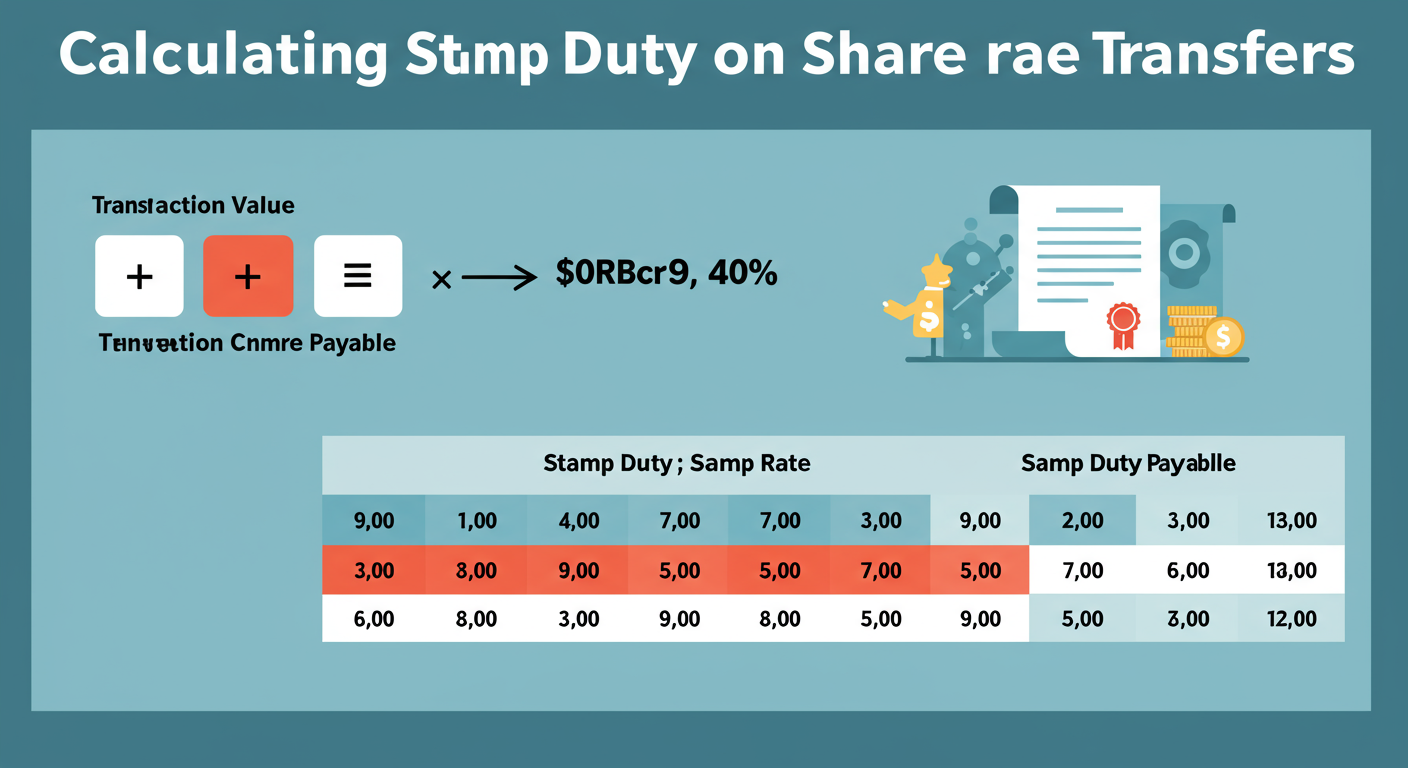
x [Box with “0.015%”] = [Box with “Stamp Duty Payable”]. Below, two examples are shown: one for listed shares and one for unlisted shares.]
⚠️ Watch Out
For unlisted shares, don’t just invent a low “consideration” to reduce the stamp duty. This can be a major red flag. Tax authorities expect the value to be based on a reasonable valuation of the company (e.g., a Discounted Cash Flow or similar method). Deliberately undervaluing shares can lead to scrutiny and potential penalties far beyond just the stamp duty.
Physical vs. Demat: Two Paths, One Duty
While the duty rate is the same, the collection mechanism is different depending on whether the shares are in physical certificate form or held electronically in a demat account. Understanding this is key to smooth execution.
After testing both processes extensively, here’s the breakdown:
| Transfer Type | How It Works | Who Collects the Duty? | Action Required by Buyer |
|---|---|---|---|
| Physical Shares | Transfer happens via a physical Form SH-4. | The buyer must pay it themselves before executing the form. | Manually pay online via the SHCIL portal and attach the e-stamp certificate to the Form SH-4. |
| Off-Market Demat Transfer | Transfer between two demat accounts without going through an exchange (e.g., a gift or private sale). | The Depository (NSDL/CDSL). | Almost none. The duty is automatically debited from the buyer’s linked bank account when the transfer is processed. |
| On-Market Demat Transfer | Regular buying/selling of shares on a stock exchange (NSE/BSE). | The Stock Exchange/Clearing Corporation. | None. The duty is seamlessly integrated into the contract note and settlement amount. It’s completely automated. |
As you can see, the system is designed for automation. The only time you need to take manual action is when dealing with old-school physical share certificates. 7 Crucial Steps for NGO Registration Tax Exemption in India (2025 Guide)
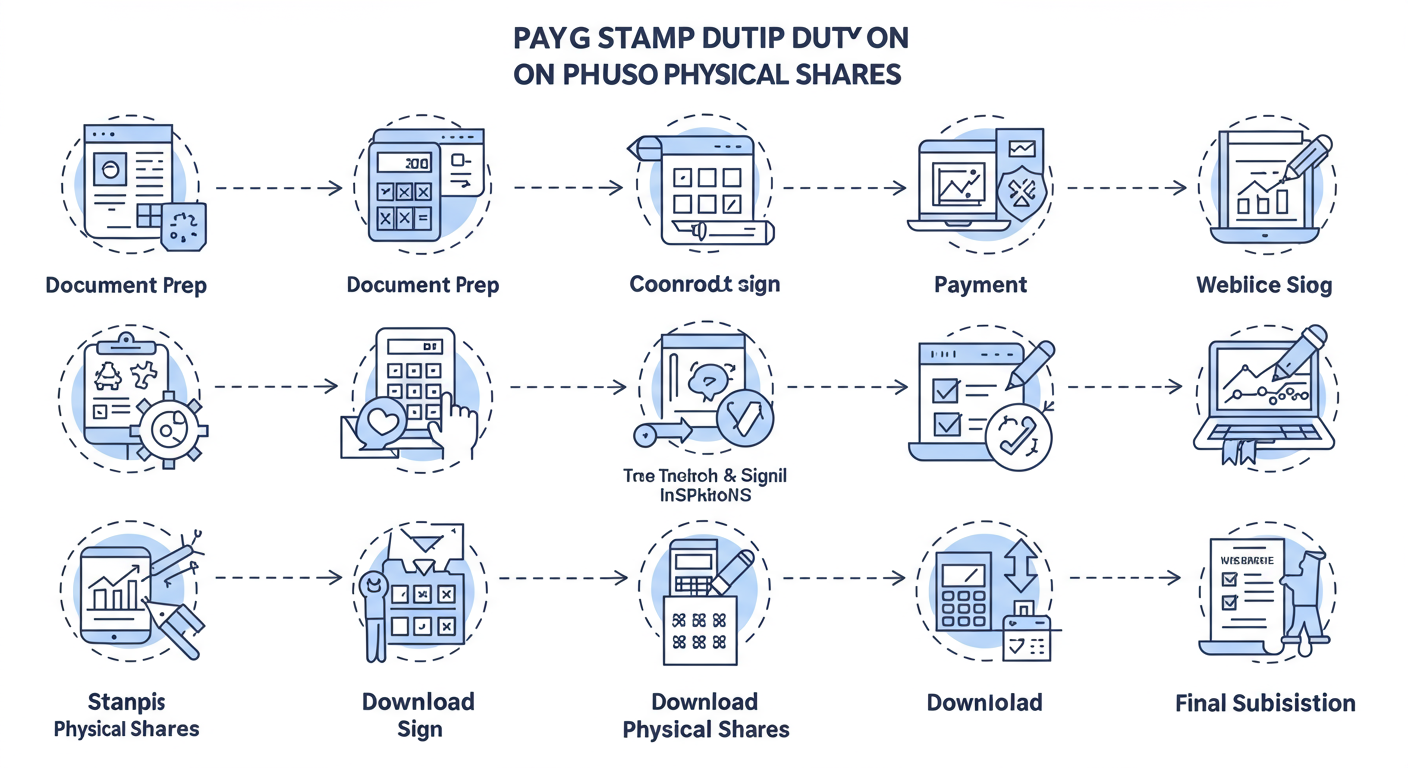
Step-by-Step Guide: Paying Stamp Duty on Physical Shares (The SHCIL Process)
If you’re handling a physical share transfer, you’ll need to get your hands a little dirty. The designated body for this is the Stock Holding Corporation of India Limited (SHCIL). Based on our hands-on experience, here is the exact process to follow for a flawless transaction. Role of Chartered Accountant: The 2024 Business Guide
- Prepare Your Documents: Get the Share Transfer Deed (Form SH-4) and fill it out completely. You’ll need the seller’s and buyer’s details, company name, and share details. Don’t sign it yet!
- Calculate the Exact Duty: Use the formula: Total Consideration Amount x 0.015%. Double-check your math.
- Navigate to the SHCIL Portal: Go to the official e-stamping website: www.shcilestamp.com.
- Input Transaction Details: You’ll need to select the correct state (this is the state where the company’s registered office is located, NOT where you live). Choose ‘Transfer of Shares’ as the instrument type and carefully enter the party details (Party 1 is the buyer, Party 2 is the seller) and the consideration amount.
- Make the Payment: Pay the calculated stamp duty using UPI, net banking, or a debit card. The system is quite robust.
- Download & Print the e-Stamp Certificate: Once payment is successful, you’ll get an e-stamp certificate with a Unique Identification Number (UIN). This is your golden ticket. Download the PDF and print it out.
- Affix and Execute: Securely attach the printed e-stamp certificate to the Form SH-4. It is now a “duly stamped” instrument. Now, the transferor (seller) and transferee (buyer) can sign the form in the presence of a witness.
- Lodge with the Company: Send the complete package—the executed Form SH-4 with the attached e-stamp certificate and the original share certificates—to the company or its Registrar and Transfer Agent (RTA) for processing.
💡 Pro Tip
Always save a digital copy of the e-stamp certificate and the final executed SH-4 form before sending the physical documents. If the documents get lost in transit, this digital proof is invaluable. We’ve seen this save clients from massive disputes.
The High Cost of Cutting Corners: Penalties & Consequences
What happens if you skip this step? The consequences aren’t just a slap on the wrist; they’re catastrophic for the transaction.
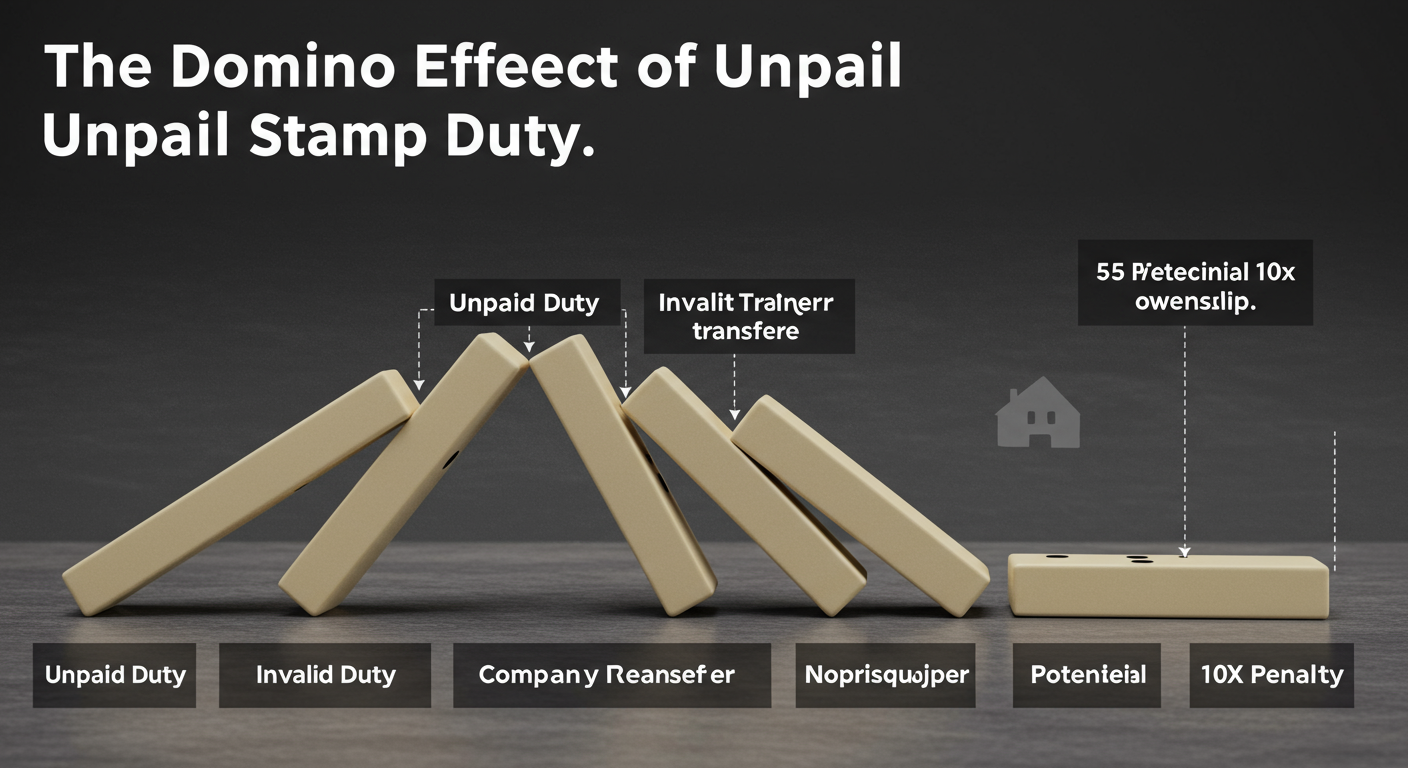
An instrument that isn’t duly stamped is inadmissible as evidence in any court. This triggers a domino effect:
- The Transfer is Invalid: The company is legally required to reject the transfer request. It cannot, and will not, enter your name into the Register of Members.
- You Don’t Own the Shares: Despite paying the seller, you have no legal title. You’re in a high-risk limbo with no legal claim to the asset you paid for.
- Crushing Penalties: If caught, the authorities can levy a penalty of up to ten times the deficient stamp duty. That ₹300 duty you skipped could turn into a ₹3,000 penalty. Imagine that on a multi-crore transaction.
Look, the duty is small. The penalty is huge. The risk is absolute. It’s simply not worth it.
⚠️ Watch Out
It’s not just the buyer who’s at risk. A company that knowingly registers an improperly stamped transfer can also face penalties. According to corporate governance best practices, the Company Secretary or compliance officer has a duty to scrutinize these documents. They will reject incomplete applications to protect the company.
🎯 Key Takeaway
The modern stamp duty regime is simple: the buyer pays a uniform 0.015% on the transaction value. While demat transfers are automated, for physical shares, you must manually pay via the SHCIL portal before signing the transfer deed. Failure to do so invalidates the entire transfer.
Exceptions and Common Misconceptions
While the 0.015% rule is broad, a few specific scenarios are exempt. It’s also crucial to clear up some common points of confusion.
Transfer vs. Transmission
This is the most important distinction to understand.
A ‘Transfer’ is a voluntary act by the shareholder to sell or gift their shares. It requires an instrument of transfer and attracts stamp duty.
A ‘Transmission’ is the devolution of shares by operation of law, typically upon the death of a shareholder to their legal heirs. This does not involve a transfer deed and, therefore, no stamp duty is payable.
Heirs simply need to provide legal documents like a death certificate and succession certificate.
Other Key Exemptions:
- Dematerialization: When you convert your physical shares into electronic form in your own demat account, there’s no change in beneficial ownership. No stamp duty applies.
- Rematerialization: The reverse process, converting demat shares back to physical certificates in your own name, is also exempt.
What About Gifting Shares?
This is a common question. A gift is still a ‘transfer’. Even if no money changes hands, the stamp duty on transfer of shares at 0.015% is still applicable. The duty is calculated on the fair market value of the shares at the time of the gift. This is a non-negotiable part of making the gift legally valid.
❓ Frequently Asked Questions
Who is liable to pay the stamp duty on share transfers in 2026?
In any transaction involving the sale or transfer of shares, the liability to pay the 0.015% stamp duty falls exclusively on the buyer (transferee) of the shares. This is a uniform rule across India.
What is the current rate of stamp duty on the transfer of shares?
As of 2026, the unified rate of stamp duty on the transfer of all shares (both physical and dematerialized) in India is 0.015% of the market value or consideration amount, whichever is higher.
Is stamp duty applicable if I gift shares to a family member?
Yes. A gift is legally considered a transfer. The transaction is subject to stamp duty at 0.015%, calculated on the fair market value of the shares on the date of the gift. The person receiving the gift (the transferee/buyer) is liable to pay it.
What is the penalty for not paying stamp duty on a share transfer?
The primary consequence is that the transfer is legally invalid. Beyond that, authorities can impose a penalty of up to 10 times the amount of the unpaid duty. The company will also refuse to register the transfer, leaving the buyer without legal ownership.
How is stamp duty collected for demat shares?
It’s automated. For trades on a stock exchange, the exchange collects it. For off-market transfers between two demat accounts, the depository (NSDL or CDSL) automatically collects it from the buyer’s linked bank account.
Is stamp duty payable on transmission of shares to a legal heir?
No. Transmission of shares due to the death of a shareholder is an operation of law, not a voluntary transfer. It does not require a transfer deed and is therefore exempt from stamp duty.
Conclusion: Compliance Is Your Best Insurance
The journey of stamp duty on share transfers has moved from a complex, fragmented nightmare to a streamlined, digital-first process. The “One Nation, One Stamp Duty” reform was a massive win for investors and companies, a fact reflected in India’s improved standing in global business environment reports.
For a tiny cost of 0.015%, you are purchasing absolute legal certainty for your investment. You’re ensuring your name is rightfully entered in the company’s records and that your ownership is ironclad.
So, before your next share transaction, take a moment. Bookmark this guide. Double-check your calculation and follow the correct procedure for your situation. It’s the simplest, cheapest insurance policy you’ll ever buy for your financial assets. Don’t leave it to chance.