Picture this: your business just had its best year ever. Revenue is soaring past the ₹1 crore mark. You’re celebrating, right? But then a nagging thought creeps in: “Wait… does this mean I need a tax audit?” Suddenly, visions of complex paperwork, endless queries, and hefty accountant fees cloud your mind.
You’re not alone. This is a critical crossroads for thousands of Indian businesses and professionals every single year. But here’s the thing most people miss: the tax audit threshold isn’t a simple, single number anymore. It’s a strategic fork in the road, with one path for traditional businesses and a much wider, smoother path for those who’ve embraced digital payments.
This article will completely demystify the tax audit limit for AY 2026-27. You’ll learn exactly when an audit is mandatory, how the game-changing ₹10 crore limit works, and how you might be able to legally bypass the entire audit process. Let’s get you compliant, confident, and back to focusing on growth.
What is a Tax Audit, and Why Should You Care?
Before we jump into the numbers, let’s be clear on what a tax audit is—and isn’t. It’s not an interrogation. It’s not an assumption of guilt. A tax audit, as defined under Section 44AB of the Income Tax Act, 1961, is simply an independent verification of your financial records by a practicing Chartered Accountant (CA).
Think of it as a financial health check-up. The CA examines your books to ensure your reported income and deductions are accurate and comply with tax laws. The final report (in Forms 3CA/3CB and 3CD) gives the Income Tax Department confidence in your filings.
Why does this matter? Because audited financials aren’t just for the taxman. They build trust. They can make it significantly easier to secure business loans, attract investors, and maintain a stellar compliance record. It’s a mark of financial discipline.
The Big Question: Do You Need an Audit in 2026?
This is the million-rupee question. The answer depends on two things: your line of work (business or profession) and your total turnover or gross receipts for the financial year 2025-26.
The government has created different thresholds to encourage digital transactions. Let’s break it down. Here’s a quick overview:
| Taxpayer Category | Turnover / Gross Receipts Threshold | Key Condition for Audit |
|---|---|---|
| Business (General) | Exceeds ₹1 Crore | Standard limit for businesses with significant cash transactions. |
| Business (Digital Focus) | Exceeds ₹10 Crore | Both cash receipts AND cash payments must be 5% or less of their respective totals. |
| Professionals | Exceeds ₹50 Lakhs | Standard limit for specified professionals (doctors, lawyers, CAs, etc.). |
Now, let’s dive into the specifics for each category.
For Businesses: The ₹1 Crore vs. ₹10 Crore Rule
This is where things get interesting. For businesses, there are two distinct limits.
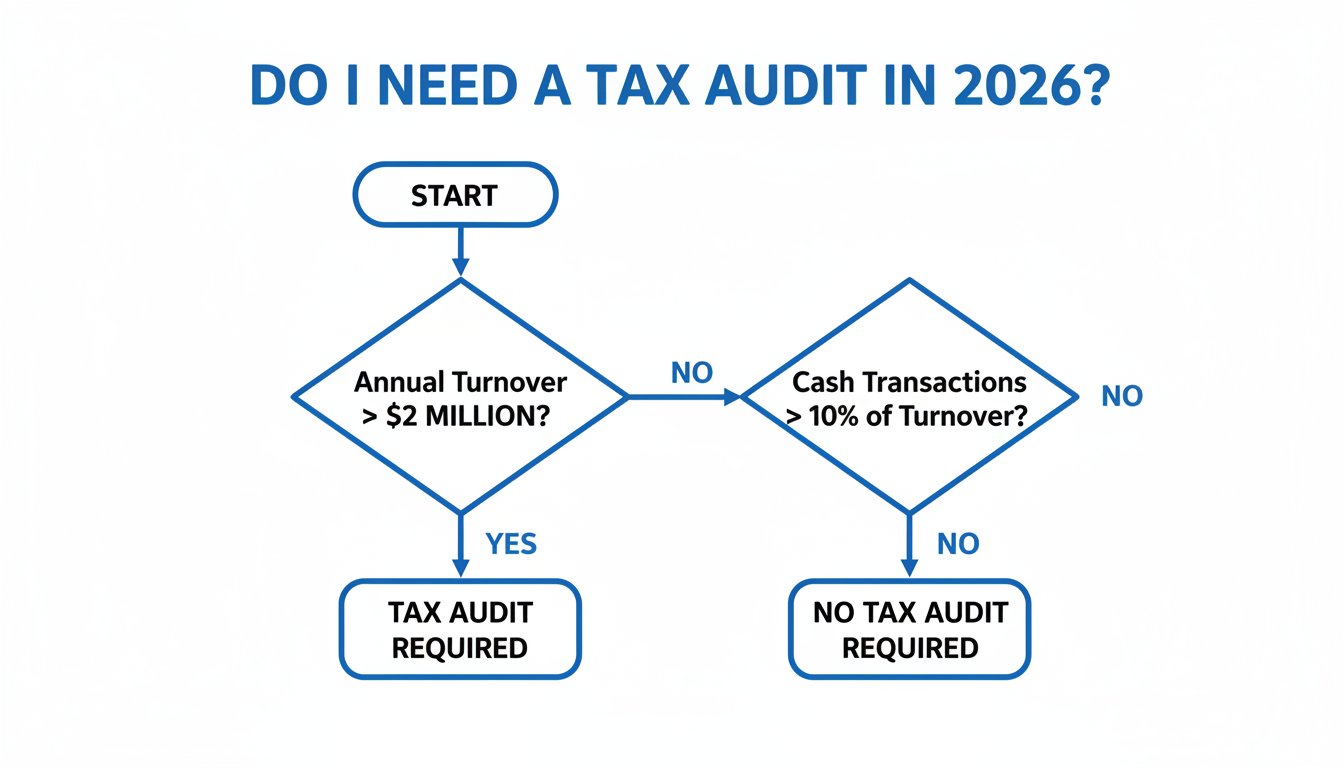
- The Standard Limit (₹1 Crore): If your total sales, turnover, or gross receipts from your business cross ₹1 crore in FY 2025-26, a tax audit is mandatory. This has been the baseline for years and applies to any business that doesn’t meet the special condition below.
- The Enhanced Digital Limit (₹10 Crore): This is the big one. The government offers a massive relief by raising the audit threshold to ₹10 crore. But there’s a catch. You must satisfy both of these conditions to qualify:
- Your total cash receipts during the year cannot exceed 5% of your total receipts.
- Your total cash payments during the year cannot exceed 5% of your total payments.
Let’s make this real. Imagine a software company with a turnover of ₹7 crore. Their total receipts (sales + a director’s loan) are ₹7.2 crore, with only ₹25 lakhs received in cash (3.47%). Their total payments are ₹6.5 crore, with only ₹30 lakhs paid in cash (4.61%).
Because both their cash receipts and payments are under the 5% mark, they are not required to get a tax audit. Huge relief. If their cash payments had been ₹35 lakhs (5.38%), they would have breached the condition and an audit would have become mandatory, even though their turnover was well below ₹10 crore.
💡 Pro Tip
When calculating the 5% cash limit, remember that “receipts” and “payments” include everything, not just sales and expenses. This means capital contributions, loans taken or repaid, and asset purchases are all part of the calculation. In our experience, this is where most businesses make a mistake. Use your bank statements and cash book as the ultimate source of truth.
For Professionals: A Simpler Threshold
If you’re a professional—like a doctor, lawyer, engineer, architect, or consultant—the rule is more straightforward. A tax audit is mandatory if your total gross receipts in the profession exceed ₹50 lakhs during the financial year 2025-26.
There is no enhanced ₹10 crore limit for professionals in the same way as for businesses. However, a powerful alternative exists: the presumptive taxation scheme.
⚠️ Watch Out
Don’t confuse “turnover” with “profit.” The tax audit limit is based on your total revenue or gross receipts for the entire year, before deducting any expenses. I’ve seen businesses with very low profit margins get caught by the audit requirement simply because their total sales volume was high.
The “No-Audit” Shortcut: Understanding Presumptive Taxation
What if you could simplify your tax life, avoid maintaining detailed books, and skip the audit altogether? That’s the promise of the presumptive taxation scheme. It’s a simplified method of taxation for smaller businesses and professionals.
But is it right for you? Let’s compare.
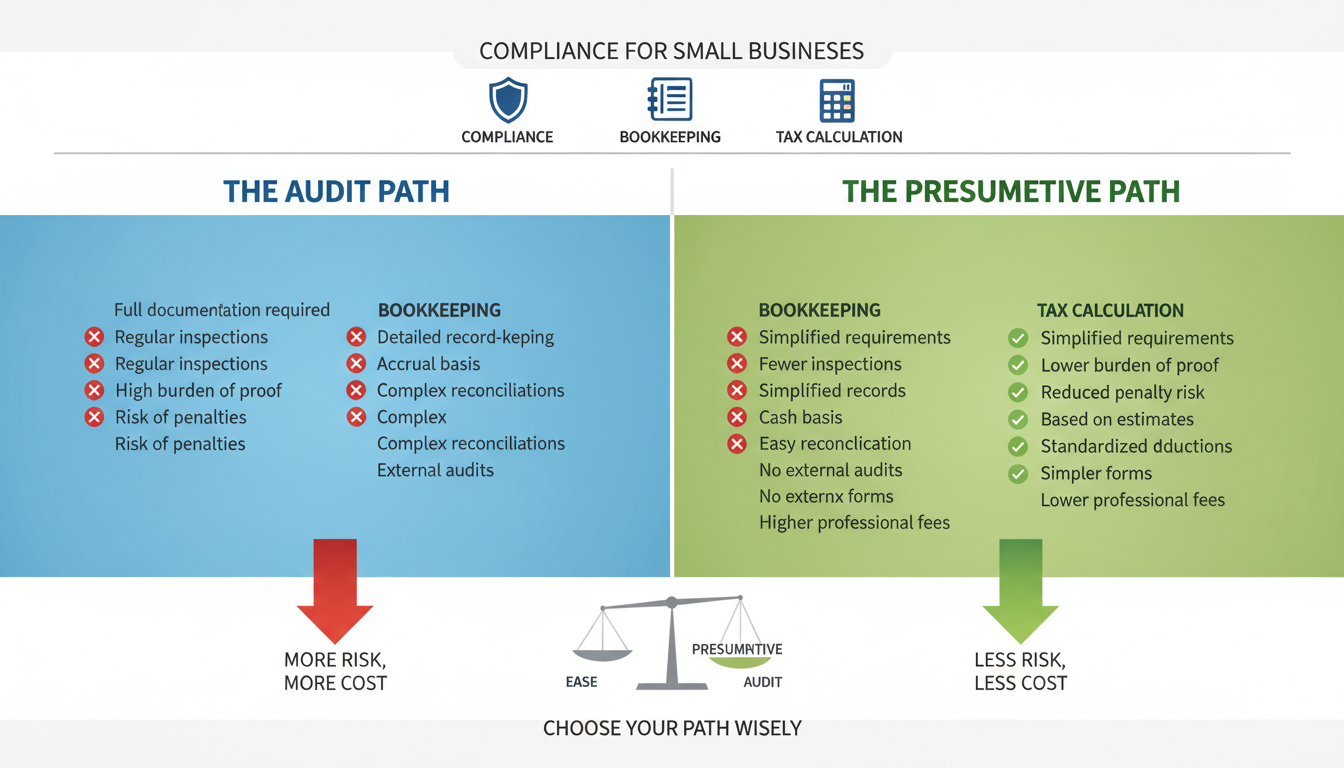
| Feature | Standard Audit Path | Presumptive Scheme Path |
|---|---|---|
| Suitability | Larger businesses; businesses with low profit margins or losses. | Smaller businesses & professionals with healthy profit margins. |
| Bookkeeping | Mandatory to maintain detailed books of accounts. | Not required to maintain detailed books. |
| Profit Declaration | Actual profit/loss as per books of accounts. | A fixed percentage of turnover/receipts is declared as profit. |
| Audit Requirement | Mandatory if turnover limits are crossed. | No audit required if you declare the presumed profit. |
Section 44AD: For Businesses
This scheme is for eligible businesses with a turnover up to ₹2 crore. However, this limit is increased to ₹3 crore if your cash receipts are 5% or less of your total turnover. Comprehensive Guide to the GST Registration Mistakes List and How to Avoid Rejection
- How it works: You declare a minimum of 8% of your turnover as your profit (or 6% for turnover received through digital channels).
- When an audit is triggered: If you opt for this scheme but declare a profit lower than the 8%/6% rate, and your total income exceeds the basic exemption limit, you’ll be forced into a tax audit.
Section 44ADA: For Professionals
This is for specified professionals with gross receipts up to ₹50 lakhs. This limit is enhanced to ₹75 lakhs if cash receipts are 5% or less of total gross receipts. Advance Tax Payment India: 2024 Rules, Due Dates & Calculato
- How it works: You simply declare 50% of your gross receipts as your income. The other 50% is automatically considered your expenses. No bills needed.
- When an audit is triggered: If you claim your profit is less than 50% of your receipts and your total income is above the basic exemption limit, an audit becomes mandatory.
⚠️ Watch Out
The presumptive scheme is a powerful tool, but it can be a trap. If your actual business expenses are very high (say, 70% of your revenue), opting for Section 44ADA and declaring 50% profit means you’ll pay tax on income you never actually earned. Always do the math before you opt-in. The Ultimate LLP Annual Compliance Checklist for Indian Businesses 2024-2025
🎯 Key Takeaway
The tax audit limit for 2026 is no longer just a number; it’s a reflection of your business’s digital maturity. The ₹10 crore threshold is a massive incentive to reduce cash transactions. For smaller entities, the presumptive scheme offers a simplified escape from audits, but you must ensure the presumed profit rates align with your actual business reality.
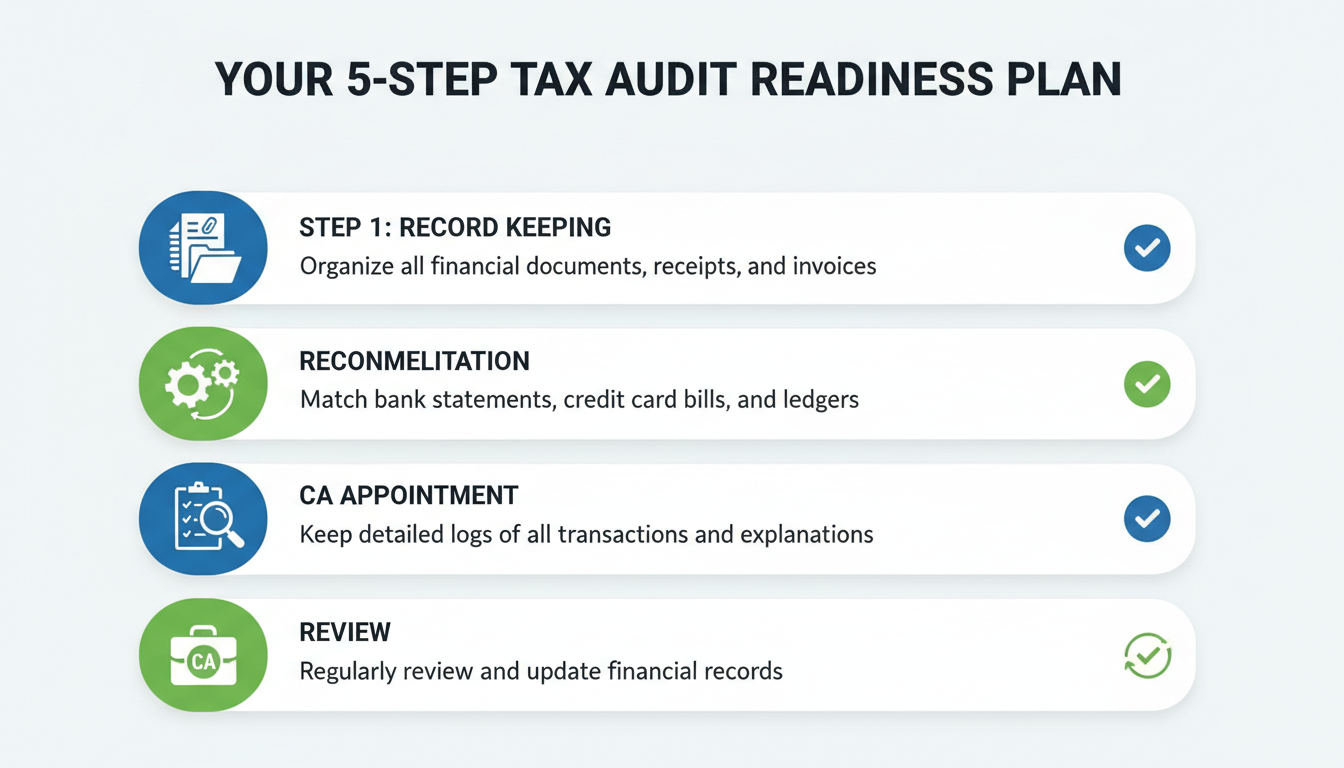
Your 5-Step Audit Readiness Plan
If an audit is unavoidable, don’t panic. Preparation is everything. A smooth audit process begins months before the deadline, not in a last-minute scramble.
- Finalize Your Books: Close your books of accounts for the financial year ending March 31, 2026. Ensure all income, expenses, assets, and liabilities are recorded accurately.
- Reconcile Everything: This is non-negotiable. Meticulously reconcile your bank statements, GST returns (GSTR-1, 3B) with your sales records, and your TDS/TCS records with Form 26AS. Based on hands-on testing, mismatches here are the #1 source of audit queries.
- Gather All Documents: Organize all key documents: invoices, expense bills, bank statements, loan agreements, investment proofs, and any important contracts. Create a digital folder for easy sharing.
- Appoint a Chartered Accountant (CA): Don’t wait until September. Engage a reputable CA by June or July. This gives them adequate time to understand your business and conduct a thorough audit without rushing.
- Review the Draft Report: Before the final submission, sit with your CA and review the draft audit report. Understand any qualifications or observations they have made and ensure all the details are correct.
💡 Pro Tip
Appointing your CA early isn’t just about avoiding the last-minute rush. It often leads to better tax planning. An experienced CA can identify potential issues or tax-saving opportunities during the audit process that you can implement for the *next* financial year. It turns a compliance cost into a strategic investment.
Deadlines and Penalties: The High Cost of Delay
Knowing the rules is only half the battle. Meeting the deadlines is what keeps you safe.
- Due Date for Tax Audit Report: The deadline to file your tax audit report is September 30, 2026.
- Due Date for Income Tax Return (for audit cases): The ITR filing deadline is October 31, 2026.
What happens if you miss the September 30th deadline? The penalty under Section 271B is steep. It’s the lower of:
- 0.5% of your total turnover or gross receipts.
- A flat ₹1,50,000.
For a business with a ₹2 crore turnover, that’s a ₹1 lakh penalty for a missed deadline. It’s an expensive and entirely avoidable mistake. According to guidelines from the Institute of Chartered Accountants of India (ICAI), only severe and provable reasons (like a natural disaster) are typically accepted as a reasonable cause for delay.
Conclusion: From Compliance to Confidence
Navigating the tax audit limit for AY 2026-27 doesn’t have to be a source of anxiety. It’s a clear-cut system designed to reward financial discipline and digital adoption.
Here’s your path forward:
- Calculate your estimated turnover for FY 2025-26.
- Analyze your cash transactions. Are you below the crucial 5% threshold?
- Decide your path: Does the high-turnover digital exemption apply to you? Or is the simplicity of the presumptive scheme a better fit? Or do you need to prepare for a full audit?
By answering these questions now, you transform a last-minute compliance scramble into a proactive financial strategy. You move from uncertainty to control, ensuring you stay on the right side of the law while building a financially robust and trustworthy business.
❓ Frequently Asked Questions
What is the main change in the tax audit limit for AY 2026-27?
The core limits (₹1 Cr, ₹10 Cr, ₹50 Lakhs) remain the same. The key updates from previous years are the enhanced presumptive scheme limits: ₹3 crore for businesses (u/s 44AD) and ₹75 lakhs for professionals (u/s 44ADA), provided their cash receipts are 5% or less of the total.
Do I need an audit if my business turnover is ₹1.5 crore but I made a loss?
Yes, absolutely. The tax audit requirement is triggered by your turnover, not your profitability. Even if your business incurred a loss, a tax audit is mandatory if your turnover exceeds the ₹1 crore threshold (and you don’t meet the ₹10 crore digital criteria).
I’m a freelancer earning ₹65 lakhs, all via bank transfer. Do I need an audit?
No, you likely don’t. Since your gross receipts are below the enhanced presumptive limit of ₹75 lakhs for professionals (as your cash receipts are 0%), you can opt for Section 44ADA. By declaring 50% (₹32.5 lakhs) as your income, you can file your return without needing a tax audit.
Does receiving a loan in cash count towards the 5% cash limit?
Yes. The 5% limit for cash receipts is calculated on total receipts, which includes revenue from sales, loans received, capital introduced, and any other form of inflow. This is a critical detail that many business owners overlook.
What happens if I file the audit report on time but my ITR late?
You will have complied with the audit requirement under Section 44AB, so no penalty under Section 271B will apply. However, you will face penalties for late filing of your Income Tax Return, including a late fee and potential loss of the ability to carry forward certain business losses.
Is the turnover for tax audit the same as my GST turnover?
They are usually very similar but not always identical. There can be minor differences in how certain items are treated under the Income Tax Act versus the GST Act. It’s always best practice to have your Chartered Accountant confirm the precise turnover figure as per income tax rules for audit applicability.