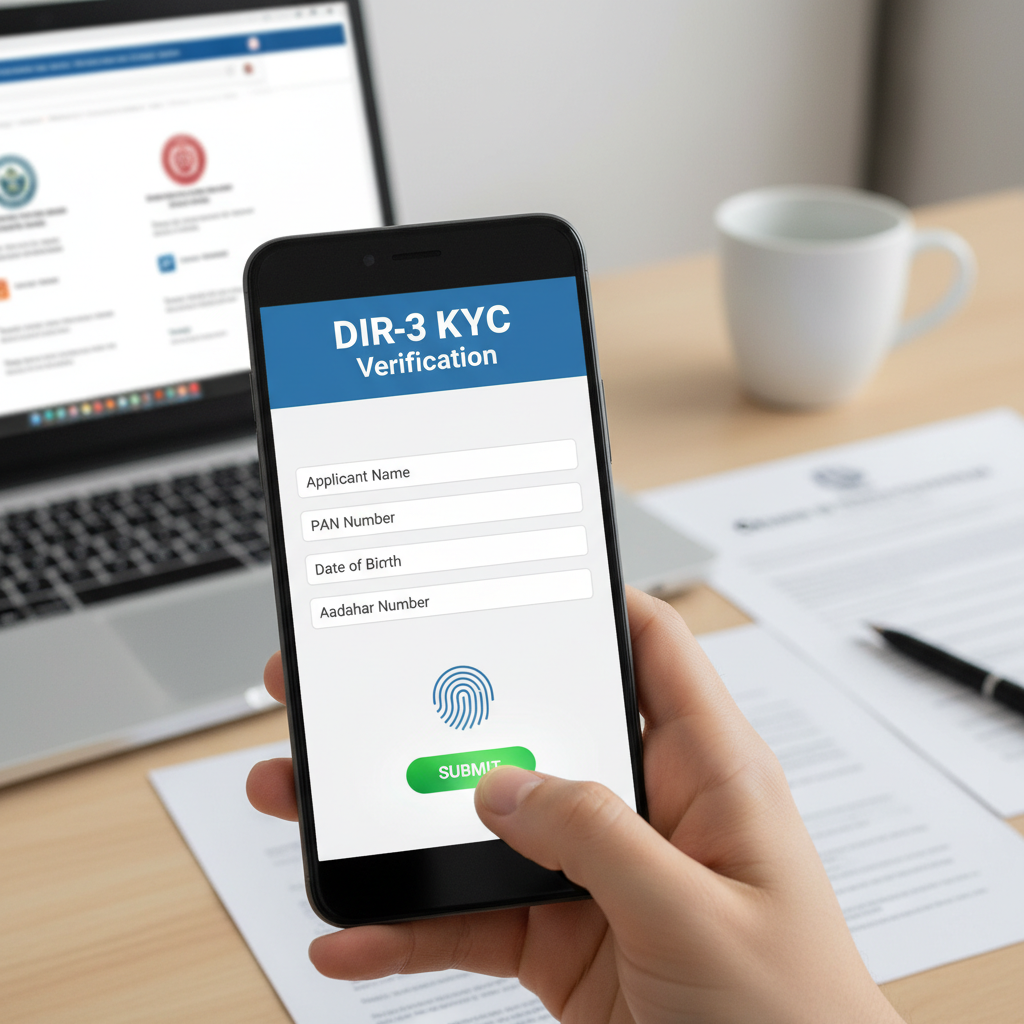
Picture this: you log into the Ministry of Corporate Affairs (MCA) portal to file a crucial company form, but you’re blocked. A stark message flashes on the screen: “DIN Deactivated.” Your ability to act as a director is frozen, all because of a 10-minute annual task you might have overlooked. Every year, thousands of directors face this exact scenario, complete with a mandatory ₹5,000 penalty.
This isn’t just about avoiding a fine. It’s about protecting your professional standing.
The DIR-3 KYC filing is one of the most critical yet misunderstood compliance requirements for company directors in India. It seems simple, but the details trip people up constantly. In this definitive 2026 guide, we’re cutting through the jargon. You’ll learn not just how to file, but how to do it right, which method to choose, and how to sidestep the common traps that lead to penalties and deactivation. Let’s make sure your DIN stays active and your record stays clean.
What Exactly is DIR-3 KYC and Why Does it Matter So Much?
Think of DIR-3 KYC as the government’s annual “roll call” for directors. The acronym stands for ‘Know Your Customer’, but in the corporate world, it means ‘Know Your Director’. Mandated under Rule 12A of The Companies (Appointment and Qualification of Directors) Rules, 2014, it’s a simple process to verify that your personal details—your address, mobile number, and email—are current in the MCA’s database.
But why the annual hassle? It’s a strategic move by the MCA for several critical reasons:
- Fighting Shell Companies: The biggest reason. By ensuring every director is a real, verifiable person with up-to-date contact info, the government makes it incredibly difficult to operate shell companies with fake or “ghost” directors.
- Enhancing Transparency: Accurate data is the bedrock of good corporate governance. It ensures that stakeholders, from investors to regulators, know exactly who is at the helm of a company.
- Improving Accountability: When regulators need to communicate with a director, they need to know their message will be received. Verified contact details make this possible, ensuring directors can be held accountable for their company’s actions.
In short, this isn’t just bureaucratic paperwork. It’s a fundamental part of creating a trusted and transparent business environment in India. From our experience, treating it as a top priority before the deadline is the hallmark of a diligent director.
Web vs. E-Form: Which DIR-3 KYC Method is for You?
The MCA offers two distinct paths for your KYC filing. Choosing the wrong one is a common mistake that can lead to an incomplete compliance status. It’s a simple choice, but you have to get it right.
Here’s a clear breakdown to help you decide in 30 seconds.
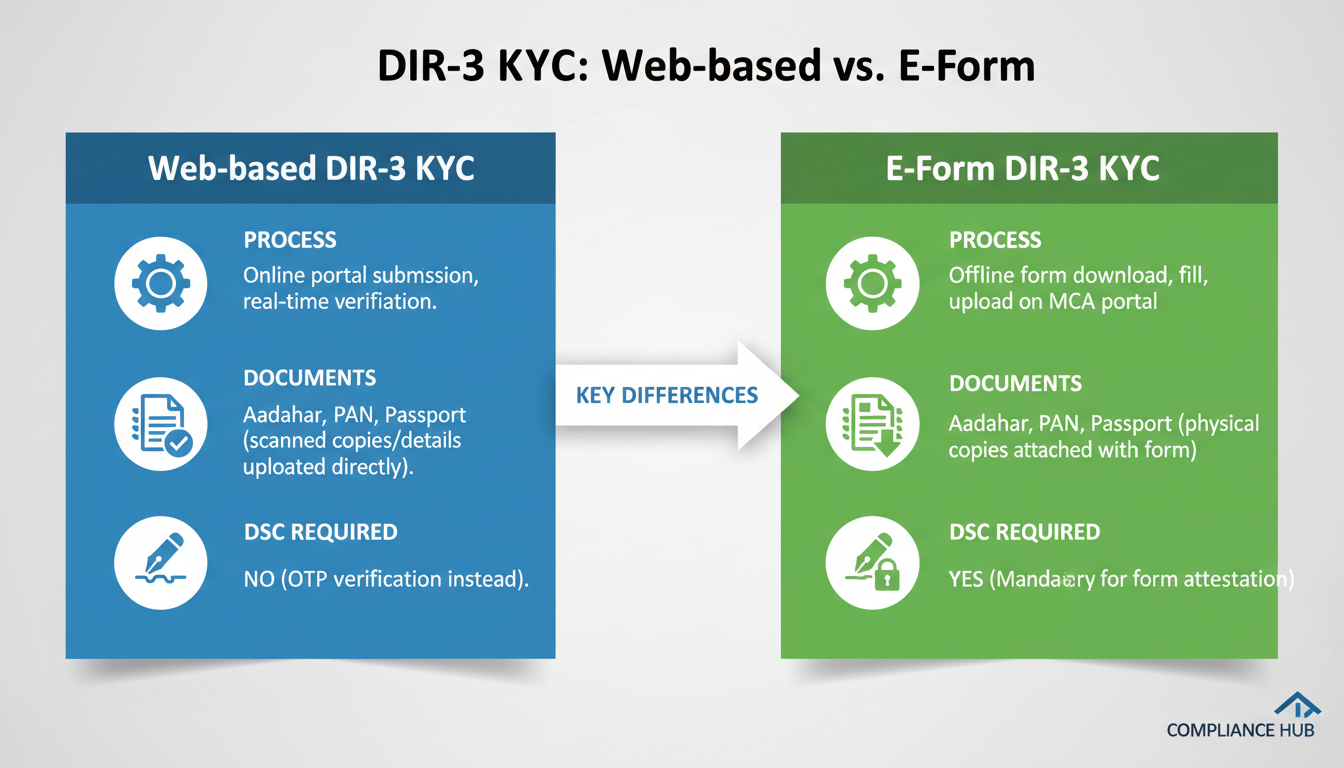
| Feature | Web-based DIR-3 KYC | E-Form DIR-3 KYC |
|---|---|---|
| Who Should Use It? | Directors whose contact details (mobile/email) and address have NOT changed since the last filing. | First-time filers OR any director whose details HAVE changed. |
| Process | Simple online OTP verification on the MCA portal. No downloads needed. | Download the PDF form, fill it, attach documents, and upload. |
| Documents | No document uploads required. | Self-attested copies of PAN, Aadhaar/Passport must be attached. |
| Professional Certification | Not required. You can do it yourself. | Mandatory. Must be digitally certified by a practicing CA, CS, or CMA. |
| Digital Signature (DSC) | Not required. | Required for both the director and the certifying professional. |
| Effort Level | Low (5-10 minutes) | Medium (Requires coordination with a professional) |
🎯 Key Takeaway
If nothing has changed since your last filing, use the simple Web-based KYC. If you’re a first-time filer or your mobile, email, or address has changed, you must use the E-Form to update your records correctly.
The Golden Rule: Who Absolutely Must File DIR-3 KYC?
The rule is deceptively simple: If you have a Director Identification Number (DIN) as of March 31st, 2026, you must complete your DIR-3 KYC by September 30th, 2026.
It doesn’t matter if you’re an active director or not. The obligation is tied to the DIN itself, not your employment status. This applies to:
- Active Directors currently on a company’s board.
- Resigned Directors who still hold a DIN.
- Disqualified Directors whose DIN is still in the system.
- Directors of Struck-Off Companies, as their DIN remains active.
I’ve seen this play out many times: a person resigns from a directorship in 2022, assumes they are done with all compliance, and gets a nasty surprise in 2026 when they find their DIN is deactivated. Remember, until you formally surrender your DIN, the KYC is your annual responsibility.
⚠️ Watch Out
A common myth is that only active directors need to file. This is false. The system automatically flags any DIN holder who fails to file, regardless of their directorship status. Don’t assume you’re exempt.
Your 7-Step Guide to a Flawless DIR-3 KYC Filing in 2026
Navigating the MCA V3 portal can feel a bit clunky, but the process is straightforward if you follow a clear plan. Let’s walk through it step-by-step.
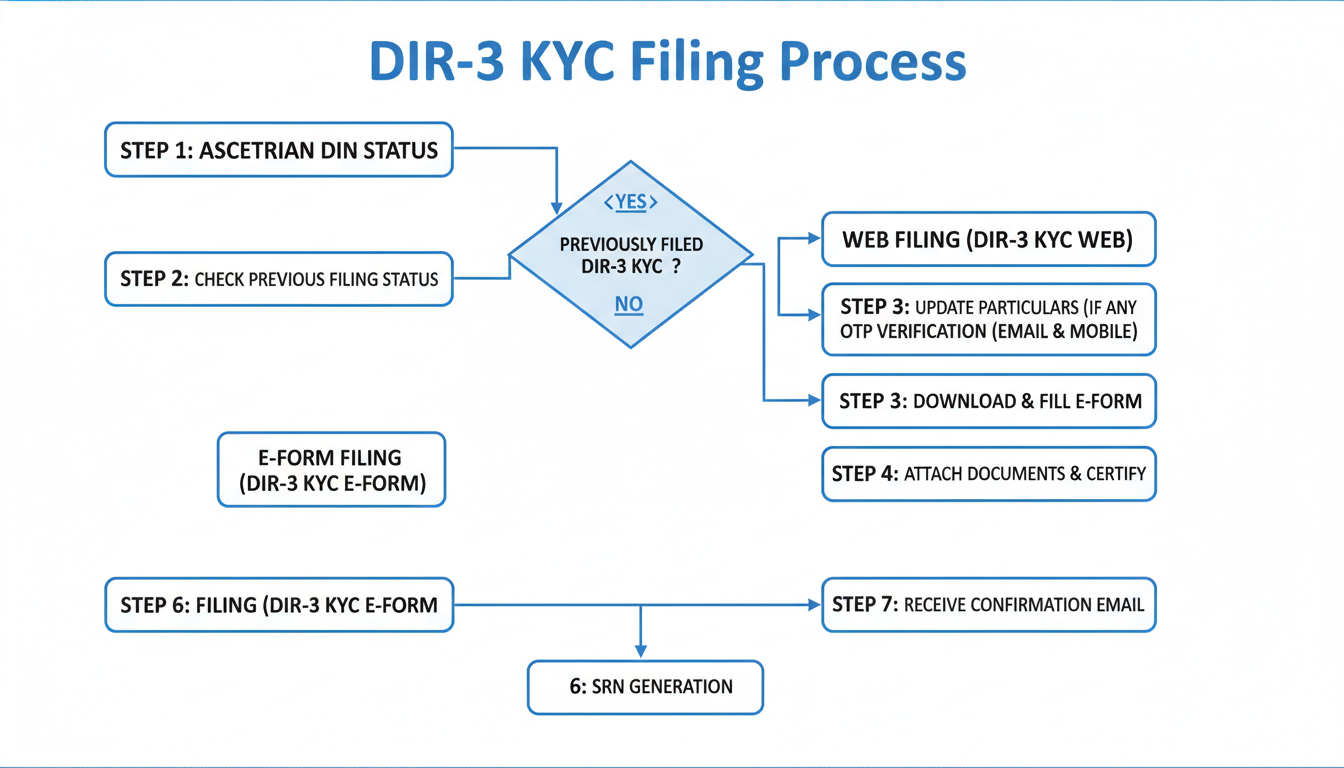
- Log in to the MCA Portal: Head over to the official Ministry of Corporate Affairs portal. You’ll need to log in with your user ID. If you’re new, you’ll have to register first.
- Find the Right Service: Once logged in, navigate this path: MCA Services > Company E-Filing > DIN Related Filings. You’ll see the two options: ‘DIR-3-KYC Web’ and ‘DIR-3-KYC E-form’.
- Select Your Method: Based on our table above, make your choice. If you click ‘Web’, the system will open an online form. If you choose ‘E-form’, you’ll need to download the PDF form to fill it out offline.
- Verify Your Pre-filled Data: The form will auto-populate your name, father’s name, PAN, and other details from the MCA database. Trust, but verify. Meticulously check every single field for accuracy.
- The OTP Verification (The Most Crucial Step): Enter your personal mobile number and personal email ID. Click ‘Send OTP’. You will receive two separate OTPs. Enter them in their respective fields. This is the core of the verification process.
- Attach Documents & Certify (E-Form Only): If you’re using the E-Form, you’ll need to attach self-attested PDFs of your PAN and address proof. Then, the form must be digitally signed (using a DSC) by a practicing Chartered Accountant (CA), Company Secretary (CS), or Cost Accountant (CMA). Finally, you affix your own DSC.
- Submit and Save Your SRN: For the web form, you’ll click ‘Submit’, and it’s done. For the e-form, you’ll upload the signed PDF. Upon successful submission, the portal will generate a Service Request Number (SRN). Screenshot it. Save it. This is your proof of filing.
💡 Pro Tip
Before you even log in, get your documents ready. Have your PAN card and Aadhaar/Passport handy. For the E-Form, scan them as clear, self-attested PDFs under 2MB. This preparation saves a ton of time and prevents frantic searching while the portal session is active.
The Unforgiving Deadline: What Happens if You Miss September 30th?
The deadline for DIR-3 KYC is non-negotiable: September 30th, 2026. Ultimate Guide to GST for Service Providers: 9 Key Compliance Rules (2025)
There is no grace period. On October 1st, the MCA system automatically flags all non-compliant DINs and changes their status to ‘Deactivated due to non-filing of DIR-3 KYC’. The consequences are immediate and severe. 7 Essential Steps to Master the GST Cancellation Process in India (2025 Guide)
“The penalty isn’t just the fee; it’s the complete halt of your ability to function as a director. It can derail board resolutions, new appointments, and critical company filings.”
Here’s what you’re up against if you miss the date:
| Consequence | Detailed Impact |
|---|---|
| Immediate DIN Deactivation | Your DIN becomes inactive. You cannot be appointed to a new directorship or file any forms for existing companies that require your DIN. |
| Flat Late Fee of ₹5,000 | To reactivate your DIN, you must file the DIR-3 KYC form and pay a mandatory, non-waivable late fee of ₹5,000. |
| Operational Gridlock | If you are the sole director or one of two required signatories for a company, your deactivation can bring business to a standstill. Financial statements, annual returns, and other crucial forms cannot be filed. |
⚠️ Watch Out
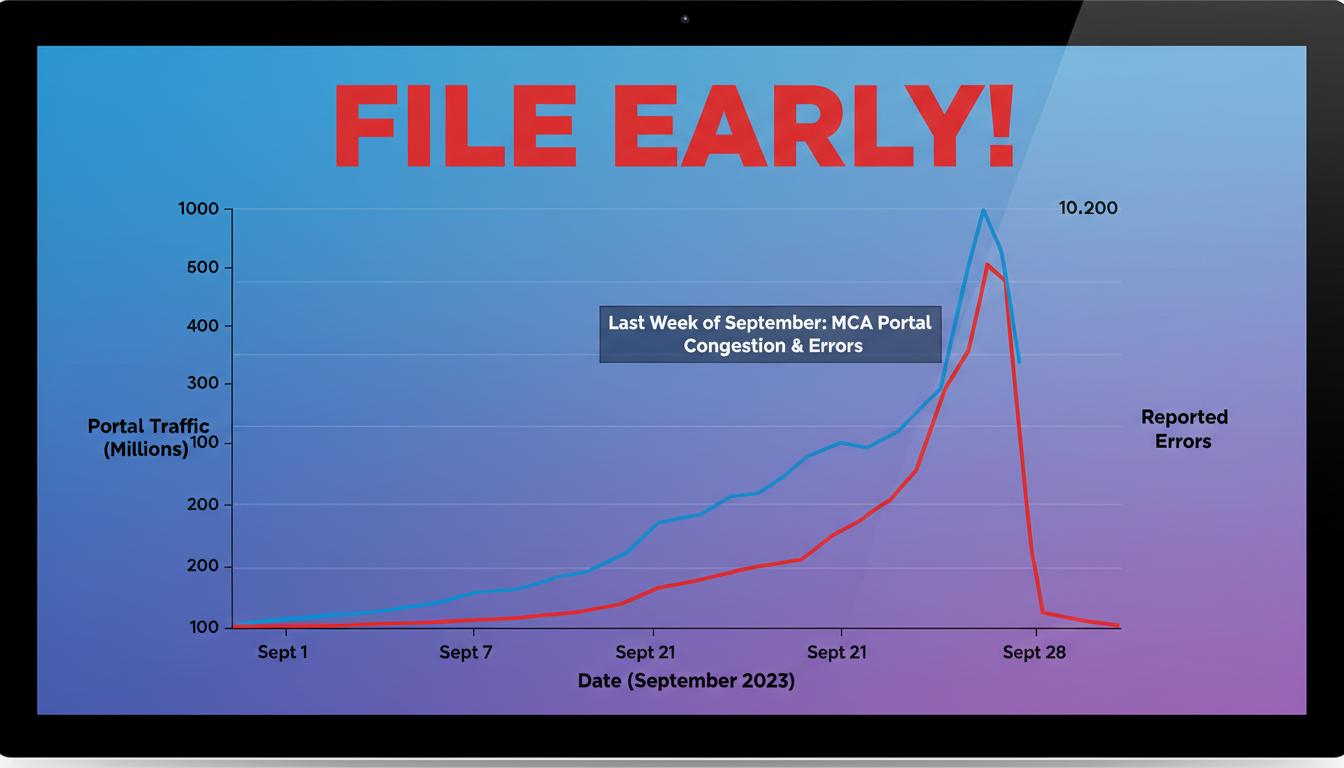
Don’t wait until the last week of September. The MCA portal is notorious for slowing down or crashing due to high traffic near compliance deadlines. Based on hands-on testing year after year, we recommend filing by the first week of September to avoid technical glitches and stress.
Common Mistakes That Will Get Your Filing Rejected
A successful filing is all about the details. Here are the most common errors we see that cause rejection or future problems:
- Using Official Contact Info: You MUST use your personal mobile number and personal email. Using a company-provided or a professional’s contact details is a direct violation and can lead to non-compliance.
- PAN Data Mismatch: The name, father’s name, and date of birth on your PAN must match the MCA records exactly. Even a small difference (e.g., “Kumar” vs. “K.”) will cause an error. You must first file a separate form to correct the data in the DIN database.
- Expired or Invalid DSC: For the E-Form, ensure both your and your professional’s Digital Signature Certificates are valid and not expired. An invalid DSC is a common reason for upload failure.
- Incorrect Address Proof: The address proof you attach (like an Aadhaar card) must match the address you’ve entered in the form. According to The Companies Act, 2013, providing accurate residential address information is a legal requirement.
💡 Pro Tip
Before starting the E-Form, do a “pre-scrutiny” check. The form has a built-in button for this. It runs a preliminary check for common errors and can save you from a failed upload attempt. Always use it.
❓ Frequently Asked Questions
What is the government fee for filing DIR-3 KYC on time?
Zero. There is absolutely no government fee if you file on or before the September 30th deadline. The ₹5,000 is purely a late filing penalty.
Do I need a Digital Signature Certificate (DSC) for the web-based KYC?
No. The web-based process is designed for simplicity and relies solely on OTP verification for your mobile and email. A DSC is only mandatory for the E-Form DIR-3 KYC.
My DIN is deactivated. What’s the exact process to reactivate it?
To reactivate your DIN, you must file the pending DIR-3 KYC form (it will have to be the E-Form) and pay the ₹5,000 late fee via an online challan. Once the form is processed and approved by the ROC, your DIN status will be updated to ‘Active’.
I’m a foreign national with a DIN. Do I need to file?
Yes, the requirement applies to all DIN holders, regardless of nationality. You must provide your international mobile number (with country code) and email for OTP verification. Your passport is the primary proof of identity, as confirmed by professional bodies like the Institute of Company Secretaries of India (ICSI).
Can I use my company’s address as my personal address in the form?
No. The form requires your permanent and present residential address. Using your office address is incorrect and could be flagged during any review. Always provide your genuine residential details.
Conclusion: From Annual Chore to Good Governance
Look, DIR-3 KYC filing isn’t the most glamorous part of being a director, but it’s one of the most fundamental. It’s a quick, simple task that protects you from a hefty ₹5,000 penalty, a deactivated DIN, and significant professional disruption.
You now have the complete playbook for 2026. You know which form to use, the exact steps to follow, and the critical mistakes to avoid. The path to compliance is clear.
Your next step is simple: Check your calendar. If it’s past April 1st, don’t delay. Log in to the MCA portal this week, verify your details, and get it done. Proactive compliance isn’t just about following rules; it’s a reflection of your commitment to transparency and your role as a responsible corporate leader.
Read Also:
- Don’t Lose Your 2026 Indian Patent
- Who is a Company Promoter? 7 Key Roles & Responsibilities (2026)
- MoA vs AoA (2026): 7 Key Differences You MUST Know
- Private vs Public Limited Company: The 2026 Founder’s Guide
- How to Register DSC on MCA Portal (2026 V3 Guide)
- Elite Auditor’s 2026 Success Playbook
- ADT-1 Filing: The Ultimate Guide to Appointing an Auditor (2026)
- One Person Company (OPC) Registration 2026: The Ultimate Guide
- MCA Director Master Data: The Ultimate Guide for 2026
- ROC Filing Guide 2026: Master Your Company’s Compliance
- Appointment of Auditor: A 7-Step Guide for 2026 Compliance
- Small Company Definition India 2026: Turnover & Capital Limits
- Form MGT-14 Filing: The Ultimate Guide for 2026
- Vet Any Indian Company in 2026
- Form DIR-12 Filing in 2026: The Definitive Guide for Director Changes