
September. For most, it’s a month of changing seasons. But for thousands of Indian business owners and professionals, it’s a high-stakes countdown. The air gets thick with the smell of old ledgers and fresh coffee as the tax audit due date looms. I’ve seen it year after year: the frantic calls, the missing documents, the sheer panic of a deadline that feels like it’s closing in at light speed.
But it doesn’t have to be this way. What if you could face this deadline with confidence, not chaos?
This isn’t just another dry article listing dates. This is your strategic playbook for mastering the tax audit process for the Assessment Year (AY) 2026-27. We’ll break down exactly who needs an audit, the non-negotiable deadlines, the steep penalties for failure, and a step-by-step action plan to make this your smoothest tax season ever. Let’s get you audit-ready.
Are You on the Hook for a Tax Audit in 2026?
First things first, let’s clear up the confusion. A tax audit, mandated under Section 44AB of the Income Tax Act, 1961, isn’t a punishment. Think of it as a routine health check for your financial statements, performed by a practicing Chartered Accountant (CA). Their job is to verify that your books are accurate and comply with tax laws. But who exactly needs this check-up?
It all boils down to your turnover, gross receipts, and the nature of your income. Getting this wrong is the first domino to fall. Let’s break it down.
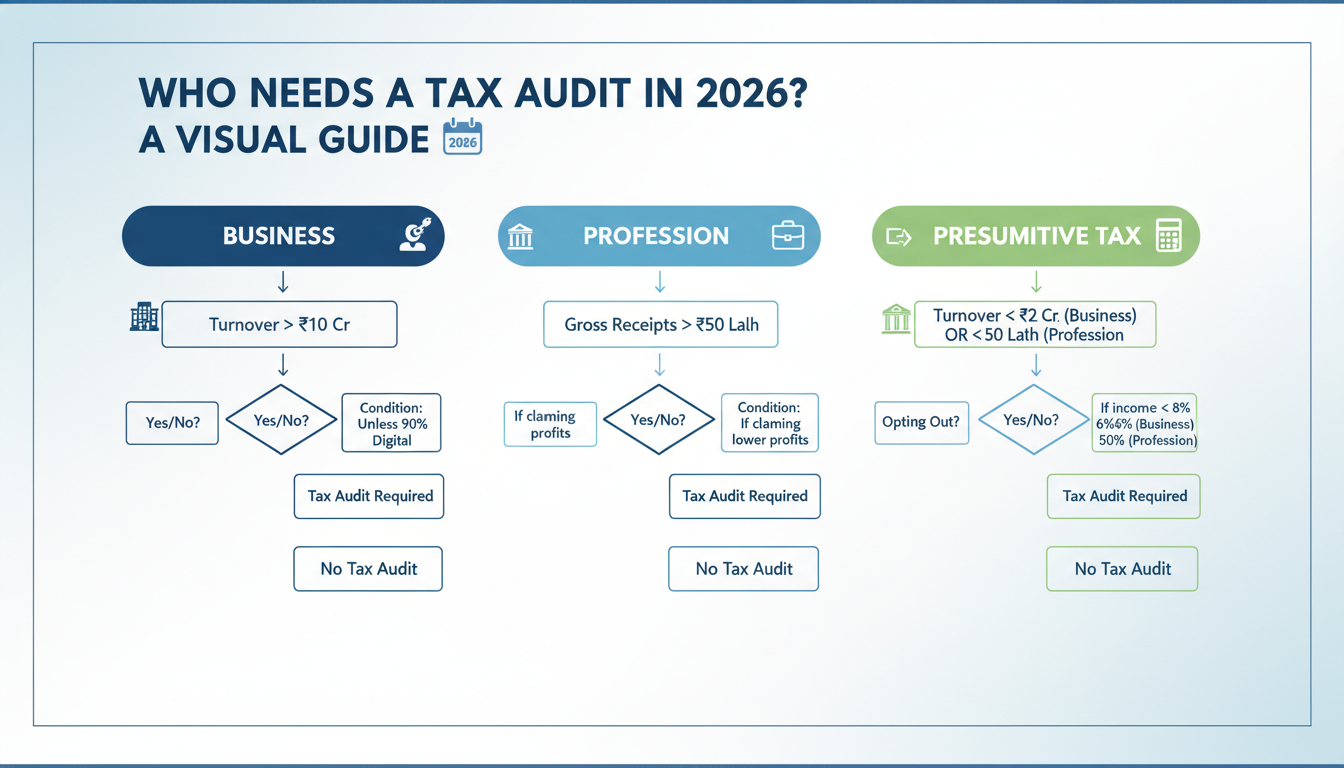
Based on our hands-on experience with clients, the nuances are where people get tripped up, especially with the presumptive tax schemes. Here’s a clear comparison of the thresholds for the Financial Year 2025-26 (which corresponds to Assessment Year 2026-27).
| Taxpayer Category | Turnover/Receipts Threshold for Mandatory Audit | Key Conditions & Exceptions |
|---|---|---|
| Business Owners | Exceeds ₹1 crore | Threshold increases to ₹10 crore IF cash receipts and payments are 5% or less of the total. This is a major incentive for digital transactions. |
| Professionals (Doctors, Lawyers, CAs, etc.) | Exceeds ₹50 lakh | This is a hard limit. The ₹10 crore digital transaction benefit does not apply to professionals. |
| Presumptive Tax (Business – Sec. 44AD) | Audit required if you claim profits lower than 6%/8% of turnover. | This only triggers an audit if your total income also exceeds the basic tax exemption limit (e.g., ₹2.5 lakh). |
| Presumptive Tax (Profession – Sec. 44ADA) | Audit required if you claim profits lower than 50% of gross receipts. | Similar to the business scheme, this is only applicable if your total income is above the basic exemption limit. |
⚠️ Watch Out
The presumptive tax trap is real. Many small business owners opt for Section 44AD for its simplicity. However, if you’ve used it in the past and then decide to declare a loss or lower profits in the current year, you could be forced into a mandatory audit. Always consult a tax professional before switching out of the presumptive scheme.
The Clock is Ticking: Key Deadlines for AY 2026-27
Okay, you’ve determined an audit is necessary. Now, let’s talk dates. And this is critical: there are two separate deadlines you need to burn into your memory. Confusing them is one of the most common—and costly—mistakes.
The tax audit report due date is the deadline for your CA to upload the signed audit report (in Forms 3CA/3CB-3CD) to the government’s e-filing portal. The ITR filing due date is your deadline to submit your actual tax return. They are not the same.
| Compliance Task | Due Date for AY 2026-27 | Who It Applies To |
|---|---|---|
| Tax Audit Report Submission (Form 3CA/3CB-3CD) | 30th September 2026 | All taxpayers subject to an audit under Section 44AB. |
| Income Tax Return (ITR) Filing | 31st October 2026 | Taxpayers who were required to submit a tax audit report. |
| Transfer Pricing Report & ITR Filing (Form 3CEB) | 30th November 2026 | Taxpayers with international or specified domestic transactions. |
This one-month buffer between the audit report and the ITR filing is intentional. It gives you time to digest the final audited figures and ensure your ITR is perfectly aligned. Don’t squander it.
The High Cost of Procrastination: Unpacking Section 271B Penalties
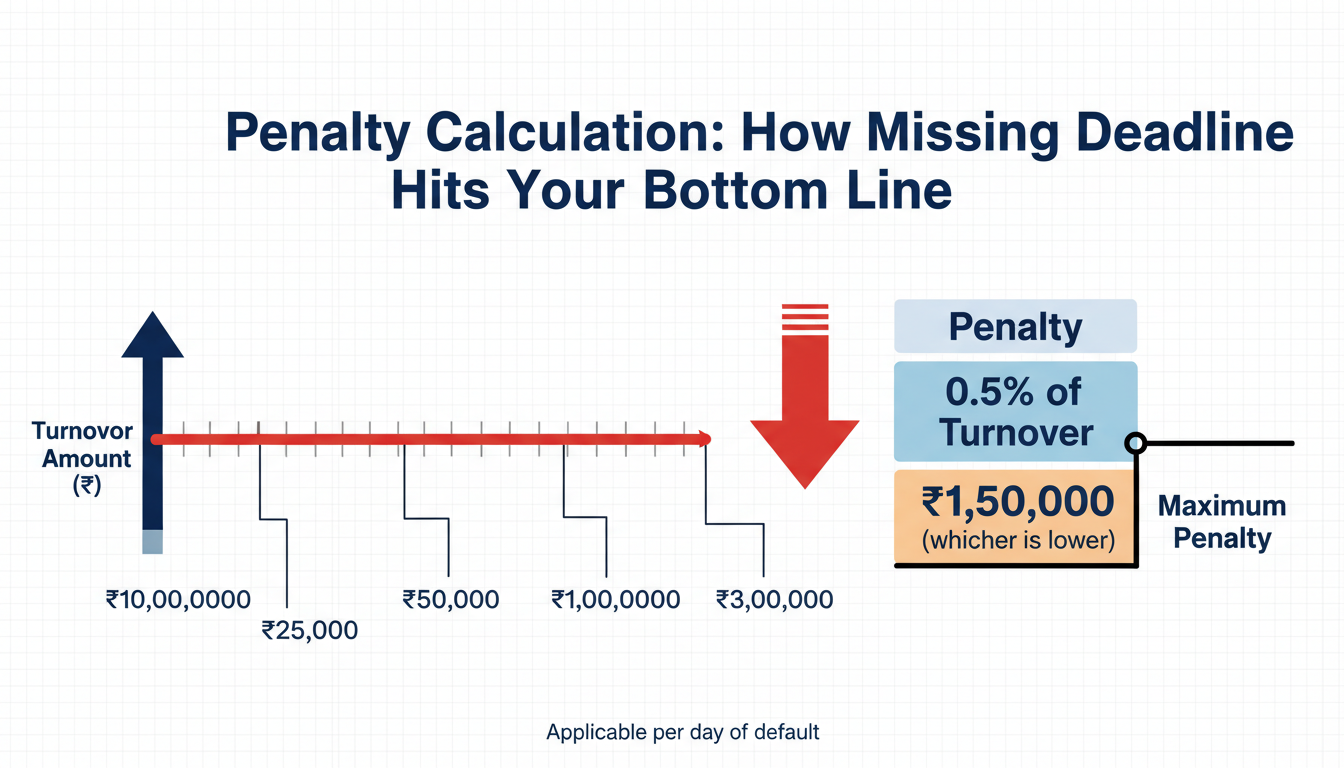
What happens if you miss the September 30th deadline? The consequences are swift and expensive. The Income Tax Act doesn’t mess around here. Under Section 271B, a penalty is levied for failing to get your accounts audited or failing to furnish the report on time.
The penalty is calculated as the lower of these two amounts:
- 0.5% of your total sales, turnover, or gross receipts.
- A flat sum of ₹1,50,000.
Let’s make this real. Imagine a small software company with a turnover of ₹2.5 crores. They miss the deadline. The penalty calculation would be:
- 0.5% of ₹2,50,00,000 = ₹1,25,000
- Flat sum = ₹1,50,000
The lower amount is ₹1,25,000. That’s a huge, completely avoidable hit to their bottom line. It’s not just a slap on the wrist; it’s a significant financial blow.
While the law allows for the penalty to be waived for a ‘reasonable cause’ (like a natural disaster or severe illness), relying on this is a terrible strategy. From real-world cases, we know that the burden of proof is extremely high, and reasons like “my accountant was busy” or “I couldn’t find my documents” will be rejected outright.
Your 7-Step Audit-Ready Action Plan
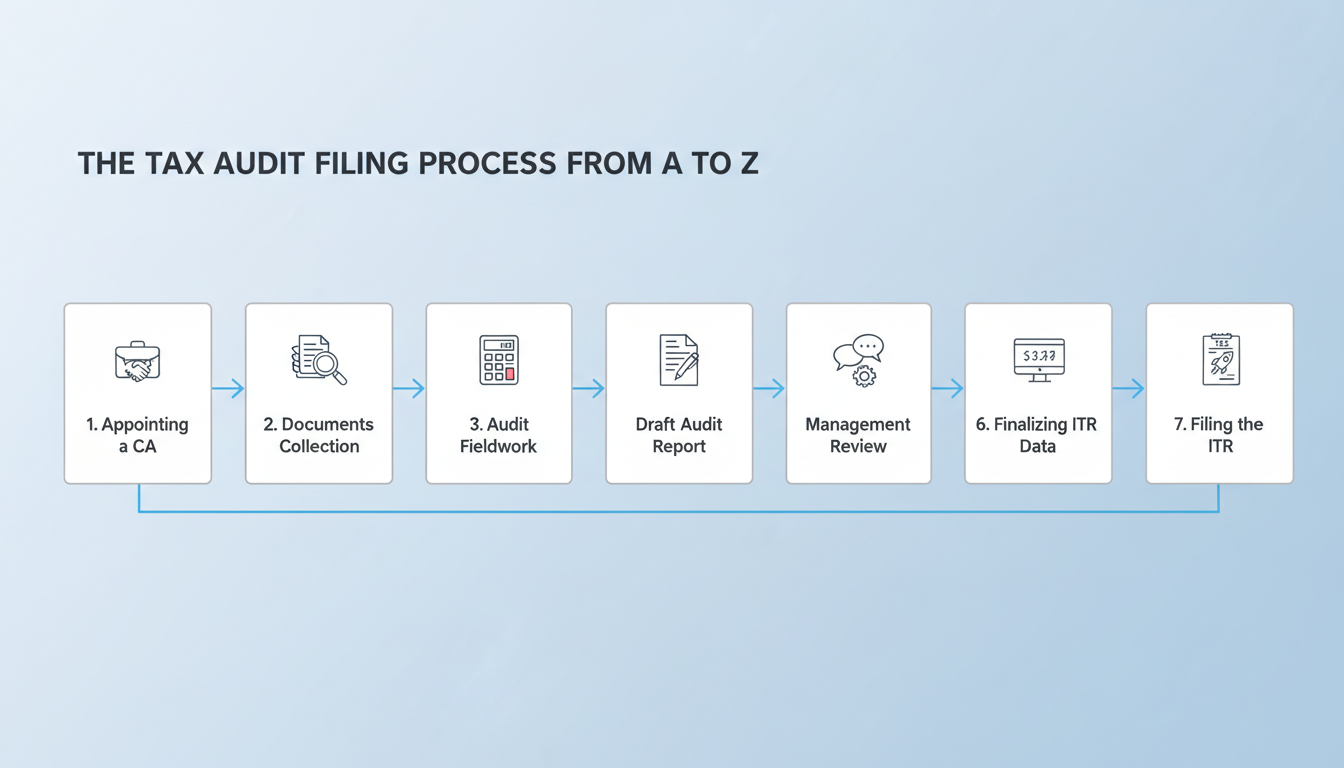
Avoiding the last-minute scramble is all about process. A structured approach turns a daunting task into a series of manageable steps. Here’s the exact workflow we recommend to our clients to ensure a smooth, penalty-free audit season. GST Registration Threshold Limit 2025: A Complete Guide for Businesses (40L vs 20L)
- Appoint Your CA by June. Yes, June. Don’t wait until August or September. The best CAs are booked solid by then. Appointing one early gives them time to understand your business, not just check boxes. It moves the process from a frantic compliance exercise to a valuable business review.
- Create a Digital Document Vault. Your CA will need everything: bank statements, sales ledgers, purchase invoices, expense vouchers, GST returns, loan agreements, and more. Use a shared cloud folder (like Google Drive or Dropbox) and organize documents by month. This is a lifesaver.
- Schedule a Mid-Year Review. Around July, have a meeting with your CA to review your books so far. This proactive check-in can identify potential issues—like missing TDS payments or incorrect GST claims—when there’s still time to fix them.
- Finalize Your Books by August 31st. This is your internal deadline. Hand over a complete, reconciled set of books to your auditor. The cleaner your data, the faster and more efficient the audit will be.
- The CA’s Audit & Report Preparation. During September, your CA will conduct the audit and prepare the report in Form 3CA/3CB and the detailed statement in Form 3CD. Be available to answer their queries promptly.
- The Critical ‘Acceptance’ Step. This is huge. After your CA uploads the report, the job isn’t done. You, the taxpayer, must log in to your own income tax portal account and formally Accept the uploaded report. Without this click, the filing is considered incomplete.
- File Your ITR Before October 31st. With the audit report accepted, you can now file your Income Tax Return. Ensure the financial data in your ITR perfectly matches the figures in the audited statements.
💡 Pro Tip
When choosing a CA, don’t just shop for the lowest price. Ask them about their process, the software they use, and their experience in your specific industry. A good CA is an investment who can offer valuable insights beyond just signing a form. They can help you optimize your tax position for the *next* financial year. How to Add New Director in Private Limited Company: A Complete Step-by-Step Guide
Decoding Form 3CD: The Heart of the Audit
If the audit report is a health check, Form 3CD is the detailed blood report. It’s a comprehensive statement with 44 clauses where your auditor provides granular details about your finances and compliance. The tax department scrutinizes this form carefully.
While you don’t fill it out yourself, understanding its key clauses helps you maintain better records all year long. For instance:
- Depreciation (Clause 18): Requires detailed calculations as per the Income Tax Act, which may differ from your company’s books.
- Disallowed Expenses (Clause 21): Details any expenses you’ve claimed that are not allowed for tax deduction (e.g., certain cash payments over ₹10,000).
- TDS/TCS Compliance (Clause 34): A thorough check of your tax deduction and collection at source compliance. Any defaults are reported here.
- GST Breakdown (Clause 44): This is a big one. It requires a detailed breakdown of all your expenses, separating payments made to GST-registered vendors from those made to unregistered ones. Messy records here are a major red flag.
💡 Pro Tip
For Clause 44, start today. Tweak your accounting software or your bookkeeping process to tag every expense with the GST status of the vendor. Trying to reconstruct this for an entire year in September is a nightmare. Proper record-keeping here is a non-negotiable in 2026.
🎯 Key Takeaway
The tax audit due date is not the starting line; it’s the finish line. True compliance begins with organized bookkeeping from day one of the financial year. Proactive planning and early collaboration with your CA transform tax season from a stressful ordeal into a routine business process.
Your Next Steps to a Stress-Free Tax Season
Look, navigating India’s tax laws can feel complex, but it’s entirely manageable. The key is to treat tax compliance not as an annual event, but as an ongoing business function. The deadlines are fixed, the penalties are real, but the power to stay ahead is entirely in your hands.
Use this guide as your roadmap. Pinpoint where you are in the process and take the next logical step. If you haven’t appointed a CA yet, do it now. If your books are a mess, start organizing. By taking small, consistent actions, you’ll cross the September 30th finish line with time to spare and your peace of mind intact.
❓ Frequently Asked Questions
Can the tax audit report due date be extended?
Yes, the Central Board of Direct Taxes (CBDT) can and sometimes does extend the due date. However, these extensions are typically announced very close to the deadline and are in response to major issues, like portal glitches or widespread natural calamities. According to the official Income Tax portal, you should always plan to meet the original 30th September deadline. Never assume an extension is coming.
What’s the difference between Form 3CA and Form 3CB?
It’s simple. Form 3CA is for businesses or professions that are already required to be audited under another law (like the Companies Act, 2013). Form 3CB is for everyone else who only needs an audit because they crossed the Income Tax Act’s thresholds. Both must be accompanied by the detailed Form 3CD.
My business turnover is below ₹1 crore, but I have a loss. Do I need an audit?
Generally, no. If your turnover is below the ₹1 crore threshold, a loss by itself doesn’t trigger a tax audit under Section 44AB. The exception is if you previously used the presumptive scheme (Section 44AD) and now want to declare a loss or a profit below the deemed rate. In that specific case, an audit becomes mandatory if your total income still exceeds the basic exemption limit.
What happens after I ‘Accept’ the tax audit report online?
Accepting the report is the final step in the audit filing process. It officially registers the report with the tax department. Your next and final task is to file your Income Tax Return (ITR) before its due date (31st October for most audit cases), ensuring all the figures in your return align with the now-finalized audit report.
Is it better to file the audit report and ITR on the same day?
No, and it’s not recommended. The law provides a one-month gap for a reason. Use the time after September 30th to carefully prepare your ITR using the final, audited numbers. Rushing to do both on the same day increases the risk of errors in your ITR, which can lead to notices and further complications.
Where can I learn more about the history of these tax laws?
The foundation of India’s current direct tax system is the Income Tax Act, 1961. This comprehensive legislation provides the legal framework for all income tax, including the provisions for tax audits. The rules and forms are then specified by bodies like the CBDT and professional standards are set by the Institute of Chartered Accountants of India (ICAI).