
You’ve got the idea. The drive. The all-consuming passion to build something from scratch, all on your own. But then, the fear creeps in. What if a client sues? What if the business takes on debt? Suddenly, your personal savings, your car, even your home feel terrifyingly exposed.
For years, this was the solo entrepreneur’s dilemma: choose the simplicity of a sole proprietorship and risk everything, or face the complexity of a multi-person company. It was a terrible choice.
But what if you could have a corporate suit of armor, designed specifically for a founder of one? You can. It’s called a One Person Company (OPC), and in 2026, it’s the single most powerful structure for ambitious solopreneurs in India. This isn’t just another business registration; it’s a strategic launchpad. In this article, you’ll learn exactly what an OPC is, its game-changing benefits, and how to register one, step-by-step.
So, What Exactly is a One Person Company (OPC)?
Let’s cut through the jargon. A One Person Company, or OPC, is a revolutionary business structure introduced by the Companies Act, 2013. Think of it as a hybrid: it gives you, the solo founder, the single greatest advantage of a large corporation—limited liability—while keeping the operational simplicity of a sole proprietorship.
Here’s the core concept: an OPC is a separate legal entity. This means the law sees you and your company as two distinct “persons.”
- Your company can own property in its own name.
- It can sign contracts and open its own bank accounts.
- Crucially, it can incur its own debts and liabilities.
This separation creates a financial firewall between your business assets and your personal assets. It’s the legal foundation that allows you to take calculated risks and build your empire with confidence. Before the OPC, this level of protection was simply unavailable to solo founders. Now, it’s accessible to everyone.
The 7 Core Advantages of an OPC in 2026
Choosing your business structure isn’t a box-ticking exercise; it’s the first major strategic decision you’ll make. For solo founders, the OPC offers a suite of benefits that directly address your biggest challenges. Based on our experience helping hundreds of entrepreneurs launch, these are the advantages that truly matter.
1. Ironclad Limited Liability Protection
This is the big one. The absolute showstopper. With a sole proprietorship, if your business owes money, creditors can come after your personal bank account, your car, and your house. It’s a terrifying thought. An OPC completely eliminates this risk.
Your liability is limited to the capital you’ve invested in the business. That’s it. If the company faces financial trouble, your personal assets remain untouched. This peace of mind is priceless, freeing you to focus on growth, not survival.
2. Sky-High Credibility and Trust
Let’s be honest. Which sounds more professional? “Rohan Sharma, Freelancer” or “Rohan Sharma Web Solutions (OPC) Private Limited”?
Registering as an OPC instantly elevates your brand. It signals to potential clients, vendors, and partners that you are a serious, legitimate business entity. I’ve seen this play out time and again: a registered company often has an easier time landing larger corporate contracts and securing better payment terms. It’s a powerful signal of stability and professionalism.
💡 Pro Tip
Use your “(OPC) Private Limited” suffix everywhere—on your website, business cards, and email signature. It’s a constant, subtle reminder to everyone you interact with that they are dealing with a formal corporate entity, not just an individual.
3. Unlocks Easier Access to Funding
Try walking into a bank for a business loan as a sole proprietor. It’s tough. Banks and formal lenders see proprietorships as high-risk. An OPC, with its corporate structure and formal financial records, is a different story entirely.
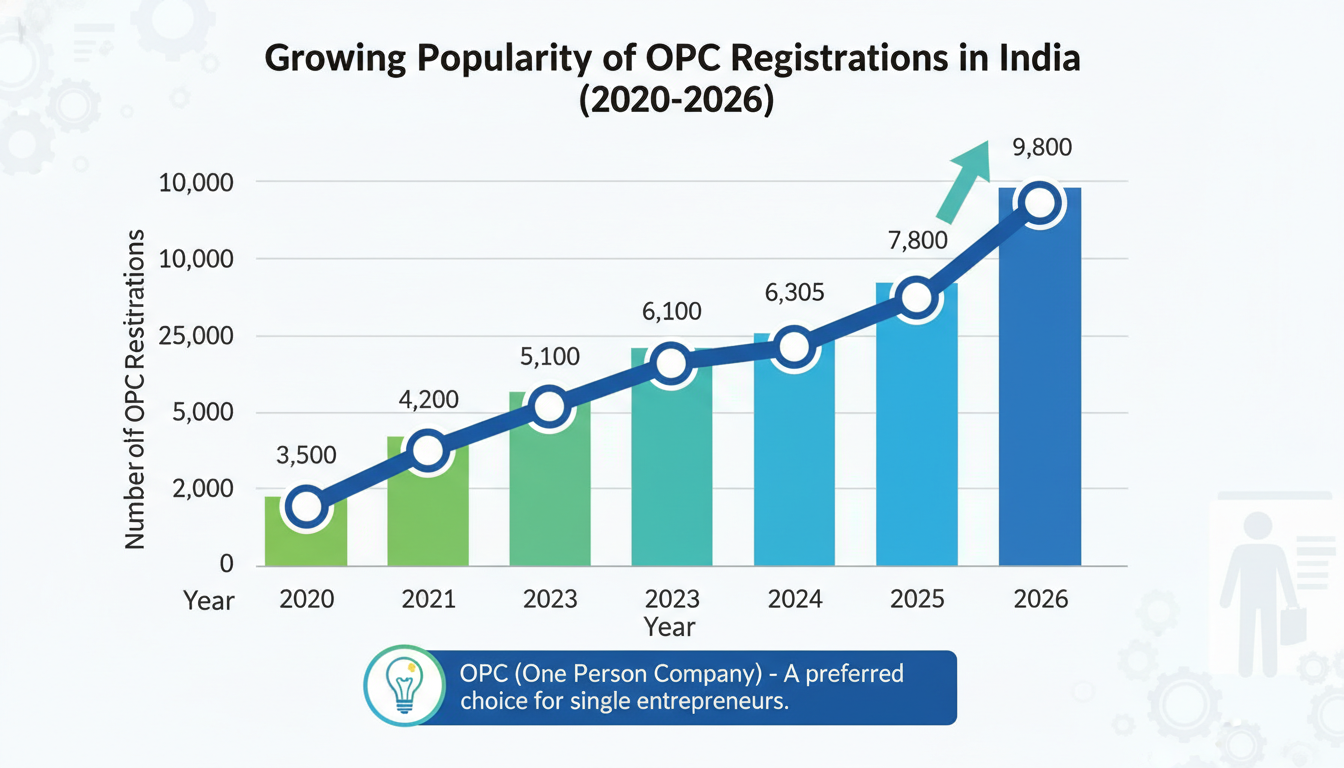
Lenders view OPCs more favorably because the business’s finances are separate and transparent. While you can’t issue shares to the public, an OPC structure makes it significantly easier to secure bank loans, and it provides a clear path to convert to a Private Limited Company later to raise funds from angel investors or venture capitalists.
4. Ensures Business Continuity (Perpetual Succession)
What happens to a sole proprietorship if the owner passes away? The business dies with them. An OPC solves this with a feature called perpetual succession.
During registration, you must appoint a nominee. This person is designated to take over the company in the event of your death or incapacitation. This ensures the business you’ve worked so hard to build can continue to operate, serve its customers, and provide for your family. It’s about building a legacy, not just a job.
⚠️ Watch Out
Choosing your nominee is a critical decision. Don’t just pick a name at random. Select a trusted individual and have a frank conversation with them about their role and responsibilities. Ensure they have given their written consent, as this is a mandatory part of the registration process.
5. Total Control, Lightning-Fast Decisions
No partners to consult. No board meetings to schedule. No co-founder disagreements. As the sole member and director of your OPC, you have 100% control. Every decision is yours to make, allowing for incredible agility.
In today’s fast-paced market, this is a massive competitive advantage. You can pivot your strategy, seize a new opportunity, or approve a project in minutes, not weeks. You are the captain of your ship, with full authority to steer it as you see fit. 8th Pay Commission Big Update – Salary Increase for Govt Staff
6. Simplified Compliance Burden
“Corporate structure” often sounds like “mountains of paperwork.” While an OPC does have more compliance duties than a proprietorship, the government has significantly simplified them compared to a Private Limited Company. For example, an OPC is exempt from holding an Annual General Meeting (AGM). These relaxed requirements, as outlined by the Ministry of Corporate Affairs, save you precious time and money on administrative overhead.
7. A Separate Legal Identity
This ties back to the core concept but has practical benefits worth mentioning. Because the company is a separate “person,” it can own assets like trademarks, patents, and real estate directly. This makes managing intellectual property and other valuable assets much cleaner and more secure than holding them in your personal name.
🎯 Key Takeaway
A One Person Company is the ultimate legal toolkit for a solo founder. It provides the liability protection of a large corporation and the credibility of a registered business, all without the complexity of having partners or a board of directors.
OPC vs. Sole Proprietorship: A Head-to-Head Showdown
Still on the fence? Seeing the differences side-by-side makes the choice crystal clear. For any serious entrepreneur, the OPC is in a different league.
| Feature | ✅ One Person Company (OPC) | ❌ Sole Proprietorship |
|---|---|---|
| Liability | Limited. Your personal assets are 100% protected from business debts. | Unlimited. Your home, car, and savings are at risk. |
| Legal Status | Separate Legal Entity. The company is distinct from you. | No Separation. You and the business are legally the same. |
| Credibility | High. Seen as a formal, professional, and stable business. | Low. Often perceived as a small, informal operation. |
| Business Continuity | Perpetual Succession. The business can outlive the founder via a nominee. | Ends with the owner’s death or incapacitation. |
| Access to Funding | Easier. Preferred by banks and formal lenders. | Very Difficult. Considered high-risk by most lenders. |
How to Register Your OPC in 2026: A 6-Step Guide
The registration process has become highly streamlined thanks to the MCA’s online portal. While it’s straightforward, attention to detail is key. Here’s the roadmap:
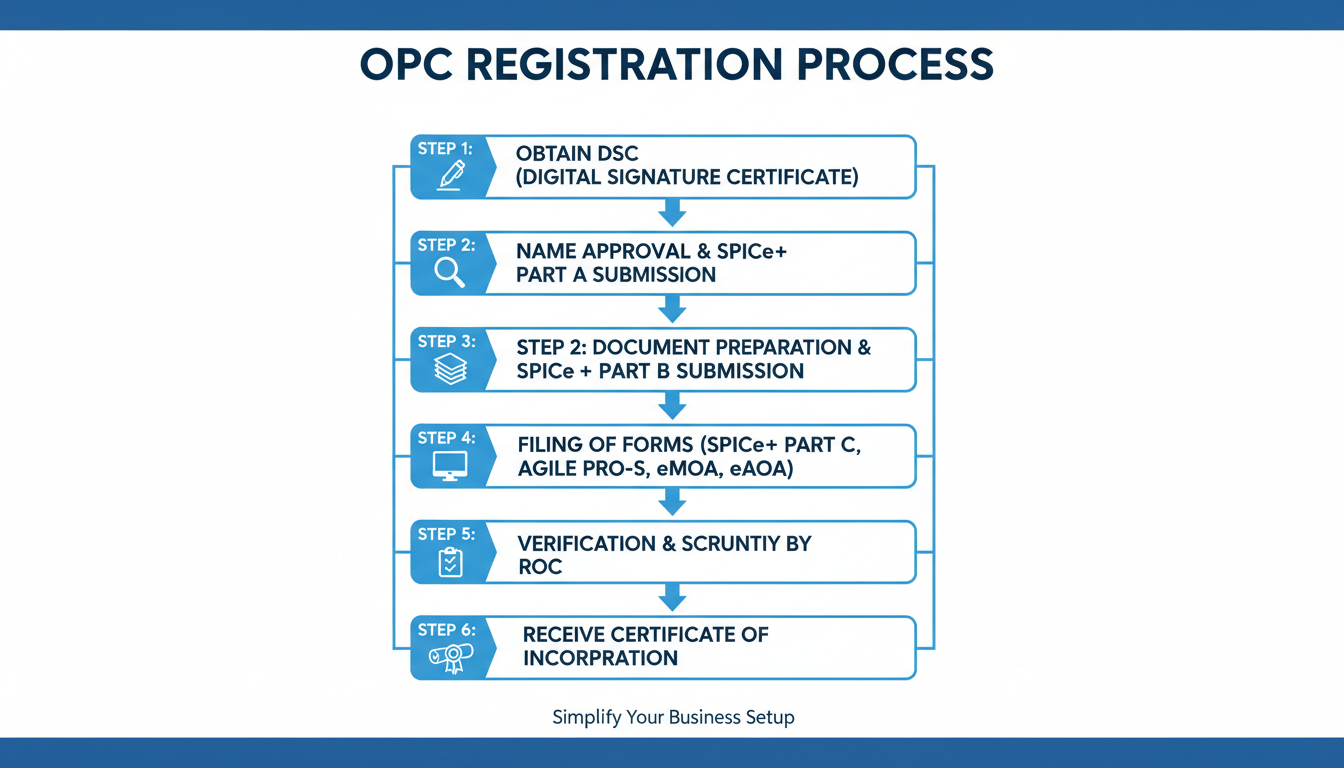
- Step 1: Obtain a Digital Signature Certificate (DSC)
This is your electronic signature and is mandatory for filing forms online. The proposed director of the OPC must obtain a Class 3 DSC from a certified agency. - Step 2: Reserve Your Company Name (SPICe+ Part A)
Your company name is your identity. It must be unique and end with the suffix “(OPC) Private Limited”. You’ll file the SPICe+ Part A form on the MCA portal to apply for name reservation. It’s wise to have a couple of options ready. - Step 3: Prepare All Essential Documents
This is the most critical preparation phase. You’ll need:- Memorandum of Association (MoA): Defines your company’s objectives.
- Articles of Association (AoA): Outlines the internal rules of your company.
- Nominee Consent: A signed consent from your chosen nominee in Form INC-3.
- Proof of Office: A rental agreement or ownership deed for your registered office address, along with a utility bill.
- Identity & Address Proof: PAN card and Aadhaar card/Voter ID/Passport for both the member and the nominee.
- Step 4: File the Main Incorporation Form (SPICe+ Part B)
This is the master form where everything comes together. You’ll fill in details about your company’s capital, director, and nominee, and attach all the documents prepared in Step 3. This form also integrates applications for your company’s PAN and TAN. - Step 5: Verification by the Registrar of Companies (RoC)
Once submitted, an officer from the RoC will scrutinize your application. If everything is in order, your application will be approved. If there are discrepancies, you may be asked to resubmit the form with corrections. - Step 6: Receive Your Certificate of Incorporation!
This is the moment of truth. Upon approval, the RoC will issue the Certificate of Incorporation. This is the official birth certificate of your company. Congratulations, you are now a corporate entity!
⚠️ Watch Out
A common mistake is a mismatch between the name/address on your identity documents and the details filled in the form. Even a small typo can lead to rejection. Double-check every single detail before submission. Accuracy is your best friend here.
OPC vs. PLC vs. LLP: Choosing the Right Structure
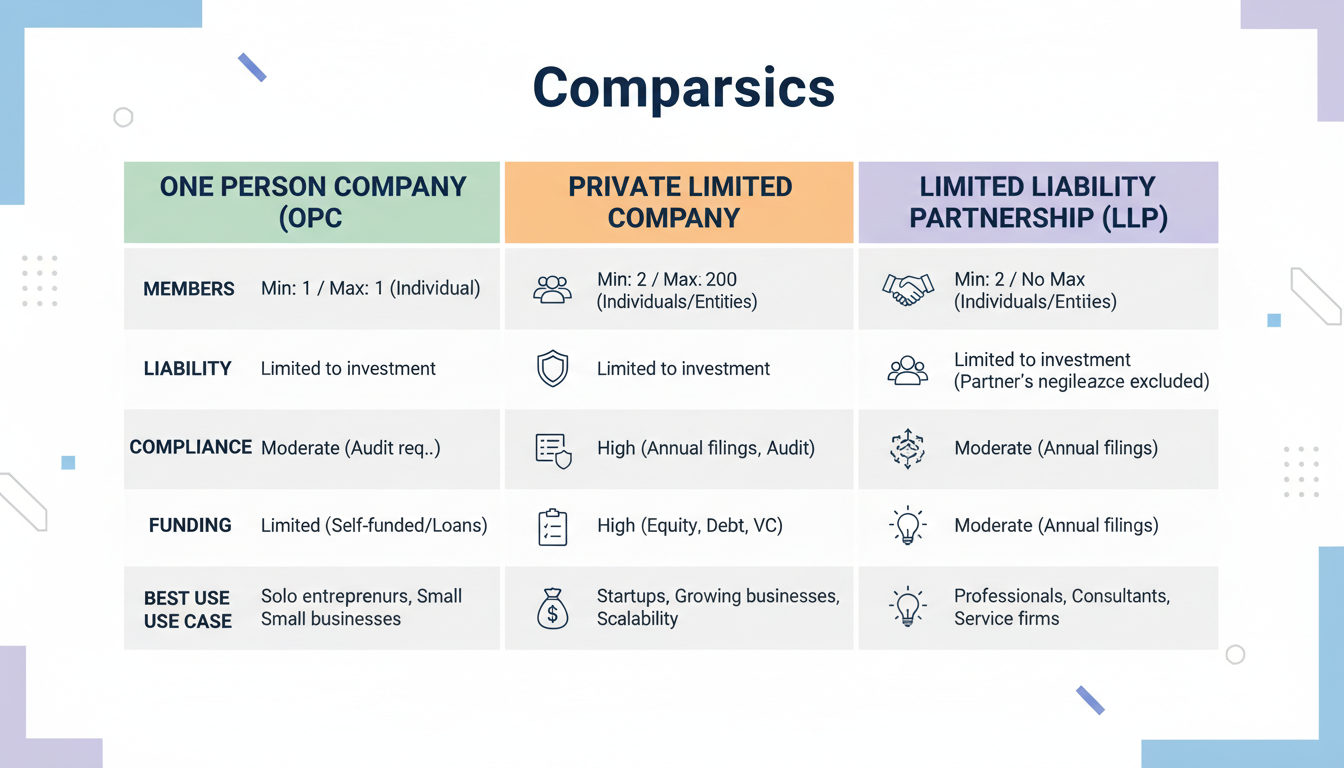
The OPC is perfect for one, but what if you plan to bring on partners later? Understanding how it compares to a Private Limited Company (PLC) and a Limited Liability Partnership (LLP) is crucial for long-term planning.
| Parameter | One Person Company (OPC) | Private Limited Co. (PLC) | Limited Liability Partnership (LLP) |
|---|---|---|---|
| Minimum Members | 1 | 2 | 2 |
| Maximum Members | 1 (Must convert if more) | 200 | No Limit |
| Minimum Directors | 1 | 2 | 2 (Designated Partners) |
| Liability | Limited | Limited | Limited |
| Compliance Burden | Low (e.g., no AGM) | High | Moderate |
| Best For | Solo founders seeking liability protection and credibility. | Startups planning to raise equity funding and scale. | Professional service firms (CAs, lawyers) and joint ventures. |
💡 Pro Tip
Start with an OPC. It’s the perfect, low-compliance launchpad. As your business grows and you need to bring in investors or partners, you can seamlessly convert your OPC into a Private Limited Company. The regulations are designed to support this growth trajectory.
❓ Frequently Asked Questions
Who can start a One Person Company in India?
To form an OPC, you must be a natural person, an Indian citizen, and a resident of India. A person is considered a resident if they have stayed in India for at least 120 days in the preceding financial year. Non-resident Indians (NRIs) and foreign nationals cannot form an OPC.
Can I be a member of more than one OPC?
No. The law is very clear on this. An individual can incorporate only one OPC and can be a nominee in only one other OPC. This rule ensures the structure is used by genuine solo entrepreneurs as intended.
Is an annual audit mandatory for an OPC?
Yes, absolutely. Just like any other company registered under the Companies Act, 2013, an OPC must have its financial accounts audited by a practicing Chartered Accountant every year. These audited financials must then be filed with the RoC.
What happens if the sole member of an OPC dies?
This is where the nominee comes in. Upon the death of the sole member, the designated nominee is legally entitled to inherit all the shares and become the new member of the company, ensuring the business continues without any legal hurdles. This process is known as perpetual succession.
Can an OPC accept investment from an angel investor?
Not directly. An OPC can only have one member (shareholder). To accept equity investment from an angel investor or VC, you must first convert the OPC into a Private Limited Company, which can have up to 200 shareholders. The conversion process is well-defined and a common step for growing OPCs.
Conclusion: Your Business, Formalized and Fortified
The One Person Company isn’t just a legal formality; it’s a declaration of intent. It’s you telling the world—and yourself—that you’re building a real, durable business, not just a side hustle.
It provides the perfect trifecta for the modern solopreneur: the complete control of a proprietorship, the liability protection of a corporation, and the enhanced credibility to win bigger deals. By removing the need for a co-founder to gain these corporate advantages, the OPC has truly leveled the playing field.
If you’re a driven individual with a vision, stop operating with unnecessary risk. The path to formalizing your venture is clear. Your next step is to take that brilliant idea and give it the strong, secure corporate foundation it deserves. It’s time to build.
Read Also:
- Pvt Ltd Company Registration in India (2026): A Founder’s Guide
- Auditor Appointment in India 2026: The Definitive Guide
- ROC Filing Guide 2026: A 7-Step Plan to Avoid Penalties
- 7 Essential Steps for NGO Registration Tax Exemption in India (2024 Guide) – Visual Story
- LLP or Pvt Ltd? Your 2026 Startup Choice
- One Person Company (OPC) Registration 2026: The Ultimate Guide
- Form DPT-3 Filing Guide 2026: Avoid Penalties & Master Compliance
- MGT-7 Due Date 2026: A Guide to Filing & Avoiding Penalties
- MCA Name Availability 2026: Get Your Company Name Approved – Visual Story
- Small Company Definition India 2026: Turnover & Capital Limits
- The Ultimate Guide to Starting an OPC Company in 2024: 7 Key Benefits
- Form INC-20A Filing in 2026: The Ultimate Business Commencement Guide