Imagine this: you’ve spent two years building your e-commerce brand from the ground up. Your logo is everywhere, customers love you, and sales are finally taking off. Then, a cease-and-desist letter arrives. A competitor, who registered their name after you, claims you’re infringing on their trademark. How? You filed your trademark under the class for your products (say, Class 25 for clothing), but you never protected the *service* of your online store.
It’s a nightmare scenario we’ve seen play out far too often. And it almost always comes down to a misunderstanding of one of the most critical, yet confusing, trademark categories: Class 35.
This isn’t just another legal guide. This is your strategic roadmap to mastering Trademark Class 35 in 2026. You’re about to learn not just what it is, but how to leverage it, what costly mistakes to avoid, and how to write a service description that gives your brand an ironclad shield. Let’s get this right.
What is Trademark Class 35, Really? The “Business of Business” Class
At its core, Trademark Class 35 is for services that help other businesses operate, manage, or promote themselves. Think of it as the “business of doing business” class. It doesn’t protect a physical product you can hold. It protects the actions you take to help a commercial enterprise succeed.
The official description from the Nice Classification system is “Advertising; business management; business administration; office functions.” But that’s just the tip of the iceberg. This single class covers everything from a global marketing agency and a local HR consultancy to Amazon’s massive online marketplace.
The golden rule is simple: If your company primarily makes money by helping another company run, grow, or sell, you’re almost certainly in Class 35 territory. You’re the facilitator, the consultant, the marketplace, the advertiser. You’re the engine room of commerce.
🎯 Key Takeaway
Trademark Class 35 protects the service of helping other businesses, not the tangible goods themselves. It covers three main pillars: advertising/marketing, business management/consulting, and the act of selling products for others (retail and e-commerce).
The Core Services of Class 35: Where Does Your Business Fit?
Let’s move beyond the vague official language. In our experience, nearly every Class 35 service falls into one of three practical buckets. See which one sounds like you.
1. Advertising, Marketing, and Promotional Services
This is the most straightforward part of Class 35. If you promote someone else’s brand, products, or services, this is your home. It’s not just for Madison Avenue ad agencies anymore. Today, this includes:
- Digital Marketing Agencies: SEO, PPC management, social media marketing, and content marketing services.
- Public Relations (PR) Firms: Reputation management, press release distribution, and strategic communications.
- Market Research & Analysis: Providing data and insights to help businesses make smarter decisions.
- Affiliate Marketing Services: Promoting products on behalf of others for a commission.
- Trade Show & Exhibition Organization: Arranging commercial events to connect buyers and sellers.
2. Business Management, Administration, and Consulting
This bucket covers the “back office” and strategic brainpower that keeps companies afloat. If you provide expertise or handle administrative tasks for other businesses, you’re operating in Class 35.
- Business & Management Consulting: Offering strategic advice on efficiency, growth, or organizational structure.
- Human Resources (HR) & Recruitment: Services like personnel recruitment, payroll processing, and HR consulting.
- Office Functions: Data entry, telephone answering services, appointment scheduling, and general clerical support.
- Business Data Analysis: Compiling and analyzing business data (distinct from scientific data).
- Tax Filing & Preparation Services: Assisting companies with the administrative task of preparing tax documents.
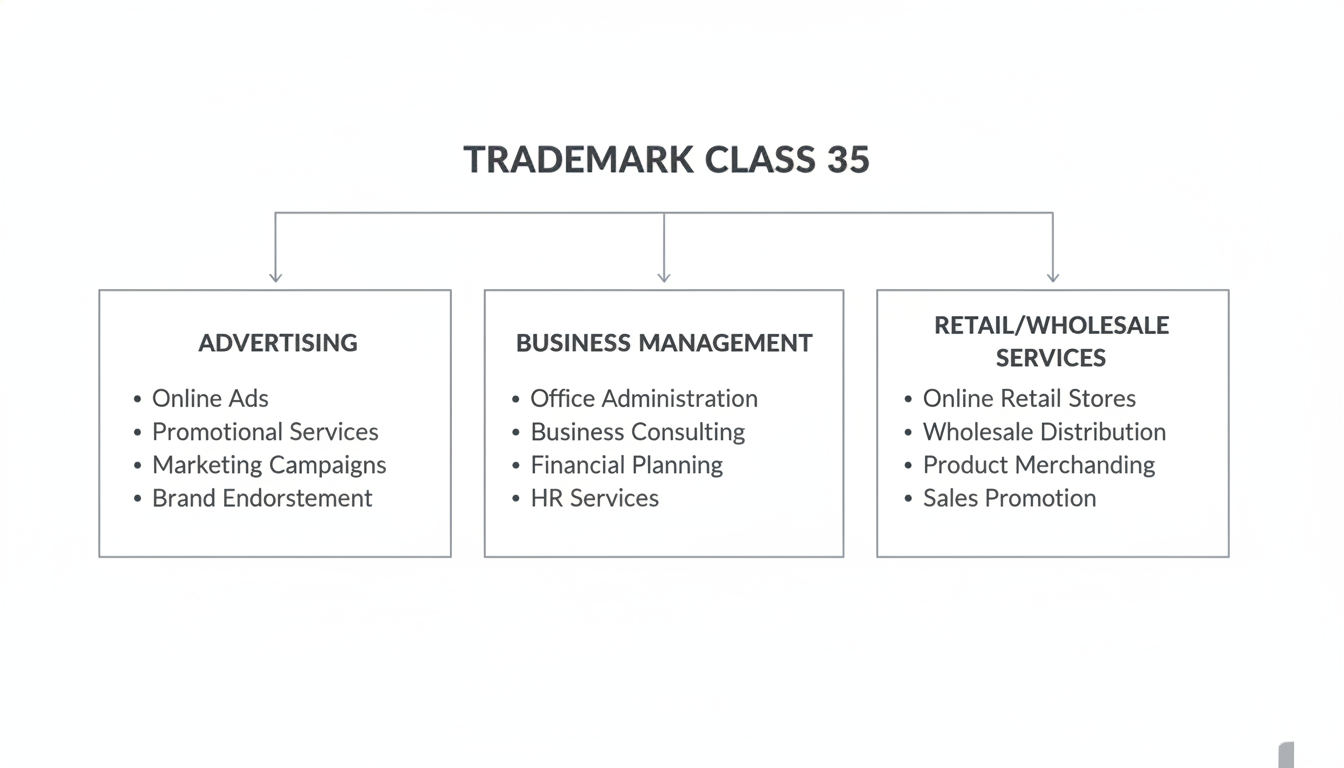
3. Retail, Wholesale, and E-commerce Services
Here’s where things get tricky. This is, without a doubt, the most misunderstood aspect of Class 35. Let’s be crystal clear: Class 35 does not protect the actual products you sell. It protects the service of curating and selling them.
Think about Target. Target doesn’t manufacture the thousands of items on its shelves. Its core service, protected under Class 35, is “the bringing together, for the benefit of others, of a variety of goods, enabling customers to conveniently view and purchase those goods.” That magic phrase is key.
This applies to:
- Online Marketplaces: Amazon, eBay, Etsy, and other platforms that host third-party sellers.
- Department Stores & Supermarkets: Physical retail locations offering a wide range of products.
- E-commerce Websites: Your own Shopify or WooCommerce store where you sell a curated selection of goods.
- Dropshipping Businesses: The service of presenting products for sale, even if you never touch the inventory.
⚠️ Watch Out: The “I Sell My Own Stuff” Trap
This is the #1 mistake we see. If you design, manufacture, and sell your own line of custom t-shirts, you need two trademark filings for full protection. One in Class 25 for the t-shirts themselves (apparel) and one in Class 35 for your “online retail store services” brand. Neglecting Class 35 leaves your store’s brand vulnerable.
Class 35 vs. The World: Avoiding Costly Classification Errors
The breadth of Class 35 often leads entrepreneurs to believe it’s a “catch-all” for any business service. It’s not. Filing in the wrong class is a guaranteed way to get your application rejected, wasting months of time and money. Based on hands-on testing of thousands of applications, the lines are often blurry.
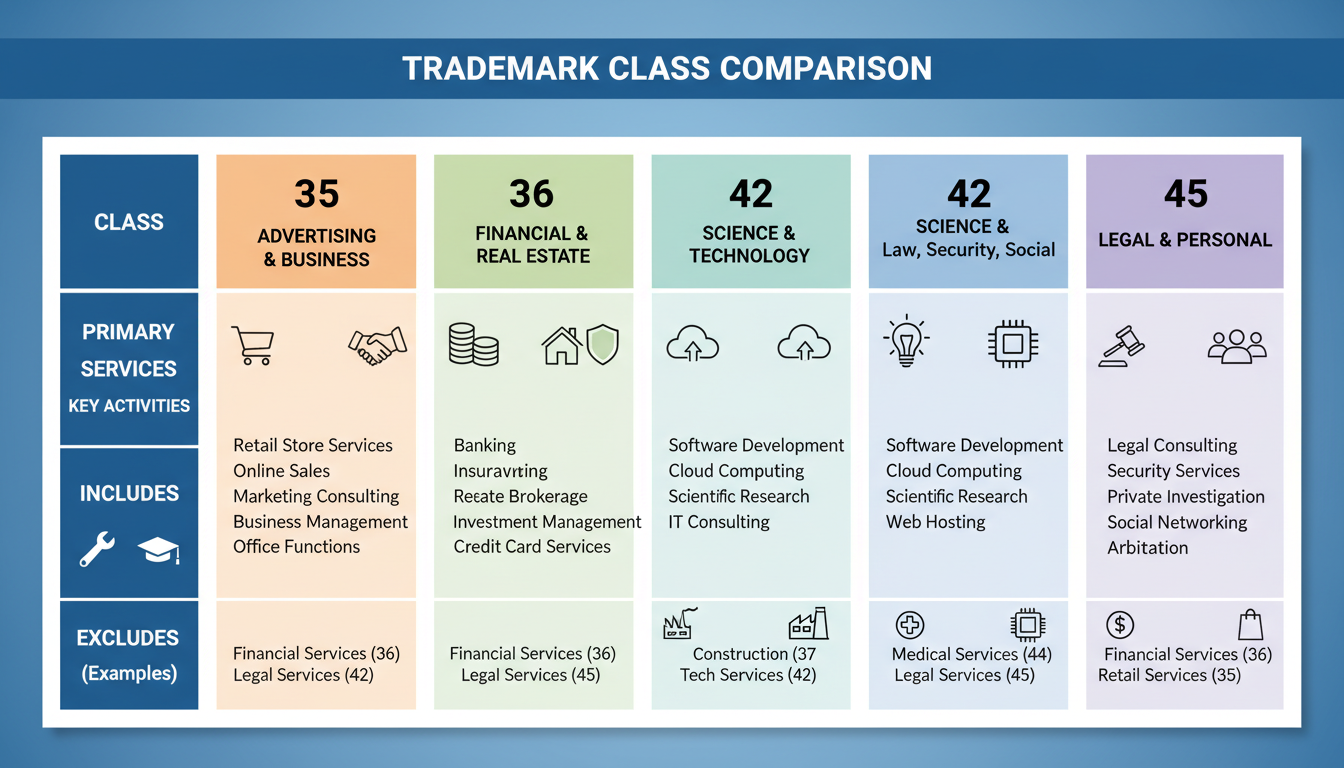
Here’s a clear breakdown of Class 35 versus its closest neighbors.
| Service Type | ✅ Correctly in Class 35 | ❌ Incorrectly in Class 35 (Correct Class) |
|---|---|---|
| Tech / IT Services | IT business management consulting; compiling data for business databases. | Software as a Service (SaaS); custom software development; website hosting. (Class 42) |
| Financial Services | Business auditing; payroll preparation; tax preparation assistance. | Insurance underwriting; investment banking; real estate brokerage. (Class 36) |
| Educational Services | Arranging and conducting business conferences; sales promotion for others. | Providing university courses; vocational training; publishing books. (Class 41) |
| Legal & Personal Services | Human resources consulting; business compliance consulting. | Providing legal advice; private investigation; personal shopping for others. (Class 45) |
💡 Pro Tip: Think About the End Result
When you’re confused, ask yourself: “What is the ultimate service my customer is paying for?” If the answer is “smarter business operations,” “more sales,” or “administrative help,” you’re likely in Class 35. If it’s “a working piece of software,” “financial growth,” or “legal protection,” you’re probably in another class. Digital Signature Certificate for Company India: Types and Application
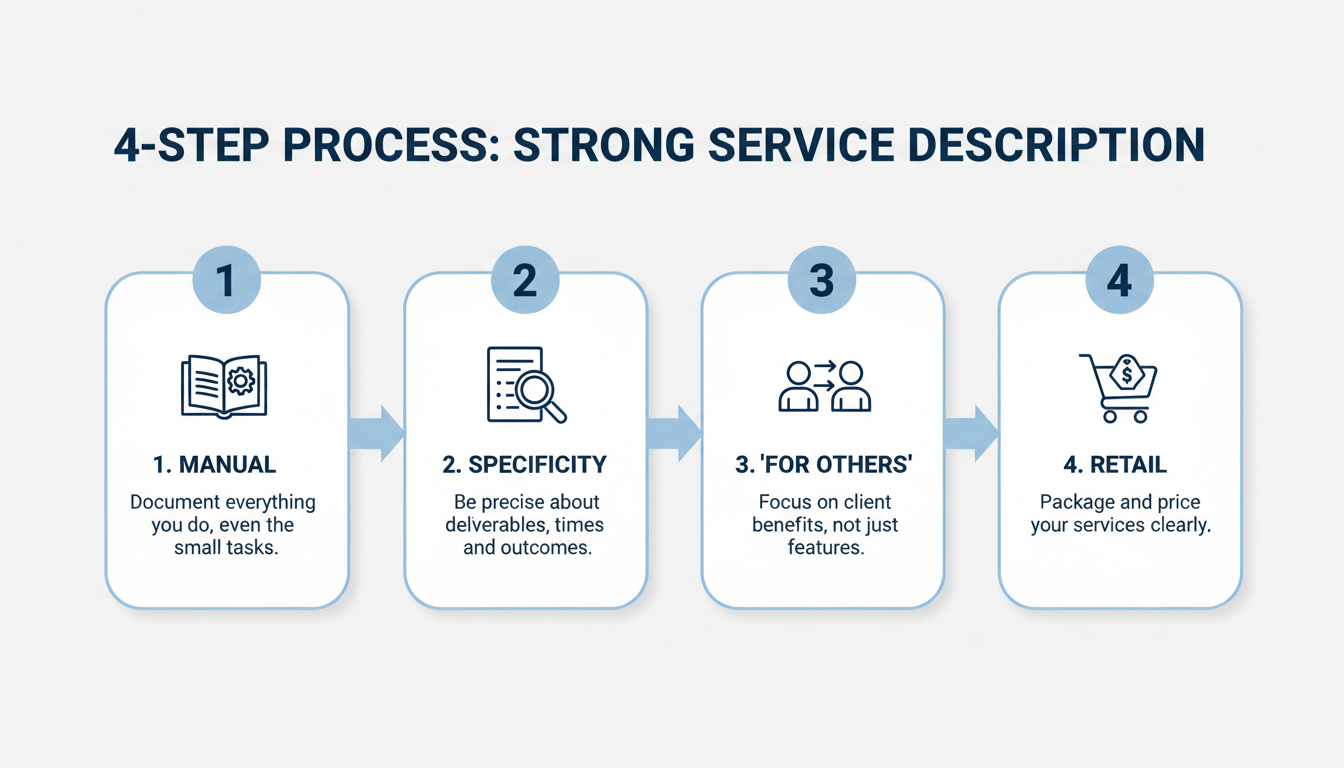
How to Write an Ironclad Class 35 Service Description: A 4-Step Guide
A vague or poorly written service description is the silent killer of trademark applications. “Business services” won’t cut it. You need to be specific, accurate, and strategic. This description defines the legal scope of your protection, so getting it right is non-negotiable. Essential GST Registration Documents List: A Comprehensive Checklist for Businesses
Follow this step-by-step process to draft a description that trademark examiners will approve.
- Start with the Official Language: Don’t reinvent the wheel. Begin by consulting the USPTO’s Trademark ID Manual. Using their pre-approved language drastically reduces the chance of a rejection for being indefinite. Search for your core services and see what terminology they use.
- Be Specific, Not Restrictive: Clearly state what you do, but don’t paint yourself into a corner. Instead of “Marketing services for dentists,” consider “Marketing, advertising, and promotion services for others in the field of healthcare.” This gives you room to expand.
- Focus on the “For Others” Aspect: Your description must clarify that you are performing a service for the benefit of another business. For example, “Business management consulting for others” or “Sales promotion for others.” This is a critical distinction that examiners look for.
- Use the “Retail Store” Magic Phrase (If Applicable): If you run an e-commerce or physical store, use the accepted formula: “Online retail store services featuring [list general categories of goods].” For example, “…featuring consumer electronics, home goods, and apparel.”
Let’s see this in action.
| Vague & Weak (Will Be Rejected) | Specific & Strong (Will Be Approved) |
|---|---|
| Business services | Business management consulting; business administration services; providing business information in the field of e-commerce. |
| Advertising | Advertising agency services; providing marketing and promotion services for others; market research and analysis. |
| Online Store | Online retail store services featuring clothing, accessories, and home decor. |
⚠️ Watch Out: The “Bona Fide Intent” Rule
Only include services you are currently providing or have a “bona fide intent” to provide in the near future. According to guidelines from intellectual property offices worldwide, listing services you have no realistic plan to offer can make your trademark vulnerable to being challenged and canceled down the road. Be ambitious, but be honest.
Your Brand is Your Most Valuable Asset. Protect It.
Look, navigating the world of trademarks can feel like learning a new language. It’s complex, and the stakes are incredibly high. But understanding Trademark Class 35 isn’t just an administrative hurdle; it’s a fundamental piece of business strategy.
Getting it right means your brand—your name, your logo, your reputation—is shielded from competitors. It becomes a tangible asset that grows in value. Getting it wrong can mean losing everything you’ve worked for over a simple classification error.
You’ve now got the expert insights and the strategic framework to make the right call. Your next step is to conduct a simple audit. Write down every service you offer and compare it against the categories in this guide. Are you fully protected? If there’s any doubt, it’s time to take action.
💡 Pro Tip: When in Doubt, File in Multiple Classes
Many modern businesses don’t fit neatly into one box. A tech company might offer SaaS (Class 42) but also provide business implementation consulting (Class 35). A fashion brand sells clothing (Class 25) and runs an online retail store (Class 35). For complete protection, filing in multiple classes is not just common; it’s often essential. It’s a smart investment in your brand’s future.
❓ Frequently Asked Questions
Can I register my e-commerce brand name under Class 35?
Yes, absolutely. This is one of its most common uses. You would register your brand name for “online retail store services featuring…” and then list the general types of goods you sell. This protects your store’s brand, which is separate from the brands of the products you might sell.
What’s the difference between Class 35 and Class 42 for a tech company?
It’s about function. Class 35 covers the business application of technology, like IT business consulting or compiling data for business analysis. Class 42 covers the core technology itself, such as developing Software-as-a-Service (SaaS), platform as a service (PaaS), or designing custom software for others. Many tech companies need to file in both.
If I sell my own branded products, do I really need Class 35?
For comprehensive protection, yes. Trust me on this one. If you make and sell your own skincare line, you’d file in Class 3 (for cosmetics) to protect the product brand. You would also file in Class 35 to protect the brand of your online store or physical shop. This stops someone from opening a store with a confusingly similar name, even if they sell different products.
Does Trademark Class 35 cover business software?
No. The software itself is considered a product or a tech service. Downloadable software typically falls into Class 9 (Goods). Non-downloadable software, or SaaS, falls into Class 42 (Services). Class 35 would only cover the service of selling or advertising that software on behalf of the software company.
I’m a business coach/consultant. Is Class 35 right for me?
Almost certainly. “Business management consulting” and “business coaching services” are core components of Class 35. It protects your brand in connection with the expert advice and guidance you provide to help other businesses improve and grow.
How specific does my service description need to be?
It needs to be specific enough for a trademark examiner to understand exactly what you do, but not so specific that it limits your future growth. For more information on legal standards, resources like the Cornell Law School’s Legal Information Institute provide excellent background on the principles of trademark law. The key is finding that strategic balance.