
Your company is growing fast. Revenue is climbing, you’re hiring, and things feel… complex. Suddenly, you’re juggling risks you never even considered a year ago. This is the exact moment when a single question starts to loom large: “Do we need an internal audit?”
Most business leaders see it as a compliance headache, a box to be ticked only when the law forces their hand. But what if that’s completely wrong? What if an internal audit is actually one of the most powerful strategic tools you can deploy to protect your growth and unlock hidden efficiencies?
Look, this isn’t another dry legal memo. This is your definitive 2026 playbook. You’re about to learn not just the mandatory legal triggers for an internal audit in India, but also the strategic signals that tell you it’s time to act—long before you’re legally required to. We’ll cover the thresholds, the benefits, the process, and the costly mistakes to avoid. Let’s get started.
Beyond the Balance Sheet: What an Internal Audit *Really* Is in 2026
First, let’s kill a common myth. An internal audit isn’t about finding fault or playing “gotcha” with your teams. Think of it less like a police investigation and more like a high-tech MRI for your business operations. Its job is to give you a crystal-clear, unbiased picture of what’s happening under the hood.
Unlike an external audit, which primarily looks backward to verify financial statements for outsiders, an internal audit is forward-looking and for your eyes only. It’s an independent consulting activity designed to add real value. In our experience, the best internal audits focus on four key pillars:
- Risk Management: Are you blind to a critical cybersecurity threat? Is your supply chain more fragile than you think? An audit stress-tests your defenses.
- Control Evaluation: It checks if your internal processes—from expense approvals to inventory management—are actually working as designed to prevent errors, waste, and fraud.
- Governance Assurance: It gives your board and leadership confidence that the company is running ethically and that decisions are being made in a structured, responsible way.
- Operational Efficiency: It uncovers bottlenecks, redundancies, and opportunities for automation that your day-to-day teams might be too busy to see.
Essentially, it answers the question every CEO has: “Are we doing things right, and are we doing the right things?”
The Legal Line in the Sand: Mandatory Internal Audit Applicability
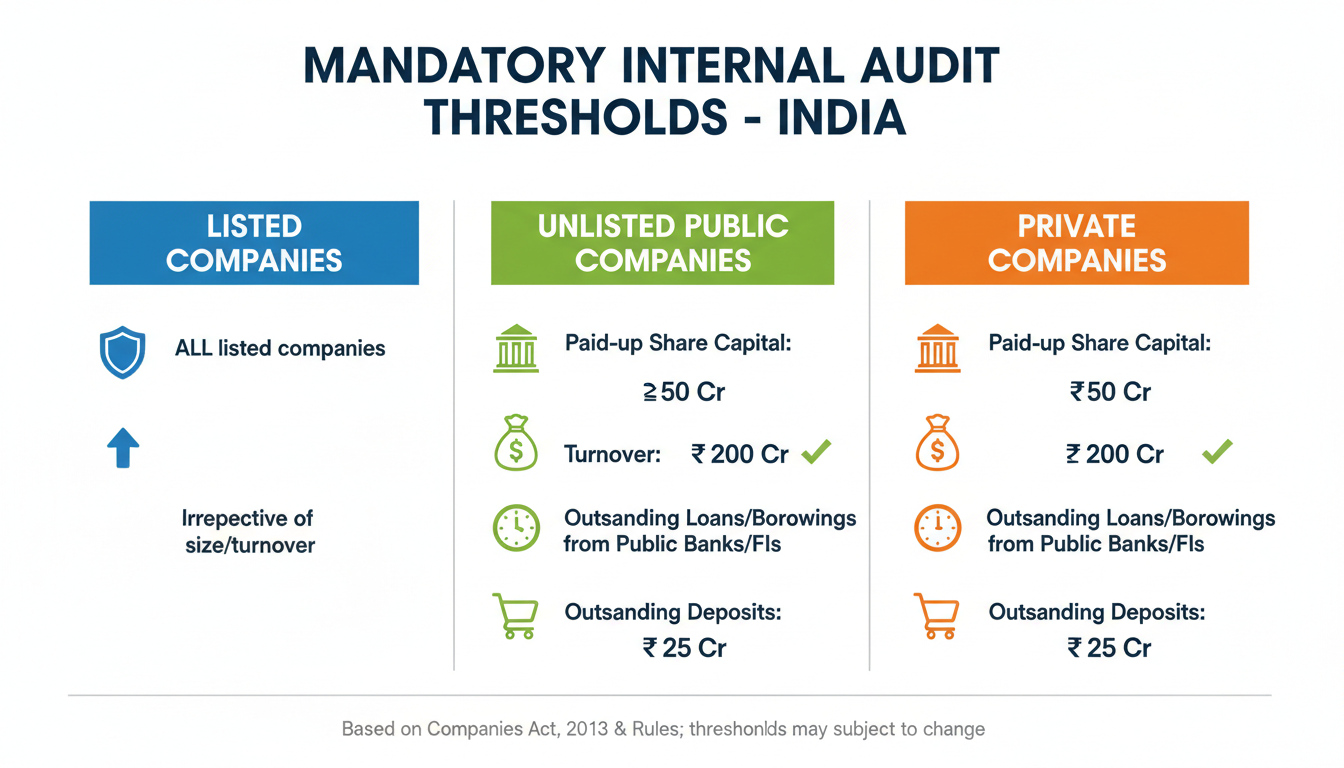
While the strategic case is compelling, the law is the law. In India, Section 138 of the Companies Act, 2013, lays down the rules. Certain companies don’t have a choice; an internal audit is mandatory. The triggers are based on your company type and specific financial thresholds from the preceding financial year.
Let’s break down these non-negotiable requirements.
| Company Type | Mandatory Trigger |
|---|---|
| Listed Company | Always applicable. The moment your company is listed on any stock exchange, an internal audit is mandatory, regardless of size or turnover. No exceptions. |
| Unlisted Public Company | Applicable if ANY ONE of the following conditions were met in the preceding financial year: • Paid-up Share Capital ≥ ₹50 Crore • Turnover ≥ ₹200 Crore • Outstanding Loans/Borrowings* > ₹100 Crore • Outstanding Deposits ≥ ₹25 Crore |
| Private Company | Applicable if ANY ONE of the following conditions were met in the preceding financial year: • Turnover ≥ ₹200 Crore • Outstanding Loans/Borrowings* > ₹100 Crore |
*From banks or public financial institutions.
⚠️ Watch Out
The “preceding financial year” clause is a classic tripwire. Don’t wait until your year-end financials are finalized to think about this. If you’re on track to cross one of these thresholds this year, you need to start planning for your internal audit for next year, right now. Waiting until the last minute leads to rushed, low-quality audits.
The Strategic Tipping Point: When to Go Voluntary (Before You’re Forced To)
Smart companies don’t wait for a government mandate. They treat an internal audit as a competitive advantage. Based on hands-on testing with dozens of scaling businesses, we’ve seen that a voluntary audit becomes a strategic necessity when you hit certain growth milestones. It signals maturity to investors, partners, and potential acquirers.
So, when should you pull the trigger? Here are the key strategic scenarios where a proactive audit pays for itself many times over.
| Strategic Trigger | Why an Internal Audit is Crucial |
|---|---|
| Seeking Venture Capital / Private Equity Funding | Investors aren’t just buying your idea; they’re investing in your execution. A clean internal audit report is proof of strong governance and operational control, which significantly de-risks their investment and can smooth out the due diligence process. |
| Rapid Scaling or Expansion | When you’re growing 100% year-over-year, processes break. What worked for 20 employees is a disaster for 100. An audit identifies these breaking points in your systems (finance, HR, operations) before they cause a catastrophic failure. |
| Entering a Highly Regulated Industry | Moving into sectors like fintech, health-tech, or insurance? The compliance burden is immense. An internal audit focused on regulatory adherence is essential to avoid crippling fines and legal trouble. |
| Preparing for an IPO or Acquisition (M&A) | This is non-negotiable. Any potential buyer or public market will scrutinize your internal controls. Having a history of internal audits demonstrates transparency and can directly impact your company’s valuation. |
| Experiencing Unexplained Financial Anomalies | Are inventory levels consistently off? Are expenses in one department suddenly spiking? An audit provides an objective investigation to find the root cause, whether it’s process failure or potential fraud. |
💡 Pro Tip
For a growing business, a full-blown audit can seem daunting. Start with a “phased” or “risk-based” approach. Focus the first audit on your most critical area—say, your revenue cycle or procurement process. This makes it more manageable and delivers high-impact results quickly, building momentum for future audits.
🎯 Key Takeaway
Internal audit applicability isn’t a binary “yes/no” based on legal thresholds. It’s a strategic decision. The moment your operational complexity outpaces your ability to confidently oversee every detail, it’s time to consider a voluntary audit to protect your business and prepare it for the next stage of growth.
A Step-by-Step Guide to Your First Internal Audit
Okay, you’re convinced. But where do you even begin? The process can be broken down into four clear phases. Don’t overcomplicate it. 7 Steps to Master the GST Return Filing Process in India (2024 Guide)
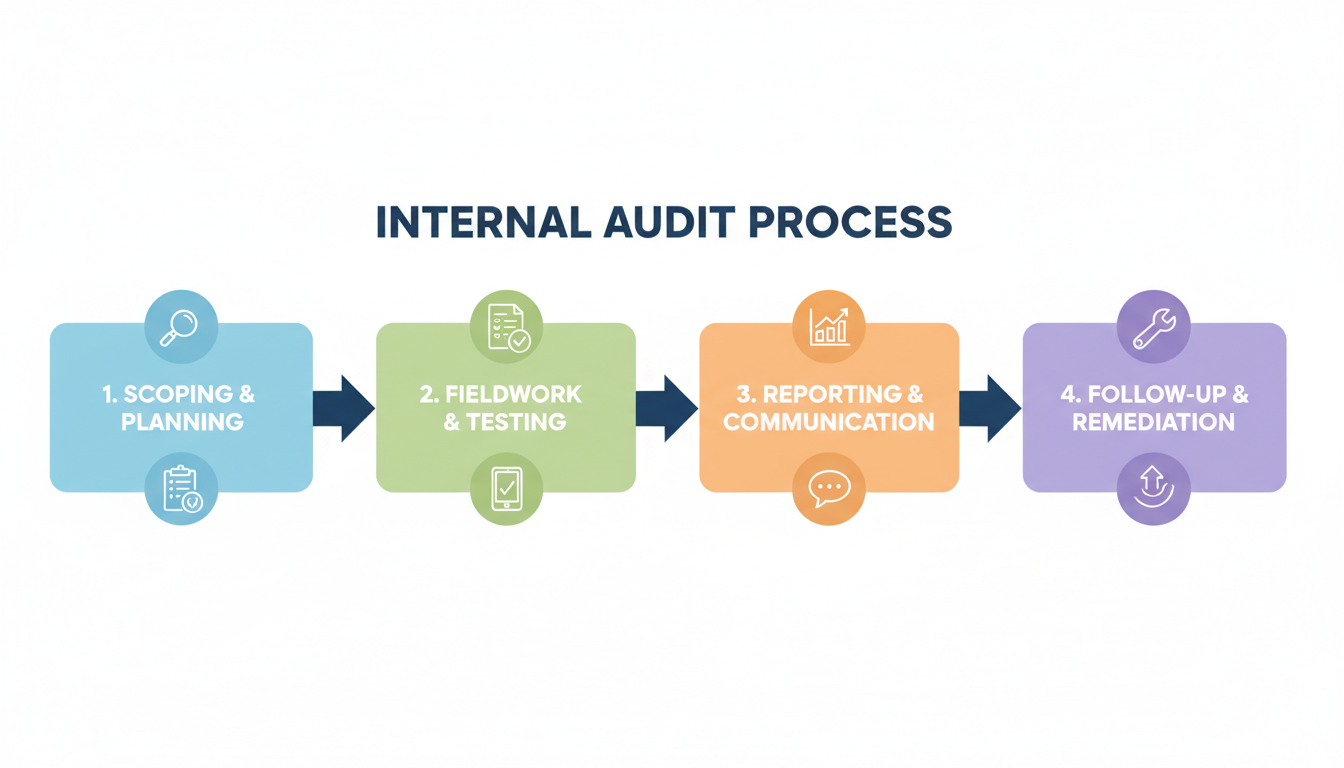
- Define the Scope & Plan: This is the most critical step. Work with your leadership team or audit committee to identify the highest-risk areas of the business. Is it financial reporting? Cybersecurity? Operational waste? A good audit plan is laser-focused on what matters most. You’ll also decide whether to use an in-house team or hire an external firm.
- Conduct Fieldwork & Testing: This is the “audit” part. The auditors will review documents, interview key personnel, observe processes, and test transactions. Their goal is to gather evidence to see if the controls in place are designed effectively and are operating as intended.
- Report the Findings: The auditors will compile their findings into a formal report. This shouldn’t just be a list of problems. A great report provides context, analyzes the root cause of each issue, assesses the potential impact, and offers clear, actionable recommendations for improvement.
- Action and Follow-Up: An audit report that sits on a shelf is worthless. Management must create a concrete action plan to address each finding, assign ownership, and set deadlines. The internal audit function will then follow up to ensure the fixes have been implemented correctly. This closes the loop and drives real change.
💡 Pro Tip
When choosing an auditor, don’t just look for a CA or Cost Accountant. According to The Institute of Internal Auditors (IIA), a global authority, modern internal audit requires a diverse skillset. Look for professionals with expertise in your specific industry, data analytics, and IT systems. This ensures they can provide insights that go beyond basic financial compliance.
Common Pitfalls and How to Avoid Them
I’ve seen this play out dozens of times. Even with the best intentions, companies make predictable mistakes that undermine the value of their internal audit. Here are the big ones to sidestep.
- The “Police” Mentality: If your team sees auditors as internal police looking to punish people, they’ll hide information and be defensive. Frame the audit as a collaborative effort to improve the company for everyone. Communication from leadership is key.
- Focusing Only on Financials: Financial controls are important, but so are operational, IT, and strategic risks. A narrow audit misses huge opportunities. A truly effective audit, as outlined in frameworks like COSO, takes a holistic view of the organization.
- No Executive Buy-In: If the CEO and board aren’t championing the process and demanding action on the findings, the audit will fail. It needs to be driven from the top down.
- Poorly Defined Scope: A vague or overly broad scope leads to a shallow audit that doesn’t provide meaningful depth in any one area. Be specific. Be ruthless in your prioritization.
⚠️ Watch Out
Don’t hire your statutory (external) auditor to also be your internal auditor. This is explicitly prohibited by the Companies Act to prevent a massive conflict of interest. The roles are fundamentally different: one provides an independent opinion for outsiders, the other provides consulting and assurance for insiders. Keep them separate. Always.
Conclusion: From Compliance Burden to Strategic Asset
So, is an internal audit applicable to your business in 2026? As we’ve seen, the answer is two-fold.
First, there’s the legal mandate. Check your numbers against the thresholds from the Companies Act, 2013. If you meet the criteria, it’s not a choice. It’s a requirement.
But more importantly, there’s the strategic imperative. Don’t wait to be told. Look at your growth trajectory, your fundraising plans, and your operational complexity. An internal audit is your tool to get ahead of risk, build a scalable foundation, and prove to the world that your company is built to last. It transforms from a cost center into a value-creation engine.
Your next step? Sit down with your leadership team this quarter. Review the strategic triggers in this article. Have an honest conversation about where your business is most vulnerable. That conversation is the first step toward building a more resilient, efficient, and trustworthy organization.
❓ Frequently Asked Questions
Who can be appointed as an internal auditor?
The board can appoint a Chartered Accountant (CA), a Cost Accountant, or any other professional they deem suitable. This can be an individual employee, a dedicated in-house team, or an external professional firm. The key is ensuring they have the right expertise for your business, not just a generic accounting background.
How often should we conduct an internal audit?
The law doesn’t specify a frequency. Best practice, however, depends on your company’s risk profile. High-risk or rapidly changing companies often benefit from quarterly or semi-annual audits focused on different areas. For more stable businesses, an annual audit might be sufficient. The Audit Committee or Board makes the final call.
Does internal audit applicability cover a Limited Liability Partnership (LLP)?
No. The mandatory requirements of Section 138 of the Companies Act, 2013, apply only to companies. LLPs are not legally required to have an internal audit, though many choose to do so voluntarily for better governance as they scale.
What’s the penalty for not complying with the mandatory internal audit rules?
Non-compliance is a serious offense. The company and every officer found in default can face significant fines as prescribed under the Companies Act. More importantly, it’s a major red flag for investors, lenders, and regulators, damaging your company’s reputation. Trust me, it’s not worth the risk.
Is an internal audit just about finding fraud?
No, that’s a common misconception. While an internal audit can act as a deterrent and help detect fraud, that’s only a small part of its role. Its primary purpose is much broader: to evaluate and improve risk management, internal controls, and governance processes to help the organization achieve its objectives. A study from the Association of Certified Fraud Examiners (ACFE) consistently shows that organizations with proactive internal audits have lower fraud losses.