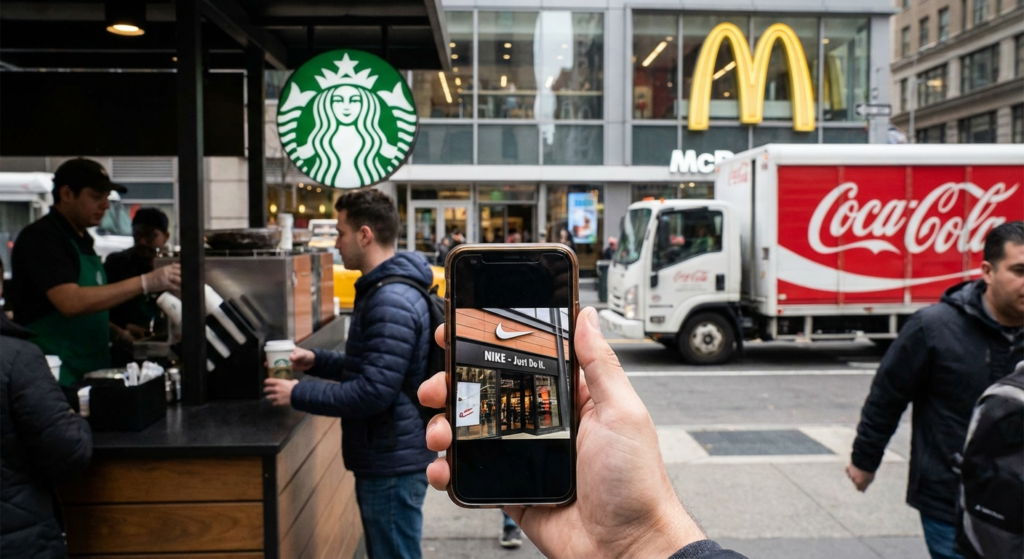
Picture this: You’re walking down a supermarket aisle in a foreign country. You don’t speak the language. You can’t read the labels. Yet, you instantly recognize a red can with a white ribbon script. You spot a triangular chocolate bar. You see a specific shade of “robin’s egg” blue on a box.
You know exactly what those products are. You know what they taste like, what they cost, and how they make you feel.
That isn’t an accident. It’s the result of billions of dollars in legal strategy and brand building. These are trademark examples at their absolute peak. In 2026, where digital noise is at an all-time high, your intellectual property (IP) is arguably your most valuable asset. It’s the only thing separating your hard work from a cheap knockoff.
Whether you’re bootstrapping a startup or managing a legacy portfolio, understanding the mechanics behind these famous marks is non-negotiable. In this guide, we aren’t just listing logos. We’re going to tear down the strategy behind the world’s most successful brands, look at the legal “spectrum of distinctiveness,” and show you exactly how to lock down your own empire.
🎯 Key Takeaway
A trademark is more than just a logo. It is a legal tool that serves as a “source identifier,” allowing consumers to distinguish your goods from competitors. The strongest trademarks are often “fanciful” or “arbitrary”—words and symbols that have no inherent meaning until you give them one.
The Big Three: Essential Trademark Examples
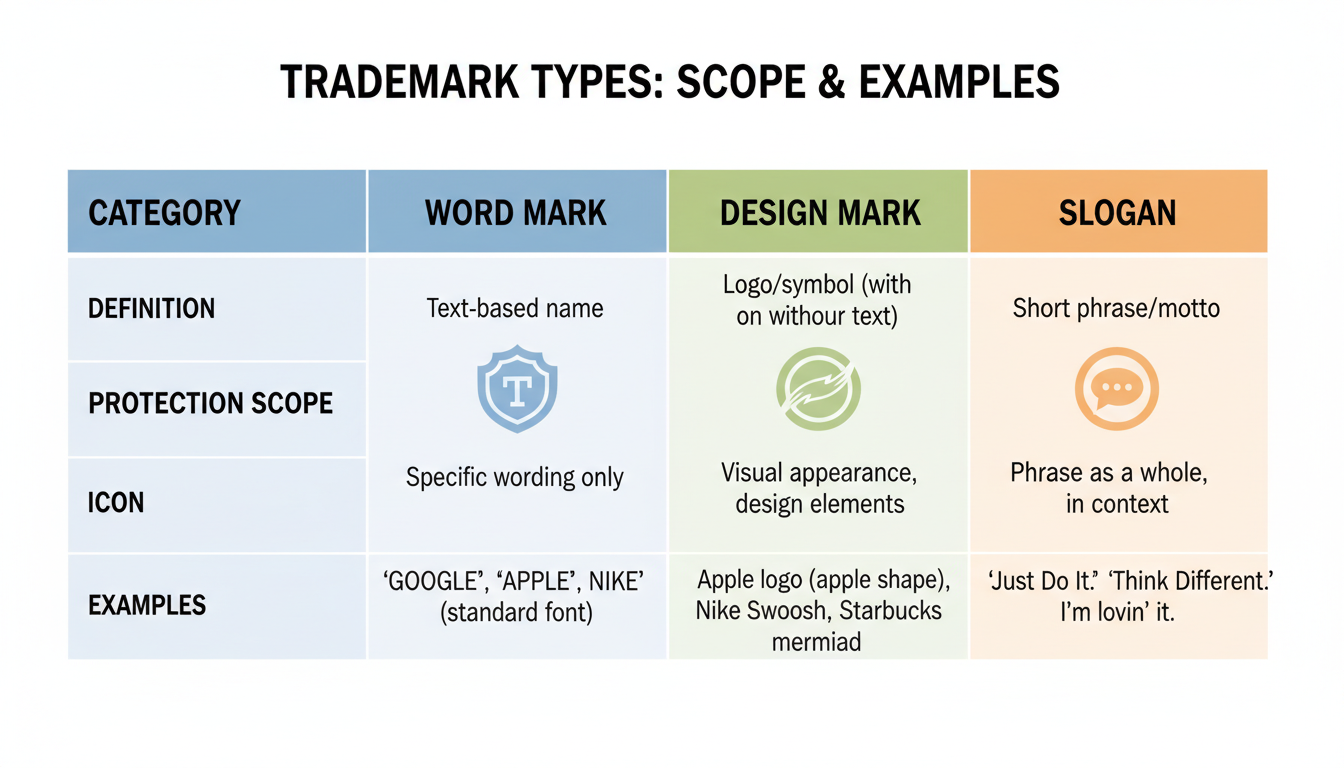
To the average consumer, a “brand” is just a vibe. To a business owner, it’s a bundle of specific legal rights. When we analyze successful trademark examples, they usually fall into three primary buckets. Understanding the difference can save you a fortune in legal fees down the road.
1. Word Marks (The Gold Standard)
A word mark (or “standard character mark”) protects the text itself. It doesn’t matter if you write it in Comic Sans, Helvetica, or neon lights—the word is yours. In our experience, this is the strongest protection you can get because it covers the name in any format.
- Google: You can’t start a shoe company called “Google” written in a different font. The word is locked.
- Coca-Cola: While the script is famous, the text “Coca-Cola” is a registered word mark.
- Nike: The name stands alone, independent of the Swoosh.
2. Design Marks (Logos and Symbols)
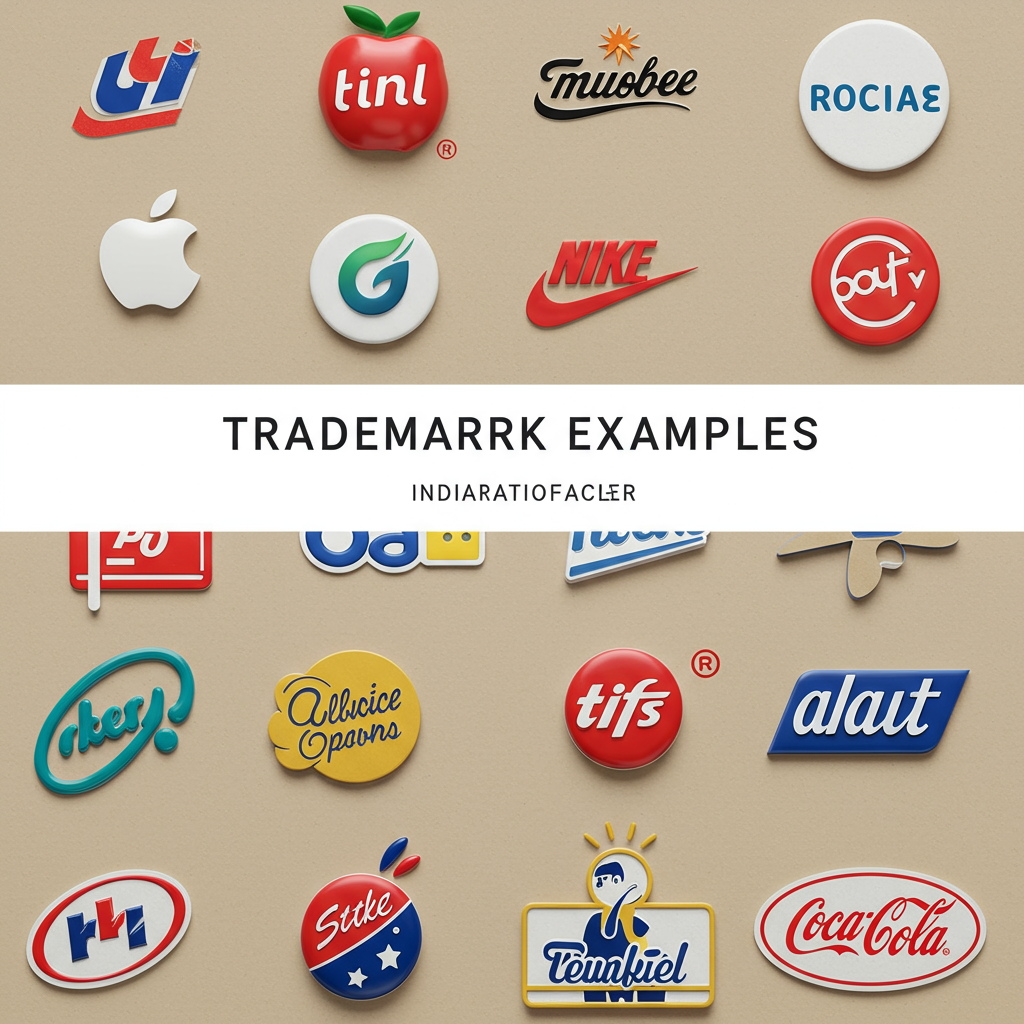
These are visual identifiers. They transcend language barriers, which is why global giants love them. If you’re planning to scale internationally in 2026, a strong design mark is critical.
- Apple’s Silhouette: It’s a fruit with a bite taken out. It says nothing about computers, yet it’s one of the most valuable trademark examples in history.
- The Starbucks Siren: That twin-tailed mermaid signifies premium coffee without a single letter of text.
- The Mercedes-Benz Star: A symbol of luxury engineering that requires no introduction.
3. Slogans and Catchphrases
Can you own a sentence? Absolutely—if it acquires “secondary meaning.” This means the public immediately links the phrase to your brand.
- “Just Do It” (Nike): Three simple words worth billions.
- “I’m Lovin’ It” (McDonald’s): You probably just hummed the jingle in your head. That’s the power of a slogan trademark.
- “The Ultimate Driving Machine” (BMW): A phrase that defines the product’s value proposition.
💡 Pro Tip
Don’t just file for your logo! If you have the budget, file a Word Mark application first. This gives you broader protection. If you only trademark your logo (the design), a competitor might be able to use your business name in a completely different design without technically infringing on your rights.
Comparing Trademark Types: A Quick Reference
Confused about which one you need? Here is a breakdown of how these different marks function in the real world.
| Trademark Type | What It Protects | Best Used For | Famous Example |
|---|---|---|---|
| Word Mark | The text/name itself | Core brand names, product lines | Sony |
| Design Mark | The visual logo/graphic | App icons, merchandise, packaging | Twitter’s Bird (Pre-X) |
| Slogan | A catchphrase | Marketing campaigns, brand ethos | “Think Different” |
| Trade Dress | Product shape/packaging | Unique physical products | Coca-Cola Bottle |
Beyond the Visual: Sensory Trademark Examples
Here is where things get interesting. Did you know you can trademark a sound? A color? A smell? These are known as “non-conventional trademarks.” They are notoriously difficult to register because you have to prove they aren’t just functional.
But when they work, they are incredibly powerful.
Sound Marks
In the streaming era, audio branding is massive. Think about how many apps you recognize just by the notification ping.
- The Netflix “Ta-Dum”: That deep thud at the start of a show? Protected.
- The MGM Lion Roar: One of the oldest sound trademark examples, registered for motion pictures.
- The NBC Chimes: The notes G-E-C are a registered audio mark.
Color Marks
You can’t just “own” the color blue. But you can own a specific shade within a specific industry if it serves as a source identifier.
- Tiffany Blue: Tiffany & Co. owns that specific robin’s-egg blue for jewelry boxes.
- T-Mobile Magenta: Try launching a cellular company using bright magenta. You will get sued.
- Owens-Corning Pink: The first color ever trademarked (1987) for fiberglass insulation.
⚠️ Watch Out
Functionality Doctrine: You cannot trademark a feature that is functional. For example, you can’t trademark the color black for solar panels because black absorbs heat (a functional benefit). You also can’t trademark the shape of a round tire. The feature must be purely for brand identification.
The Spectrum of Distinctiveness: How to Choose a Strong Name
This is the most critical section for any business owner. Not all names are created equal in the eyes of the law. The Cornell Law School defines trademarks along a “spectrum of distinctiveness.”
If you pick a weak name, you will spend thousands trying to defend it. If you pick a strong name, protection is almost automatic. A Comprehensive Guide on How to Add New Director in Private Limited Company: Steps and Compliance

1. Fanciful Marks (Strongest)
These are made-up words. They mean nothing until the brand gives them meaning. Because they are unique, they get the highest level of protection. TDS on Rent Payment Section 194I: A Comprehensive Guide with Examples
- Kodak: Means nothing in any language.
- Exxon: A completely invented term.
- Pepsi: A unique derivative.
2. Arbitrary Marks (Strong)
These are real words used in a way that has nothing to do with their dictionary definition.
- Apple: A fruit. Totally unrelated to computers.
- Shell: A sea object. Unrelated to gasoline.
- Amazon: A river. Unrelated to an online bookstore (originally).
3. Suggestive Marks (Moderate)
These require a leap of imagination. They hint at the product but don’t describe it outright.
- Netflix: Suggests “Net” (internet) and “Flicks” (movies).
- Airbus: Suggests a bus for the air.
- KitchenAid: Suggests it aids you in the kitchen.
4. Descriptive Marks (Weak)
These just describe the product. You generally cannot trademark these unless you’ve been using them for years and have massive recognition.
- American Airlines: Describes the location and service.
- Best Buy: Describes the value proposition.
5. Generic Terms (Zero Protection)
You can never trademark these. You cannot trademark “Apple” for a company that sells apples. You cannot trademark “Elevator” for an elevator company.
| Category | Legal Strength | Marketing Difficulty | Verdict |
|---|---|---|---|
| Fanciful | ⭐⭐⭐⭐⭐ | High (Must educate consumers) | Best for long-term value |
| Arbitrary | ⭐⭐⭐⭐ | Medium | Excellent balance |
| Suggestive | ⭐⭐⭐ | Low (Easy to understand) | Good for startups |
| Descriptive | ⭐ | Very Low | Avoid if possible |
Step-by-Step: How to Secure Your Trademark in 2026
Inspired by these trademark examples? Ready to lock down your brand? Here is the workflow we recommend based on current best practices.
- The “Knockout” Search: Before you spend a dime, search Google and the USPTO database (or your local equivalent). If someone is using a similar name in a similar industry, stop.
- Identify Your Class: Trademarks are filed under “classes” (e.g., Class 25 for clothing, Class 9 for software). You only get protection in the classes you pay for.
- File the Application: In the US, this is done via the TEAS system. You’ll need to submit a “specimen”—proof that you are actually selling goods with this mark.
- Wait for the Examining Attorney: It usually takes 3-6 months for a government attorney to review your file.
- Publication for Opposition: If approved, your mark is published in a weekly gazette. This gives the public 30 days to object if they think your mark hurts their business.
- Registration: If no one objects, you get your certificate. Congratulations, you now own a piece of intellectual property.

Learning from Failure: Infringement Examples
Sometimes the best way to learn is to look at the train wrecks. Infringement doesn’t mean you copied a logo pixel-for-pixel. It means you created a “likelihood of confusion.”
The “South Butt” Parody:
A teenager launched a clothing line called “The South Butt” parodying “The North Face.” He used a similar fleece material and an inverted logo. He argued it was a joke. The courts (and The North Face’s lawyers) didn’t laugh. The lesson? Parody is a very thin shield in trademark law. If consumers might think the brands are related, you are in trouble.
3M vs. 3N:
The conglomerate 3M successfully stopped a company from using “3N.” This highlights that phonetic similarity matters. If it sounds the same, it infringes.
❓ Frequently Asked Questions
Can I trademark my own name?
It’s difficult. Personal names are generally considered “descriptive.” You usually need to prove “secondary meaning”—that when people hear the name, they think of the product, not the person (e.g., Ford, McDonald’s, or Dell). For most new businesses, it’s better to choose a unique brand name.
What is the difference between ™ and ®?
Great question. You can use the ™ symbol immediately on any mark you consider your trademark—no registration required. It signals your intent. However, you can ONLY use the ® symbol after your mark is officially registered with the government. Using ® prematurely is actually illegal.
Does a trademark last forever?
Unlike copyrights (which expire 70 years after death) or patents (20 years), a trademark can last forever. The catch? You must continue to use it in commerce and file maintenance documents (usually every 10 years) to prove it’s still active.
Does my US trademark protect me in Europe or Asia?
No. Trademarks are territorial. A US registration only protects you in the US. If you manufacture in China or sell in Europe, you need to file separately there or use the Madrid System to file one application for multiple countries.
Conclusion: Your Brand is Your Business
From the distinctive shape of a Hershey’s Kiss to the made-up word “Kodak,” the world is built on trademark examples that signal trust and quality. In 2026, your brand is likely the most valuable thing you own—often worth more than your inventory or your office equipment.
Don’t leave it to chance. Audit your current branding. Are you using a generic name that can’t be protected? Are you infringing on a competitor without knowing it? Take the time to select a distinct, powerful mark and protect it legally. It’s the best investment you’ll ever make for your company’s future.
Read Also:
- Auditor Duties 2026: Guarding Economic Truth
- Your 2026 India Business Structure Guide
- Small Company Definition 2026: Are You Missing These Benefits? – Visual Story
- Indian Patent Application Status: The Ultimate 2026 Guide
- Avoid This Costly 2026 Director Filing Mistake
- 7 Essential Startup India Tax Benefits You Must Know in 2025 – Visual Story
- Indian Patent Application Status: The Ultimate 2026 Guide – Visual Story
- Trademark Registration Fees in 2026: The Unfiltered Cost Breakdown
- Trademark Renewal in India: The Ultimate 2026 Guide