Let’s face it: starting a business in India used to feel like jumping off a cliff without a parachute. But things have changed. If you’re building a company today, you’re not just on a daring adventure; you’re on a supported career path. The government is actively pushing for innovation, and for you, that means money saved.
Cash flow is the lifeblood of any early-stage venture. Every rupee you save on taxes is a rupee you can pour back into product development, marketing, or hiring that rockstar developer. That’s where the suite of Startup India tax benefits comes in. These aren’t just minor perks; they are strategic tools designed to keep your capital where it belongs—in your business.
In this guide, I’m going to cut through the legal jargon. We’ll look at exactly how these exemptions work, who qualifies, and how you can claim them without getting a headache.
The Big One: 3-Year Tax Holiday (Section 80-IAC)
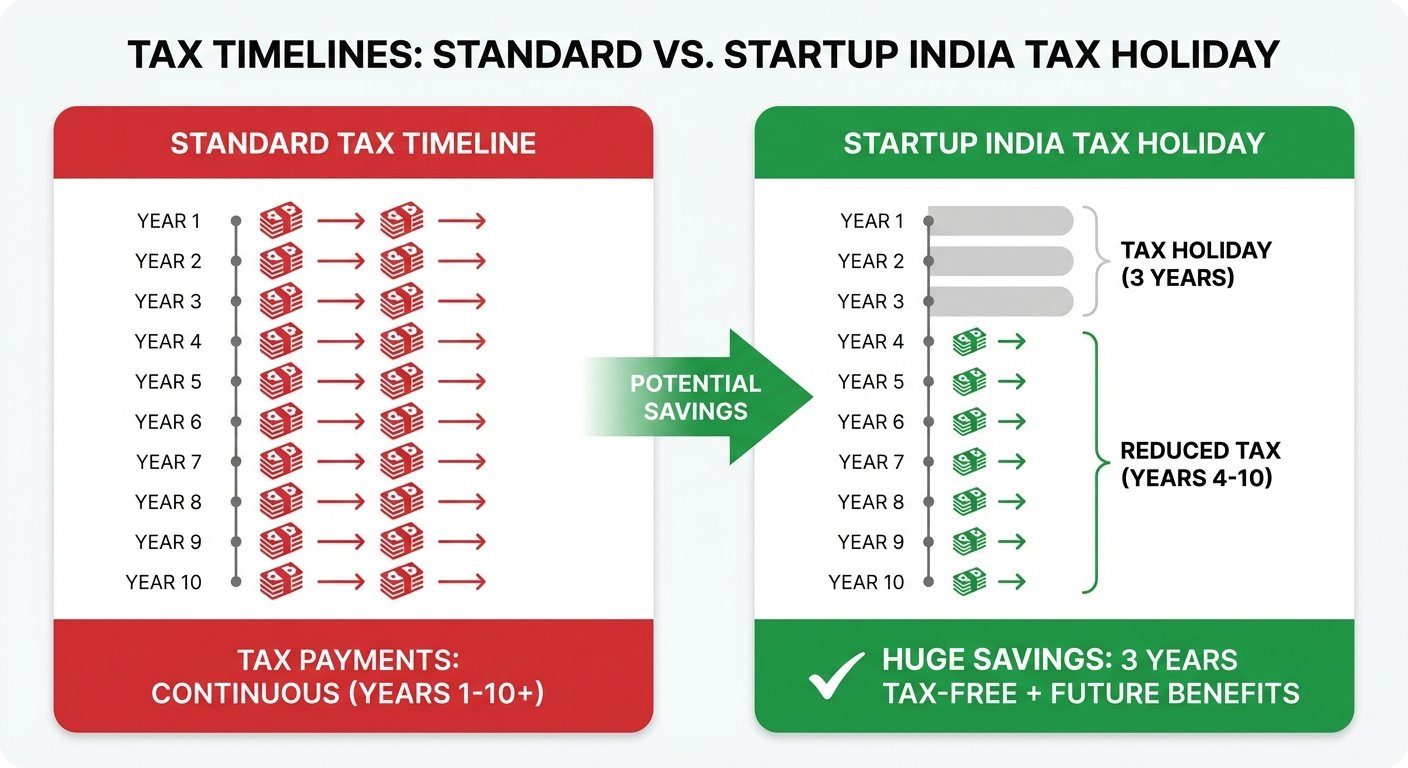
When founders talk about Startup India tax benefits, this is usually the headline act. Under Section 80-IAC of the Income Tax Act, eligible startups can get a 100% tax deduction on their profits for three consecutive years.
You get to pick which three years this applies to within a block of ten years starting from your incorporation. This flexibility is huge. Most startups don’t make a profit in year one or two. But if you hit a massive growth spurt in year four? You can trigger this tax holiday then and pay zero income tax on those windfall profits.
Who Actually Qualifies?
Here’s the catch: not every new business gets this. To unlock this specific tier of Startup India tax benefits, you need to meet strict criteria:
Entity Structure
You must be a Private Limited Company or an LLP incorporated after April 1, 2016. Proprietorships are unfortunately left out of this party.
Certification
DPIIT recognition isn’t enough. You must obtain a Certificate of Eligibility from the Inter-Ministerial Board (IMB).
If you’re still in the napkin-sketch phase, make sure you structure your entity correctly from day one. Check out my guide on how to register a small business in India to ensure you don’t accidentally disqualify yourself before you even start.
The Angel Tax Exemption: Raising Funds Without the Penalty
Raising capital is hard enough without the taxman taking a cut of your investment. Historically, the ‘Angel Tax’ was a nightmare. Under Section 56(2)(viib), if a startup issued shares at a price higher than the Fair Market Value (FMV), the difference was treated as income and taxed. It effectively penalized high-potential startups for having high valuations.
Thankfully, the government fixed this. One of the most critical Startup India tax benefits today is the exemption from Angel Tax. If you are a DPIIT-recognized startup, you are exempt from this provision as long as your total paid-up share capital and share premium don’t exceed ₹25 Crore.
To get this, you simply need to file a self-declaration (Form 2) via the DPIIT portal. It’s a move that has democratized investment, letting you raise funds based on your future potential, not just your current assets.
Capital Gains: Reinvesting Personal Wealth
Often, funding a startup means selling off other assets—like a house or stocks. The government knows this, so they’ve tailored specific Startup India tax benefits to cover capital gains.
Section 54EE: Long-Term Capital Gains
If you have long-term capital gains, you can save on taxes by investing them into a government-notified fund within six months of the asset transfer. The cap here is ₹50 lakh, and you must hold the investment for three years. It’s a great way to park gains tax-free while you focus on your business.
Section 54GB: Selling Property for Equity
This one is huge for founders bootstrapping with personal assets. Under Section 54GB, if you (or your HUF) sell a residential property and invest the gains into equity shares of your eligible startup, the tax on those gains is exempt. The catch? Your startup has to use that money to buy new assets, like machinery or computers, within one year.
Operational Perks That Save You Money
Beyond the headline tax holidays, there are operational benefits that help you survive the daily grind. The Ultimate Guide to Starting a Proprietorship Firm: 7 Steps (2026)
Carry Forward of Losses
Startups burn cash; it’s part of the game. Usually, you can only carry forward losses if shareholding stays the same. But Startup India tax benefits allow you to carry forward and set off losses even if your shareholding changes by more than 51%—as long as the original promoters are still holding shares. This is vital when you’re diluting equity to bring in investors. Essential GST Registration Documents List: A Comprehensive Checklist for Businesses
Relaxed Compliance
Time is money. Startups can self-certify compliance for 6 labor laws and 3 environmental laws for 3 to 5 years. This reduces harassment from inspectors and saves you legal fees.
Solving the ESOP Problem
You want top talent, but you can’t pay Google-level salaries yet. The solution? Employee Stock Option Plans (ESOPs). The problem? Traditionally, employees had to pay tax the moment they exercised their options, even if they hadn’t sold the shares yet. It was a cash-flow nightmare for them.
Recognizing this, the Startup India tax benefits scheme introduced a deferment. Now, for eligible startups, the tax payment on ESOPs is pushed back to the earliest of:
- Five years from the end of the assessment year.
- When the employee sells the shares.
- When the employee leaves the company.
This makes your equity offer much more attractive to prospective hires.
How to Claim These Benefits (The Roadmap)
Navigating bureaucracy can feel like pulling teeth, but the process has been digitized. Here is your roadmap:
- Incorporate Correctly: Register as a Pvt Ltd or LLP.
- Get DPIIT Recognition: Apply on the Startup India Portal. This gets you into the ecosystem.
- Apply for IMB Certification: This is the big one for the Section 80-IAC tax holiday. It involves a stricter review of your business model’s innovation and scalability.
- File Form 2: Do this to claim your Angel Tax exemption before raising funds.
Remember, DPIIT recognition and IMB certification are two different things. Most founders get the first one and assume they are tax-exempt. They aren’t. You need the IMB stamp of approval for the income tax holiday.
Conclusion
The entrepreneurial landscape in India has never been more favorable. The Startup India tax benefits are legitimate, powerful tools to minimize your risk of failure in those early, fragile years. By utilizing Section 80-IAC, avoiding the Angel Tax trap, and leveraging capital gains exemptions, you secure a financial runway that allows your business to take flight.
Don’t leave money on the table. Consult with a chartered accountant, ensure you meet the compliance norms, and claim the exemptions you’re entitled to. Your startup deserves every advantage it can get.
Frequently Asked Questions (FAQs)
To claim the major benefits, your entity must be a Private Limited Company or LLP incorporated after April 1, 2016. You must be recognized by the DPIIT, and for the 3-year tax holiday (Section 80-IAC), you specifically need certification from the Inter-Ministerial Board. Your turnover must also stay under ₹100 Crore.
It’s a provision that allows eligible startups to claim a 100% deduction on their profits for any three consecutive years within their first ten years. This means you pay zero income tax for those three selected years.
No. Even if you are DPIIT-recognized, you must file a self-declaration in Form 2 regarding your investment to claim the exemption under Section 56(2)(viib). The cap for this exemption is a paid-up share capital of ₹25 Crore.
Technically, an OPC is a Private Limited Company and can be recognized by DPIIT. However, as you scale and seek investment (which usually triggers the need for these benefits), you will likely need to convert it into a standard Private Limited Company.
They allow for the deferment of tax on ESOPs. Employees don’t have to pay tax immediately upon exercising their options, which solves a major cash-flow issue and makes your stock options much more appealing to talent.