Let’s be honest: for most business owners in India, tax season feels like navigating a maze blindfolded. But among all the regulatory hoops, TDS compliance India is the one you absolutely cannot afford to ignore. Whether you’re running a scrappy startup or managing finances for a large private limited company, getting your Tax Deducted at Source (TDS) right is non-negotiable.
Think of TDS as the government’s way of saying, "pay as you earn." It ensures a steady cash flow for the nation, but for you, the deductor, it brings a strict cycle of responsibilities. Slip up here, and you aren’t just looking at a slap on the wrist—you’re facing financial penalties, disallowed expenses, and legal headaches.
In this guide, I’m going to cut through the jargon and walk you through the practical steps to master TDS compliance India in 2024 without losing your mind.
What Does TDS Compliance India Actually Entail?
To navigate these waters smoothly, you first need to understand the workflow. TDS compliance India isn’t just about cutting a check to the government; it’s a four-stage lifecycle: Deduction, Deposition, Filing, and Certification.
Under the Income Tax Act, 1961, whenever you make specific payments—like salaries, professional fees, rent, or commissions—you must deduct a percentage before paying the vendor or employee. This deducted amount belongs to the government, and you are merely the custodian until you deposit it.
1. Deduction
Deduct tax at the time of credit or payment, whichever happens first.
2. Deposition
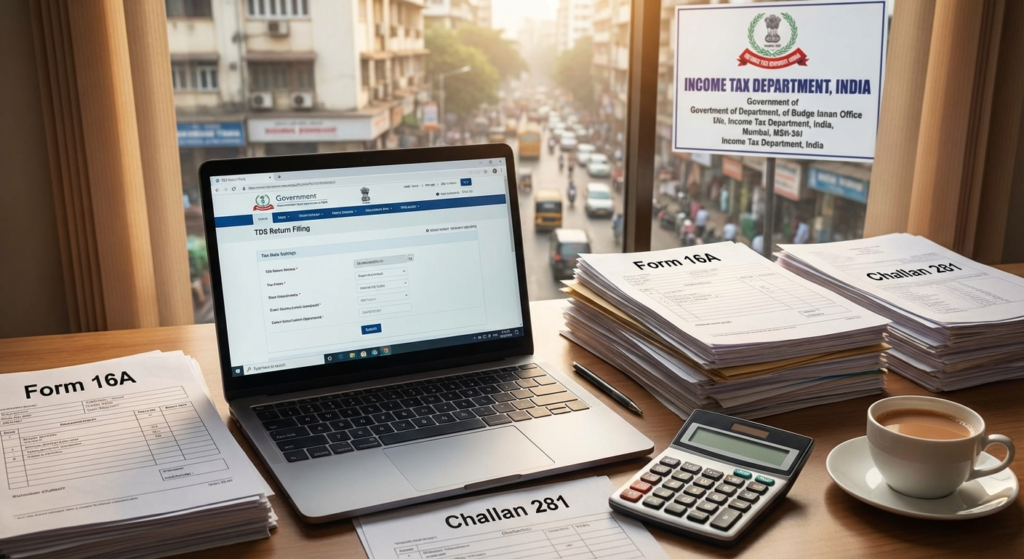
Deposit the deducted amount via Challan 281 by the 7th of the next month.
3. Reporting
File quarterly returns detailing the PAN of deductees and amounts paid.
Why TDS Compliance is Critical for Business Health
I’ve seen many businesses treat TDS as a backend chore, but it actually impacts your bottom line directly. The Income Tax Department has fully digitized its tracking. If there is a mismatch between what you claimed to deduct and what you deposited, you will get a notice.
Here is the kicker: If you fail to deduct TDS, or deduct it but don’t pay it, the entire expense can be disallowed under Section 40(a)(ia). This means your taxable profit artificially shoots up, increasing your own tax liability. If you’re worried about how this affects your annual filing, check out our guide on income tax return filing in India to see the bigger picture.
7 Essential Steps to Master TDS Compliance
Ready to get your compliance in order? Follow this checklist to stay on the right side of the law.
1. Obtain a TAN (Tax Deduction Account Number)
You cannot start TDS compliance India procedures without a TAN. This 10-digit alphanumeric number is your identity as a deductor. You must quote it on every challan and return. No TAN means you can’t deposit tax, which means immediate non-compliance.
2. Verify Liability and Rates
Not every payment needs TDS. Check if the payment exceeds the threshold limits (e.g., ₹30,000 for contractors under Section 194C). Also, verify if the vendor has a Lower Deduction Certificate to avoid over-deducting.
3. Deduct at the Right Time
The rule is simple: deduct at the time of booking the invoice or making the payment, whichever is earlier. Don’t wait for the actual cash to leave your bank account if you’ve already entered the bill in your books.
4. Deposit Monthly
Accumulating TDS liabilities is a bad habit. Deposit the tax collected by the 7th of the subsequent month using Challan ITNS 281.
5. File Quarterly Returns
This is where you tell the government who you deducted tax from. Accuracy here is vital to ensure your vendors get their tax credit.
6. Issue TDS Certificates
Once you’ve filed, you must generate Form 16 (for salaries) or Form 16A (for others) from the TRACES portal and give them to your payees. This serves as their proof of tax paid. GST Council 54th Meeting 09.09.2024 Highlights
7. Regular Reconciliation
Log in to TRACES regularly to check for any ‘Defaults’. The sooner you spot a mismatch, the cheaper it is to fix. ITR Filing Penalties for Late Submission: What You Need to Know 2026
Navigating Forms: 24Q, 26Q, and 27Q
Using the wrong form is a common rookie mistake that leads to ‘defective’ returns. In the world of TDS compliance India, keeping your paperwork organized is half the battle. For broader updates on statutory requirements, you can always browse our law and regulations category.
Form 24Q
Use for: Salaries.
Details: Contains salary breakdown and tax deducted under Section 192. Filed quarterly.
Form 26Q
Use for: Non-salary domestic payments.
Details: Covers professional fees, rent, interest, and contractor payments.
Form 27Q
Use for: Payments to NRIs/Foreigners.
Details: Mandatory for cross-border transactions and foreign vendor payouts.
Common Pitfalls and Penalties
Even well-intentioned businesses falter. Here is what usually trips people up in their TDS compliance India journey:
- Late Deduction Interest: 1% per month from the date the tax was deductible until it is actually deducted.
- Late Payment Interest: 1.5% per month if you deducted it but delayed the deposit.
- PAN Errors: If you furnish an invalid PAN, you are forced to deduct TDS at a flat 20% (or the applicable rate, whichever is higher).
- Late Filing Fee: Under Section 234E, you will pay ₹200 for every day your return is late. This can add up fast.
Conclusion
Mastering TDS compliance India isn’t just about avoiding notices; it’s about building a reputation as a credible, compliant business. Vendors trust you when they get their Form 16A on time. Employees trust you when their tax returns process smoothly.
Start by getting your TAN, verifying your rates, and sticking to the deadlines. It might seem tedious, but with the right process and tools, it becomes just another smooth part of your monthly operations.
Frequently Asked Questions
You will be liable to pay interest at 1.5% per month (or part of the month) from the date of deduction until the date of payment. This interest must be paid before filing your TDS return.
Yes, if you are responsible for deducting tax (except for certain property transactions under Sec 194-IA), obtaining a TAN is mandatory. You cannot file returns without it.
Absolutely. If you spot an error, you can file a ‘Correction Return’. You’ll need to download the consolidated file from the TRACES portal to identify and fix the specific discrepancies.
Aside from the daily late fee of ₹200 under Section 234E, the Assessing Officer can levy a penalty ranging from ₹10,000 to ₹1,00,000 under Section 271H if the return is not filed within one year of the due date.
Read Also:
- Master Your 2026 GST Liability Calculation
- 12 Common Income Tax Filing Mistakes to Avoid This Assessment Year – Visual Story
- India’s 2026 NRI Tax Rules Explained
- Income Tax Intimation Order Password: The 2026 Formula
- Maharashtra PT Payment 2026: The Definitive Online Filing Guide
- Proprietorship Firm Registration in 2026: A 5-Minute Guide
- TDS Return Filing Due Date 2026: The Ultimate Guide
- TDS Rates FY 2020-21: The Definitive Guide (Updated 2026) – Visual Story
- Maharashtra PT 2026: Pay Online Easily