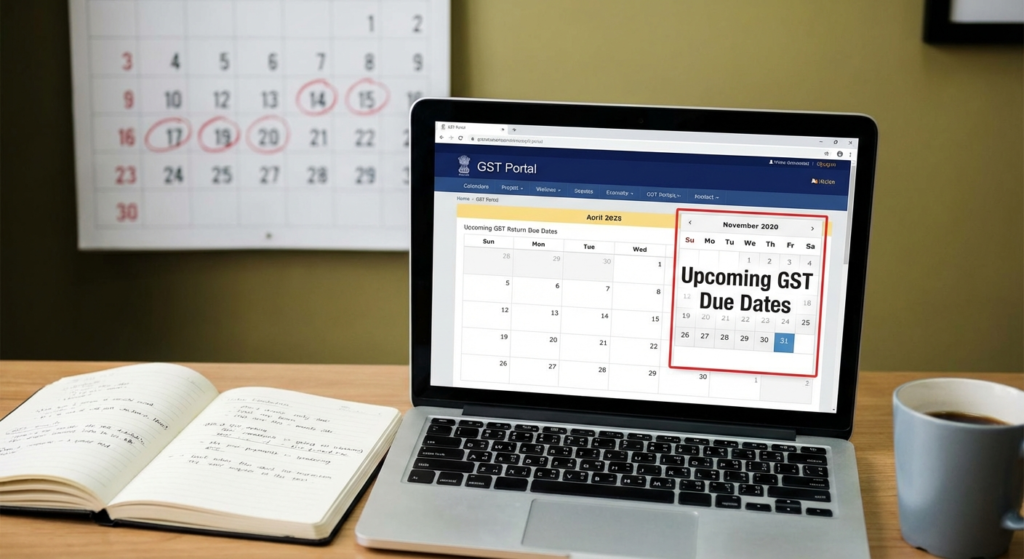
In my two decades of advising businesses on tax compliance, I’ve learned one undeniable truth: GST return due dates are not just calendar entries—they are the heartbeat of your business’s cash flow. I’ve seen profitable companies face severe liquidity crunches simply because they treated these dates as suggestions rather than strict deadlines.
It’s easy to think, “It’s just a late fee of ₹50, right?” Wrong. The real cost of missing a deadline in 2025 is far more insidious. It involves 18% interest on your cash liability, the blocking of your E-Way bill generation (stopping your logistics dead in its tracks), and worst of all, your customers denying your payments because your non-compliance is blocking their Input Tax Credit (ITC).
Whether you are a seasoned CFO, a Chartered Accountant grappling with multiple clients, or a business owner wearing every hat possible, this guide is your definitive playbook. We aren’t just going to list dates; we are going to dive deep into the strategy of compliance, helping you navigate the complexities of GSTR-1, GSTR-3B, QRMP, and annual filings with the confidence of an expert.
Why GST Return Due Dates Are Your Business Lifeline
The Goods and Services Tax (GST) system in India is a digitally interconnected web. Unlike the old VAT days where you could file a return and worry about the assessment years later, GST is real-time. The government has designed gst return due dates to synchronize the flow of credit across the entire economy.
When you miss a date, you break the chain. Here is exactly why this matters more than you think:
1. The ITC Chain Reaction
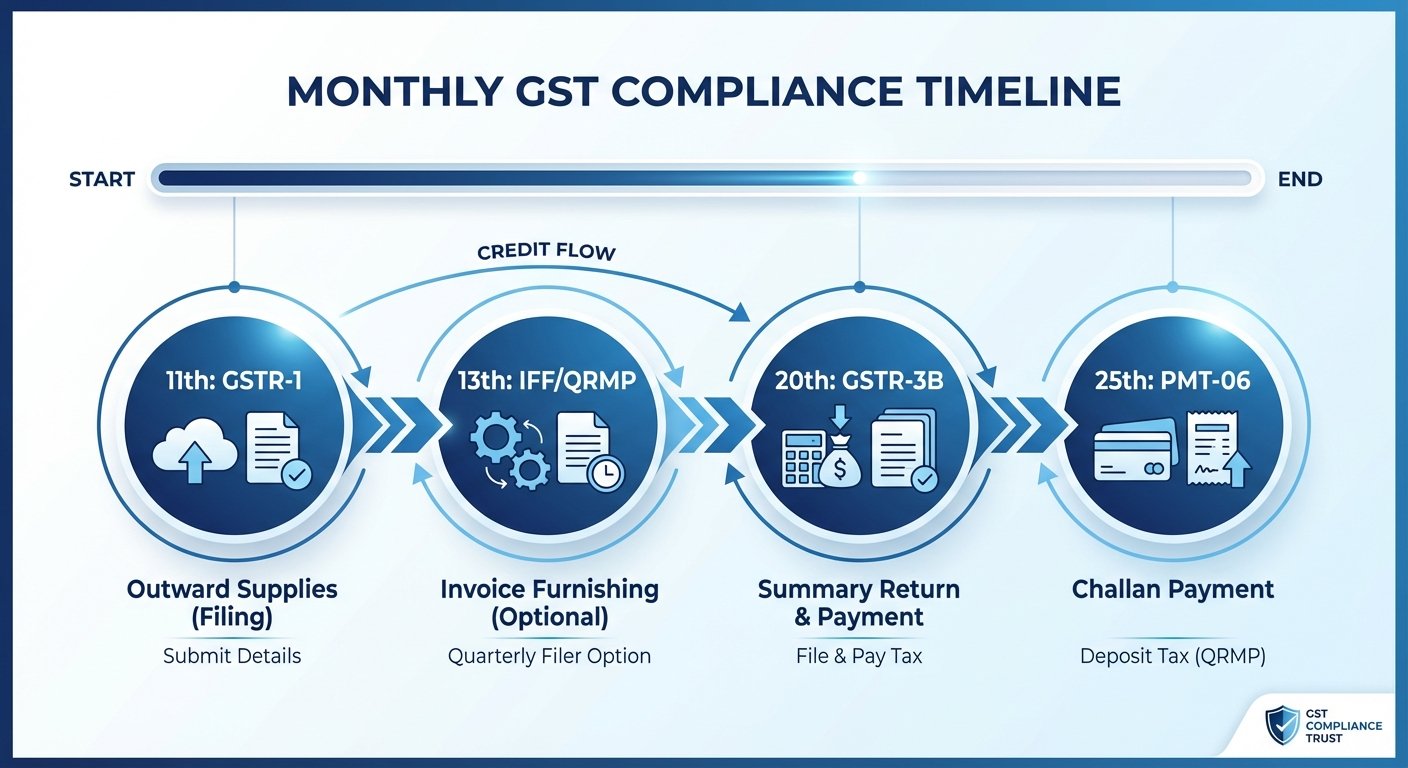
Your GSTR-1 filing directly populates your customer’s GSTR-2B. If you miss the gst return due dates for GSTR-1 (say, the 11th of the month), your customer cannot claim the ITC for that month. In today’s tight market, buyers are increasingly adding clauses in contracts that delay payments to vendors until the GST is reflected in their portal. By delaying filing, you are effectively delaying your own receivables.
2. The Compliance Rating Score
The GST portal maintains a compliance history. While the public rating system is still evolving, banks and financial institutions already ask for GST return filing proofs before sanctioning working capital loans. A history of late filings screams “financial instability” to a lender.
The 2025 Compliance Calendar: GSTR-1 & GSTR-3B
For regular taxpayers, the monthly cycle revolves around two critical forms: GSTR-1 (Sales) and GSTR-3B (Payment & Summary). Understanding the gap between these two is where smart tax planning happens.
GSTR-1: The Statement of Outward Supplies
This is where you tell the government, “Here is what I sold.” No tax is paid with this return, but it is the trigger for passing on credit.
- Monthly Filers (Turnover > ₹5 Crore): You must file by the 11th of the following month. For example, for January 2025 sales, the due date is February 11th, 2025.
- Quarterly Filers (QRMP Scheme): You file GSTR-1 once a quarter. The due date is the 13th of the month following the quarter.
GSTR-3B: The Payment Return
GSTR-3B is where reality hits—this is when money leaves your bank account. You summarize your sales, claim your ITC (auto-populated from GSTR-2B), and pay the net liability.
- Monthly Filers: The gold standard due date is the 20th of the following month.
- Quarterly Filers: To reduce server load, the government has staggered the gst return due dates for quarterly filers based on the state where your business is registered.
State-Wise Staggered Due Dates for GSTR-3B
If you are under the QRMP scheme, it is crucial to know which category your state falls into. Filing on the wrong date doesn’t just mean a late fee; it means you aren’t following the prescribed law.
Category X States (Due Date: 22nd)
States: Chhattisgarh, Madhya Pradesh, Gujarat, Maharashtra, Karnataka, Goa, Kerala, Tamil Nadu, Telangana, Andhra Pradesh, Daman & Diu, Dadra & Nagar Haveli, Puducherry, Andaman & Nicobar Islands, and Lakshadweep.
If you are registered here, your quarterly GSTR-3B is due on the 22nd of the month following the quarter.
Category Y States (Due Date: 24th)
States: Himachal Pradesh, Punjab, Uttarakhand, Haryana, Rajasthan, Uttar Pradesh, Bihar, Sikkim, Arunachal Pradesh, Nagaland, Manipur, Mizoram, Tripura, Meghalaya, Assam, West Bengal, Jharkhand, Odisha, Jammu and Kashmir, Ladakh, Chandigarh, and New Delhi.
For these regions, the due date is the 24th of the month following the quarter.
Mastering the QRMP Scheme: It’s Not Just “Quarterly”
Here is the biggest misconception I see with the Quarterly Return Filing and Monthly Payment of Taxes (QRMP) scheme: Business owners think, “Great! I only have to worry about tax every three months.” This is a dangerous myth.
While you file the returns quarterly, you must still calculate and pay tax monthly. Failing to do so attracts interest.
1. The Invoice Furnishing Facility (IFF)
Even if you file GSTR-1 quarterly, your B2B customers need their credit monthly. The IFF allows you to upload B2B invoices for the first two months of the quarter.
Due Date: 13th of the following month (Optional but highly recommended).
2. Form PMT-06 (The Monthly Payment Trap)
For the first two months of the quarter (e.g., April and May), you must deposit tax using a challan in Form PMT-06.
Due Date: 25th of the following month.
You can pay either by:
- Fixed Sum Method: Pay 35% of the cash tax paid in the previous quarter. (No interest if paid by the 25th, even if actual liability is higher).
- Self-Assessment Method: Calculate actual liability (Output Tax – ITC) and pay exactly that amount.
For small businesses, this scheme is a blessing, much like the benefits of MSME registration, which provides other structural supports. Combining QRMP with MSME benefits can significantly lower your administrative burden.
Composition Scheme: Simplified Dates for Smaller Players
If your turnover is up to ₹1.5 Crore and you deal only in goods (or are a restaurant service provider), you might be under the Composition Scheme. You don’t get ITC, and you can’t charge GST. Your calendar is simpler, but missing dates is still penalized.
CMP-08 (The Quarterly Challan)
You don’t file a full return every quarter; you file a statement called CMP-08 to pay tax on your turnover (usually 1% for traders/manufacturers, 5% for restaurants).
Due Date: 18th of the month following the quarter.
GSTR-4 (The Annual Return)
Once the financial year ends, you file one consolidated return.
Due Date: 30th April of the following financial year.
Annual Returns: The Final Reconciliation
Many businesses scramble in December to file their annual returns, but the preparation should start months in advance. The GSTR-9 is not just a compilation of your 12 monthly returns; it is your last chance to fix errors.
- GSTR-9 (Annual Return): Mandatory for aggregate turnover > ₹2 Crore.
- GSTR-9C (Self-Certified Reconciliation): Mandatory for aggregate turnover > ₹5 Crore. (Note: The requirement for CA certification was removed; it is now self-certification, but the complexity remains).
Standard Due Date: 31st December following the end of the financial year.
Just like tracking the tax audit due date is crucial for income tax, the GSTR-9 deadline is the finish line for your GST year. Missing this invites general penalties and keeps your assessment open to scrutiny for longer.
The True Financial Cost of Missing GST Return Due Dates
Let’s get real about penalties. It’s not just about the ₹50 per day. The ecosystem has evolved to punish non-compliance in multiple ways.
1. Late Fees (Section 47)
The government has rationalized these fees to help small businesses, but they still sting if you ignore them.
| Return Type | Late Fee (CGST + SGST) | Max Cap (Based on Turnover) |
|---|---|---|
| Nil Return | ₹20 per day | ₹500 |
| Turnover up to ₹1.5 Cr | ₹50 per day | ₹2,000 |
| Turnover ₹1.5 Cr – ₹5 Cr | ₹50 per day | ₹5,000 |
| Turnover > ₹5 Cr | ₹50 per day | ₹10,000 |
2. Interest Under Section 50 (The Silent Killer)
This is where businesses bleed money. If you file GSTR-3B late, you must pay interest at 18% per annum.
Crucial Distinction:
If you file the return late but pay via the cash ledger, interest is calculated only on the Net Tax Liability (i.e., Tax Payable – ITC available). However, if the department initiates proceedings under Section 73 or 74 for short payment, interest applies to the Gross Liability. Always file voluntarily to save interest on the ITC portion!
3. Operational Paralysis
- E-Way Bill Blocking: Miss two GSTR-3B filings (or two QRMP quarters), and you cannot generate E-Way Bills. Your goods will be stuck in the warehouse.
- ITC Blocking (Rule 86A): If the officer believes there is a discrepancy, they can block your electronic credit ledger, freezing your working capital.
Expert Strategies to Manage Deadlines Like a Pro
Over the years, I’ve developed a system that helps my clients stay ahead of the curve. Compliance isn’t about memory; it’s about systems.
1. The “T-Minus 5” Rule
Never aim for the actual due date. Set your internal deadline 5 days prior. Aim to finalize GSTR-1 data by the 6th and GSTR-3B data by the 15th. This gives you buffer time for technical glitches on the GST Portal.
2. Real-Time Reconciliation
Don’t wait until the 14th to download GSTR-2B. Use accounting software that fetches data daily or weekly. This allows you to follow up with non-compliant vendors before the month ends, rather than after you’ve lost the credit.
3. Separate Tax Funds Weekly
Cash flow issues are the #1 reason for late filings. Calculate your approximate GST liability every week and move that cash into a separate bank account or a liquid fund. When the 20th comes, the money is already there, waiting to be paid.
4. Use the “Search Taxpayer” Tool
Before doing significant business with a new vendor, use the “Search Taxpayer” feature on the GST portal (or the CBIC website). Check their filing table. If you see a pattern of late filings, negotiate better payment terms to protect yourself.
Common Compliance Mistakes to Avoid
Even experienced accountants slip up. Here are the pitfalls I see most often:
- Confusing Zero-Rated and Nil-Rated: Exports are zero-rated; grains might be nil-rated. Mixing these up in GSTR-1 causes refund issues later.
- Ignoring RCM Liability: Services like Goods Transport Agency (GTA) or legal services often attract Reverse Charge Mechanism (RCM). This liability must be paid in cash; you cannot use ITC to pay RCM tax.
- Reporting B2C as B2B: If you enter a B2B transaction as B2C in GSTR-1, your customer won’t see it in their GSTR-2B. You’ll have to amend it later, which is a headache.
Conclusion: Peace of Mind is Priceless
Navigating the maze of indirect taxation requires vigilance, but it doesn’t have to be stressful. By understanding the nuances of gst return due dates—from the monthly GSTR-1 and GSTR-3B to the complex QRMP payment challans—you secure more than just compliance. You secure your reputation, your supply chain relationships, and your peace of mind.
Remember, the cost of compliance is always lower than the cost of non-compliance. Stay organized, keep your books updated in real-time, and view these due dates as milestones for your business’s financial health rather than hurdles to jump over.
FAQs
This is a technical impossibility in the current system because the GSTR-3B return is only considered “filed” once the tax is paid and the return is submitted. You cannot separate the filing from the payment. Therefore, if the return is late, the payment is technically late, attracting interest and late fees.
No, the current GST system does not allow for a “revised return” like Income Tax. However, you can rectify errors made in one month’s return in the subsequent month’s return, subject to certain time limits (usually up to 30th November of the next financial year).
Generally, no. The due date is the 13th of the month following the quarter. Extensions are rare and only granted via official notification from the CBIC in extreme cases like natural calamities or portal failures.
For the first two months of the quarter, you must use Form PMT-06 to deposit tax by the 25th of the next month. For the third month, you pay the balance liability while filing the GSTR-3B return.
For businesses with a turnover up to ₹1.5 Crore, the maximum late fee is capped at ₹2,000 per return (₹1,000 CGST + ₹1,000 SGST) if there is tax liability. If it is a Nil return, the cap is ₹500.
Read Also:
- Keep Your Cash: 2026 Tax Guide
- Beyond Salary: Your 2026 Hidden Income Guide
- Social Impact Startups: Your 2026 Guide
- 7 Essential Steps for TDS Compliance India: The Complete Business Guide (2025) – Visual Story
- 7 Critical GST Amendment Rules in India: A Comprehensive Guide (2025) – Visual Story
- India Startup Guide 2026: Register Your Company