Let’s be honest: for most of us, the phrase “tax season” triggers a mild panic response. It’s that time of year when we scramble for passwords, dig through emails for investment proofs, and worry that we’ve missed some obscure deadline. But after two decades of helping people navigate their finances, I can tell you this—income tax return filing India doesn’t have to be a nightmare. In fact, if you approach it strategically, it’s your single best opportunity to clean up your financial house.
The 2025 tax season (Assessment Year 2025-26) brings its own set of rules, specifically around the default New Tax Regime and the critical importance of the Annual Information Statement (AIS). If you are still filing taxes the way you did in 2020, you are likely leaving money on the table or, worse, inviting a notice from the tax department.
I’ve written this master guide not just to help you click the right buttons, but to help you understand the strategy behind filing. We’re going to cover everything from the “New vs. Old” regime debate to the specific documents that trigger red flags if missing. Whether you are a salaried employee, a freelancer, or a business owner, this is the only resource you will need to master income tax return filing India this year.
Why You Should Care (Beyond Just “It’s the Law”)
Most people view filing an Income Tax Return (ITR) as a chore to avoid penalties. While that’s true, I want you to shift your perspective. Your ITR is essentially your financial report card. It is the most accepted proof of income in India, and neglecting it can paralyze your future financial moves.
Here is why I push my clients to file on time, even if their income is below the taxable limit:
- The Loan Approval Golden Ticket: When you apply for a home loan or a car loan, the first thing a bank asks for is your last three years of ITR. No ITR often means no loan, or a loan with a significantly higher interest rate.
- Visa Applications: Planning a trip to Europe or the US? Consulates look at your ITR to ensure you have strong financial ties to India and aren’t looking to immigrate illegally. A solid track record of income tax return filing India smooths this process immensely.
- Claiming Refunds: If your employer deducted TDS (Tax Deducted at Source) but your total tax liability is lower than what was cut, the only way to get that money back into your bank account is by filing an ITR. I’ve seen freshers leave thousands of rupees with the government simply because they didn’t file a return to claim their refund.
- Carrying Forward Losses: This is a big one for stock market investors. If you made a loss in the share market this year, you can carry that loss forward to offset profits in future years—but only if you file your ITR by the due date.
The 2025 Landscape: New vs. Old Tax Regime
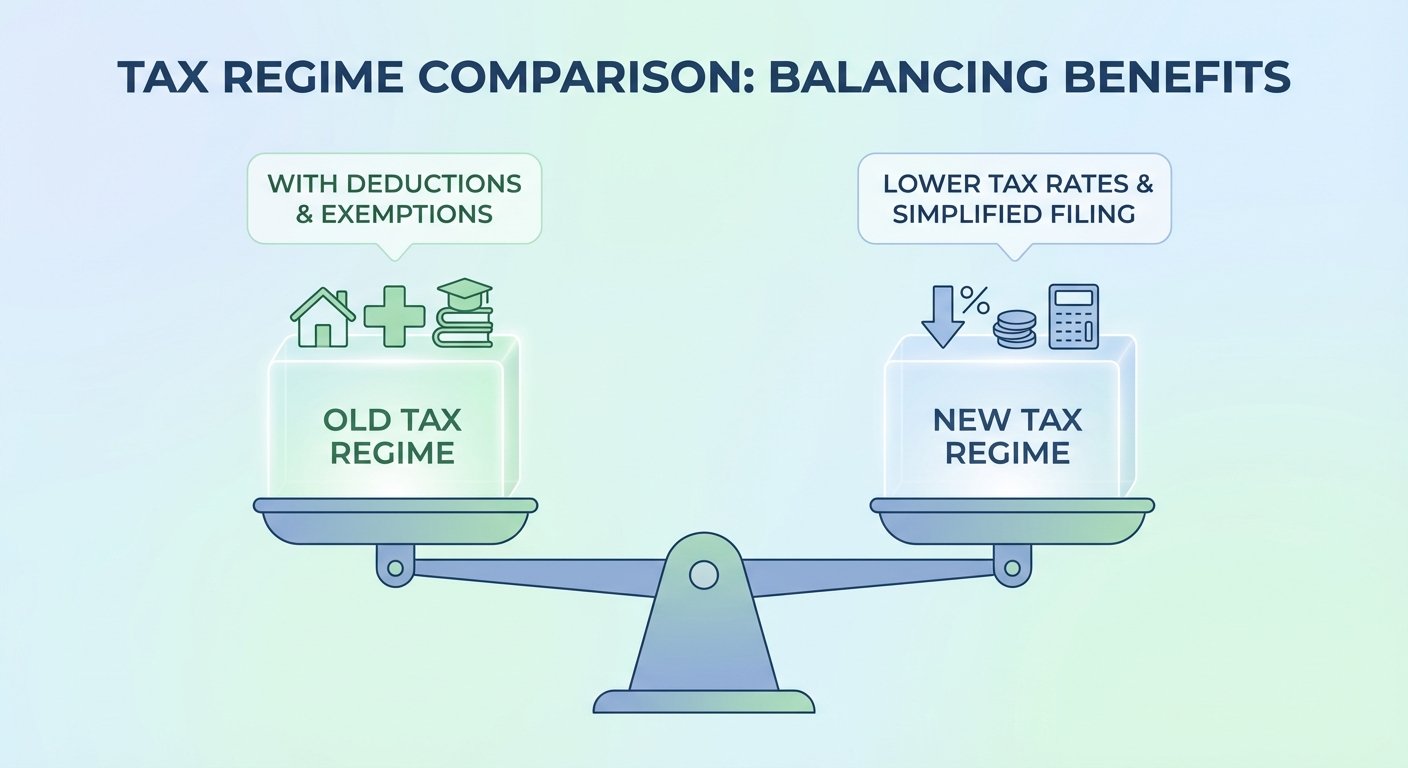
This is the question I get asked most often: “Which regime should I pick?” In 2025, the government has made the New Tax Regime the default setting. This means if you do nothing, your taxes will be calculated based on the new slab rates. But is that good for you?
The New Regime: Simplicity over Strategy
The New Regime offers significantly lower tax rates but strips away almost all major deductions. You cannot claim HRA, LTA, Section 80C (PPF, LIC, ELSS), or Section 80D (Health Insurance) deductions.
Who is it for? It is fantastic for fresh earners, people with minimal investments, or high-net-worth individuals who want to avoid the hassle of locking in money just to save tax. The government recently tweaked the slabs to make this even more attractive, effectively making income up to ₹7.5 Lakhs (including standard deduction) tax-free under this regime.
The Old Regime: The Saver’s Paradise
The Old Regime is still alive, but you have to manually select it. It retains the higher tax rates but allows you to reduce your taxable income through deductions.
Who is it for? If you have a home loan (Section 24b allows ₹2 Lakh interest deduction), pay hefty school fees, contribute to PF, and have medical insurance for senior parents, the Old Regime usually wins.
For a deeper dive into how these regimes affect your overall financial planning, check out our taxation category.
The Document Checklist: It’s Not Just About Form 16
The days when you could just hand over your Form 16 to a CA and forget about it are over. The Income Tax Department now tracks your financial footprint through the Annual Information Statement (AIS) and Taxpayer Information Summary (TIS). These documents are game-changers for income tax return filing India.
1. The “Holy Trinity” of Tax Documents
- Form 16: The certificate from your employer detailing your salary and TDS.
- Form 26AS: Your tax passbook. It shows all taxes deposited against your PAN by employers, banks, or clients.
- AIS/TIS: This is the new watchdog. It records high-value transactions, stock market trades, mutual fund dividends, foreign remittances, and even interest from savings accounts.
2. Investment Proofs (For Old Regime)
Gather your LIC premium receipts, PPF passbook updates, ELSS statements, and tuition fee receipts. If you are claiming HRA, ensure you have the landlord’s PAN if the rent exceeds ₹1 lakh per annum.
3. Bank Statements
You need these to calculate the exact interest earned on your savings account. Yes, savings interest is taxable! Under Section 80TTA, you get a deduction up to ₹10,000, but you must declare the income first.
Decoding the Forms: Which One is Yours?
Choosing the wrong form is the fastest way to get your return rejected. The forms for income tax return filing India are specific to your income sources.
ITR-1 (Sahaj)
The Simple One. Use this if you are a resident individual with income up to ₹50 Lakhs from salary, one house property, and other sources like interest.
Note: You cannot use this if you are a director in a company or hold unlisted equity shares.
ITR-2
The Investor’s Choice. For individuals and HUFs who don’t have business income but have capital gains (stock market profits), more than one house property, or foreign income. If you sold shares this year, this is likely your form.
ITR-3 & ITR-4
The Business Owners. ITR-3 is for those with business/profession income. ITR-4 (Sugam) is a simplified version for presumptive taxation (Section 44AD) where you declare a flat percentage of turnover as profit.
If you are starting a new venture and aren’t sure about your business structure, make sure to read about easy business registration in India to ensure your tax filings align with your legal entity.
Step-by-Step Walkthrough: Filing Like a Pro
Ready to file? Let’s walk through the actual process on the portal. I recommend doing this on a desktop with a stable internet connection—tax portals can be finicky.
Step 1: The Setup
Log in to the Income Tax e-Filing portal. Go to e-File > Income Tax Returns > File Income Tax Return. Select the Assessment Year (AY 2025-26 for income earned between April 2024 and March 2025).
Step 2: Pre-fill Validation
The system will ask if you want to use pre-filled data. Always say yes, but verify everything. The portal pulls data from your employer and banks. Cross-check the salary figure with your Form 16. If there is a discrepancy, trust your documents over the pre-filled data, but be prepared to explain the difference if asked.
Step 3: Income Reporting
Enter your income details. Don’t forget to report exempt income like PPF interest or dividends (if applicable). Even if it’s not taxable, reporting it explains the growth in your assets. 7 Essential Facts About GST Composition Scheme India: A Complete 2025 Guide
Step 4: Claiming Deductions
If you opted for the Old Regime, this is where you enter your 80C, 80D, and 80G details. Be precise. Rounding off figures or estimating can lead to scrutiny.
Step 5: Tax Computation and Payment
The system will calculate your final liability.
- Refund Due: Great! Ensure your bank account is “Validated” on the portal to receive the money.
- Tax Due: You must pay this immediately via Net Banking or UPI. This is called “Self-Assessment Tax.” You cannot submit the return until this is paid.
Step 6: Verification (Crucial!)
I cannot stress this enough: Filing is not complete until you verify. You have 30 days to verify your return after uploading it. The easiest way is via Aadhaar OTP. If you don’t verify, your return is treated as invalid, and you might face penalties for non-filing.
Common Mistakes That Trigger Notices
In my experience, 90% of tax notices are sent because of simple, avoidable errors. Here is what to watch out for during your income tax return filing India process.
The Savings Interest Trap
People often ignore the interest credited to their savings account. The AIS captures this. If you don’t declare it under “Income from Other Sources,” you are asking for a discrepancy notice.
Job Hopping Confusion
If you changed jobs mid-year, you likely have two Form 16s. Both employers probably gave you the benefit of the basic exemption limit and standard deduction. When you combine the incomes, your tax liability shoots up. You must consolidate both incomes and calculate the remaining tax.
Fake Rent Receipts
The department is using AI to detect fake HRA claims. If you claim HRA but don’t actually pay rent to a landlord (or pay it to a parent without a proper trail), you are in the danger zone. Ensure you have a valid rent agreement and bank transfer proofs.
Dividend Income
Dividends from stocks and mutual funds are now fully taxable at your slab rate. They are no longer tax-free. Many investors miss this line item.
Benefits of Timely Filing (The Carrot, Not the Stick)
We often talk about the penalties for late filing (Section 234F imposes a fine up to ₹5,000), but let’s talk about the benefits of being an early bird.
Faster Refunds: The tax department processes returns on a first-come, first-served basis. If you file in June, you could see your refund in 10-15 days. If you wait until July 31st, it could take months.
Interest on Refunds: If the department is late in issuing your refund, they pay you interest of 0.5% per month. However, this interest is only paid if you file your return on time.
Stress Reduction: The e-filing portal is notorious for crashing or slowing down in the last week of July. Filing early saves you from the technical glitches and the mental load of a looming deadline.
Conclusion: Take Control of Your Financial Narrative
Filing your taxes is one of the few financial interactions where you have complete control. You decide the regime, you organize the proofs, and you declare the income. Don’t let the complexity of income tax return filing India intimidate you. With the tools available in 2025—pre-filled forms, digital verifications, and comprehensive guides like this one—the power is firmly in your hands.
My final piece of advice? Don’t wait for the deadline. Gather your documents this weekend, log in to the portal, and get it done. The peace of mind you’ll feel when you see that “ITR Processed Successfully” message is worth every minute of effort.
For broader economic context that influences these tax laws, you can always refer to reputable sources like The Economic Times.
FAQs
If you miss the July 31st deadline, you can file a “Belated Return” until December 31st. However, this attracts a late fee of up to ₹5,000 under Section 234F. Additionally, you will be charged penal interest at 1% per month on the unpaid tax amount under Section 234A.
Yes, if you are a salaried individual, you can choose the regime that benefits you most at the time of filing, regardless of what you declared to your employer. However, individuals with business or professional income can only switch back to the Old Regime once in their lifetime; otherwise, they are locked into the New Regime.
If you see a transaction in your AIS that doesn’t belong to you or is incorrect (e.g., a duplicate entry), you can submit feedback directly on the compliance portal. The tax department will verify this with the reporting entity (like the bank) and update the record.
Technically, no. However, filing a ‘Nil Return’ is highly recommended. It serves as crucial proof of income for loans, visa applications, and credit card approvals. It also helps you claim refunds for any TDS deducted on your income.
If Aadhaar OTP isn’t an option, you can verify using your Net Banking account, a Pre-validated Bank Account, or a Demat Account. As a last resort, you can print the ITR-V acknowledgement, sign it in blue ink, and send it via speed post to the CPC in Bengaluru within 30 days of filing.
Read Also:
- Long Term Capital Gain Tax Changes in Budget 2024
- How to Invest in Quant Mutual Fund: A Beginner’s Guide
- Instantly Download Your 2026 Trademark Certificate
- Your 2026 Company COI: Download Guide
- Section 194Q Explained (2026): A Buyer’s Guide to TDS
- DPT-3 Form 2026: Avoid Huge Penalties
- Income Tax Audit Report Due Date 2026: Your Guide to Sec 44AB
- Section 194Q TDS: The Ultimate Guide for Businesses (2026)
- Internal Audit Applicability in India (2026): Is It Mandatory? – Visual Story
- Your 2026 Startup’s Secret Legal Weapon