
Picture this: It’s the 25th of the month. You realize you missed the GSTR-3B deadline by five days. You rush to file, pay the late fee, and breathe a sigh of relief. You think you’re in the clear.
But six months later, you get a notice. You owe money. Why? Because you forgot about the silent profit killer: GST penalty interest.
In my years consulting with businesses—from small retail shops to large manufacturing units—I’ve seen this scenario play out dozens of times. Business owners obsess over the Late Fee (which is visible and capped) but completely overlook the Interest (which is automatic and uncapped). It’s an expensive mistake.
Here’s the thing: The GST framework in India is designed to be self-policing. If you hold onto the government’s money longer than you should, you pay for the privilege. And unlike a penalty, which requires an officer to issue an order, interest is automatic. It starts ticking the moment the clock strikes midnight on the due date.
In this deep dive, we aren’t just going to quote sections of the law. We’re going to break down exactly how GST penalty interest works, the critical difference between paying 18% vs. 24%, and the specific strategies you need to stop bleeding cash unnecessarily.
🎯 Key Takeaway
GST penalty interest is mandatory and automatic—you don’t need a notice to be liable for it. It is charged at 18% p.a. for delayed tax payments and 24% p.a. for wrongful ITC claims. Crucially, interest is now calculated only on your Net Cash Liability, not your gross tax amount.
The Core Concept: Interest vs. Penalty
Before we get into the math, let’s clear up a common misconception. I often hear clients use “interest” and “penalty” interchangeably. They aren’t the same thing.
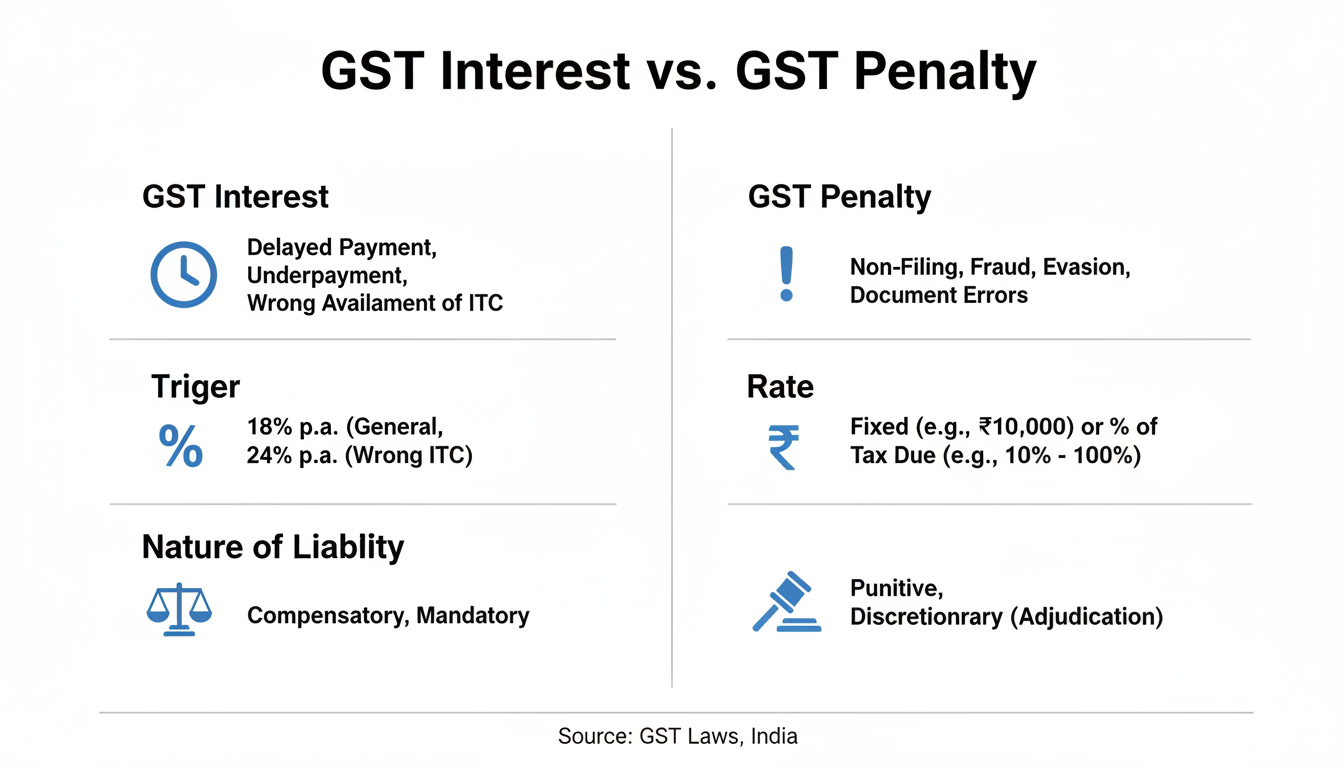
Think of it this way: Interest is compensatory; Penalty is punitive.
When you delay a payment, the government is essentially “lending” you that tax money for the duration of the delay. The interest is the cost of that loan. A penalty, on the other hand, is a punishment for breaking the law (like tax evasion or fraud).
According to Section 50 of the CGST Act, 2017, the liability to pay interest arises automatically. You don’t wait for a demand notice. You are expected to self-assess and pay it.
The Two Rates: Are You Paying 18% or 24%?
Not all delays are created equal. The government distinguishes between an honest delay in payment and a wrongful claim of credit. Knowing which bucket you fall into can save you significant money.
Here is the breakdown of the rates as per current GST laws:
| Scenario | Section | Interest Rate (p.a.) | Why is it charged? |
|---|---|---|---|
| Delayed Payment | Section 50(1) | 18% | You filed your return late or paid less tax than required. This is the most common scenario. |
| Wrongful ITC Claim | Section 50(3) | 24% | You claimed Input Tax Credit (ITC) you weren’t entitled to AND utilized it to pay liability. |
⚠️ Watch Out
The 24% Trap: The higher rate of 24% applies specifically when you have wrongly availed and utilized ITC. If you wrongly claimed it in your electronic ledger but never used it to pay off a liability, you generally do not have to pay interest when you reverse it. This was a major point of litigation that has been clarified in favor of the taxpayer.
The “Net vs. Gross” Liability Debate (Solved)
For years, this was the most controversial topic in the industry. If I have ₹1,00,000 in tax liability, but I have ₹80,000 sitting in my Input Tax Credit (ITC) ledger, and I pay the remaining ₹20,000 late—do I pay interest on the full ₹1 lakh or just the ₹20k?
Initially, tax officers demanded interest on the Gross Liability (₹1 lakh). It was a nightmare for businesses with huge credit balances.
Good news: The Finance Act, 2021, clarified this retrospectively. Interest is levied only on the Net Cash Liability.
This means if you have enough balance in your electronic credit ledger to cover your tax, but you just forgot to file the GSTR-3B, you technically owe zero interest (though you still owe late fees). You only pay interest on the amount you actually pay from your bank account (Electronic Cash Ledger).
💡 Pro Tip
Always ensure your Electronic Credit Ledger has enough balance before the due date. Even if you can’t file the return on time due to a technical glitch, having the credit balance available strengthens your case that no financial loss was caused to the exchequer.
Step-by-Step: How to Calculate GST Penalty Interest
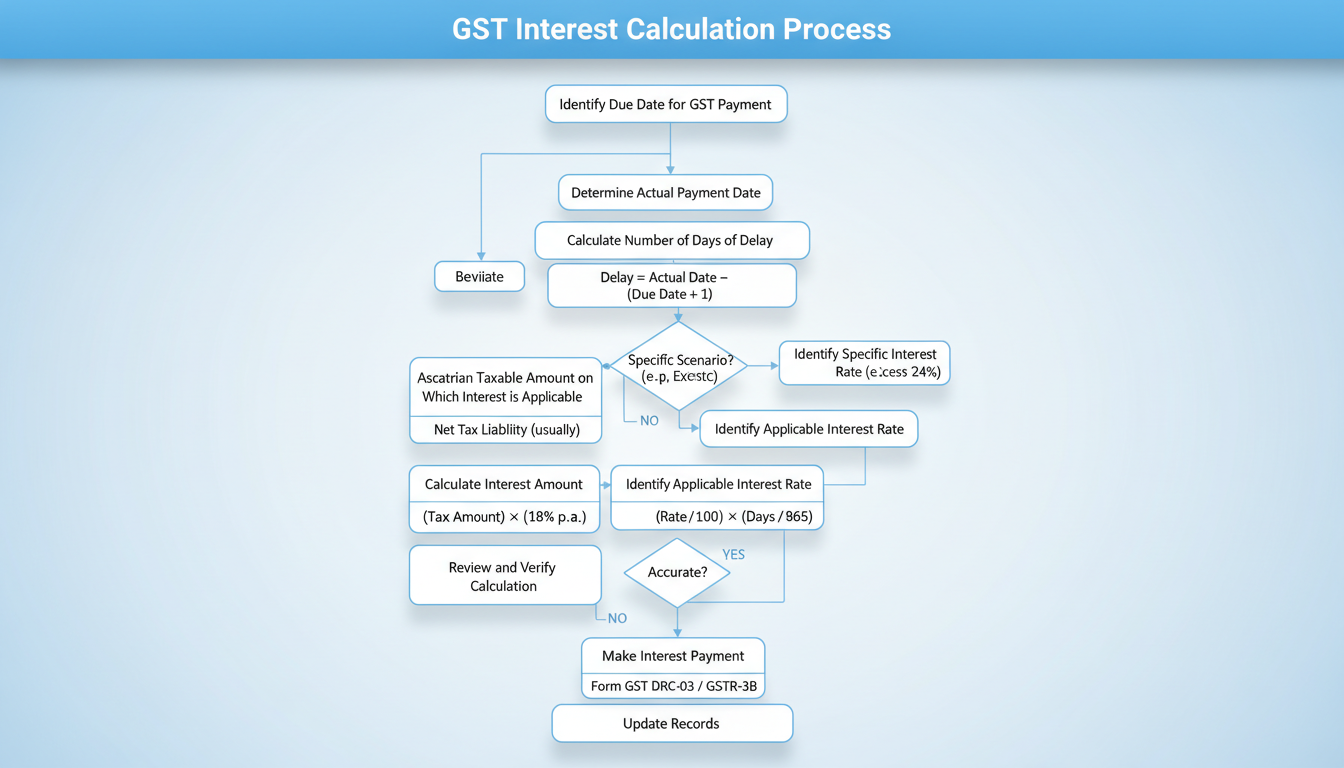
Let’s get practical. You don’t need complex software to check if the department’s notice is correct. You just need this formula.
Formula:
Interest = (Net Tax Liability × 18% ÷ 365) × Number of Days Delayed
Real-World Example: The Case of “TechSolutions Ltd”
Let’s say TechSolutions Ltd has to file returns for January.
- Due Date: February 20th.
- Actual Filing Date: March 10th.
- Total Tax Liability: ₹1,00,000.
- ITC Available: ₹60,000.
- Net Payable (Cash): ₹40,000.
The Calculation Steps:
- Identify the Delay: From Feb 21st to March 10th = 18 days.
- Identify the Principal Amount: Since interest is on Net Liability, we use ₹40,000 (not ₹1 lakh).
- Apply the Math: (40,000 × 0.18) ÷ 365 = ₹19.72 per day.
- Total Interest: ₹19.72 × 18 days = ₹355.
If TechSolutions had calculated on Gross Liability, they would have paid nearly ₹900. Knowing the rules saves money. Comprehensive Guide to GST for Ecommerce Sellers: Registration, Compliance, and Key Rules
Interest vs. Late Fees: What’s the Difference?
I’ve seen seasoned accountants mix these up. While both are costs of non-compliance, they behave very differently. Here is a quick comparison to keep them straight. New Direct Tax Code 2025: India’s Taxation Future
| Feature | GST Interest | GST Late Fee |
|---|---|---|
| Basis | Percentage of Tax Amount | Fixed amount per day |
| Cap/Limit | No Limit (Keeps growing) | Capped (e.g., ₹500/₹2000/₹5000 depending on turnover) |
| Nil Return | Zero Interest | Applicable (Minimum late fee applies) |
| Payment Source | Must be paid in Cash | Must be paid in Cash |
Note that neither interest nor late fees can be paid using your Input Tax Credit balance. You must transfer fresh funds to your Electronic Cash Ledger. Extension of certain due dates falling on 30th June 2020 [CBDT Notification No. 35/2020 dated 24/06/2020].
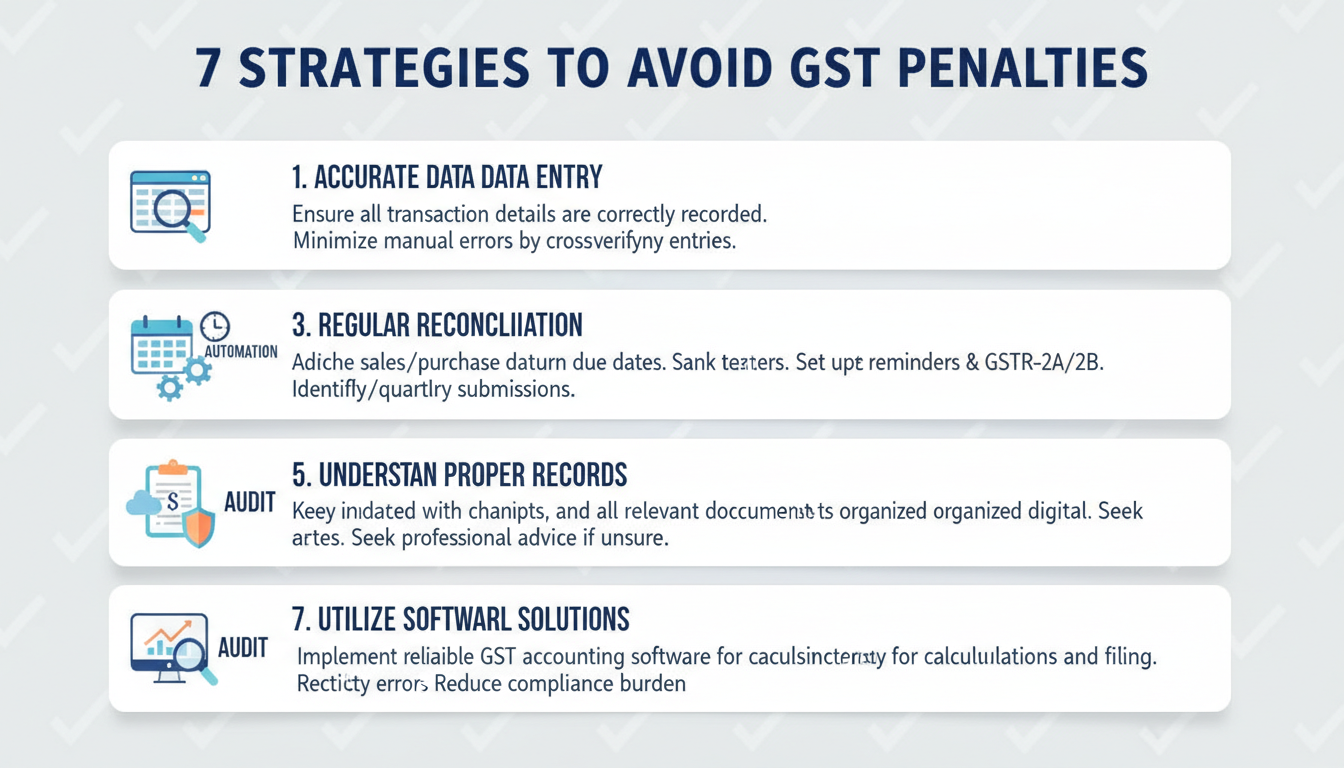
7 Proven Strategies to Avoid GST Penalty Interest
You want to keep your money in your business, not hand it over to the government in penalties. Based on my experience handling GST audits, here are the seven most effective ways to stay safe. 7 Crucial Facts About Professional Tax in India: A Comprehensive Guide (2025)
1. The “20th Morning” Rule
Don’t wait until the evening of the 20th to file. Servers slow down, OTPs get delayed, and banks have downtime. Make it a strict internal policy to file GSTR-3B by the 18th or the morning of the 20th at the latest. 10 Essential Steps to Master GST Compliance for MSME in 2025
2. Automate Your Reconciliation
Manual matching of Purchase Registers with GSTR-2B is a recipe for disaster. Use accounting software that automates this. If you claim ITC that isn’t in GSTR-2B, you risk the 24% interest penalty under Section 50(3).
3. Maintain a “Tax Reserve”
Cash flow issues are the #1 reason for delayed payments. I recommend clients move their estimated GST liability into a separate bank account weekly. When the 20th comes, the money is already there.
4. File Even If You Can’t Pay (Wait, Don’t Do This!)
Actually, the GST portal won’t allow you to file GSTR-3B without paying the tax liability. This is a catch-22. If you don’t have the funds, you can’t file. This triggers both late fees AND interest. The only solution is working capital management.
5. Monitor the Electronic Credit Ledger
Ensure you aren’t just looking at your bank balance. Your credit ledger is digital cash. Regular audits ensure you aren’t under-utilizing valid credits that could lower your cash liability.
6. Professional “Health Checks”
Once a quarter, have a Chartered Accountant review your returns specifically for Section 50 compliance. It’s cheaper to pay a consultant for an hour than to pay 18% interest on a year’s worth of errors.
7. Stay Alert on Amnesty Schemes
Occasionally, the government announces amnesty schemes for waiving late fees. However, remember that gst penalty interest is almost never waived. It is statutory. Don’t bank on a waiver.
Common Offences That Trigger Section 122 (Beyond Interest)
While we are focusing on interest, you need to know when a simple delay turns into a serious offence. Under Section 122, the department can levy a penalty equal to 100% of the tax evaded (or ₹10,000, whichever is higher) for specific actions:
- Collecting GST from a customer but failing to deposit it with the government within 3 months (This is considered a serious offence).
- Taking ITC without actual receipt of goods (Bill trading).
- Falsifying records.
If you cross these lines, you aren’t just looking at 18% interest; you are looking at litigation and heavy penalties.
💡 Pro Tip
Voluntary Payment (DRC-03): If you discover you made a mistake and short-paid tax, pay it voluntarily along with interest using Form DRC-03 before the department sends a notice. In many cases, this prevents a Show Cause Notice (SCN) and saves you from the heavier Section 122 penalties.
Conclusion: The Cost of Compliance vs. Non-Compliance
Navigating GST compliance can feel like walking a tightrope. But here is the bottom line: GST penalty interest is a completely avoidable cost. It adds zero value to your business and eats directly into your margins.
By understanding that interest applies to your Net Cash Liability and ensuring your ITC claims are clean, you can protect your business from these leaks. Don’t wait for the notice. Review your last six months of filings today. If you find a gap, pay the interest voluntarily. It’s always cheaper to fix it yourself than to have the taxman fix it for you.
❓ Frequently Asked Questions
Can GST penalty interest be waived?
No. Unlike late fees which are sometimes waived during amnesty schemes, interest under Section 50 is statutory and mandatory. It is rarely waived unless you can prove a technical glitch on the GST portal prevented you from paying.
Is interest calculated on the Gross or Net liability?
Interest is calculated on the Net Cash Liability. This means you only pay interest on the portion of tax paid through your bank account (Electronic Cash Ledger), provided you file the return before proceedings are initiated against you.
How do I pay the interest amount?
You cannot pay interest using your Input Tax Credit balance. You must deposit cash into your Electronic Cash Ledger and then offset the interest liability while filing GSTR-3B or through Form DRC-03.
What happens if I file a Nil Return late?
If you have zero tax liability, your interest will be zero because 18% of zero is zero. However, you will still have to pay the Late Fee for the delay in filing.
Does the department send a notice for interest?
They can, but they expect you to self-assess. If you pay the tax late but don’t pay the interest, the system or an officer will eventually detect the shortfall and issue a notice, often with a demand for immediate payment.
Read Also:
- India’s 2026 NRI Tax Rules Explained
- 7-Step Guide to Partnership Firm Registration India: Process, Documents & Fees (2024) – Visual Story
- Build Your 2026 Business Fortress
- India Biz Finances: Your 2026 Playbook
- Your Startup’s DNA: MoA vs AoA 2026
- AOC 4 Due Date 2026: The Definitive Guide to Filing & Penalties – Visual Story
- GST Number Kaise Le? The Definitive 2026 Guide (Mistakes to Avoid)