
Picture this: It’s a Tuesday morning. You open your email and see a subject line that makes your stomach drop: “Notice for Mismatch in GST Liability.” Panic sets in. You thought you did everything right, but a tiny data entry error from three months ago has now snowballed into a potential penalty and a compliance headache.
This isn’t just a hypothetical scenario; it’s a reality for thousands of Indian businesses every month. The GST return filing process, while designed for transparency, is a minefield of deadlines, complex forms, and reconciliation challenges. Get it right, and it’s a smooth, automated part of your business. Get it wrong, and you risk blocked working capital, damaged business relationships, and serious financial penalties.
But it doesn’t have to be this way. This guide isn’t just another list of steps. It’s a strategic playbook, built from years of hands-on experience, designed to turn you from a nervous filer into a confident compliance master. You’ll learn not just how to file, but why each step matters, where the common traps are, and how to leverage the system to your advantage.
🎯 Key Takeaway
Mastering the GST return filing process is less about data entry and more about a disciplined system of reconciliation. Your GSTR-2B is your single source of truth for Input Tax Credit (ITC), and ensuring it matches your purchase records before filing GSTR-3B is the single most effective way to avoid notices and protect your cash flow.
Understanding the GST Ecosystem: More Than Just Paperwork
Let’s get one thing straight: GST returns are not just a compliance task you check off a list. They are the financial heartbeat of your business, visible to the government, your customers, and potential lenders. Think of the GST portal as a massive, interconnected network. The GSTR-1 you file (your sales) directly populates the GSTR-2A/2B for your customers (their purchases), enabling them to claim Input Tax Credit.
When you file on time and accurately, you’re a good citizen in this ecosystem. Your customers get their ITC without a hitch, strengthening your business relationship. When you delay or make mistakes, you don’t just hurt yourself—you create a ripple effect that can damage your reputation and your supply chain.
In our experience, businesses with a pristine GST compliance record are viewed far more favorably by banks and NBFCs. Your GST returns are a real-time report card of your business’s health and turnover, making them a critical document for securing business loans.
Know Your Forms: A Breakdown of Key GST Returns
The GST regime has several returns, but for most regular taxpayers, the world revolves around two key forms: GSTR-1 and GSTR-3B. However, understanding the supporting cast is just as important. Before diving in, you need to know if you’re on a monthly filing schedule or the QRMP (Quarterly Return Monthly Payment) scheme, which is available for businesses with an aggregate annual turnover of up to ₹5 crore.
| Return Form | Purpose & Key Details | Who Files It? | Frequency |
|---|---|---|---|
| GSTR-1 | Statement of outward supplies (sales). This is where you declare all your B2B and B2C invoices. Accuracy here is non-negotiable as it determines your customer’s ITC. | All regular taxpayers & casual taxable persons. | Monthly (turnover > ₹5 Cr) or Quarterly (under QRMP scheme). |
| GSTR-3B | A summary return for self-declaring your tax liability. You report summarized sales figures, claim eligible ITC, and pay the final tax amount. | All regular taxpayers. | Monthly (payment is monthly even for QRMP filers). |
| GSTR-2B | An auto-drafted, static ITC statement. It shows the ITC available to you based on the GSTR-1 filed by your suppliers. It’s your guide for how much ITC you can claim in GSTR-3B. | Read-only form for all regular taxpayers. | Monthly. |
| GSTR-9 | The Annual Return. It consolidates all the data from your monthly/quarterly GSTR-1 and GSTR-3B filings for the financial year. | Taxpayers with turnover above ₹2 crore. | Annually. |
💡 Pro Tip
If your turnover is below ₹5 crore, seriously consider the QRMP scheme. Filing GSTR-1 quarterly instead of monthly can significantly reduce your compliance burden. However, you must still pay your tax liability monthly using a simple challan (Form PMT-06). This offers a great balance between reduced effort and consistent cash flow management.
The Step-by-Step GST Return Filing Process (2026 Walkthrough)
Ready to file? Let’s walk through the process with the precision of a seasoned accountant. Before you start, ensure you have your sales register, purchase register, and login credentials for the official GST Portal handy.
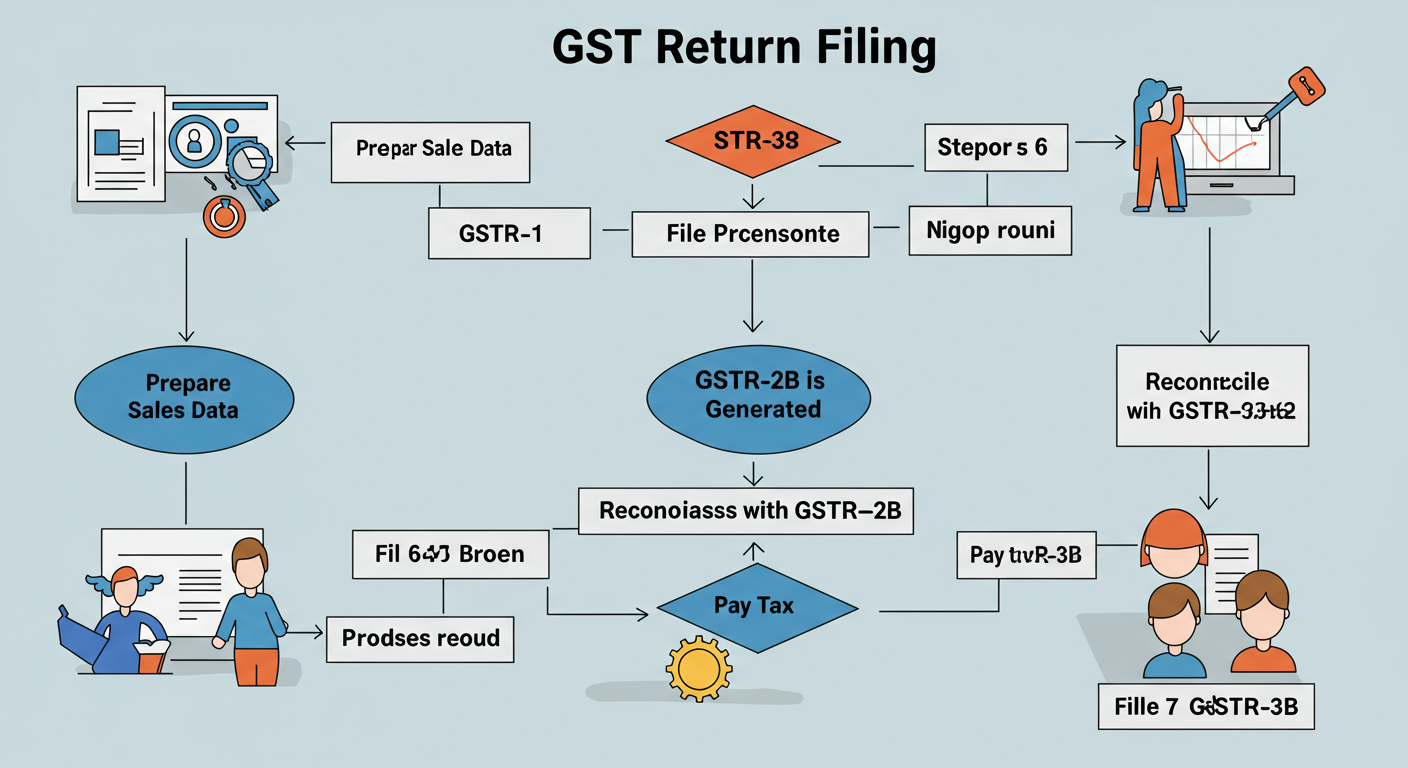
- Prepare Your Sales Data (GSTR-1): This is your foundation. Collate all your sales invoices for the period. Meticulously separate B2B (sales to other GST-registered businesses) from B2C (sales to consumers). For B2B invoices, you need the customer’s GSTIN, invoice number, date, value, and tax breakdown. For B2C, you can provide consolidated state-wise summaries.
- File GSTR-1: Log in to the GST portal, navigate to the Returns Dashboard, and select GSTR-1 for the relevant period. You can enter invoices one by one online or, for larger volumes, use the offline utility. After entering all data, verify the summary, submit, and file using a Digital Signature Certificate (DSC) or Electronic Verification Code (EVC). The due date is typically the 11th of the next month for monthly filers.
- Crucial Wait Period & Reconciliation: After the GSTR-1 due date passes, the system generates GSTR-2B for you and your customers. This form, usually available on the 14th of the month, is critical. It shows the ITC officially available to you based on what your suppliers have declared.
- Reconcile Purchases with GSTR-2B: This is where champions are made. Export your GSTR-2B data. Compare it line-by-line with your own purchase register. Identify any discrepancies. Is an invoice from a supplier missing? That means they haven’t filed their GSTR-1, and you can’t claim that ITC yet. You must follow up with them immediately.
⚠️ Watch Out
Never, ever claim ITC for an invoice that isn’t appearing in your GSTR-2B. This was a common practice in the early days of GST, but the system is now fully automated to detect these mismatches. Claiming excess ITC is the fastest way to get a notice from the tax department. Trust your GSTR-2B.
- Prepare and File GSTR-3B: Now, navigate to GSTR-3B. The system will auto-populate your sales liability from your filed GSTR-1. Your main task is to enter the eligible ITC figures, which should be based on your reconciled GSTR-2B data from the previous step.
- Pay Your Tax Liability: The system will calculate your net tax liability (Total Tax – Eligible ITC). If you have sufficient balance in your Electronic Cash Ledger, you can offset the liability. If not, you must first create a challan and pay the required tax via net banking, NEFT/RTGS, or other prescribed methods.
- Final Submission of GSTR-3B: Once the tax is paid and the liability is offset, you can proceed to file GSTR-3B using your DSC or EVC. Congratulations, you’ve completed the cycle! The due date is typically the 20th of the next month.
Avoiding the Most Common (and Costly) Mistakes
After analyzing thousands of filings, we’ve seen the same painful mistakes trip up even experienced business owners. Here’s what to watch for:
- HSN/SAC Code Errors: Using the wrong HSN (for goods) or SAC (for services) code can lead to incorrect tax rates being applied. This is a major red flag during audits. Double-check the codes for all your major products/services.
- Reporting B2C as B2B (or Vice Versa): Accidentally entering a customer’s GSTIN for a B2C sale or failing to enter it for a B2B sale creates reconciliation chaos for everyone. It’s a simple typo with big consequences.
- Ignoring Debit/Credit Notes: Did you issue a credit note for a sales return? It must be properly reported in your GSTR-1 to reduce your tax liability for that month. Forgetting this means you overpay tax.
- Incorrectly Claiming Ineligible ITC: Not all tax you pay on purchases is eligible for ITC. For example, GST paid on food and beverages, motor vehicles (with exceptions), or goods/services for personal consumption cannot be claimed. According to the Goods and Services Tax framework in India, these are blocked credits. Claiming them will lead to demands for reversal with interest.
⚠️ Watch Out
The GSTR-1 vs. GSTR-3B mismatch is the tax department’s low-hanging fruit. Their automated systems constantly check if the tax liability you declared in GSTR-1 matches what you reported and paid in GSTR-3B. Any significant deviation, even if accidental, will trigger an automated notice (like DRC-01B). Always do a final check before filing GSTR-3B.
The High Cost of Delay: Penalties and Consequences
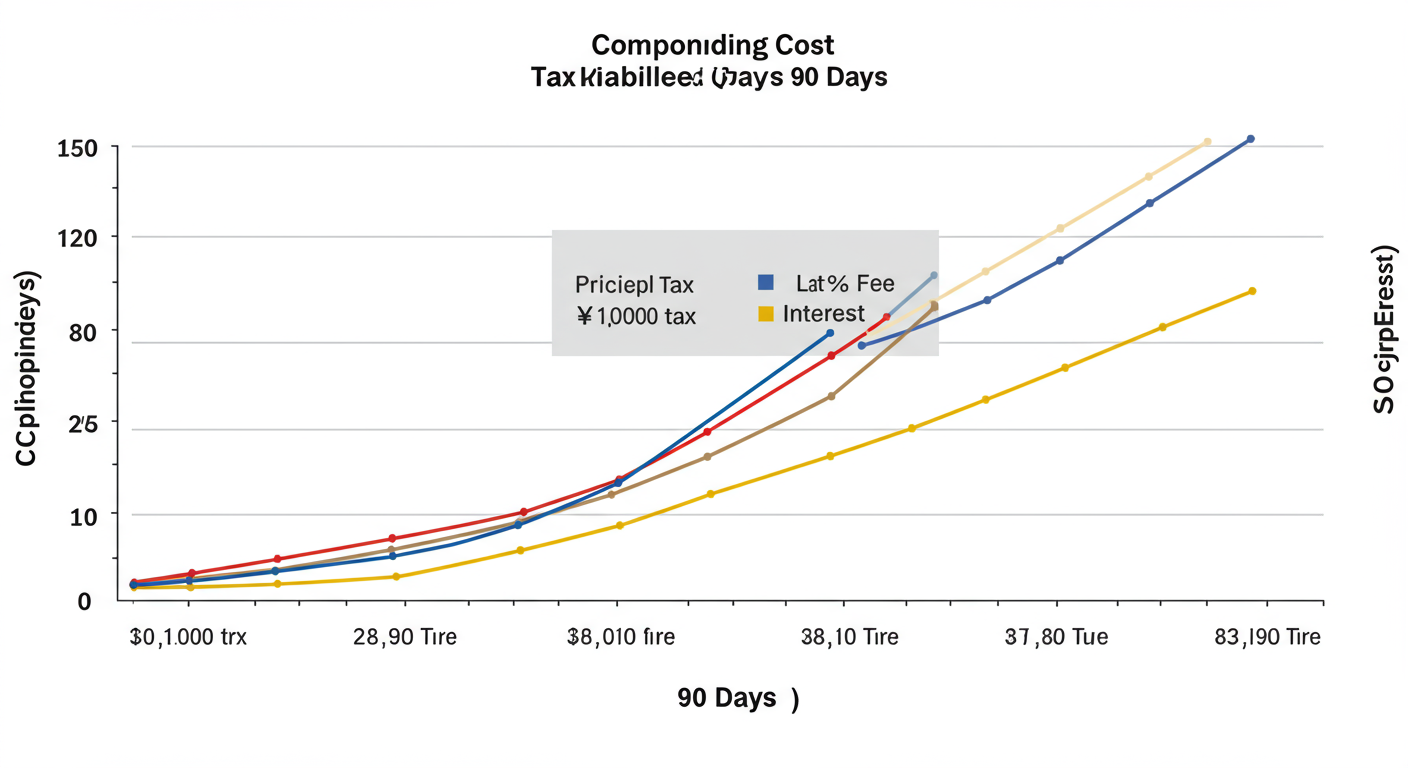
Thinking of pushing that filing date by “just a few days”? Think again. The penalties are automatic and unforgiving. It’s not just about the money; it’s about the operational paralysis that can follow.
| Type of Default | Penalty / Consequence | Why It Hurts |
|---|---|---|
| Delay in Filing GSTR-1 / GSTR-3B | Late fee of ₹50/day (₹25 CGST + ₹25 SGST). Capped based on turnover. For Nil returns, it’s ₹20/day. | This is a direct cash outgo. A 30-day delay on a regular return costs you ₹1,500 for nothing. |
| Delay in Paying Tax | Interest at 18% per annum on the net tax liability (the amount you had to pay in cash). | This is much more painful than the late fee. 18% is a high rate that can quickly add up on large tax amounts. |
| Consecutive Non-Filing | Failure to file for two consecutive tax periods can lead to E-Way Bill generation being blocked. | This is a business killer. You can’t legally move goods worth over ₹50,000, effectively halting your operations. |
| Prolonged Non-Filing | The proper officer can initiate the process for cancellation of your GST registration. | The ultimate penalty. Re-activating a cancelled registration is a long and arduous process. |
The message from the Central Board of Indirect Taxes and Customs (CBIC) is clear: compliance is not optional. The system is designed to penalize delays swiftly.
💡 Pro Tip
Use technology to your advantage. Set up multiple calendar reminders for the key due dates: the 11th (GSTR-1), 14th (GSTR-2B check), and 20th (GSTR-3B). Better yet, use accounting software that provides automated alerts and dashboards, so you’re always ahead of the deadlines.
❓ Frequently Asked Questions
Can I revise a GST return after filing it?
No, once a GST return is filed, it cannot be revised. This is a fundamental principle of the current system. However, you can correct any mistakes or omissions from a previous return in the GSTR-1 and GSTR-3B of a subsequent month. For example, if you forgot an invoice in January, you can add it to your February GSTR-1.
What is the difference between GSTR-2A and GSTR-2B?
GSTR-2A is a dynamic, real-time view of invoices uploaded by your suppliers. GSTR-2B is a static, fixed statement generated once a month (on the 14th). For filing purposes, you must only use GSTR-2B. It provides a clear cutoff and ensures both you and the tax department are looking at the same set of eligible ITC for a given month.
Do I have to file a GST return if I had no business activity?
Yes, absolutely. Filing is mandatory for every registered person for every tax period. If you had no sales and no purchases, you must file a ‘Nil Return’ for both GSTR-1 and GSTR-3B. Failure to file a Nil Return still attracts late fees, though at a reduced rate.
My supplier made a mistake in their GSTR-1. What should I do?
You cannot directly edit what your supplier has filed. The invoice will either be missing from your GSTR-2B or show incorrect details. Your only course of action is to contact the supplier immediately, inform them of the error, and ask them to amend it in their next GSTR-1. This is why strong supplier communication is key to smooth ITC claims.
What happens if I pay the tax but forget to file GSTR-3B?
Simply paying the tax into your Electronic Cash Ledger is not enough. The filing process is only complete when you submit the GSTR-3B return and offset the liability. If you pay but don’t file, the return is still considered ‘not filed’, and late fees will continue to apply until you complete the final submission step.
Your Next Step: From Compliance to Strategy
The GST return filing process is a monthly rhythm. It can be a source of stress or a signal of a well-oiled business machine. The choice is yours.
By now, you understand that success isn’t about frantically entering data on the 19th of the month. It’s about a disciplined, three-part strategy:
- File GSTR-1 Accurately: Your data integrity starts here.
- Reconcile with GSTR-2B Religiously: This is your non-negotiable ITC check.
- File GSTR-3B Confidently: Pay your dues and file on time, every time.
Stop treating GST compliance as a chore. Start seeing it as a strategic function that protects your cash flow, strengthens your business relationships, and builds a foundation for sustainable growth. Implement the systems we’ve discussed today, and that dreaded “GST Notice” email will become a thing of the past.