The service sector is a dominant force in the Indian economy, contributing significantly to the nation’s GDP. Since the implementation of the Goods and Services Tax (GST) in 2017, the taxation landscape for freelancers, consultants, agencies, and professional firms has transformed drastically. Understanding GST for service providers is no longer optional; it is a critical component of business survival and growth.
Whether you are a freelance graphic designer, a legal consultant, or run a large IT firm, navigating the complexities of GST compliance is essential to avoid penalties and optimize your cash flow. This guide provides a deep dive into the regulations, registration limits, and filing procedures tailored specifically for the service industry.
In this article, we will explore the nuances of GST for service providers, breaking down the technical jargon into actionable insights. From understanding when you need to register to calculating your tax liability correctly, we have you covered.
1. Registration Thresholds: When Does GST Apply?
One of the first questions businesses ask is regarding the requirement for registration. Unlike goods suppliers who often enjoy a higher limit (up to ₹40 Lakhs in some cases), the threshold for GST for service providers is generally lower. This distinction is crucial because failing to register once you cross the turnover limit can lead to severe legal consequences.
Generally, if your aggregate annual turnover exceeds ₹20 Lakhs, you must register under GST. However, for service providers located in Special Category States (such as the North-Eastern states, Uttarakhand, etc.), this threshold is reduced to ₹10 Lakhs.
It is important to note that if you are involved in inter-state supply of services (providing services to clients in a different state), mandatory registration applies in many scenarios, though there are specific exemptions for smaller service providers engaging in inter-state supplies up to the ₹20 Lakh limit.
Standard Threshold
₹20 Lakhs
Applicable to most states in India. If your annual turnover from services crosses this amount, registration is mandatory.
Special Category States
₹10 Lakhs
Applicable to states like Manipur, Mizoram, Nagaland, and Tripura. Lower threshold ensures wider tax net in these regions.
2. SAC Codes: The Classification System
While goods are classified using HSN (Harmonized System of Nomenclature) codes, services are classified using SAC (Services Accounting Code). Correctly identifying your SAC is fundamental to GST for service providers because it determines the tax rate applicable to your invoice.
For instance, legal services, IT services, and construction services all have distinct SAC codes. Using the wrong code can lead to incorrect tax payments and subsequent disputes with tax authorities. You must mention the SAC code on your tax invoices.
Common GST Rates for Service Providers
The GST rates for services typically fall into four slabs: 5%, 12%, 18%, and 28%. The most common rate applicable to general services (like consultancy, IT, marketing) is 18%. However, it is vital to check the specific notification for your industry.
- 5%: Transport services, restaurant services (without ITC).
- 12%: Construction of buildings for sale (under specific conditions).
- 18%: IT services, professional consulting, telecom, financial services.
- 28%: Entertainment events, gambling, luxury services.
3. The Composition Scheme in GST for Service Providers
Initially, the Composition Scheme was only available to traders and manufacturers. However, recognizing the needs of small service businesses, the government introduced a composition scheme for service providers as well. This is a game-changer for those who find the regular compliance of GST for service providers too burdensome.
Service providers with a turnover of up to ₹50 Lakhs in the preceding financial year can opt for this scheme. The tax rate is significantly lower, standing at a flat 6% (3% CGST + 3% SGST).
While this lowers the tax outgo and simplifies filing, there is a catch: you cannot claim Input Tax Credit (ITC) on your purchases, and you cannot collect GST from your customers. This scheme is ideal for B2C businesses where customers do not require a tax invoice to claim credit.
4. Invoicing Rules for Service Providers
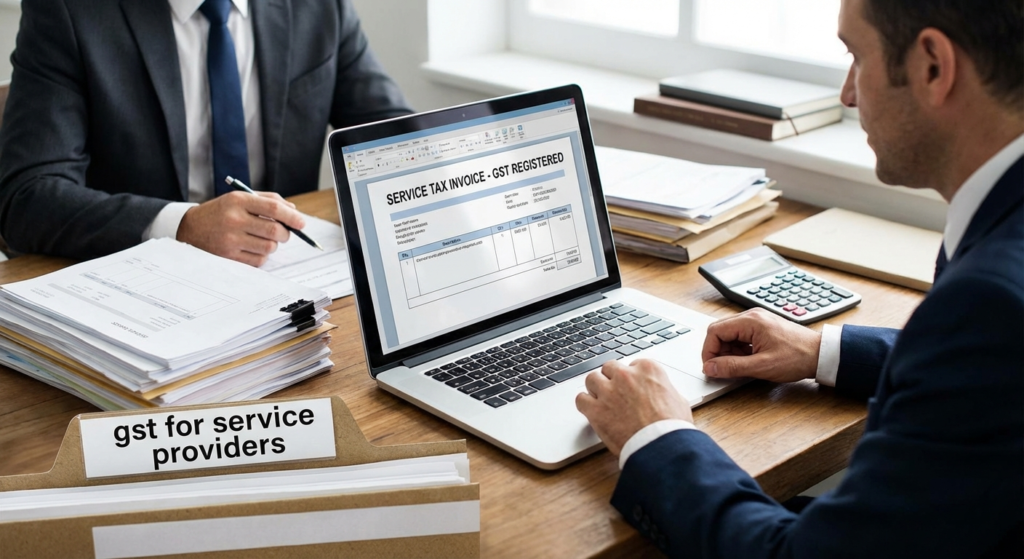
Creating a compliant GST invoice is the bedrock of the tax system. For GST for service providers, the invoice must be issued within 30 days from the date of supply of service. If the supplier is a bank or financial institution, this timeline is extended to 45 days.
A valid tax invoice must contain:
- Name, address, and GSTIN of the supplier.
- Invoice number (consecutive serial number).
- Date of issue.
- Name, address, and GSTIN of the recipient (if registered).
- SAC Code.
- Description of service.
- Total value of service and tax amount charged.
For more detailed insights on general GST regulations, you can explore various GST resources and guides that delve into specific compliance nuances.
5. Input Tax Credit (ITC) and Its Importance
One of the biggest benefits of the GST regime is the seamless flow of Input Tax Credit. In the context of GST for service providers, ITC allows you to reduce the tax you have to pay on your output services by the amount of tax you have already paid on your inputs (expenses).
For example, if you are an IT consultant, you likely pay GST on office rent, internet bills, laptop purchases, and software subscriptions. You can claim this GST as credit to offset the 18% GST you collect from your clients.
Conditions for Claiming ITC
To claim ITC, specific conditions under Section 16 of the CGST Act must be met:
- You must possess a valid tax invoice or debit note.
- You must have received the services or goods.
- The supplier must have paid the tax to the government.
- You must have filed your GST returns.
6. Filing Returns: Compliance Calendar
Filing returns on time is non-negotiable. The return filing structure for GST for service providers depends on whether you are under the Regular Scheme or the Composition Scheme.
Regular Scheme (Monthly/Quarterly)
GSTR-1: Details of outward supplies (Sales).
GSTR-3B: Summary return and tax payment.
Composition Scheme (Quarterly/Annual)
CMP-08: Quarterly statement for tax payment.
GSTR-4: Annual return.
Keeping track of dates is vital. Just as businesses monitor TDS return filing due dates, service providers must adhere to the GST calendar to avoid late fees. The government charges interest at 18% per annum on delayed tax payments.
7. Reverse Charge Mechanism (RCM)
Usually, the service provider collects tax and pays it to the government. However, under the Reverse Charge Mechanism (RCM), the liability to pay tax shifts to the recipient of the service. This is a critical concept in GST for service providers.
Common examples where RCM applies to services include:
- Legal services provided by an advocate or firm to a business entity.
- Sponsorship services.
- Services provided by directors to the company.
- Security services (under certain conditions).
If you receive these services, you are liable to pay the GST directly to the government, even if the supplier is not registered.
8. Place of Supply Rules
Determining whether a transaction is intra-state (within the same state) or inter-state (between two states) depends on the ‘Place of Supply’. For GST for service providers, the general rule is that the place of supply is the location of the registered recipient.
If the recipient is unregistered, the place of supply is usually the location of the recipient where the address on record exists. However, there are specific rules for services like real estate, events, performance-based services, and transportation. Accurate determination ensures you charge the correct tax (CGST+SGST vs. IGST).
9. Penalties for Non-Compliance
The GST portal has become increasingly sophisticated in tracking non-compliance. Ignoring the rules of GST for service providers can result in steep penalties. Late filing fees can accumulate daily, subject to a maximum cap. Furthermore, if you are found to be evading tax, the penalty can be 100% of the tax evaded or ₹10,000, whichever is higher.
To stay compliant, ensure your books of accounts are maintained for at least 72 months (6 years) from the due date of the annual return. For authoritative updates, always refer to the Central Board of Indirect Taxes and Customs (CBIC) or the official GST Portal.
Conclusion
Mastering GST for service providers is about more than just filing a return; it is about integrating tax compliance into your business strategy. From choosing the right SAC code to deciding between the Regular and Composition schemes, every decision impacts your profitability and legal standing.
As the service sector continues to expand, the government will likely introduce more streamlined measures. Staying informed and organized is the best way to ensure your business thrives without regulatory hurdles. Remember, GST is a transaction-based tax—if your documentation is strong, your compliance will be effortless.
FAQs
No, GST registration is mandatory only if your aggregate annual turnover exceeds ₹20 Lakhs (₹10 Lakhs for Special Category States) or if you are involved in specific inter-state supplies that do not qualify for exemptions.
Yes, service providers with an annual turnover of up to ₹50 Lakhs can opt for the Composition Scheme. The tax rate is 6%, but you cannot claim Input Tax Credit or charge GST to customers.
SAC stands for Services Accounting Code. It is used to classify services under GST. It is crucial for determining the correct GST rate applicable to your service and must be mentioned on your invoices.
Failure to mention the SAC code or using an incorrect one is considered non-compliance. It can lead to penalties and may cause issues for your clients when they try to claim Input Tax Credit.
No, Input Tax Credit can only be claimed on goods and services used for the furtherance of business. Personal expenses, such as food for personal consumption or personal travel, are not eligible for ITC.